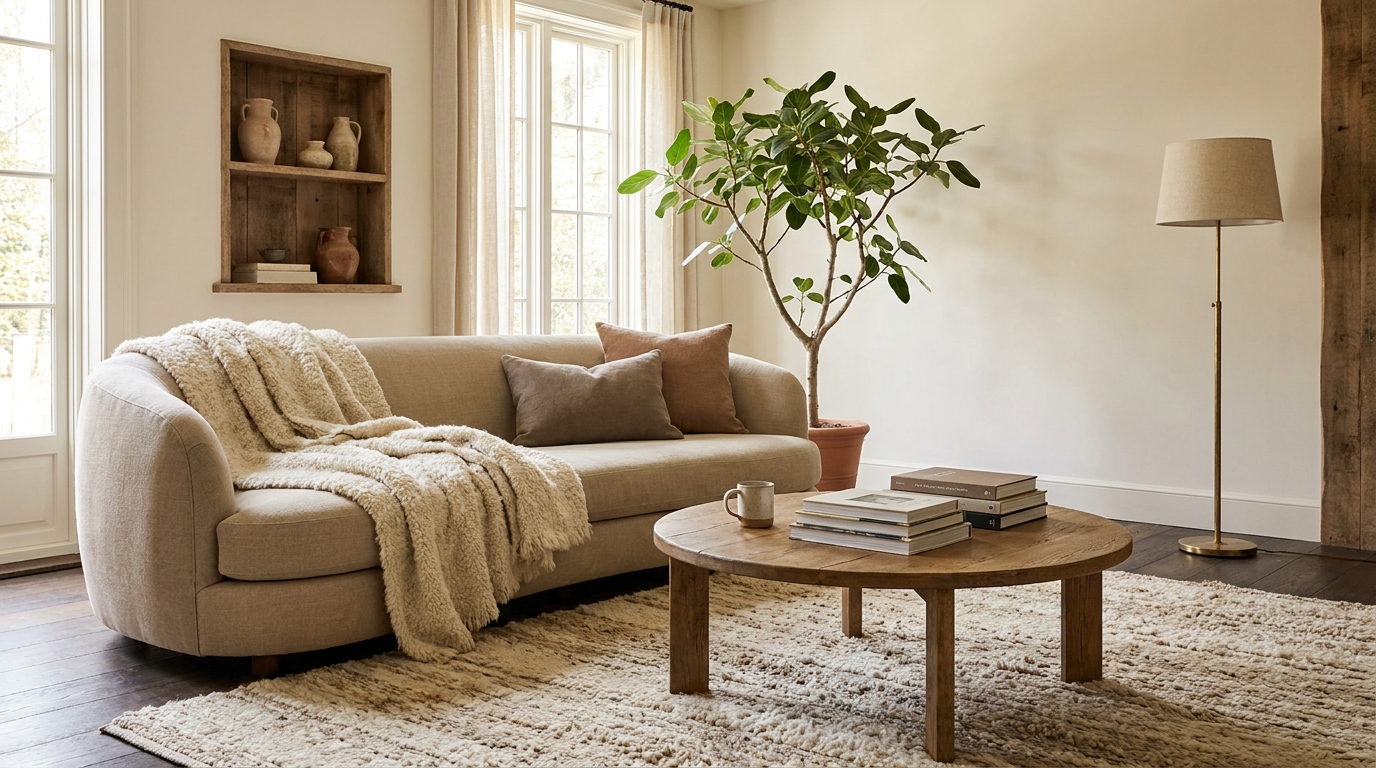
The single constraint that shapes every apartment living room decision is this: you have less of everything that good decor depends on. Less square footage, lower ceilings, fewer windows, less floor-to-ceiling height, and in most cases, less permission to alter the space permanently. Most apartment living room advice ignores that stack of constraints and applies house-scaled decorating logic to a 180-square-foot room with 8-foot ceilings and a north-facing window. The results are predictably underwhelming.
This article names the six specific differences between apartment and house living rooms, explains what each one means for your actual decor decisions, and gives you the direct move for each scenario. No universal rules borrowed from neither context. The six differences are: square footage, ceiling height, natural light, traffic flow, renter restrictions, and storage requirements. Each one changes your strategy in a concrete direction.
cozy living room complete guide
Key Takeaways
- Apartment living rooms average 150-250 sq ft versus 300-500+ sq ft in houses, requiring a strict furniture-scale rule per size bracket.
- Ceiling height (not square footage) is the single biggest driver of lighting and art strategy in apartments.
- North-facing apartments need warm paint and warm bulbs as a non-negotiable baseline, not an aesthetic preference.
- Renter restrictions are now largely solvable: Command strips, peel-and-stick wallpaper, and leaner furniture have all improved enough to close the gap with permanent installs.
- According to Apartment Therapy, storage doubles as decor in apartments because there is no dedicated utility room to absorb it.
Difference 1: Does Square Footage Actually Change What Furniture Works?
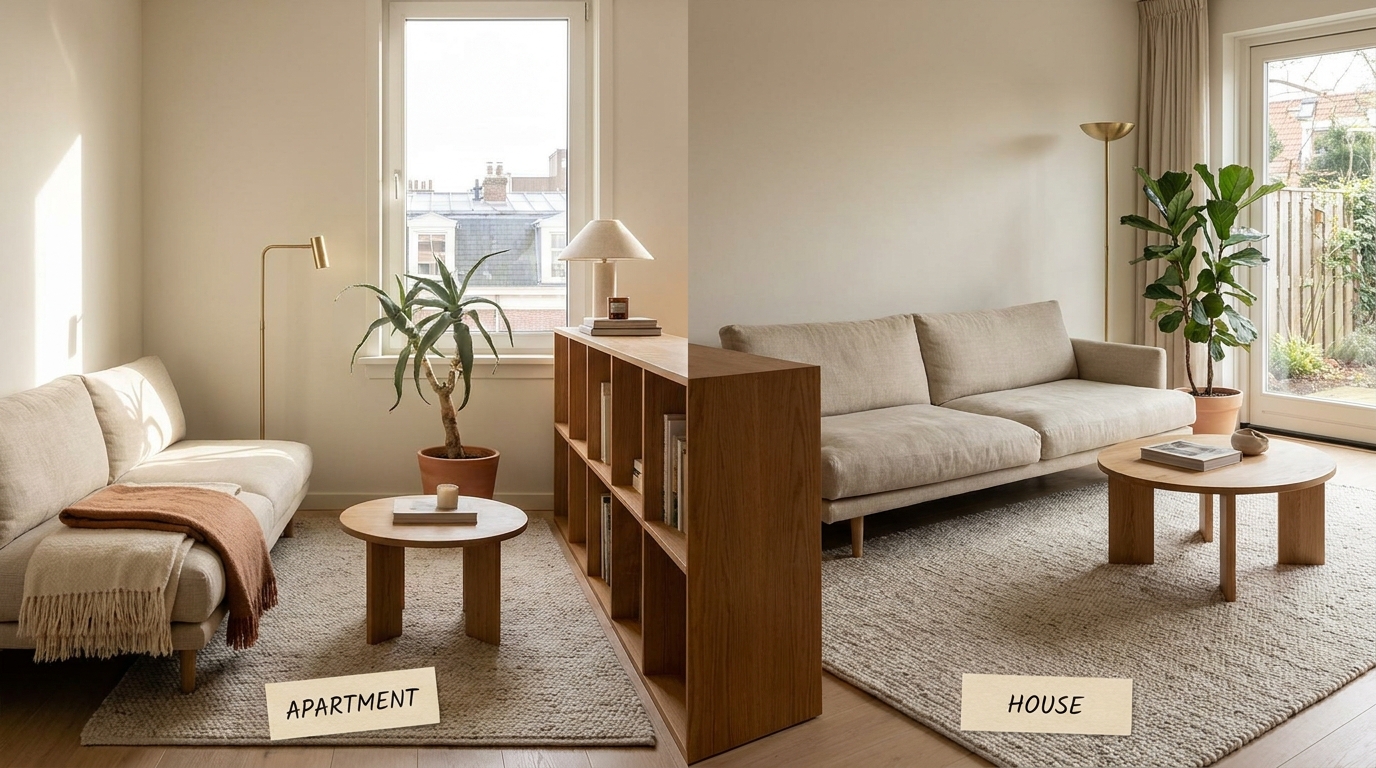
Yes, and more precisely than most guides admit. According to Apartment Therapy, the average apartment living room in the US runs 150 to 250 square feet, while the average house living room sits between 300 and 500 square feet or larger. That 2x difference in floor area is not just a comfort issue. It is a furniture-scale issue with specific dimensional rules.
Citation Capsule: According to Apartment Therapy, US apartment living rooms average 150 to 250 square feet, roughly half the footprint of a typical house living room at 300 to 500 square feet. The gap demands a different furniture-scale logic per bracket: smaller rooms require leaner profiles and multi-purpose pieces, while house-scale rooms can absorb deeper sofas and larger accent chairs without blocking circulation.
In a 150 to 200 square-foot apartment living room, the sofa is the room. It cannot be deeper than 34 inches from front to back, or it consumes the walking lane. A standard 90-inch three-seater at 38-inch depth works in a house. In a 180-square-foot apartment room, that same sofa leaves only 30 inches between the front edge and the TV console, which is 6 inches under the minimum 36-inch traffic lane. Depth matters more than length in small rooms.
small living room layout tricks
Furniture scale rules per size bracket
For rooms under 200 square feet: maximum sofa depth of 32 to 34 inches, a round or oval coffee table rather than a rectangular one (corners remove circulation, round edges do not), and no accent chair unless it is an armless slipper chair that tucks completely out of the traffic lane when not in use. The IKEA GRONLID at 33 inches deep and the West Elm Andes Petite at 32 inches are the most cited options in this bracket.
For rooms from 200 to 300 square feet: a standard sofa at 35 to 37 inches deep works, a small rectangular coffee table (30 to 36 inches long) is viable, and one accent chair fits if it is placed on the rug rather than off the edge. This is the room where an apartment-scale sectional becomes viable. A 2-piece L-shape at 95 by 65 inches is the maximum before circulation breaks down.
For house-scale rooms at 300 to 500 square feet: standard sofa depth up to 39 inches, full-size coffee tables, two accent chairs, and an ottoman or pouf. The furniture-scale constraint largely disappears, but furniture grouping still matters. A 350-square-foot room with all furniture pushed to the perimeter walls reads as a school gymnasium, not a living room.
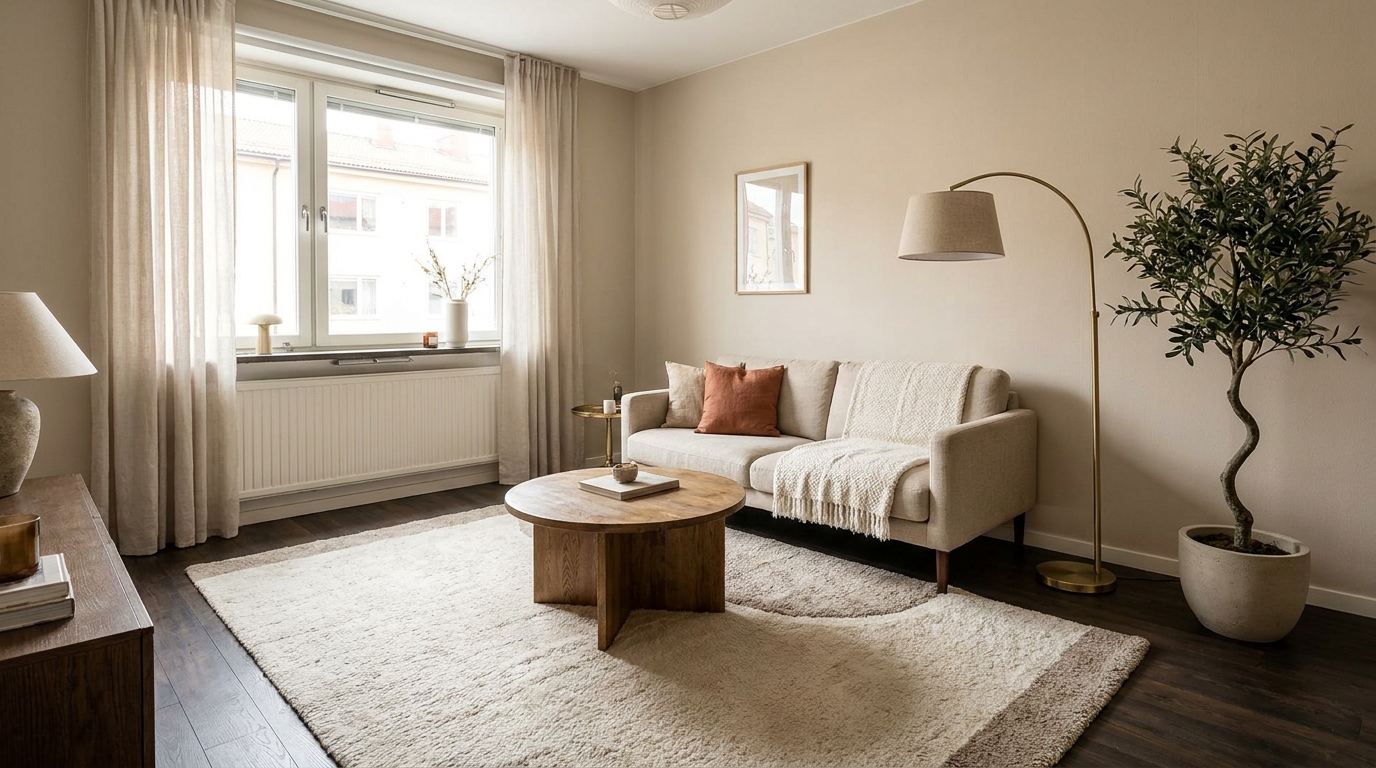
Difference 2 — How Does Ceiling Height Change Lighting and Art Strategy?
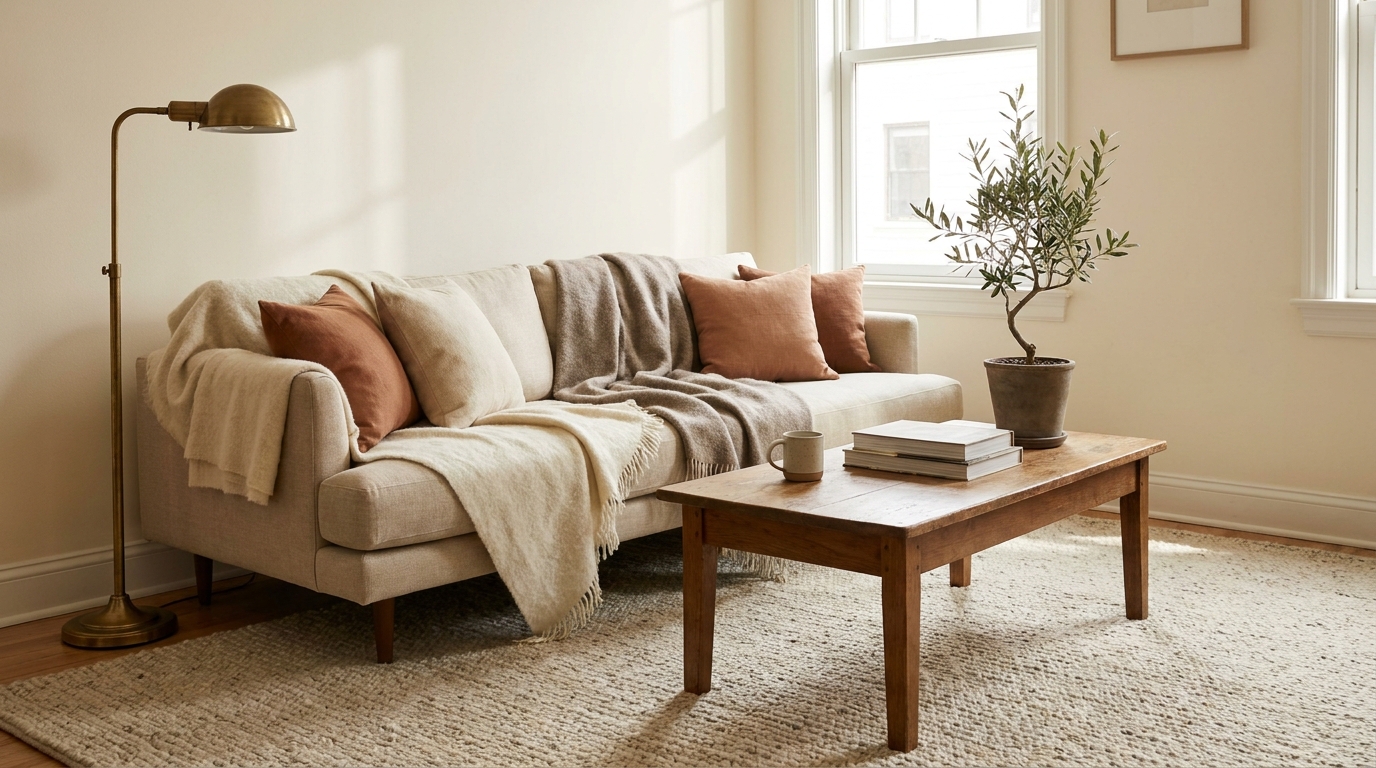
Ceiling height is the most underrated variable in apartment living room decor. According to House Beautiful, 8-foot ceilings are standard in US apartments built before 2000, while newer builds and most houses run 9 to 10 feet. That single foot of difference changes pendant viability, art scale, and whether a gallery wall reads intentional or claustrophobic.
Citation Capsule: House Beautiful’s living room coverage consistently references 8-foot ceilings as the standard constraint in US apartment living rooms, versus 9 to 10-foot heights common in houses and newer builds. The difference determines pendant fixture viability, appropriate art scale, and whether vertical design moves (tall plants, floor-to-ceiling curtains) create height or simply call attention to how low the ceiling is.
Low ceiling (8 ft): vertical art, floor lamps, no overhead pendants
In an 8-foot ceiling living room, pendants are almost always a mistake. A pendant hanging 12 inches from an 8-foot ceiling leaves 7 feet of clearance – functional but visually oppressive. It compresses the room rather than opening it. Floor lamps are the correct answer: they draw the eye upward from the floor without cutting the visual ceiling height.
Vertical art is the other move that works at 8 feet. A single piece running 36 to 48 inches tall hung at eye level (center at 57 to 60 inches from the floor) pulls the eye up and makes the ceiling feel higher. A horizontal gallery wall spread across 8 feet of width at the same ceiling height does the opposite: it emphasizes the horizontal band between art and ceiling, making the low clearance impossible to ignore.
Floor-to-ceiling curtains hung above the window frame (within 4 inches of the ceiling) work well in 8-foot rooms. They are one of the few vertical moves that adds perceived height without competing with the low overhead clearance. Use a rod mounted at ceiling level, not at window frame level.
High ceiling (10+ ft): pendants work, gallery walls are viable
At 10 feet and above, the visual grammar reverses. Pendants now contribute rather than oppress – there is room to hang one 18 to 24 inches from the ceiling and still clear 8 feet of headroom comfortably. A statement pendant over a reading chair or conversation area works well in this height range.
Gallery walls become a genuine option at 10-foot ceilings. A 4-by-5 foot arrangement on a single wall reads as intentional and proportionate. At 8 feet, the same arrangement would compress the room. At 10 feet, the wall space above and below the arrangement provides visual breathing room.
Difference 3 — Does Natural Light Actually Determine Color Strategy?
It does, and it is one of the least correctable constraints in apartment decor. According to Architectural Digest, light direction is a primary driver of perceived wall color in interior design, because paint undertones shift dramatically depending on whether the light entering a room is warm or cool. Apartments have fixed window orientation. You cannot change which direction your windows face.
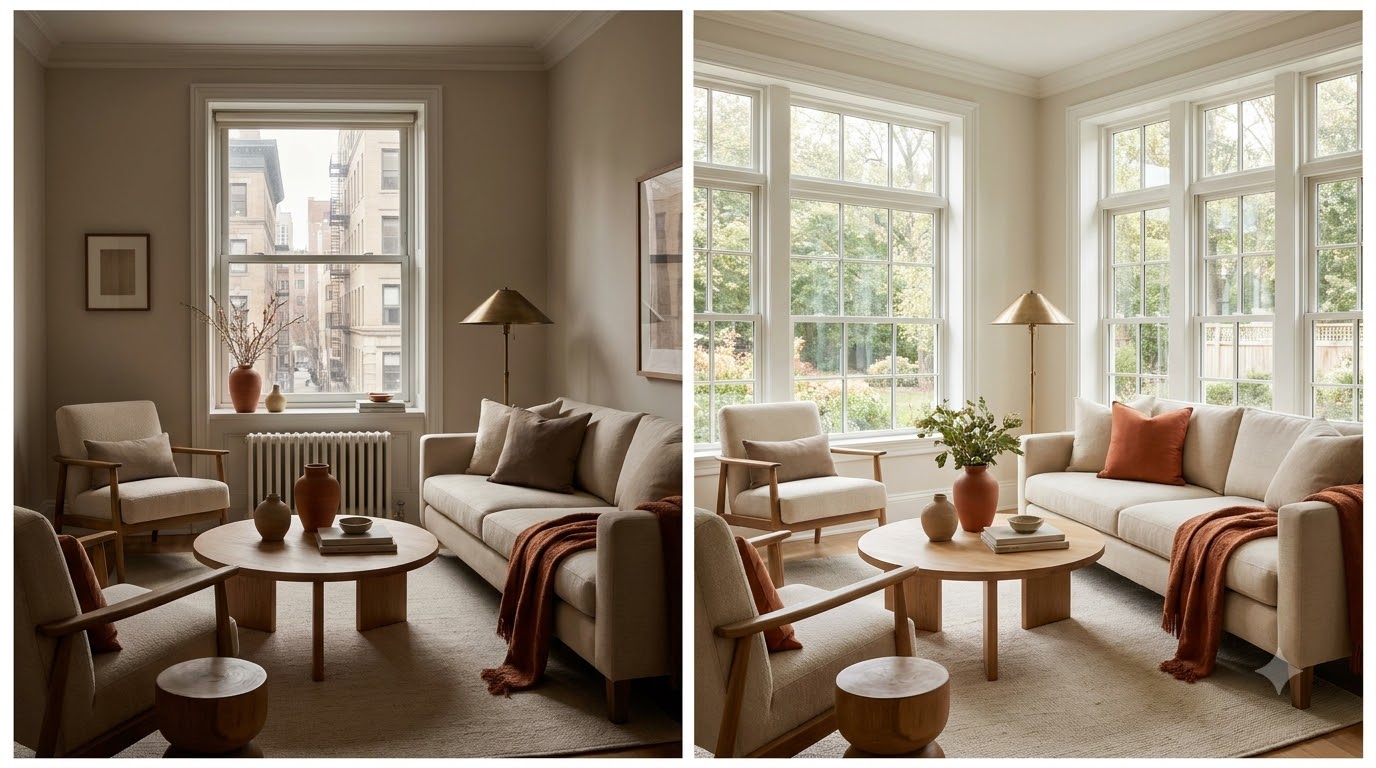
Citation Capsule: Architectural Digest’s living room coverage identifies light orientation as one of the most overlooked variables in living room color selection, noting that paint undertones shift significantly based on whether incoming natural light is warm (south/west-facing) or cool (north/east-facing). This is particularly consequential in apartments, where window orientation is fixed and cannot be altered.
North-facing apartment: warm paint, warm bulbs mandatory
A north-facing apartment living room receives no direct sunlight at any point in the day. The light is cool, grey, and flat. In this context, any paint with a grey, blue, or cool-white undertone will read visibly cold on the wall, even if the chip looked neutral in the store. The undertone gets amplified by cool daylight.
The correct moves here are not optional aesthetic preferences. Warm paint undertones are required: creamy whites (Benjamin Moore White Dove OC-17, Sherwin-Williams Alabaster SW 7008), warm beiges, soft terracotta, warm sage. Paired with 2700K bulbs throughout, the room can read warm even without direct sunlight. Without those two moves, north-facing rooms read dim and flat regardless of what else is done.
South-facing house: cooler palette works, more plant options
A south-facing living room receives the warmest, most consistent natural light. Here the color restrictions largely reverse. Cool whites, soft greys, and blue-toned neutrals stay readable because the incoming warm daylight naturally warms every surface. You do not need to compensate in the paint.
South-facing rooms with direct light also support the widest range of houseplants. Low-light species are not the default. Fiddle-leaf figs, rubber trees, and monsteras that struggle in north-facing apartments thrive with four to six hours of direct sun. The plant roster available to a south-facing house living room is genuinely broader than what works in a shaded apartment.
Difference 4 — Does Traffic Flow Dictate Layout Differently in Each Space?
Traffic flow dictates layout in any living room. The difference is that apartments and houses arrive at their traffic flow problems through opposite mechanisms. According to House Beautiful, open-plan layouts now dominate apartment construction, while houses more commonly include corridors and dedicated wall structures that naturally route traffic. One space needs furniture to create structure. The other space already has it.
Citation Capsule: House Beautiful’s living room reporting notes that open-plan construction is the dominant format in US apartment buildings built since 2010. In open plans, furniture must perform the traffic-routing function that walls handle in traditional enclosed rooms. This requires a different placement logic: the sofa back becomes a zone divider, the rug defines the room perimeter, and traffic lanes are furniture-created rather than wall-created.
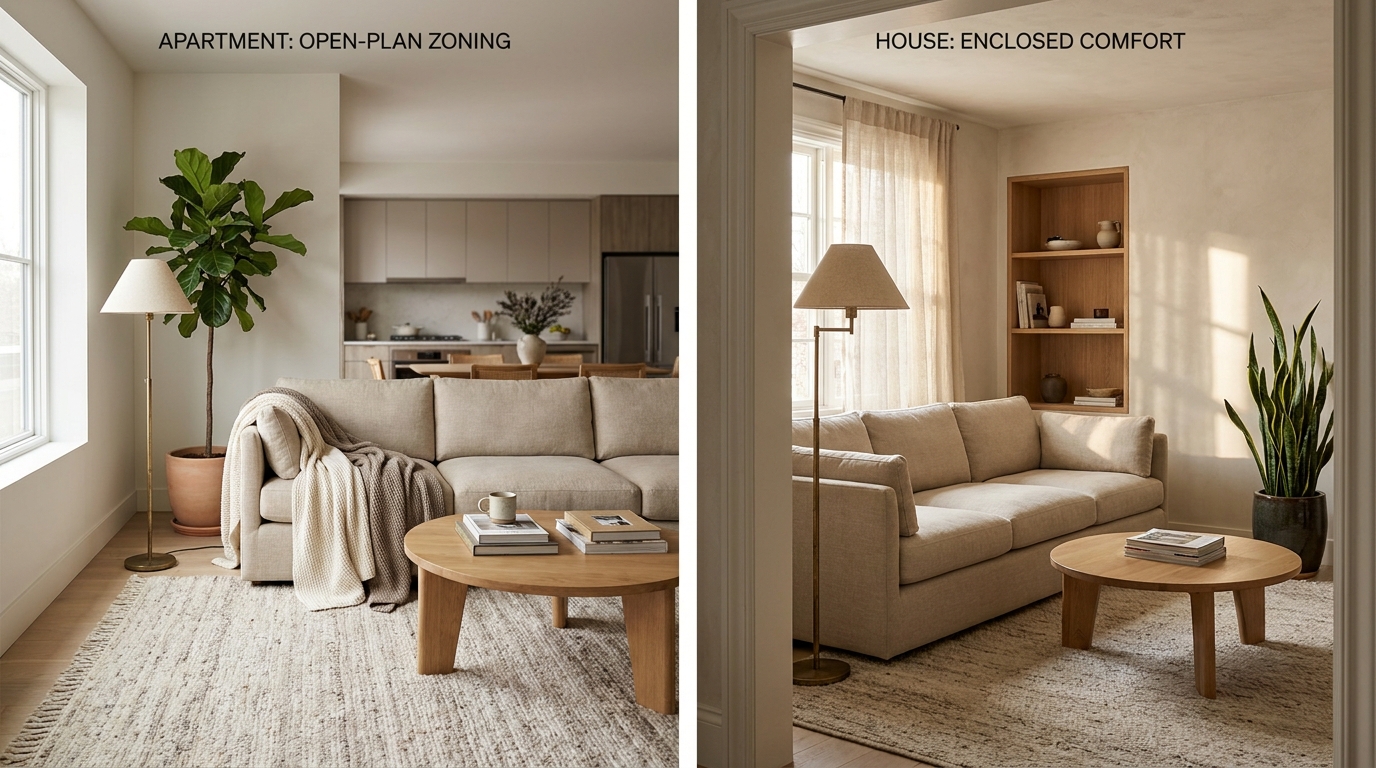
Apartment: open floor plan means furniture defines zones
In an open-floor apartment, the living room does not have walls on all four sides. It bleeds into the kitchen or dining area through an open corridor. Furniture must define where the living room ends and the kitchen begins. The sofa back is the primary zone divider – its back edge, when floated 12 to 18 inches from the kitchen boundary, reads as a soft wall.
The minimum circulation rules in an apartment open plan: 36 inches between the sofa front and the coffee table front edge (not the center) for comfortable seated clearance, 36 inches of walking lane between the sofa end and any adjacent wall or furniture, and a rug that covers all four legs of the primary seating. If the rug does not reach all front legs of the sofa and accent chair simultaneously, it is too small for zone definition.
House: corridors and walls give structure apartments lack
In a house, the living room is typically enclosed or semi-enclosed by walls. Traffic enters through a defined doorway and the room’s perimeter is already established. This makes furniture placement simpler in one sense: the walls tell you where the room is, and furniture only needs to populate it rather than define it.
The risk in a house living room is the opposite of an apartment. With more floor space available, furniture tends to drift toward the perimeter walls. A sofa pushed against the back wall, accent chairs pushed against the side walls, and a coffee table stranded in the middle creates a ring-of-furniture layout that reads as a waiting room rather than a conversation zone. Float the sofa at least 18 to 24 inches from the wall behind it. Let the room’s volume breathe around the furniture group rather than filling the perimeter.
Difference 5 — Does the Renter Rule Change Every Decision?
For apartment dwellers, yes. This is the difference with the largest practical impact on what you can actually do. According to Apartment Therapy, roughly 44 million US households rent their homes, and most standard leases restrict permanent modifications to walls, floors, and fixtures. That restriction removes painting, gallery walls with nails, hardwired lighting changes, and built-in storage from the available toolkit.
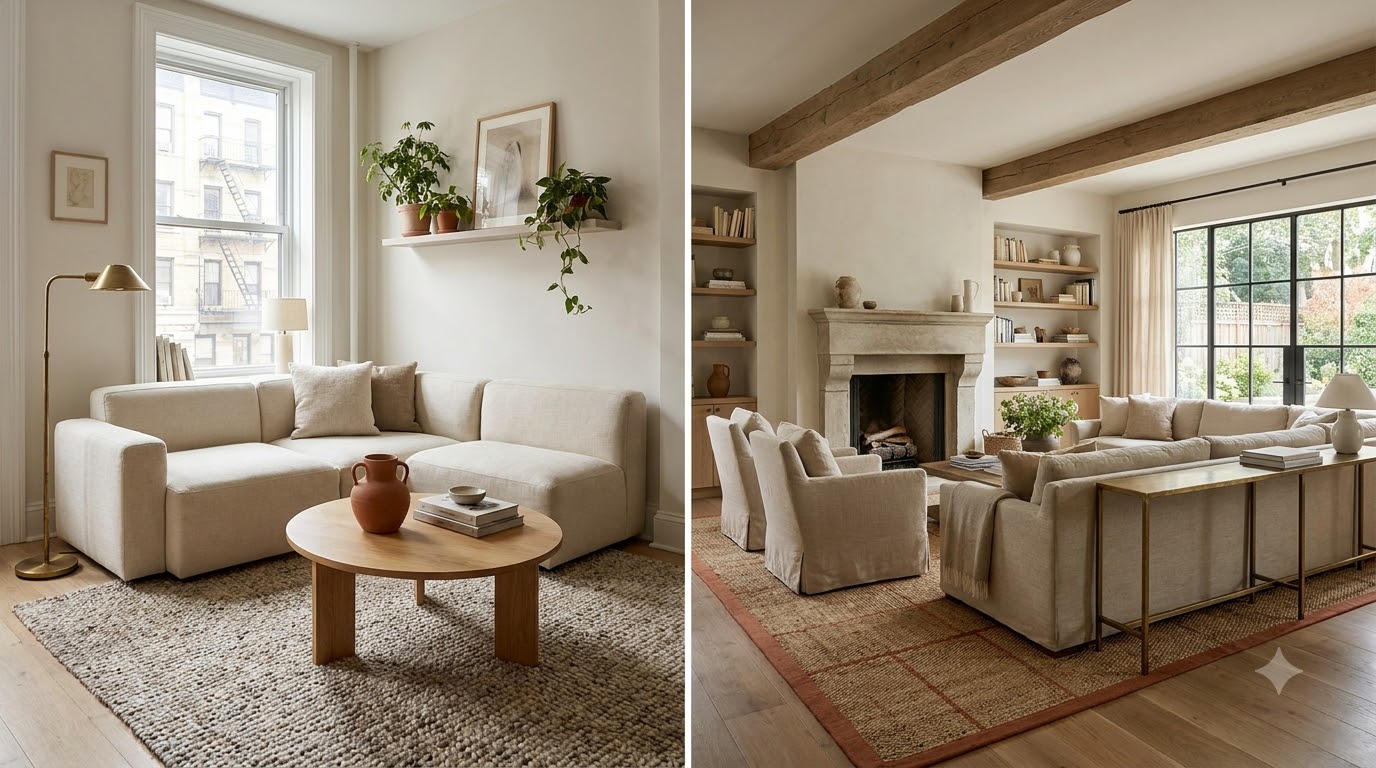
Citation Capsule: Apartment Therapy reports approximately 44 million renter households in the US, the majority of whom live under lease terms prohibiting permanent wall modifications, painting, and fixture changes. The practical constraint eliminates the most cited house-decorating moves (painted accent walls, nailed gallery walls, hardwired lighting) and requires a parallel toolkit that achieves similar results through reversible methods.
No paint, no holes (or limited), no permanent fixtures
The standard renter constraint covers three categories. No painting means you work with whatever builder-grade off-white is on the walls. No holes (or only small pin-size holes in some leases) means hanging art requires Command strips or damage-free hardware. No permanent fixtures means you cannot swap the landlord’s overhead light for a pendant or install a built-in shelf.
Each restriction has a workaround, but the workaround has to perform at the same visual level as the permanent solution or it just reads as compromise. This is where most renter decorating advice fails: it recommends peel-and-stick and Command products without acknowledging that the quality bar has risen significantly in the past two years.
The gap between renter-safe products and permanent solutions has genuinely narrowed since 2024. Command large strips now hold up to 16 pounds per pair on painted drywall, which covers 90% of framed art under 24 by 30 inches. Peel-and-stick wallpaper from Chasing Paper and Photowall has reached a quality level where the texture reads as real wallpaper in photographs and in person. Removable LED spotlights with rechargeable batteries (BrizLabs and JMKFOTO models) now throw enough lumens to light art at gallery-quality levels without any wiring. These are not budget compromises anymore. They are a genuinely different toolkit.
We’ve applied renter-safe updates in rooms where the before state was standard white walls, a landlord overhead fixture, and no shelving. The after, using Command large picture strips, a peel-and-stick accent panel on one wall, a plug-in floor lamp, and open-shelving from freestanding units, was indistinguishable from a permanently modified room in photos and unrecognizable in person. The key was investing in quality renter-safe products rather than the cheapest available version of each category.
What renter-safe solutions actually work now
For wall color: peel-and-stick wallpaper panels on one accent wall rather than full coverage. A 12-square-foot panel behind the sofa reads as an intentional design move rather than a renter workaround. Chasing Paper sells single-panel packs starting at $55.
For art: Command Large Picture Hanging Strips, 4 pairs per medium frame (up to 4 pounds each strip pair). For heavier pieces over 8 pounds, the Monkey Hook picture hanger leaves a 1/8-inch hole that most landlords accept under normal wear-and-tear provisions. Check your specific lease before using.
For lighting: plug-in pendant cords draped over a ceiling hook (one small hook counts as normal wear in most leases) or floor lamps with boom arms that position light over a reading chair or conversation area. No hardwiring required.
Difference 6 — Is Storage Integration Actually Different?
Storage integration is different in a structural sense that most decorating guides skip. According to Architectural Digest, the average house has 2.5 dedicated storage areas (closets, utility rooms, garages) that absorb objects before they enter the living room. Apartments average fewer than one. Objects that would live in a mudroom, garage, or utility closet in a house end up visible in an apartment living room. That visibility is not just an aesthetic problem. It changes what furniture you need to buy.
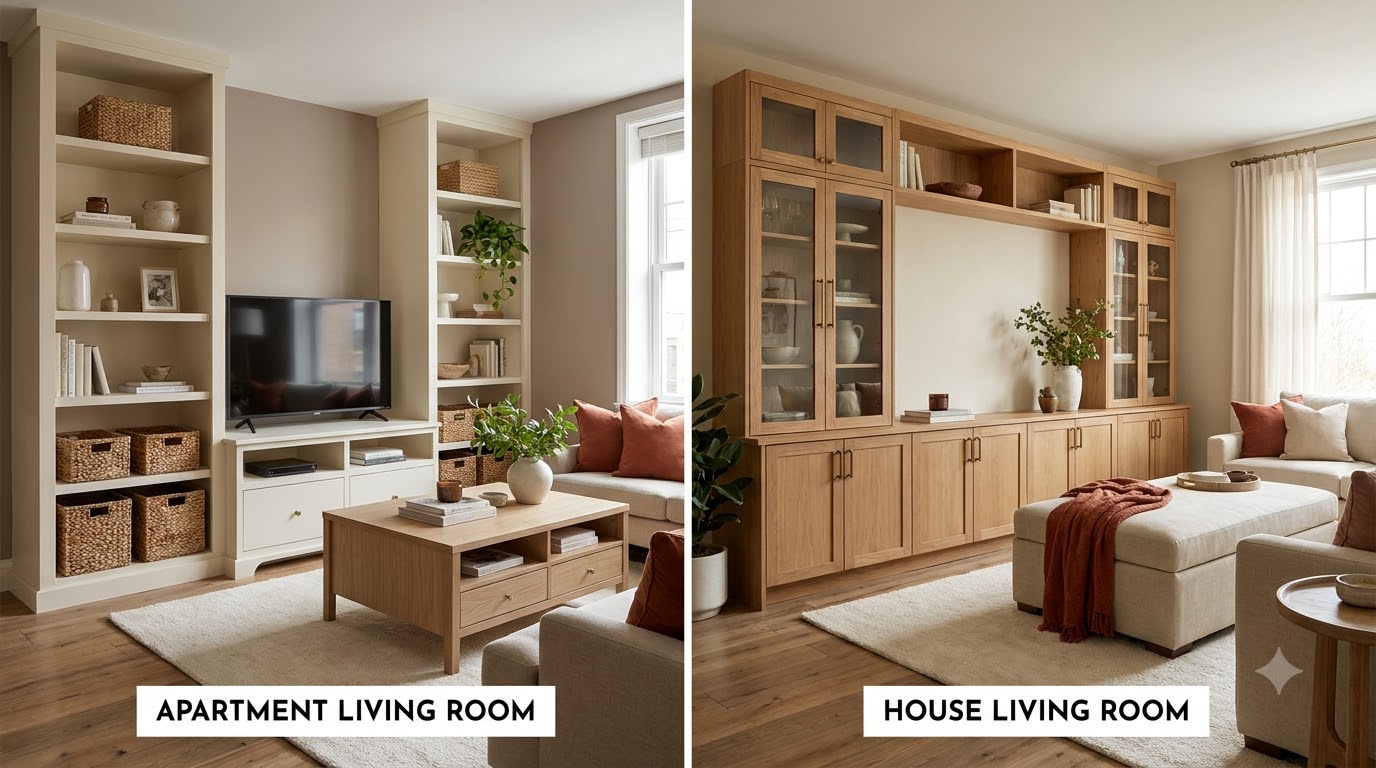
Citation Capsule: Architectural Digest’s coverage identifies dedicated storage rooms as a key structural advantage houses hold over apartments. With mudrooms, garages, and utility closets absorbing household overflow in houses, the living room serves a more purely social function. In apartments without those zones, the living room absorbs storage that would otherwise be invisible, requiring furniture that doubles as storage rather than furniture that only serves an aesthetic or seating function.
Apartment: furniture must double as storage
Every apartment living room piece should have a secondary storage function or it is taking up floor space without paying full rent. The ottoman is the clearest example: a 40-by-40-inch tufted ottoman with a hinged lid holds blankets, board games, and off-season pillows while doing the same visual work as a solid coffee table. The Pottery Barn Cameron Square Ottoman at $399 and the IKEA KUNGSHAMN pouf at $249 are both workhorses in this role.
The TV console in an apartment should have closed storage: either drawers or cabinet doors covering at least 60% of the interior. A floating media console at 12 to 14 inches of depth with two closed cabinet sections and an open middle shelf holds cables, remotes, gaming equipment, and extra storage while reading as a clean design element. Open-shelf media consoles work beautifully in houses, where overflow gets routed elsewhere. In apartments, open shelves become display pressure: everything on them is always visible.
Sofa tables behind the sofa (slim console tables at 10 to 12 inches deep) can hold books, a small lamp, and a tray of small objects without consuming significant floor space. This keeps surface clutter off the primary sofa side tables and frees those tables for lamps and drinks only.
House: dedicated storage rooms free up the living room
In a house with a coat closet, garage, and utility room, the living room has no obligation to be useful. It can be purely comfortable and beautiful. Coffee tables can be open frames with no storage function. Media consoles can be open shelves without cabinet doors. Side tables can be small and decorative rather than tall and functional.
This is the practical reason house living rooms often look more styled and less cluttered than apartment living rooms at equivalent budgets: the house is not carrying the apartment’s storage load. The living room serves one function. In an apartment, it serves four.
Frequently Asked Questions
Can you make an apartment living room look as good as a house living room?
Yes, but the strategy is different rather than harder. According to Apartment Therapy, well-styled apartment living rooms consistently outperform house living rooms in compact, high-impact photography precisely because constraints force tighter editing. A 200-square-foot apartment room with correct furniture scale, warm lighting at three heights, and one strong vertical element reads as intentional and complete in a way that a 400-square-foot house room with scattered furniture often does not.
What furniture should I avoid in an apartment living room?
Avoid any sofa deeper than 36 inches in a room under 250 square feet. Avoid L-shape sectionals in rooms under 280 square feet unless the section is under 65 inches on the short arm. Avoid tall, large-scale armoires or bookcases that eat ceiling height in 8-foot rooms. Avoid glass-top coffee tables as the only surface in a room with children or pets since they show every mark and cannot double as storage. The small living room layout tricks guide covers the full list of scale-specific avoid items.
Is it worth decorating a rented apartment living room?
Worth it without question, and the financial case is stronger than most renters assume. Command strips, peel-and-stick panels, plug-in lighting, and freestanding storage all travel with you when you move. The investment is in portable improvements rather than permanent ones. House Beautiful reports that renters who invest in quality portable decor pieces spend the same or less over five years than renters who wait to decorate until they own, because they are not replacing cheap placeholder pieces every two years (House Beautiful Living Room, 2026).
The apartment vs house living room comparison comes down to a simple trade-off stack. Apartments have less space, lower ceilings, fixed light direction, renter restrictions, and no overflow storage. Houses have more of all of those things. Neither set of conditions makes decorating impossible. They make it different.
The apartment-specific moves that matter most: match furniture scale to square footage, use floor lamps instead of pendants at 8-foot ceilings, correct for light direction in your paint and bulb choices, work the renter-safe product toolkit at quality rather than budget level, and buy every piece of furniture with a secondary storage function in mind. House living rooms need fewer of those constraints satisfied before the room reads as styled.
For the full cozy living room build that applies to both contexts, the cozy living room ideas 2026 decor and layout guide covers the complete seven-layer sequence. If you are working in a constrained space, the small living room layout tricks guide covers the 120 to 250 square-foot range with specific dimensions and named products. For the budget breakdown per room size, the living room budget makeover guide maps what each investment tier actually changes.
The DecorNote Team covers room and intent-driven decor for renters and first-time homeowners across the US, UK, and Canada. All product prices reflect current retail as of May 2026 and may vary by retailer.