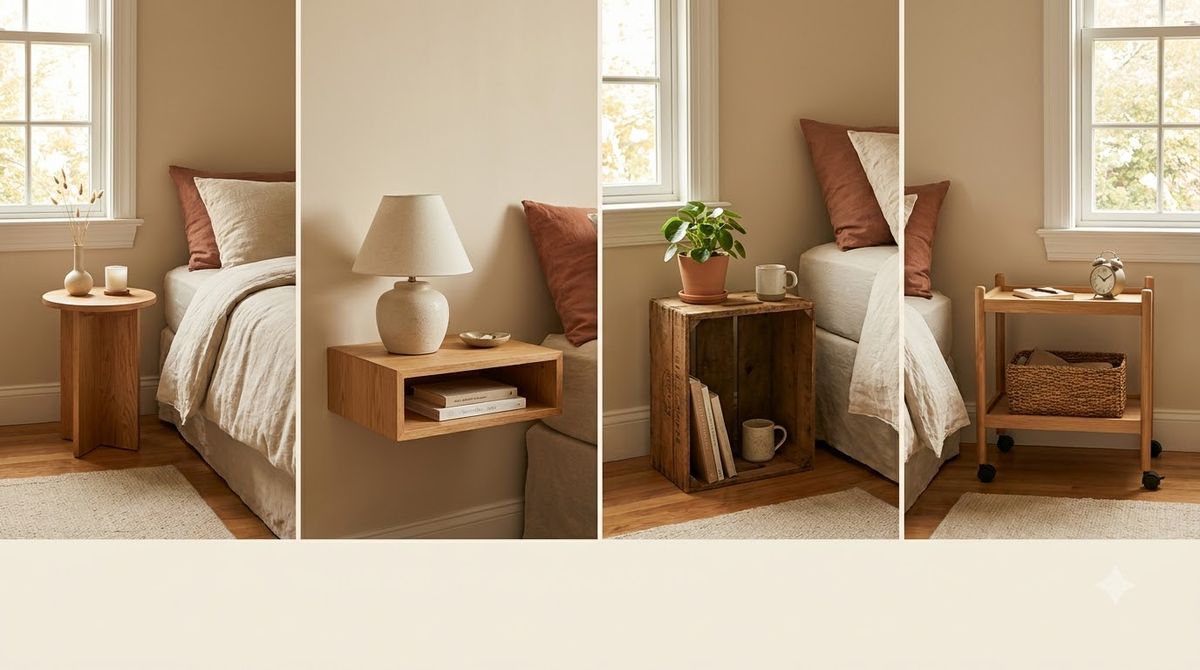
The best nightstand ideas under $100 come down to matching a type to your bedroom: a 2-drawer chest for storage-hungry sleepers, an open-shelf table for renters who hate clutter, a round pedestal for tight corners, a floating wall-mounted shelf for the smallest rooms, a nesting stool for flexibility, and cane or rattan for warmth on a budget.
Every one of these sits comfortably in the $30-$100 range, and the only rule that never bends is height: aim for a surface within about 2 inches of your mattress top, with a footprint roughly 16-24 inches wide. Below we walk through each type, what it’s genuinely best for, and how to buy it without overspending.
Key Takeaways
- Height beats everything: the top surface should land within 2 inches of your mattress top, usually 24-28 inches off the floor.
- Width guide: 16-24 inches suits most beds; go narrow (12-16 inches) for small rooms and tight walkways.
- Under $100 is realistic: open-shelf and pedestal tables start near $30-$50; 2-drawer and cane styles run $60-$100.
- Match type to need: drawers hide clutter, open shelves feel airy, floating units free up floor space, nesting stools flex between rooms.
- Materials that last on a budget: solid pine, rubberwood, powder-coated metal, and real rattan hold up better than thin laminate over particleboard.
How to choose a nightstand type (the quick version)
A common pattern: people fixate on style first and regret it when the drawer scrapes the mattress or the table blocks the closet door. So flip the order. Start with the constraint your room hands you, then pick the type that solves it. Here is the shortcut.
- Need to hide clutter? Choose a 2-drawer chest.
- Want it to feel light and open? Choose an open-shelf table.
- Fighting a tight corner or narrow walkway? Choose a round pedestal.
- Zero floor space to spare? Choose a floating, wall-mounted shelf.
- Moving often or want double duty? Choose a nesting table or stool.
- Craving warmth and texture cheaply? Choose cane or rattan.
If you want the wider room context before committing, our complete guide to aesthetic bedroom ideas for 2026 covers how nightstands fit alongside beds, lighting, and layout.
The 6 best nightstand types under $100
1. The 2-drawer chest: best for storage and hiding clutter
A 2-drawer nightstand is the workhorse. It gives you a display surface up top plus two closed drawers to swallow chargers, medication, spare glasses, and the small chaos that collects beside a bed. Expect a footprint around 18-22 inches wide and 24-26 inches tall, which pairs well with a standard 25-inch mattress top. For most renters this is a good first buy, because it does the most jobs at once.
- Price range: $60-$100 for solid pine or rubberwood; simpler laminate versions dip to $45-$70.
- Typical size: 18-22 inches wide, 24-26 inches tall, 15-18 inches deep.
- Watch for: drawer glides (metal ball-bearing beats plastic runners) and a top that clears the mattress edge.
2. The open-shelf table: best for an airy, uncluttered look
Open-shelf tables skip drawers for one or two exposed shelves. They read light in a small room because your eye travels right through them, and they’re usually the cheapest solid option on the shelf. They suit bedrooms that already feel cramped, since a leggy open frame takes up visual space without taking up much actual room.
The trade-off is that everything is on show, so they suit tidy sleepers or anyone happy to keep a book and a lamp as the whole story.
- Price range: $30-$60, one of the most affordable types under $100.
- Best for: small bedrooms, minimalist styling, and light sleepers who keep essentials minimal.
- Materials: solid wood tops on metal legs, or all-wood frames in oak-look and walnut-look finishes.
For how to actually style one of these next to a bed, see our nightstand and reading-corner setups.
3. The round pedestal: best for tight corners and softer lines
A round pedestal table has no sharp corners to catch a hip in the dark, and its small circular footprint slips into awkward spaces beside a bed frame. Diameters usually run 14-18 inches, which is narrower than most rectangular stands, so it’s a smart pick when your walkway is tight. It won’t store much beyond a lamp, a glass of water, and a phone, but for bedrooms where every inch counts, that restraint is the point.
- Price range: $35-$80 depending on material and whether it includes a lower shelf.
- Diameter: 14-18 inches; height 22-26 inches to sit near the mattress top.
- Best for: narrow walkways, rounded-edge safety, and a softer, less boxy bedroom feel.
4. The floating, wall-mounted shelf: best when you have zero floor space
When the bed is pushed against a wall in a studio, a floating nightstand mounts directly to that wall and frees up the entire floor beneath it. That makes cleaning easy and the room feel bigger.
The catch is that renters need to check their lease and their wall type before drilling, and a floating shelf holds less weight than a standing unit. Treat these as the specialist pick: perfect for the smallest rooms, less ideal if you want to pile on books and a heavy lamp.
- Price range: $30-$70, often sold as a single shelf or a shelf-plus-drawer combo.
- Best for: studios, bunk-adjacent walls, and floor space you don’t want to give up.
- Renter tip: confirm you can drill, use appropriate anchors, and mount the surface within 2 inches of the mattress top.
Floating units are a recurring favorite in our small apartment decor ideas for exactly this reason.
5. The nesting table or stool: best for flexibility and frequent movers
A nesting set or a simple stool moonlights as a nightstand and then becomes something else when your life changes. Slide a nesting pair apart for extra surface when guests stay, or carry a lightweight stool to the living room. For anyone who moves apartments often, this is the type that survives the most floor plans. It offers no hidden storage, but its portability and low price make it forgiving.
- Price range: $40-$90 for a nesting pair; single stools often $25-$50.
- Best for: frequent movers, guest-room duty, and rooms that need furniture to multitask.
- Size note: pick a top 16-20 inches wide and a height within 2 inches of your mattress.
6. Cane and rattan: best for warmth and texture on a budget
Cane-front and woven rattan nightstands bring natural texture that flat laminate never manages, and they’ve become one of the easiest ways to warm up a plain rented bedroom cheaply. Many pair a cane drawer front with a wood or rubberwood frame, so you still get closed storage plus that woven detail. Real rattan holds up better than printed cane-look panels, so it’s worth a close look at the product photos before buying.
- Price range: $60-$100 for genuine cane-front pieces with a drawer.
- Best for: boho, coastal, and warm-neutral bedrooms wanting texture without a splurge.
- Buy smart: favor real woven cane over printed panels, and check the frame is solid wood, not hollow board.
Nightstand types compared: best for and price
| Type | Best for | Price range |
|---|---|---|
| 2-drawer chest | Storage and hiding clutter | $45-$100 |
| Open-shelf table | Airy, minimalist small rooms | $30-$60 |
| Round pedestal | Tight corners, softer lines | $35-$80 |
| Floating / wall-mounted | Zero floor space, studios | $30-$70 |
| Nesting table / stool | Flexibility, frequent movers | $25-$90 |
| Cane / rattan | Warmth and texture on a budget | $60-$100 |
What height should a nightstand be?
A nightstand should be within about 2 inches of your mattress top, which for most beds means a stand 24-28 inches tall. When the surface sits level with where you sleep, reaching for a glass of water or a phone in the dark feels natural and you’re not fishing downward or knocking things off. Here’s how to measure it before buying.
- Measure from the floor to the top of your mattress (not the frame).
- Aim for a nightstand whose top lands within 2 inches above or below that number.
- Remember taller mattresses and thick toppers push your ideal height up toward 28 inches.
- For platform beds that sit low, a shorter 22-24 inch stand often fits best.
What size nightstand for a small bedroom?
In a small bedroom, keep the width to 12-18 inches so the stand doesn’t crowd the walkway or block a door. Round pedestals (14-18 inch diameter), narrow open-shelf tables, and floating units all win here because they take up little floor space while still holding a lamp and a phone.
A good test: leave at least 24-30 inches of clear path beside the bed so you can walk without turning sideways. If your room is genuinely tiny, a floating shelf removes the footprint entirely.
- Small-room widths: 12-18 inches for standing stands; 14-18 inch diameter for pedestals.
- Keep clear: 24-30 inches of walkway beside the bed.
- Space-savers: floating shelves and nesting stools that tuck away when unused.
What materials hold up best under $100?
Under $100 you can still buy pieces that last years if you read the material line carefully. Solid pine and rubberwood take knocks without chipping, powder-coated steel legs resist wobble, and genuine woven rattan ages gracefully. The material to approach cautiously is thin laminate over particleboard, which can swell if it meets a spilled drink.
Feel the drawer and lift a corner in store when you can, because weight is a quick honesty check on build quality. Pairing a durable nightstand with quality bedding is worth it too, and our roundup of the best bedroom bedding for 2026 covers linen, cotton, and bamboo options.
Frequently asked questions
Can you get a good nightstand for under $50?
Yes. Open-shelf tables, round pedestals, and floating shelves regularly land in the $30-$50 range and still use solid wood tops or powder-coated metal. You give up hidden drawer storage at that price, but for a lamp, a book, and a phone, these simple types do the job reliably without feeling cheap in a small bedroom.
Do nightstands need to match the bed or dresser?
No, and matching everything can actually make a room feel flat. Try pairing a wood-tone nightstand with a different bed finish and let a shared color or material tie them together. What matters more than an exact match is consistent height, a compatible undertone, and a footprint that suits the space beside your bed.
How wide should a nightstand be next to a queen bed?
For a queen, a 16-24 inch wide nightstand looks balanced and gives useful surface without overwhelming the bed. If the room is generous, lean toward 20-24 inches for extra room to set things down. In a tighter space, drop to 16-18 inches so the stand stays proportional and keeps your walkway clear.
Is one nightstand or two better for a small room?
In a small room, a single nightstand on the more accessible side often works better than squeezing in two. It keeps the walkway open and cuts clutter. If both sleepers need a surface, choose narrow 12-16 inch stands or a floating shelf on one wall so the pair doesn’t crowd the space.
Are floating nightstands safe for renters?
They can be, with two checks. First, confirm your lease allows small wall holes, since most do with proper patching at move-out. Second, use anchors rated for your wall type and keep the load light. Done right, a floating shelf is renter-friendly and reversible, and the patched holes disappear with a little filler and paint.
Whatever type you land on, buy for the constraint first and the style second, and you’ll end up with a nightstand that fits your bed, your room, and a budget under $100.