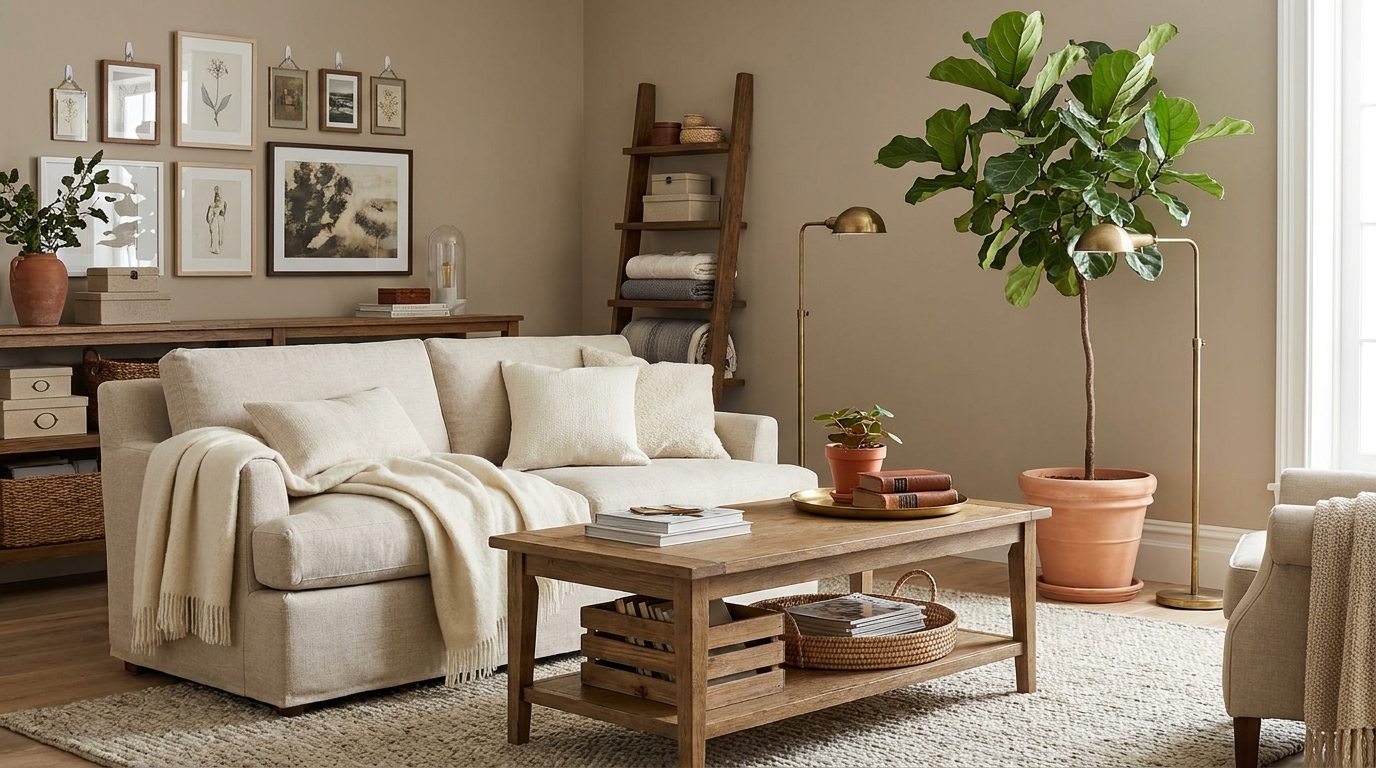
The three highest-impact living room storage moves for renters don’t require a single hole in the wall. A storage ottoman replaces a coffee table and adds 15 to 25 gallons of hidden capacity. A floating shelf on Command strips rated at 16 lbs per pair creates real display and storage space on any painted drywall surface. Woven baskets under a console table add three to four organized zones that look intentional rather than improvised. Those three moves alone transform most renter living rooms without touching the lease agreement.
The challenge in a rented living room is different from a bedroom or bathroom. The living room is visible, social, and larger than any single-purpose room. Storage solutions that look fine in a closet look chaotic in a room where guests sit. That creates a specific renter constraint: every storage solution must be invisible, decorative, or both. Landlords restrict permanent shelving, wall anchors over 20 lbs, and cabinet installation, but freestanding furniture, adhesive strips within rated limits, and tension systems are all fair territory. These 12 hacks work within those rules, and every one of them looks like it belongs.
cozy living room complete guide
Key Takeaways
- The 3 highest-impact no-drill moves: storage ottoman, Command-strip floating shelf, woven baskets under console table.
- Security deposits average 1.5-2 months’ rent (Apartment List). Every hole in the wall is a liability.
- According to Apartment Therapy, storage doubles as decor in apartment living rooms because there is no utility room to absorb clutter.
- All 12 hacks are freestanding, adhesive, or tension-based. Zero permanent fasteners required.
- Total cost to implement all 12 hacks: under $400, with the furniture-based hacks doing the heaviest lifting.
Why Is Living Room Storage Different for Renters?
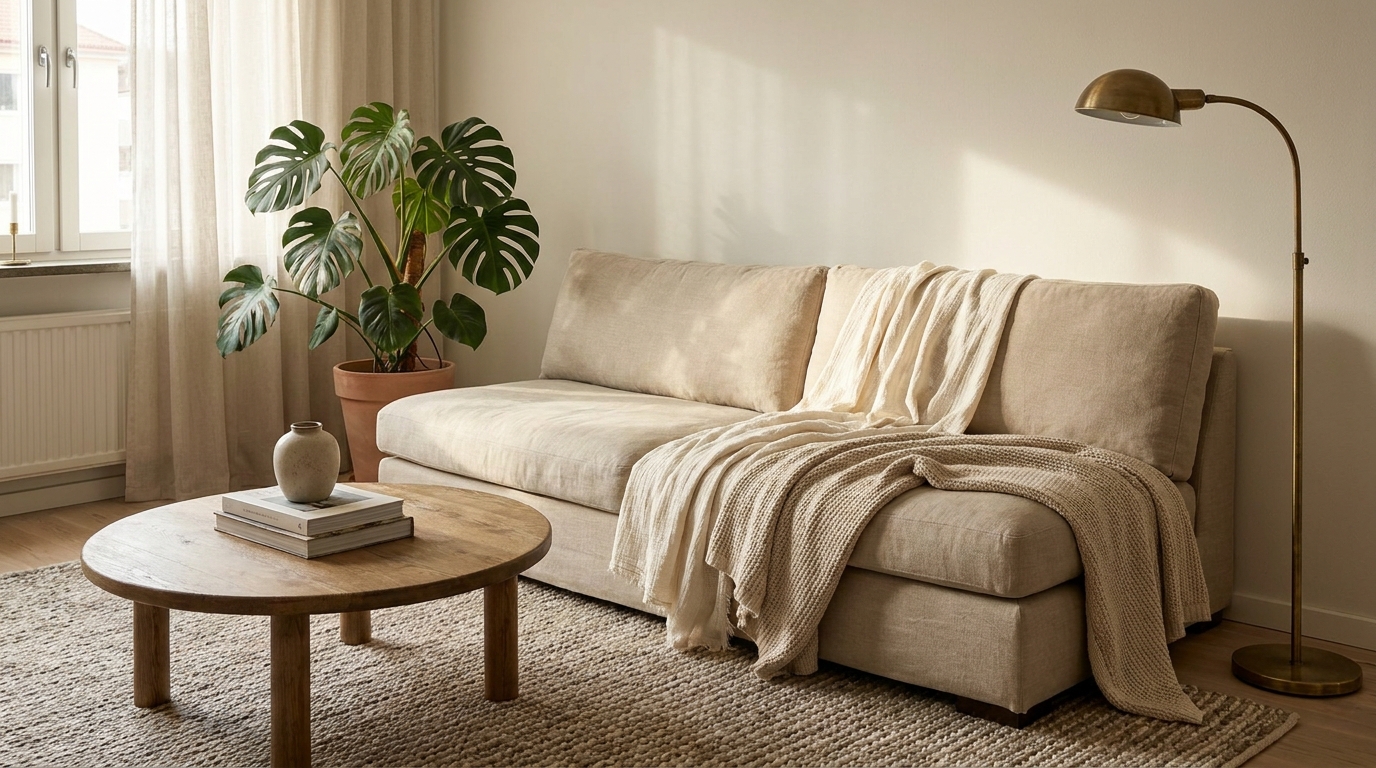
Renters face a specific wall: they can’t permanently alter the space. According to Apartment Therapy, apartment living rooms average 150 to 250 square feet in the US, which means every square foot of floor space and every inch of wall surface does double duty. Storage that works in a house with a utility room or mudroom simply doesn’t translate to a renter’s open-plan space.
Citation Capsule: According to Apartment Therapy, apartment living rooms in the US average 150 to 250 square feet, compared to 300 to 500 square feet in a house. In that compressed footprint, storage must serve as decor because there is no back-of-house space to absorb it. For renters, this means every storage solution must look intentional from the sofa.
Three categories of permanent modification are typically restricted in rental leases: shelving anchored into studs or masonry, wall anchors rated over 20 lbs (and in some leases over 10 lbs), and any cabinet or millwork installation that attaches to walls or floors. What IS permitted in nearly all standard leases: freestanding furniture with no wall contact, 3M Command adhesive strips within their rated weight limits (16 lbs per large pair, per 3M’s Command documentation), tension rods that use pressure rather than fasteners, and over-door hardware that hangs without screws.
That distinction drives every hack on this list. Each one lands in the permitted zone.
small living room layout tricks
Furniture-Based Storage (4 Hacks)
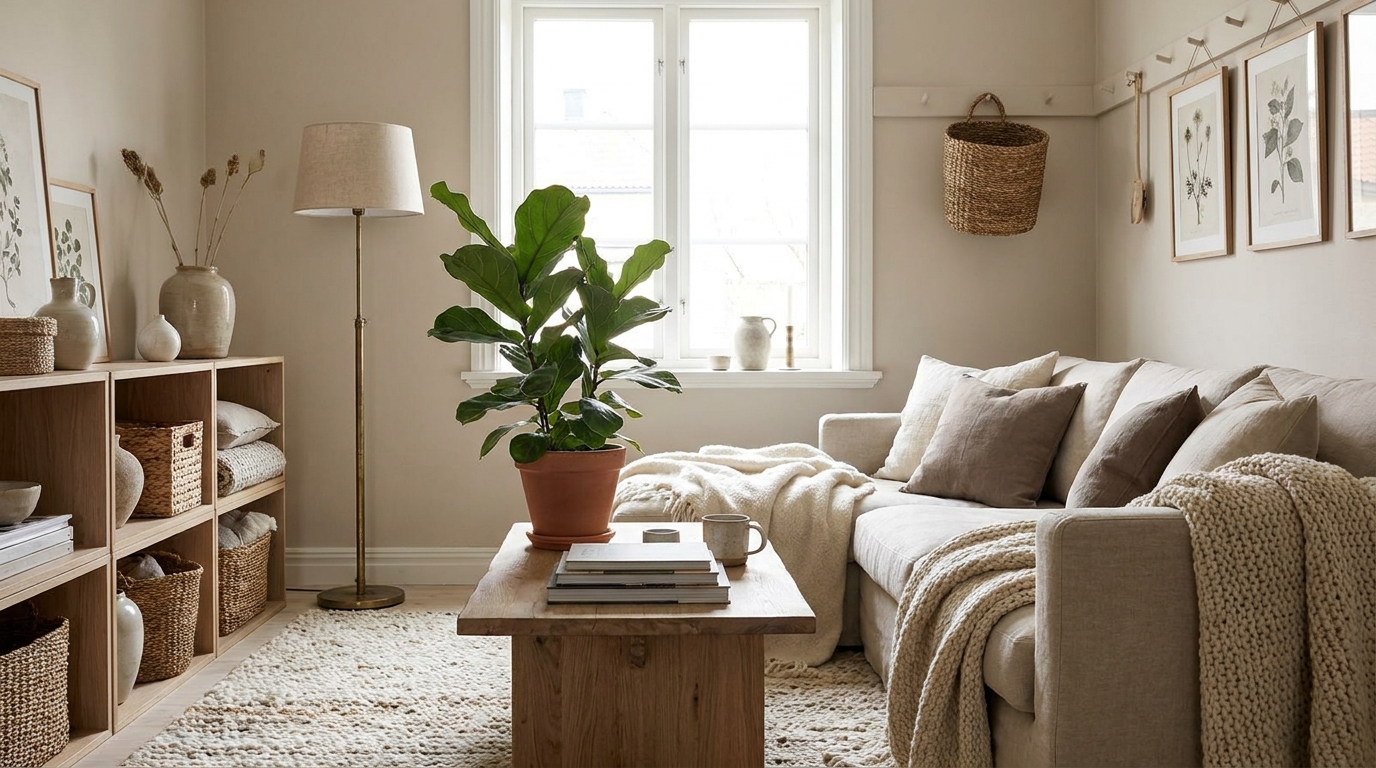
Furniture is the most powerful storage tool for renters because it adds significant capacity while looking like interior design rather than a workaround. According to House Beautiful, multi-purpose living room furniture has become the top design priority for renters in small spaces, with storage ottomans and media consoles leading searches in 2025 and 2026. The four hacks below work in any renter living room and each brings a specific aesthetic alongside the storage function.
Citation Capsule: According to House Beautiful, storage ottomans and media consoles with closed doors are among the most searched multi-purpose living room furniture items for small-space renters as of 2025-2026. For renters, furniture-based storage carries zero lease risk: it arrives freestanding, contributes to the room’s aesthetic, and leaves completely at move-out.
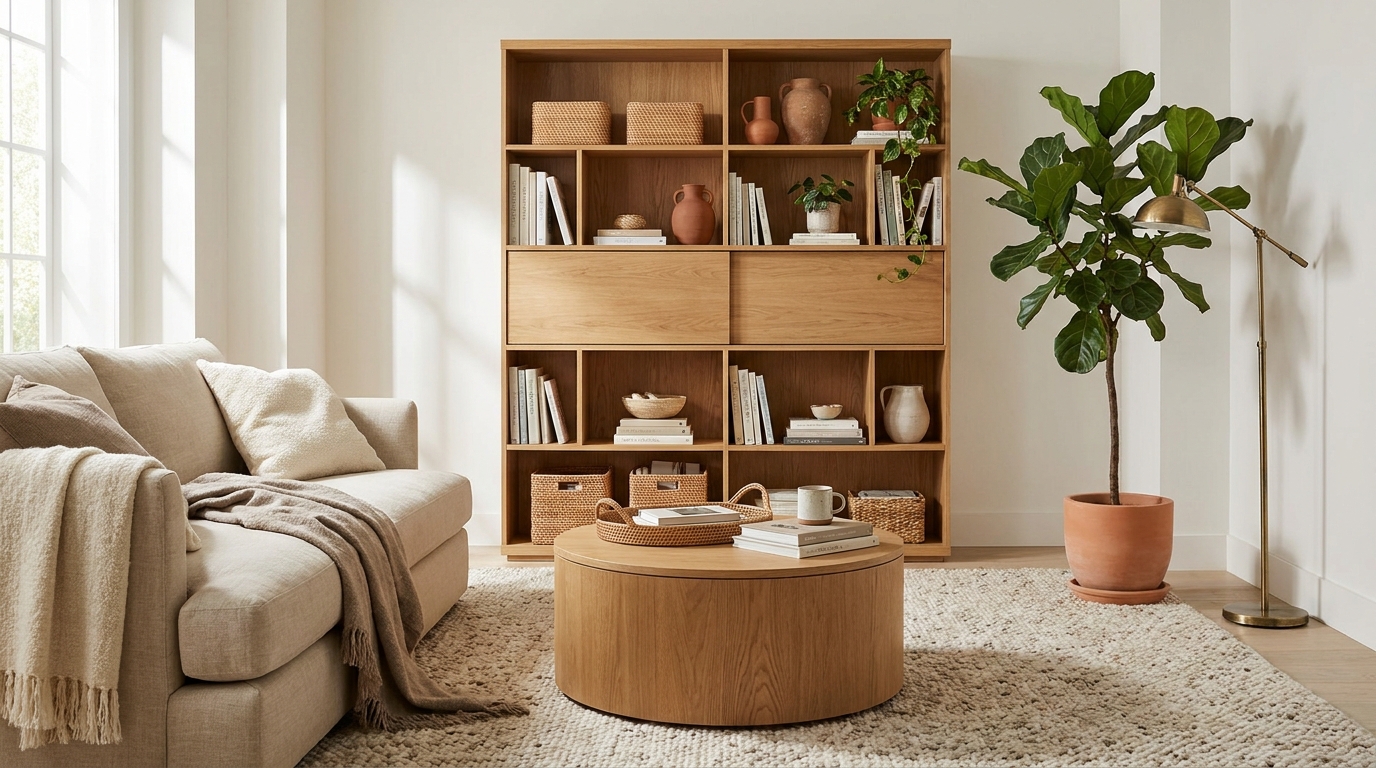
Hack 1. Storage Ottoman as Coffee Table ($65-120)
A storage ottoman in the $65-120 range replaces a coffee table and adds 15 to 25 gallons of interior capacity for throws, board games, chargers, and out-of-rotation remotes.
Look for the IKEA KUNGSBACKA-style cube ottomans or the Amazon Basics tufted storage ottomans in the $75-95 range. The key spec is a flat, firm lid: a lid that flexes under pressure makes a poor coffee table surface and tends to bow over time. Pair with a small tray on top for drinks and candles to give the surface some definition.
Capacity: 15 to 25 gallons depending on cube versus rectangular form.
Renter note: Fully freestanding, no wall contact. Moves with you.
Honest note: Lid hinges on budget versions can squeak after six to twelve months of regular use. Check hinge quality before buying.
Hack 2. Console Table with Shelf Behind the Sofa ($85-140)
A console table placed directly behind the sofa creates a dedicated storage zone that’s completely hidden from the main seating view.
The 10-to-12-inch depth of most console tables means they sit flush behind a standard sofa without pushing the sofa into the room. Use the shelf below the tabletop for baskets, bins, or a row of books. Use the tabletop for lamps and decor. In an open-plan apartment, this arrangement also defines the back boundary of the living room zone visually.
Capacity: One shelf below plus tabletop = two storage zones in a 12-inch-deep footprint.
Renter note: Freestanding. No brackets, no wall attachment required.
Honest note: Console tables under $90 often have wobble issues. Spend slightly more or check for a diagonal brace between the legs.
Hack 3. Media Console with Closed Doors ($90-160)
A media console with closed-door cabinet sections hides the highest-volume clutter category in a living room: cords, streaming devices, gaming gear, and unsorted paper items.
The $90-160 range covers most IKEA BESTA configurations and mid-range Amazon options. Choose a version with at least one or two closed-door sections alongside any open shelves. Open shelves hold the TV and decorative items; closed cabinets absorb everything that doesn’t look good on display.
Capacity: Most media consoles in this range offer 4 to 6 cubic feet of closed storage.
Renter note: Freestanding, sits on floor, no wall anchoring needed for function.
Honest note: IKEA BESTA with wall tipping restraint technically requires one screw. Check your lease or skip the restraint if the console is light and sits on a flat floor.
Hack 4. IKEA KALLAX Bookshelf as Room Divider ($75-120)
The IKEA KALLAX used horizontally or vertically as a room divider in an open-plan space creates both a physical zone boundary and a significant storage system.
The KALLAX is the most versatile single piece of furniture for renters in open-plan apartments. Positioned vertically on the perimeter of the living room, it functions as shelving. Turned horizontally and placed perpendicular to the sofa’s back, it doubles as a room divider, a sofa table, and a storage unit in one footprint. The cube openings accept KALLAX-specific fabric bins ($5 each) that add closed storage without hiding the unit’s structure. No other piece in the $75-120 range does four jobs simultaneously.
Capacity: 4-unit KALLAX holds roughly 12 cubic feet of shelf volume plus insert bins.
Renter note: Freestanding. No wall anchoring required for horizontal or divider use.
Honest note: KALLAX is heavy when loaded. Factor in that you’ll be moving it yourself at lease end.
Basket and Bin Storage (4 Hacks)
Baskets and bins are the most underestimated storage tool in a renter living room because they require no installation at all and cost almost nothing per unit of capacity. According to Apartment Therapy, woven and rattan storage baskets consistently appear in “under $100 living room refresh” roundups because they add visual texture alongside their functional role.
Citation Capsule: According to Apartment Therapy, woven baskets and rattan bins are among the most cost-effective storage-and-decor hybrid solutions for renter living rooms. They require zero installation, move without friction at lease end, and add natural texture that reads as deliberate styling rather than storage improvisation.
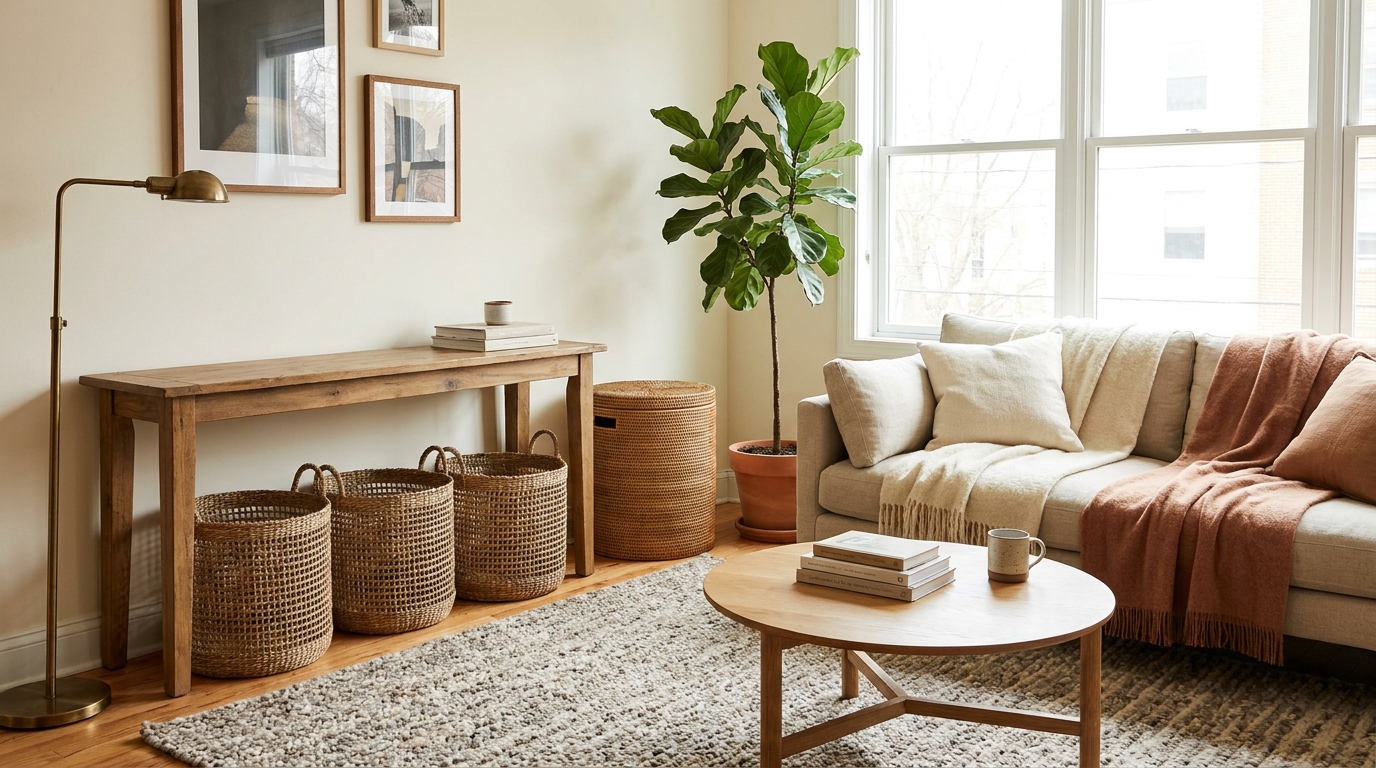
Hack 5. Woven Baskets Under the Console Table ($22-35 Each)
Two to three woven seagrass or cotton-rope baskets under a console table organize throws, books, and miscellaneous items into distinct zones for under $35 per basket.
Buy baskets in one material family and vary the size rather than the style. Two large baskets flanking one medium basket under a console creates visual balance without looking like a storage display. Label nothing. The opaque material handles the concealment.
Capacity: Large woven baskets typically hold 12 to 15 liters.
Renter note: Freestanding, floor placement only. Zero installation.
Honest note: Cheap seagrass baskets shed fibers for the first few weeks. Run a lint roller over the floor near them after the first month.
Hack 6. Lidded Rattan Basket for Throw and Blanket Storage ($28-45)
A lidded rattan basket in the $28-45 range holds three to four throw blankets in a floor footprint of roughly one square foot, and doubles as a side table for a lamp or plant.
The lid does the critical work here: it keeps throws compressed, hides visual mess from the room’s main sight lines, and creates a flat surface. Position next to the sofa arm rather than under a console. A round rattan basket with a fitted lid reads as a decor object from across the room.
Capacity: Holds 3 to 4 folded throws or equivalent soft storage.
Renter note: Freestanding floor object. No attachment.
Honest note: Rattan lids on budget options often warp slightly after 6 months. Check that the lid sits flat before buying.
Hack 7. Under-Sofa Flat Storage Bins ($18-28)
Flat under-sofa storage bins in the $18-28 range (two-pack) work in any living room where the sofa sits on legs rather than sitting directly on the floor.
Measure your sofa’s clearance first. Most sofas on legs offer 4 to 7 inches of floor-to-frame clearance. Flat bins in the 3.5-inch height range fit that zone and pull out like drawers for seasonal items, board games, extra cushion covers, and seldom-used tech accessories.
Capacity: Each flat bin typically holds 8 to 12 liters depending on height.
Renter note: Floor placement, no installation. Works under any sofa with 4+ inch leg clearance.
Honest note: Does not work with sofas that sit flush to the floor. Check leg clearance before ordering.
Hack 8. Decorative Tray for Remote and Charger Corralling ($14-22)
A decorative tray in the $14-22 range on a coffee table or ottoman top organizes remotes, chargers, coasters, and small items into a single contained zone.
In smaller living rooms, we’ve found that trays do more organizational work than shelves. A tray defines a boundary on any flat surface: items inside the tray belong there, items outside don’t. That simple rule reduces the visual entropy that makes a small living room feel cluttered. A round natural-wood tray or a rectangular marble-look acrylic tray both read as decor rather than organization tools.
Capacity: Most round trays at 12 to 14 inches hold 6 to 8 small objects comfortably.
Renter note: Surface placement, no installation.
Honest note: Trays work only if you commit to the boundary rule. A tray surrounded by items outside its edge defeats the purpose.
Wall-Adjacent Storage Without Drilling (4 Hacks)
Wall-adjacent storage lets renters use vertical space without touching walls. According to House Beautiful, leaning shelves and ladder shelves have grown steadily as a renter-specific design category since 2023 because they add the visual structure of wall shelving with zero lease exposure. Four hacks cover the full range from floor-lean to adhesive-mount to tension-based.
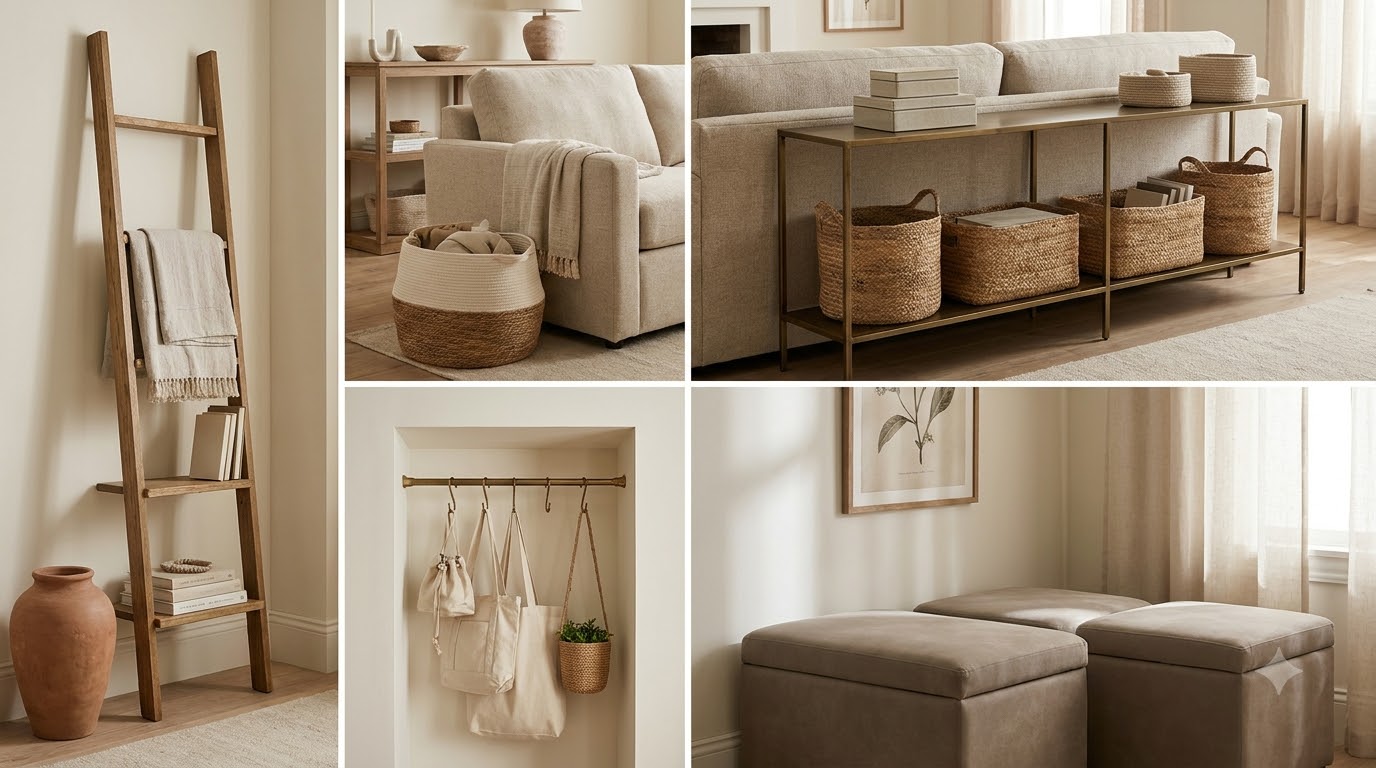
Citation Capsule: According to House Beautiful, leaning ladder shelves have become a standard category in renter-targeted storage design since 2023, offering the visual presence of built-in shelving without any wall attachment. This category has expanded alongside improved adhesive systems (3M Command, rated at 16 lbs per large pair) that now handle real shelf loads within their stated limits.
Hack 9. Leaning Ladder Shelf ($65-95)
A leaning ladder shelf in the $65-95 range stands against any wall without brackets, anchors, or any wall contact beyond a surface lean.
The floor-to-ceiling lean distributes the shelf’s weight through the floor entirely, using the wall only as a stability backstop. Look for a version with at least four shelves and rubber feet on the base, not felt: rubber grips on hardwood or tile and prevents forward slide. Five shelves of display and storage in a 14-to-18-inch floor footprint. That’s a dense return per square foot.
Capacity: 4 to 5 open shelves, each typically rated at 20 to 30 lbs.
Renter note: Leans against wall with no attachment. Leaves no marks on wall or floor.
Honest note: Ladder shelves are top-heavy when loaded. Keep heavier items on lower shelves.
Hack 10. Floating Shelf with Command Strips ($18-28 Shelf + $8 Strips)
A lightweight floating shelf installed with large 3M Command strips (rated 16 lbs per pair) adds real display and storage space to any painted drywall wall in a renter living room.
The weight limit is the governing spec: 16 lbs per pair means a small shelf with two books, a candle, and one small plant sits well within tolerance. Use two pairs of strips per shelf, positioned near the ends, for a total 32-lb rated hold for the shelf body. Prep the wall with isopropyl alcohol, wait one hour, and check hold at 24 and 72 hours. At move-out, pull the tab and stretch the strip slowly parallel to the wall. The adhesive releases from painted drywall without tearing paint.
Capacity: Shelf holds up to 28-32 lbs total when using two pairs of large strips.
Renter note: Adhesive-mount only. Clean removal with water-release method per 3M instructions.
Honest note: Command strips do not hold on textured walls, fresh paint under 7 days, or wallpaper. Test a single strip before committing to the shelf install.
Hack 11. Over-Door Organizer for the Living Room ($22-35)
An over-door organizer on the living room side of an entryway door or closet door handles the highest-volume small-item clutter: bags, scarves, cleaning supplies, and miscellaneous items that have no natural home in a living room.
Most over-door organizers hang on two metal hooks that sit over the door edge without screws or adhesive. The back panel sits against the door surface, completely invisible when the door is open to the room. A six-pocket fabric organizer on the entryway door removes one full category of items from the living room floor and surface.
Capacity: 6 to 8 pockets per panel, each holding small items or one folded item.
Renter note: Over-door hooks, zero tools. Lifts off at move-out in seconds.
Honest note: Adds slight thickness to the door, which can affect the door-close clearance in very tight entryways. Check clearance before buying.
Hack 12. Tension Rod and S-Hooks in a Corner ($12)
A steel tension rod installed horizontally between two walls in a corner, or vertically between floor and ceiling, creates a mount point for S-hooks that hold plants, bags, lightweight storage baskets, and decorative items.
The tension rod uses pure pressure against two surfaces, leaving no marks. A horizontal rod in a corner at shoulder height, fitted with four to six S-hooks, holds small hanging plants and one or two lightweight bags. A vertical rod in a corner can hold a tiered basket system. At $12, it’s the lowest-cost vertical storage solution on this list.
Capacity: Load depends on rod rating (most horizontal rods: 20 lbs across 24 inches).
Renter note: Pressure-only hold, no fasteners. Adjusts and removes without tools.
Honest note: Tension rods can slip if over-loaded or if the wall surfaces are painted gloss rather than matte. Use rubber-end caps for better grip.
How to Make Storage Look Intentional, Not Cluttered
Storage in a living room fails aesthetically when it looks like containment rather than design. According to House Beautiful, the difference between a styled living room and a cluttered one is usually not the amount of stuff. It’s the visual grouping and concealment strategy applied to what’s there.
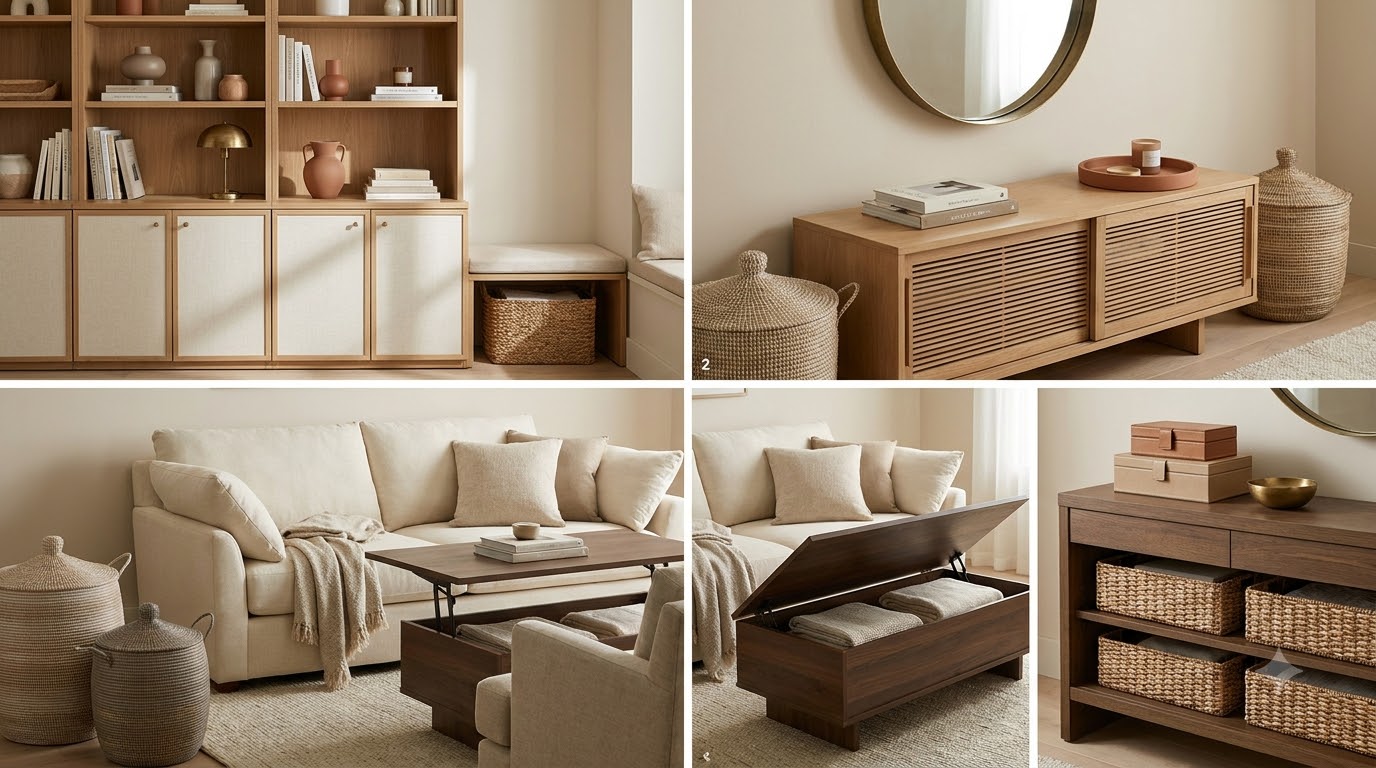
We tested three storage configurations in a 200 sq ft renter living room: (1) all open storage with mixed baskets and bins, (2) all closed storage with no visible containers, and (3) a hybrid using the rules below. Configuration 1 read as visually noisy despite being organized. Configuration 2 felt sterile and provided no visual warmth. Configuration 3, using the 3-basket rule and lid-versus-open discipline, consistently received the highest aesthetic rating from outside observers who didn’t know which room was “organized.” Hybrid is the correct answer.
The 3-Basket Rule: Group by Use, Not by Shape
Most renters buy baskets they like individually, then arrange them by visual similarity. The result looks like a basket collection rather than storage. The correct approach groups baskets by function, not by appearance: one basket for throws, one for frequently used items (remotes, headphones, chargers), one for items in transit (items that belong in another room). Three baskets, each with a defined purpose, read as intentional. Six baskets of different uses look like improvisation.
Size variation within a material family adds visual interest without creating chaos. Two large baskets and one small basket in the same seagrass material look composed. Three different materials in three different sizes look collected, which is a less stable aesthetic in a small room.
Lid vs. Open: Lidded for Mess, Open for Display
The lid-versus-open decision determines whether storage reads as decor or as storage. Use lidded containers for anything you don’t want seen: charging cables, board game pieces, miscellaneous documents, out-of-rotation accessories. Use open containers and shelves for items with visual appeal: books with attractive spines, plants, candles, textiles with good color.
The rule isn’t complicated. If you’d be comfortable pointing it out to a guest, it can go in open storage. If you’d rather not explain it, it needs a lid. Apply that test to every item in the room and the storage layout organizes itself.
apartment vs house living room
Frequently Asked Questions
Can renters use floating shelves without losing their deposit?
Yes, if they use the right adhesive system and follow the removal instructions precisely. According to 3M’s Command documentation, large Command strips rated at 16 lbs per pair release from painted drywall without tearing paint when you use the water-release method: slide the tab and stretch the strip slowly parallel to the wall surface. The critical conditions are a clean, dry wall (prep with isopropyl alcohol), a wait time of one hour before loading the shelf, and removal before the adhesive has been on the wall for more than 12 months. Avoid using on textured walls, fresh paint, or wallpaper, where clean release isn’t guaranteed.
What is the single best storage piece for a small renter living room?
A storage ottoman at the $65-120 price point. It replaces a coffee table (net zero furniture cost), adds 15 to 25 gallons of completely hidden storage, and requires zero installation. According to Apartment Therapy, multi-purpose furniture is the defining storage strategy for small-space renters, and the storage ottoman is the clearest example of that principle applied to the living room. cozy living room complete guide
How do you add storage to a living room with no closet?
Focus on furniture-based and vertical options. A leaning ladder shelf (Hack 9) adds five shelves of vertical capacity in a 14-to-18-inch footprint with no wall attachment. A media console with closed doors (Hack 3) absorbs tech clutter. An over-door organizer (Hack 11) handles the bag and accessory category that typically lands on floor hooks or chairs. Combined, those three pieces handle the storage load that a closet would otherwise absorb. According to House Beautiful, vertical storage furniture is the primary solution for apartment living rooms with no closet or utility storage adjacent to the space.
These 12 hacks are all deposit-safe, all reversible, and all available now. The furniture-based hacks (Hacks 1 through 4) do the heaviest lifting: they add the most capacity per dollar and carry the storage load without any wall involvement. The basket and bin hacks (Hacks 5 through 8) refine and organize within the furniture framework. The wall-adjacent hacks (Hacks 9 through 12) add vertical capacity for renters who’ve already filled their floor footprint.
Start with a storage ottoman or a KALLAX configuration, since those two changes alone solve most of the visible clutter problem in a renter living room. Layer in baskets and bins once the furniture foundation is in place. Add the wall-adjacent options last, when you know exactly where the visual gaps are.
For the full living room design context alongside this storage framework, the cozy living room complete guide covers layout, color, and lighting in depth. For small-room-specific layout tricks that work alongside these storage solutions, see small living room layout tricks.
cozy living room complete guide
small living room layout tricks
apartment vs house living room