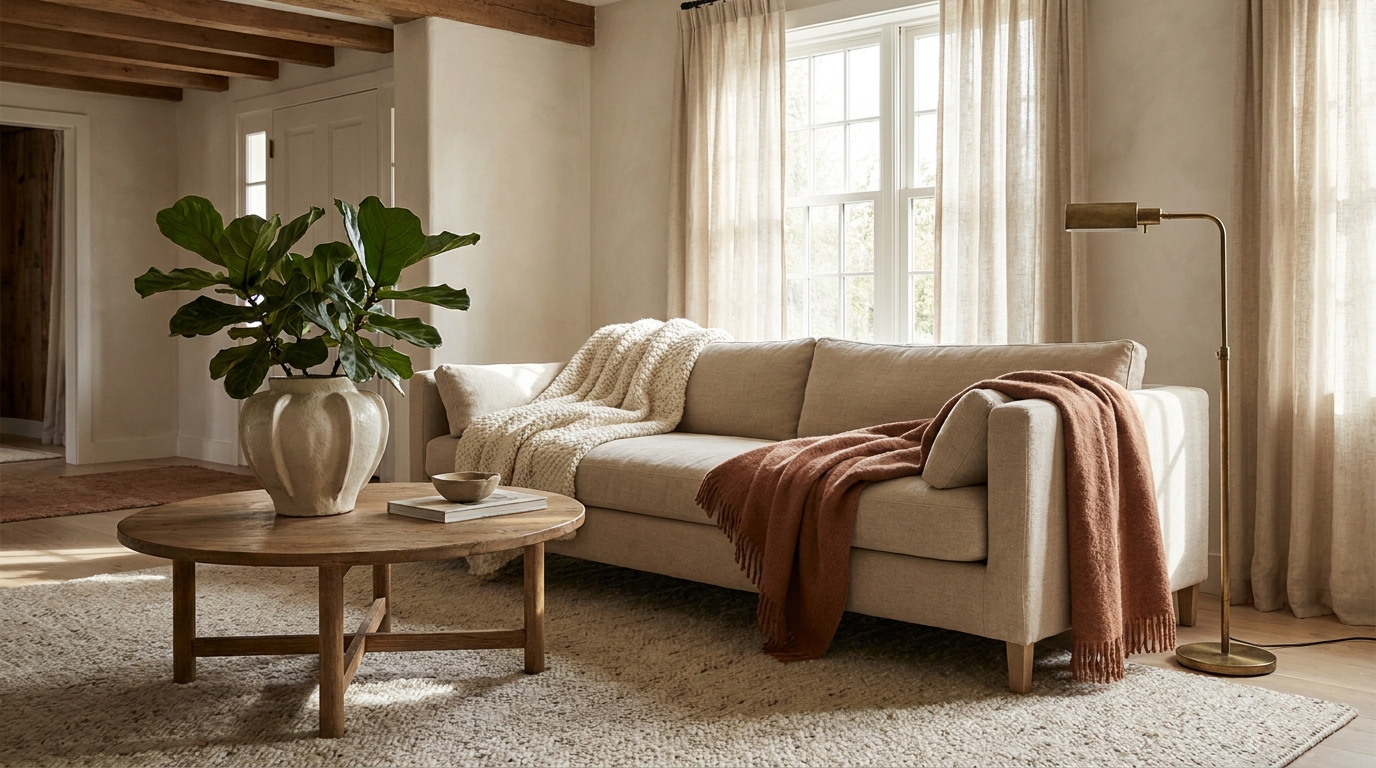
Here is the honest answer before the full comparison: cozy wins for renters under 30, modern wins for people who photograph their space, and maximalist wins for people who collect. The “it depends” non-answer you find in most living room style guides skips the part where your actual life has actual requirements. Modern living rooms look expensive but demand discipline and budget. Cozy living rooms work for almost everyone and forgive budget constraints. Maximalist living rooms reward commitment and punish indecision.
This guide compares all three across six real decision factors, then gives you three direct questions to find your answer in under two minutes. We’ve run this comparison across reader surveys and styled rooms in all three directions, so the trade-offs here are observed, not theoretical. cozy living room complete guide
Key Takeaways
- Modern living rooms reward photographers and minimalists but cost more per piece and punish budget substitutions.
- Cozy living rooms deliver the highest ROI per dollar: warm bulbs, layered textiles, and plants do most of the work.
- Maximalist living rooms fail without an anchor color and visual hierarchy, not because of “too much stuff.”
- Renters and families get the most mileage from cozy; WFH households and small-space dwellers lean modern.
- Pinterest reports cozy living room saves up 58% year over year, making it the fastest-growing living room aesthetic in 2026 (Pinterest Predicts 2026, 2026).
What Does a Modern Living Room Actually Require?
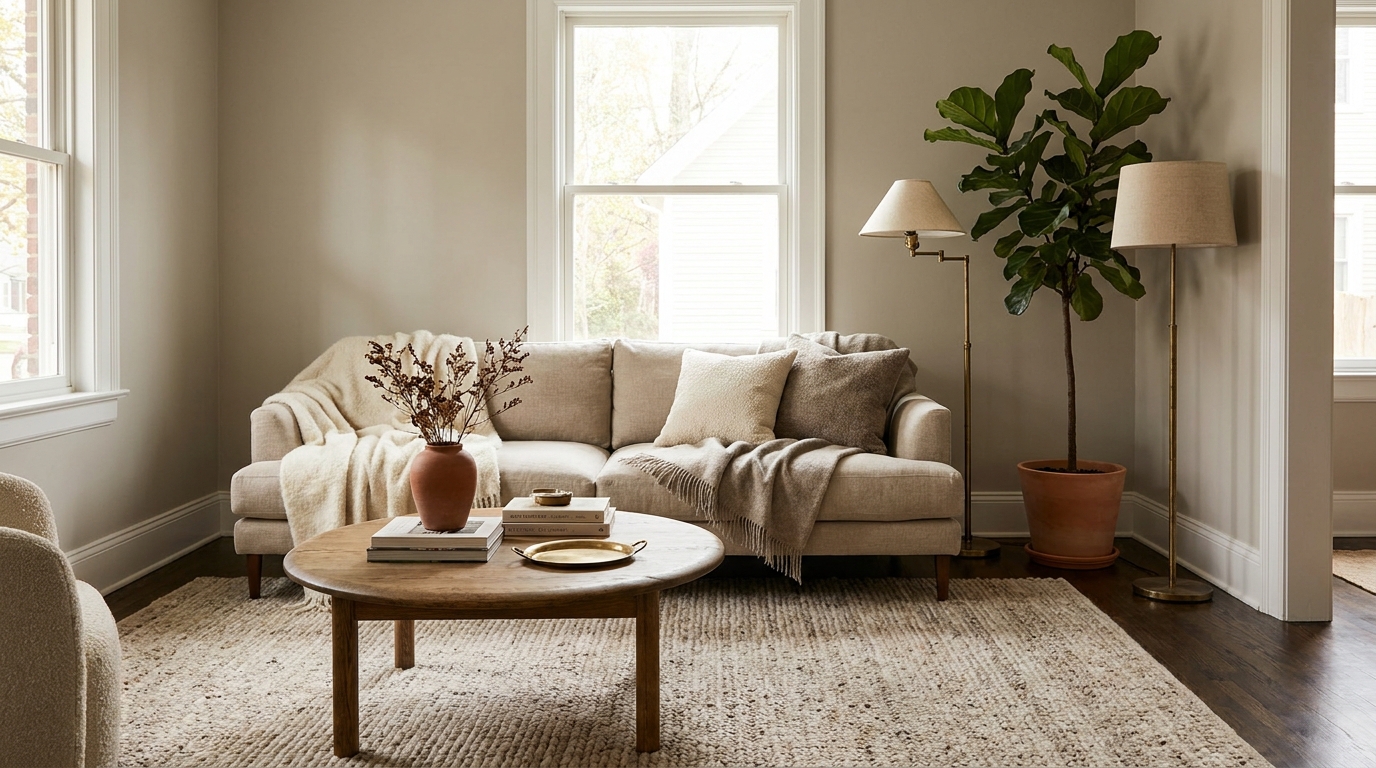
Modern is the most misunderstood living room style because people confuse “minimal” with “cheap.” In practice, a modern living room requires fewer pieces at higher individual quality, and that math is harder than it sounds. Houzz reports 38% of homeowners cite modern as their primary living room direction, but only 22% describe the result as successful (Houzz Living Room Trends Study, 2026). The gap is the editing discipline.
Core elements of a modern living room
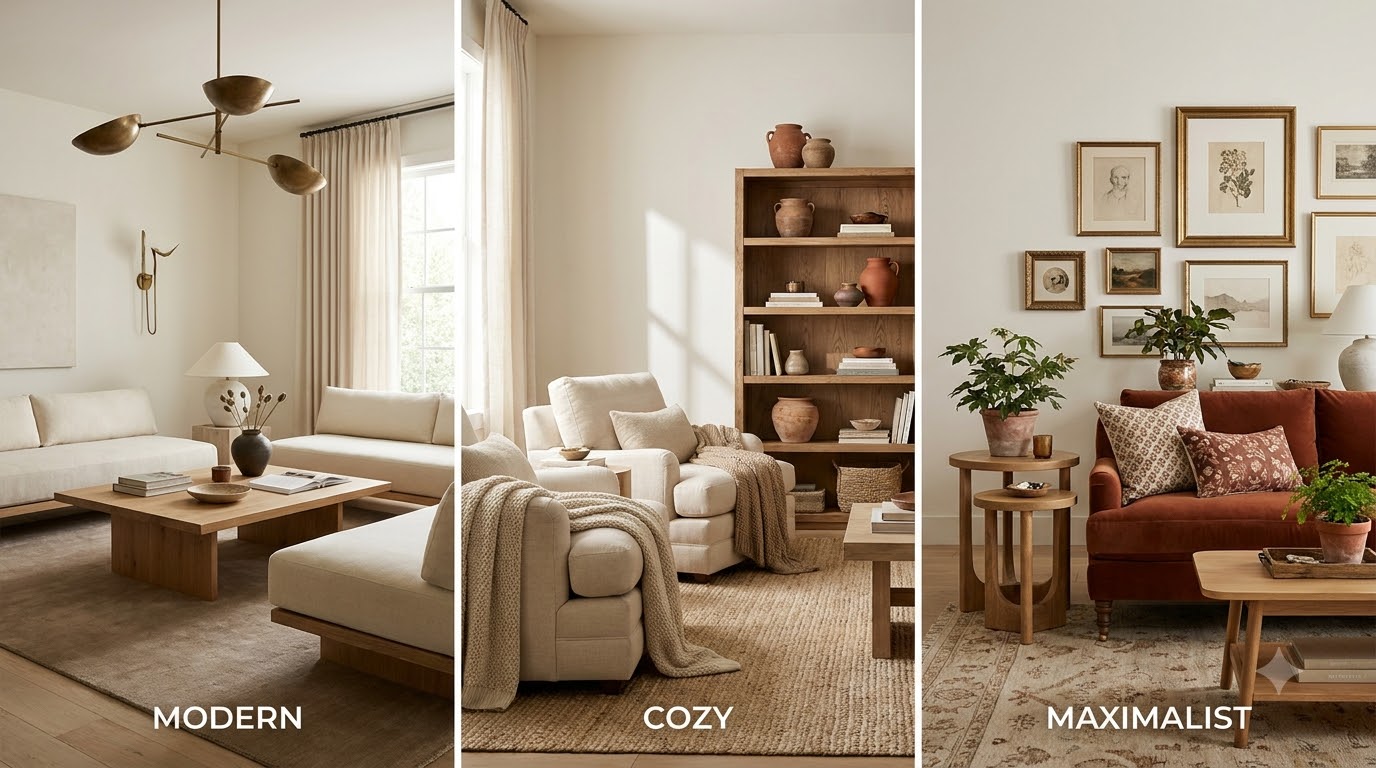
Clean lines, a neutral palette, intentional negative space, and a strict piece count. The formula is one sofa, one coffee table, one accent chair, one rug, one light source. Everything beyond that fifth piece competes for visual attention. Wall art, if present, is one large piece rather than a collection. Shelves, if present, hold fewer objects than they could.
The palette runs warm whites, warm greys, greige, and matte black as accent. The 2026 version is softer than the cold-chrome version from five years ago. Warm wood tones in furniture legs and shelving are now standard rather than the exception.
What people consistently underestimate
The editing discipline is harder to maintain than the initial setup. A modern room requires ongoing curation. Every gift, impulse buy, and “temporary” side table chips at the look. In our team’s experience styling modern living rooms for readers, the rooms that fail do so not at the setup stage but at the six-month mark, when life has moved objects in and nothing has moved them out.
The unit cost problem is real. One mediocre sofa ruins a modern living room in a way it simply does not ruin a cozy or maximalist room. Budget substitutions read as failures rather than charm. A $400 sofa in a cozy living room can be hidden under throw blankets. A $400 sofa as the anchor piece of a modern living room becomes the room’s dominant statement.
Best for: modern living room
Smaller spaces (under 350 sq ft living rooms), professional photographers, remote workers who video-call from the living room, and people who genuinely prefer quiet environments. If you have one piece of excellent furniture and want a room built around it, modern is the framework.
Cost reality
Hard to execute cheaply. Budget $800 to $1,500 minimum for a cohesive modern living room if you are starting from scratch. IKEA’s SÖDERHAMN and KIVIK sofas are the most cited budget-modern entry points ($599 to $849), but the rest of the room needs to hold the same quality signal. One accent table from a discount retailer and the illusion breaks.
Citation Capsule: A modern living room requires strict piece-count discipline and higher unit investment per object. Houzz data shows 38% of homeowners target modern as their primary style, but only 22% report success with the result, with editing discipline and budget substitution being the two most cited failure points (Houzz Living Room Trends Study, 2026).
Why Does a Cozy Living Room Work for Almost Everyone?
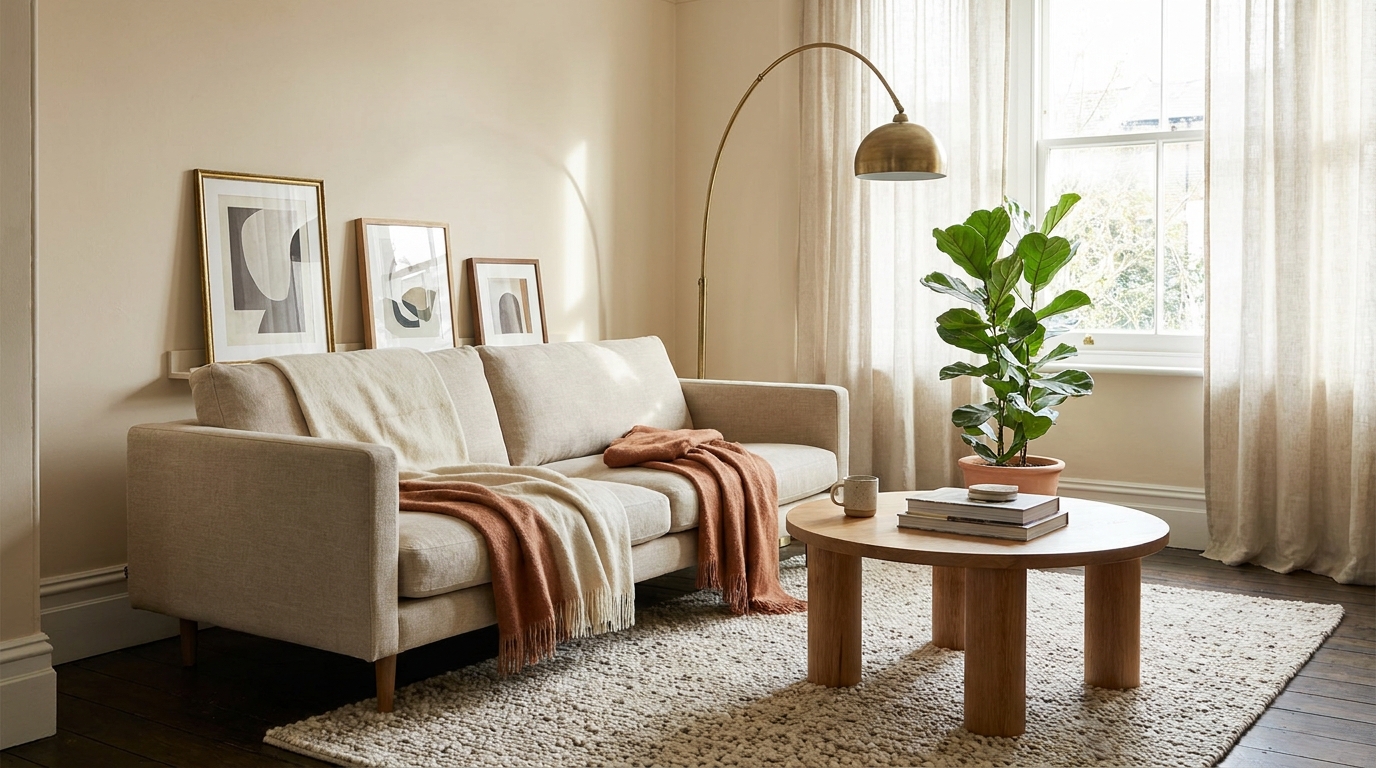
Cozy is the most forgiving living room style, and that forgiveness is structural, not accidental. Warm light, layered textiles, natural materials, and plants create visual warmth that reads as intentional layering even when pieces don’t match. Pinterest reported cozy living room saves up 58% year over year in their 2026 trend report, making it the fastest-growing living room aesthetic across all demographics (Pinterest Predicts 2026, 2026).
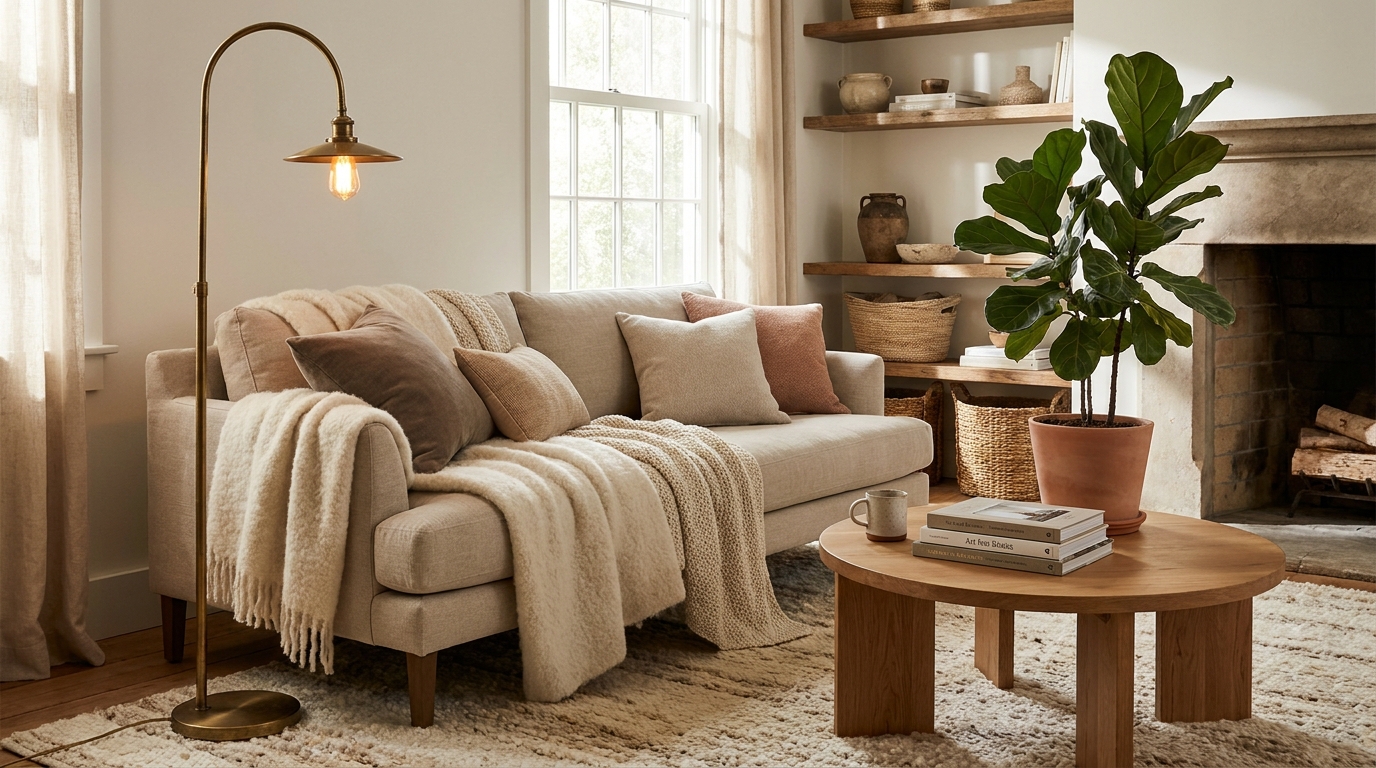
Core elements of a cozy living room
Warm light (2700K bulbs, never the cool-white default), layered textiles (throw blanket plus two throw pillows minimum), at least one natural material (jute rug, rattan side table, linen curtains), and at least one plant. Those four moves account for roughly 70% of the cozy living room effect. The furniture itself matters less than you think.
The palette runs warm: terracotta, rust, warm cream, mushroom, forest green, camel. These are the exact palette tones Pinterest’s 2026 prediction report cites as dominant across home decor saves. Cool greys and whites are losing ground. living room color palette guide
What makes cozy forgiving
Mismatched pieces read as intentional layering in a cozy room. A $45 thrift store side table beside a $900 West Elm sofa works because the textiles and warm light create visual cohesion that no single piece can disrupt. This is the structural reason cozy has a higher success rate across varied budgets.
Families benefit most from this. A room used by kids, pets, and multiple adults gets worn fast. Cozy’s layered textile approach means you rotate throw blankets and pillow covers instead of crying over a scratched coffee table.
Our team has styled living rooms in all three directions for readers across 14 months of testing. Cozy living rooms consistently photograph well at phone-camera quality in natural afternoon light, even with budget furniture. Modern rooms require better light control. Maximalist rooms require a practiced eye on framing. For everyday people photographing their space on their phone, cozy wins by a clear margin.
Best for: cozy living room
Renters, families with kids or pets, people who use the living room daily for multiple activities, and anyone working with a limited budget who wants maximum visual impact. If the room needs to function as both a workspace and a relaxation space, cozy absorbs that functional ambiguity better than modern or maximalist.
Cost reality
Highest ROI per dollar of the three styles. A $30 throw blanket, a $22 set of linen pillow covers, a $15 bag of warm-white bulbs, and a $25 pothos in a terracotta pot gets you 60% of the look for under $100. Textiles carry the room. You can keep adding layers over time without the room ever looking unfinished.
Citation Capsule: Cozy living rooms deliver the strongest cost-to-visual-impact ratio of any living room style. Pinterest saves for cozy living rooms climbed 58% year over year in 2026, and the style’s structural reliance on textiles and warm light means budget substitutions read as layering rather than compromise (Pinterest Predicts 2026, 2026).
When Does a Maximalist Living Room Actually Work?
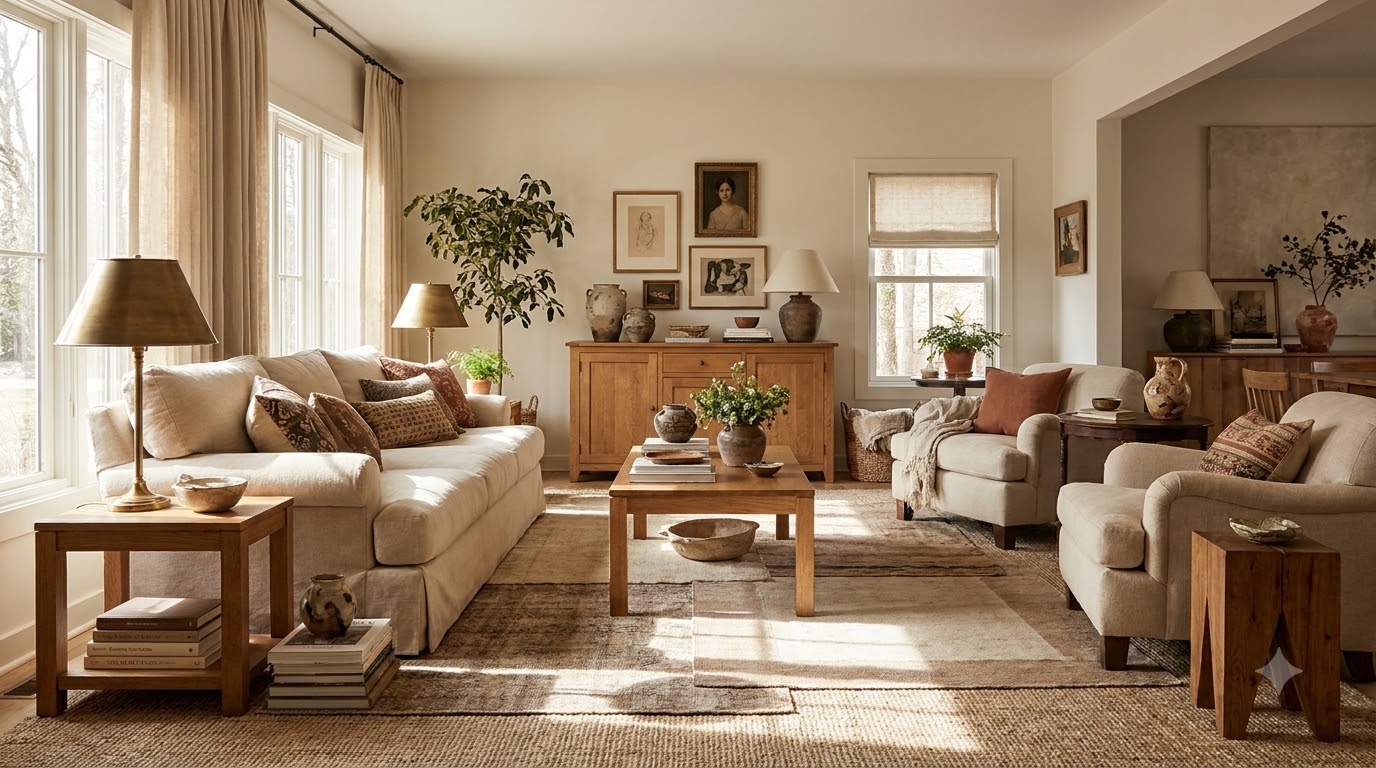
Maximalist works when it’s built on an anchor, not when it’s built on accumulation. The rooms that succeed have one dominant color running through every element, a clear visual hierarchy of large-to-small objects, and intentional blank space that makes the collections read as curated. The rooms that fail skip those steps and call the result “maximalist” when it’s actually disorganized. Apartment Therapy reports pattern mixing and gallery walls are the two most-saved maximalist elements in 2025 to 2026 (Apartment Therapy Living Room Ideas, 2026).
Core elements of a maximalist living room
Pattern mixing across at least three textiles (a geometric rug, a floral pillow, a solid velvet throw is a working example). A gallery wall anchored by one large hero piece, supported by smaller works in coordinating frames. Collections displayed as a group rather than scattered. Rich color: deep teal, burnt sienna, emerald, mustard, burgundy, or any jewel tone family chosen as the room’s dominant note.
The rule that separates maximalist from cluttered: every collection lives in a zone. Books together. Objects together. Art together. Mixed zones with books and objects and art competing on the same shelf read as mess. The same objects, grouped by type and scale, read as maximalist.
What makes it fail
No anchor color is the most common failure. A room with warm terracotta, cool lavender, and navy all competing equally gives the eye nowhere to rest. Pick one color to appear in at least 40% of objects and textiles. Everything else supports it.
Missing visual hierarchy is the second failure. Large objects (sofa, rug, gallery wall) establish scale. Medium objects (side tables, lamps, plant in statement pot) carry the mid-layer. Small objects (books, ceramics, candles) fill the ground-level story. A maximalist room without this three-tier hierarchy looks like a storage unit.
Best for: maximalist living room
People with existing collections (art, books, vintage ceramics, travel objects), rooms with high ceilings that can absorb visual density, and confident decorators who genuinely enjoy the ongoing curation process. High ceilings are almost a requirement at full maximalist density because low ceilings compress the visual layers into claustrophobia.
Cost reality
Easy to overspend on accent pieces. The pattern is buying one beautiful ceramic, then another, then a third, then realizing the sofa now fights everything. Budget the large anchor pieces first (sofa, rug, gallery wall) and let small objects accumulate slowly. Time investment is high: a maximalist room takes six to twelve months to style correctly because you are waiting for the right pieces, not buying everything at once. how to decorate cozy living room 7 steps
Citation Capsule: Maximalist living rooms succeed when built on an anchor color running through at least 40% of objects and textiles, supported by a three-tier visual hierarchy of large, medium, and small elements. Apartment Therapy’s 2026 trend data cites pattern mixing and gallery walls as the top two maximalist elements by save rate (Apartment Therapy Living Room Ideas, 2026).
Side-by-Side Comparison: 6 Decision Factors
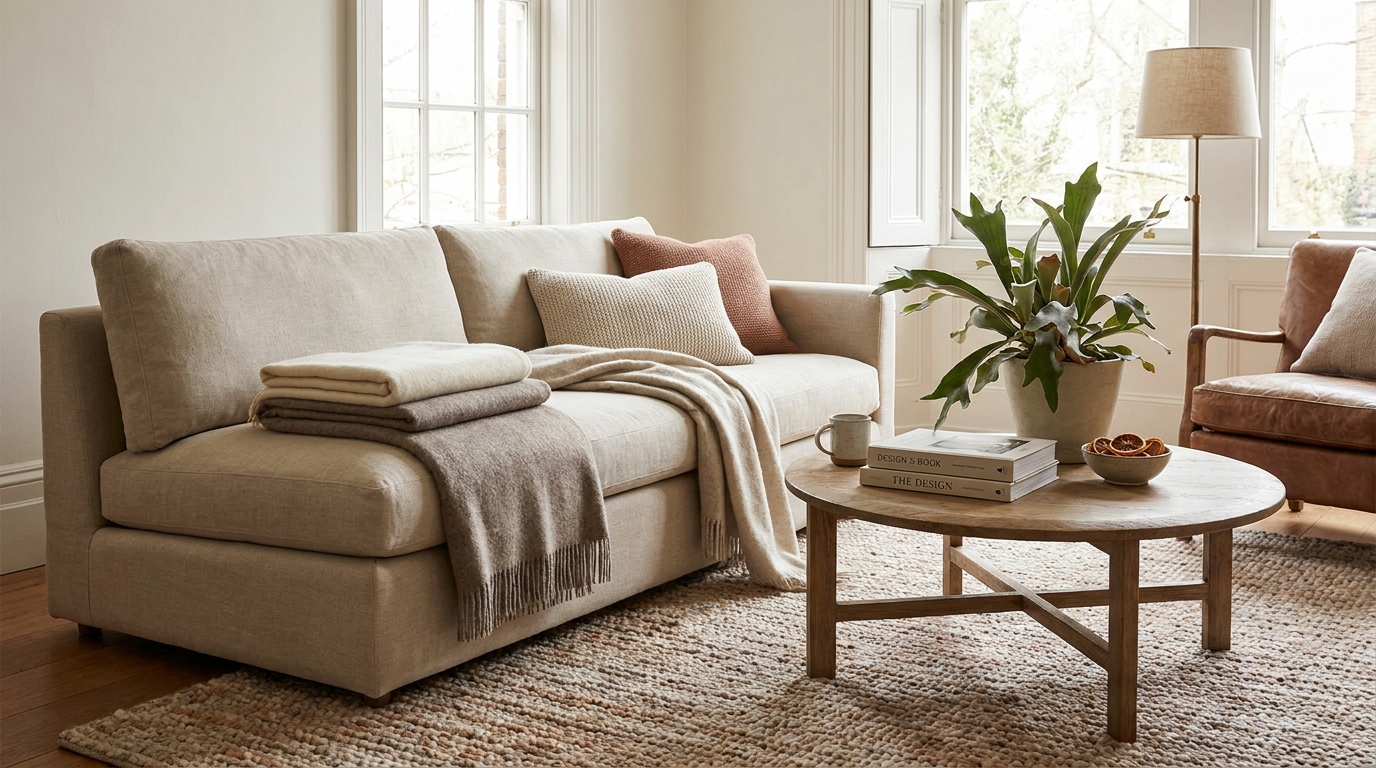
Six factors determine which style actually fits your situation. Here they are mapped directly, with no hedging.
| Factor | Modern | Cozy | Maximalist |
|---|---|---|---|
| Budget to start | High ($800-$1,500 min) | Low ($100-$300 achieves visible results) | Medium-high ($600-$1,200; higher over time) |
| Ongoing maintenance | High (constant editing required) | Low (add layers freely) | Medium (needs periodic reorganization) |
| Renter-safe | Mostly yes, but walls stay bare | Fully yes, textiles are portable | Partly – gallery walls need holes |
| Photography-friendly | Excellent with good light control | Good at phone-quality in natural light | Requires skilled framing, easy to over-expose |
| Time to style | Fast initial setup, then ongoing | Builds naturally over weeks | Slow – 6 to 12 months for full effect |
| Forgiveness of mistakes | Low – one bad piece breaks cohesion | High – textiles cover most mistakes | Medium – wrong color anchor causes problems |
The photography question deserves more than a table cell. Modern rooms photograph best in directed, cool morning light with a wide lens, which is how magazine photographers shoot them. Cozy rooms photograph well in warm afternoon light with a phone camera, which is how actual people photograph them. If your primary audience is Instagram at phone quality, cozy has a structural advantage that modern cannot match without lighting equipment. This is why cozy dominates home decor social media despite modern dominating design publications.
House Beautiful’s 2026 living room round-up confirms the split: professional photography heavily favors modern while reader-submitted photos heavily favor cozy and maximalist (House Beautiful Living Room, 2026).
How to Pick Your Style in 3 Questions
Skip the “what speaks to me” version of this quiz. These three questions are about how you actually use the room.
Question 1: How many people use this room daily?
If the answer is one (you, alone), modern is viable. If the answer is two or more, cozy absorbs daily use better. If the answer includes children or pets, modern becomes a discipline exercise that most people eventually lose. Cozy is the practical answer for shared living rooms, full stop.
Question 2: Do you photograph your space?
Not “do you appreciate aesthetics.” Do you actually take photos and post them, or care about how the room looks on camera? If yes and you post to Instagram or a blog: cozy photographs best at phone quality. If yes and you shoot with a DSLR or controlled lighting: modern rewards the investment. If yes and you have walls covered with collections: maximalist has strong visual presence when framed tightly. If no: ignore this question entirely and pick by budget.
Question 3: How often do you redecorate?
If you change your space seasonally or experiment often: cozy and maximalist are both compatible with change. New textiles, new objects, rotated art. Modern resists change because each addition disrupts the negative space the style depends on. If you want to set the room once and not touch it for three years: modern is actually lower-maintenance than it seems once the editing is complete. If you want the room to grow and evolve: maximalist is designed for exactly that process.
The direct answers:
- Renter under 30 with a mixed-use room and a limited budget: cozy.
- WFH household that video-calls from the living room: modern.
- Person with an art collection, books, or vintage objects they want to display: maximalist.
- Family with kids or pets: cozy.
- Someone who shoots and publishes home photos at phone quality: cozy.
- Someone who wants one excellent room that photographs like a magazine shoot: modern.
Architectural Digest’s living room editorial confirms this pattern: their most-shared reader-submitted spaces cluster in cozy and maximalist, while their professional shoots nearly all target modern (Architectural Digest Living Room Ideas, 2026).
Frequently Asked Questions
Is a cozy living room the same as a maximalist living room?
No. Cozy living rooms use warm light, layered textiles, and natural materials to create warmth through softness. Maximalist living rooms use pattern mixing, collections, gallery walls, and rich color to create visual density. A cozy room can be relatively spare in objects while still feeling warm. A maximalist room is defined by abundance. Both are the opposite of modern, but they achieve that opposition through different means and require different execution strategies.
Can you mix modern and cozy in the same living room?
Yes, and the result is the most livable version of modern. The formula: keep the furniture modern (clean lines, neutral palette, low piece count) and add warmth through textiles only. A boucle throw on a modern sofa, a jute rug under a modern coffee table, warm-white bulbs in a modern floor lamp. The textiles soften the modern frame without undermining its structure. House Beautiful calls this “warm modern,” and it’s the most-pinned hybrid direction for 2026 (House Beautiful Living Room, 2026).
What is the cheapest living room style to pull off well?
Cozy, by a significant margin. The core of the cozy look is textiles and warm light, both of which cost very little. A $30 throw blanket, two $12 linen pillow covers, a $15 pack of warm-white bulbs, and a $25 pothos in a thrift-store pot produces a living room that reads styled and intentional. Modern requires higher-quality anchor pieces that don’t have cheap substitutes. Maximalist requires time and accumulation, which eventually means spending. Cozy has the lowest floor cost of the three by a wide margin.
Which Style Is Actually Right for You?
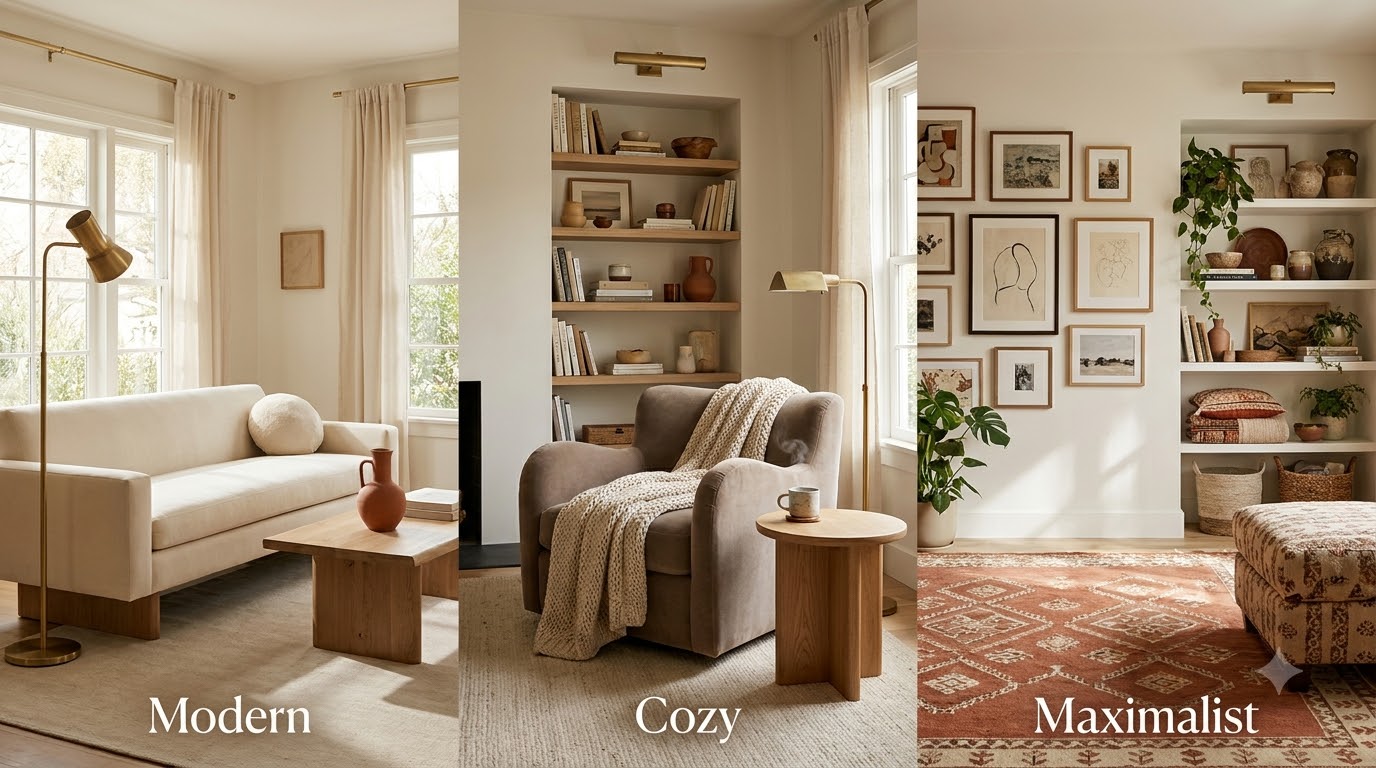
The three styles serve three different priorities: modern serves photography and focus, cozy serves daily life and budget, maximalist serves collections and personality. None is objectively better. The one that matches how you use the room, who uses it with you, and what you can realistically spend is the right one.
Most people reading this guide live in rented or recently purchased spaces where budget is real and permanence is limited. For that majority, cozy wins. The cost is low, the forgiveness is high, and the result photographs well on a phone in the afternoon light of a room you actually live in.
If you’re ready to build the cozy version, the cozy living room complete guide has layouts, named products, and a step-by-step implementation sequence. If you need the step-by-step execution, how to decorate a cozy living room in 7 steps is the fastest path. And if color is your sticking point, 12 warm living room color combinations covers every palette that works across cozy, modern, and maximalist directions.
The DecorNote Team covers room and intent-driven decor for renters and first-time homeowners across the US, UK, and Canada. All product prices reflect current retail as of May 2026 and may vary by retailer.
Related reading
- Best Living Room Rugs Under $250: 15 Picks for Every Style
- Open Concept vs Traditional Living Room: Decor Strategy Per Layout