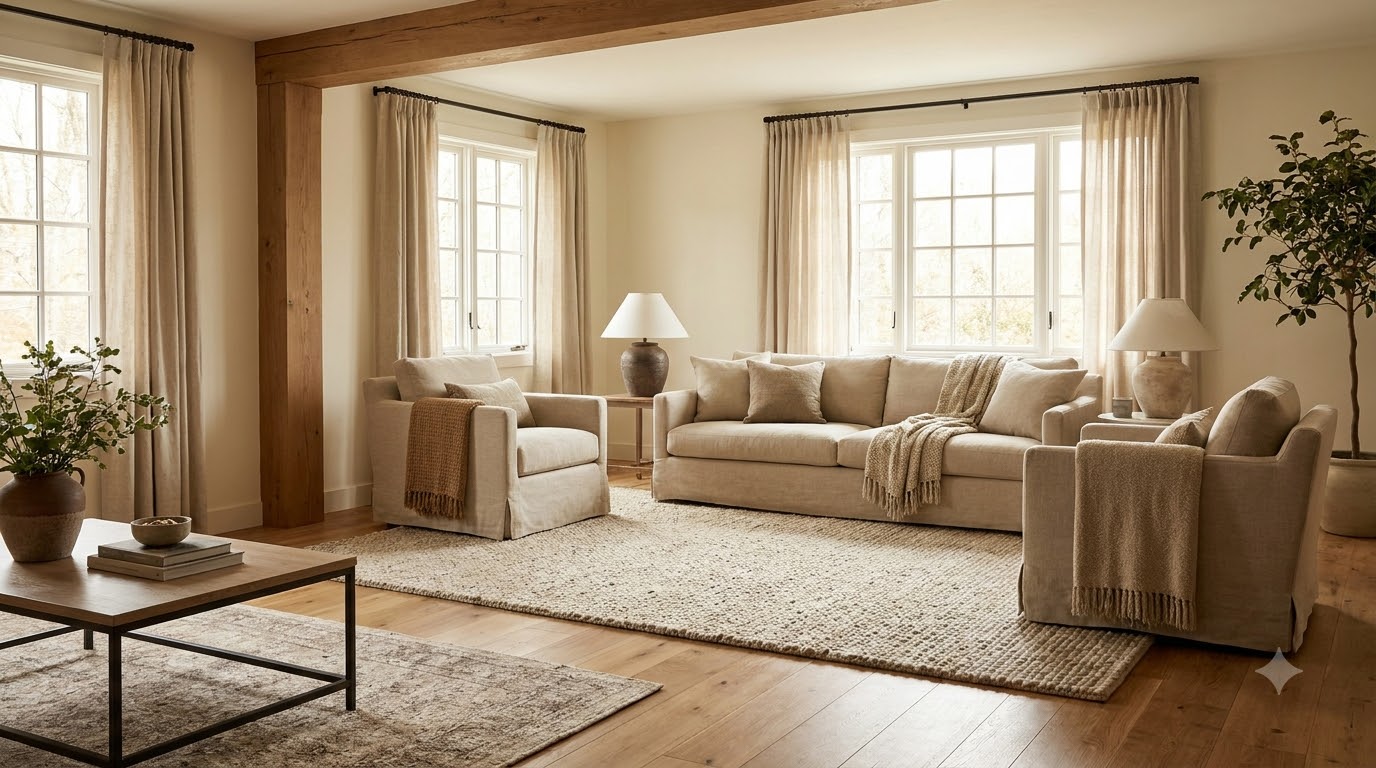
If your living room feels a little off and you cannot name why, the rug is usually the culprit. The single most common mistake we see is a rug that is too small. A too-small rug floats in the middle of the floor like a bath mat, shrinks the whole room, and disconnects your furniture instead of pulling it together. The fix is simple: buy bigger than you think, and make sure at least the front legs of your sofa and chairs sit on the rug. That one rule does more for a space than any throw pillow ever will.
For most living rooms, an 8×10 ft rug is the safe starting point, and a 9×12 ft is the upgrade that makes a room look designed rather than furnished. Below we walk through exact sizes, the front-legs-on versus all-legs-on rules, and the placement mistakes that quietly cost you comfort and square footage.
Key Takeaways
- Too small is the #1 mistake. When in doubt, size up one increment.
- Front legs on the rug at minimum; all four legs on looks most polished.
- 8×10 ft suits most living rooms; go 9×12 ft for larger, open layouts.
- Leave 8 to 18 inches of bare floor as a border between rug and wall.
- Renters: a 5×8 ft works only in tiny rooms or as a layered accent.
What size rug for a living room?
For a standard living room, choose an 8×10 ft rug. It is large enough to anchor a full-size sofa and coffee table while keeping a healthy floor border. If your seating area is generous or your room reads open-plan, step up to 9×12 ft. Very large or great-room spaces call for 10×14 ft, while 5×8 ft should be reserved for apartments, reading nooks, or layering over a larger natural-fiber base.
The size you need is driven less by the room’s total square footage and more by your seating footprint, the rectangle formed by your sofa and chairs. The rug should extend under the front edge of that footprint on every side. Here are the four sizes worth knowing and where each one belongs:
- 5×8 ft: Small apartments, condos, and studios. Best under a loveseat or as a layered accent.
- 8×10 ft: The everyday standard. Fits most three-seat sofas with a coffee table.
- 9×12 ft: Larger living rooms and open-concept layouts where all legs sit on the rug.
- 10×14 ft: Great rooms and expansive spaces with a sectional plus accent chairs.
When we furnished our own small rental living room, we started with a 5×8 because it was cheap and easy to carry up three flights of stairs. It looked like a postage stamp. Swapping to an 8×10 cost more but instantly made the room feel twice as large, because the eye read the whole floor as one connected zone. If you are weighing budget options, our roundup of the best living room rugs under $250 covers sizes that punch above their price.
Should all furniture sit on the rug?
Not necessarily. There are three accepted placements, and each works with a different rug size and budget. The mistake is not choosing one of them, it is landing halfway between and leaving furniture legs teetering half-on and half-off.
- All legs on: Every furniture leg sits fully on the rug. The most luxurious look, and it needs a 9×12 ft or larger.
- Front legs on: Only the front legs of the sofa and chairs rest on the rug. The most versatile, budget-friendly option and our default recommendation.
- All legs off: The rug floats in front of the seating with no legs touching. Reserve this for small accent rugs in tight nooks only.
The front-legs-on rule is the one to memorize. It ties the furniture to the rug visually, works with a more affordable 8×10, and forgives a room that is not perfectly square. Whenever a client or friend asks us to fix a room that feels “cheap,” the answer is almost always: pull the sofa forward so its front legs land on a bigger rug.
There is one more reason we lean on front-legs-on for renters and budget shoppers. It lets a single 8×10 do the work of a much larger rug, because your eye reads the rug as running under the entire seating group even though it technically stops a foot short of the back legs. You get the anchored, all-legs-on look for the price of a mid-size rug. If your chairs and sofa face each other across a coffee table, aim to catch the front legs of every piece so the rug pulls the whole conversation area into one zone.
Rug size chart by room and sofa size
Use this table to match your room dimensions and sofa length to a recommended rug size. Measure your room first, then find the closest row.
| Room size | Sofa length | Recommended rug | Leg placement |
|---|---|---|---|
| Up to 10×10 ft | Loveseat, up to 72″ | 5×8 ft | Front legs on |
| 11×13 ft | Standard, 78 to 84″ | 8×10 ft | Front legs on |
| 13×16 ft | Large, 84 to 96″ | 9×12 ft | All legs on |
| 15×18 ft | Sectional or 96″+ | 10×14 ft | All legs on |
| Open-plan / great room | Sectional + chairs | 10×14 ft or larger | All legs on |
One rule keeps this simple: leave 8 to 18 inches of bare floor between the edge of the rug and the walls. That border frames the rug like a mat frames art. Fill the floor wall-to-wall and it reads like carpet you forgot to fasten down; leave too little and the room feels crowded.
The most common living room rug mistakes
Beyond sizing, a handful of placement errors show up in nearly every room we are asked to rescue. Run through this checklist before you buy or before you rearrange:
- Going too small. The number one error. A rug that stops short of the sofa shrinks the room.
- All-legs-off by accident. Furniture that never touches the rug looks disconnected and unplanned.
- Skipping the coffee table math. The coffee table should sit fully on the rug with room to walk around it.
- Ignoring the border. A rug jammed against the baseboards on one side throws the whole room off balance.
- Forgetting the pad. A non-slip pad keeps the rug flat, protects renter-friendly floors, and adds cushioning underfoot.
If your space is tight and a bigger rug simply will not fit, layering is your friend. A small patterned rug on top of a larger jute base gives you scale without the price of one enormous piece. We break down the whole approach in our guide to the living room layering technique for rugs, pillows, and throws.
How to place a rug in a small living room
Small rooms and rentals have less margin for error, but the rules still hold, just scaled down. In a compact space, the goal is to make the floor feel continuous rather than chopped into pieces. A rug that is too small does the opposite and visually cuts the room into a patchwork.
- Choose the largest rug that still leaves an 8 to 12 inch border on the shortest wall.
- Use the front-legs-on placement to stretch an 8×10 across the seating without buying bigger.
- Run the rug’s long side parallel to the longest wall to lengthen the room.
- Pick a low pile and a light or tonal pattern so the floor recedes instead of shouting.
In our own 11-by-12-foot rental, an 8×10 turned lengthwise gave us a clean 10-inch border on each long wall and let the front legs of both the sofa and the accent chair sit on the rug. Nothing else about the room changed, but it finally looked deliberate. That is the quiet power of getting the size and orientation right before you spend a dollar on anything decorative.
For a full walkthrough of arranging seating, lighting, and textiles in a compact footprint, our cozy living room ideas and layout guide pairs perfectly with the rug rules above.
What about rugs in the bedroom?
The living room is not the only place a too-small rug ruins the effect. Bedrooms follow their own version of the same principle. The rug should extend 18 to 24 inches beyond each side of the bed so your feet land on softness when you get up, not cold floor. For a queen bed that usually means an 8×10; for a king, a 9×12.
- Queen bed: 8×10 ft, placed with the top third under the bed and nightstands.
- King bed: 9×12 ft, extending 18 to 24 inches on both sides and at the foot.
- Small bedroom or budget: Two runners flanking the bed instead of one large rug.
If you are shopping the bedroom next, we rounded up affordable picks in our best bedroom rugs under $150 guide, all sized to clear that 18 to 24 inch border.
Frequently asked questions
Is an 8×10 rug big enough for a living room?
Yes, an 8×10 ft rug is big enough for most standard living rooms with a three-seat sofa and coffee table. Use the front-legs-on placement so the sofa and chairs connect to the rug. If your room is open-plan or larger than about 13×16 feet, size up to a 9×12 instead.
Should a rug be wider than the sofa?
Ideally, yes. The rug should be at least as wide as your sofa, and a few inches wider on each side looks best. This keeps the front legs of the sofa comfortably on the rug and prevents the arrangement from feeling pinched. A rug narrower than the sofa is a classic too-small mistake.
How much floor should show around a rug?
Leave 8 to 18 inches of bare floor between the rug and the walls. This border acts like a frame and keeps the rug from looking like wall-to-wall carpet. In very small rooms you can tighten it to about 8 inches, but never run the rug all the way to the baseboards on every side.
Can I use a 5×8 rug in a living room?
A 5×8 ft rug works only in small apartments, condos, or under a loveseat where the seating footprint is compact. In a full-size living room it will look undersized and float. If a 5×8 is your budget, layer it over a larger jute base to gain visual scale without the extra cost.
Which direction should a living room rug face?
Run the long side of the rug parallel to your longest wall or to the sofa. This orientation stretches the room visually and lines the rug up with the main seating. In narrow rooms it is especially important, since a crosswise rug can make an already tight space feel choppy and shorter.
Get the size right first, follow the front-legs-on rule, and keep your 8 to 18 inch border, and your living room will feel intentional no matter your budget. A rug is one of the few upgrades that changes how an entire room reads, so it is worth measuring twice and sizing up once.