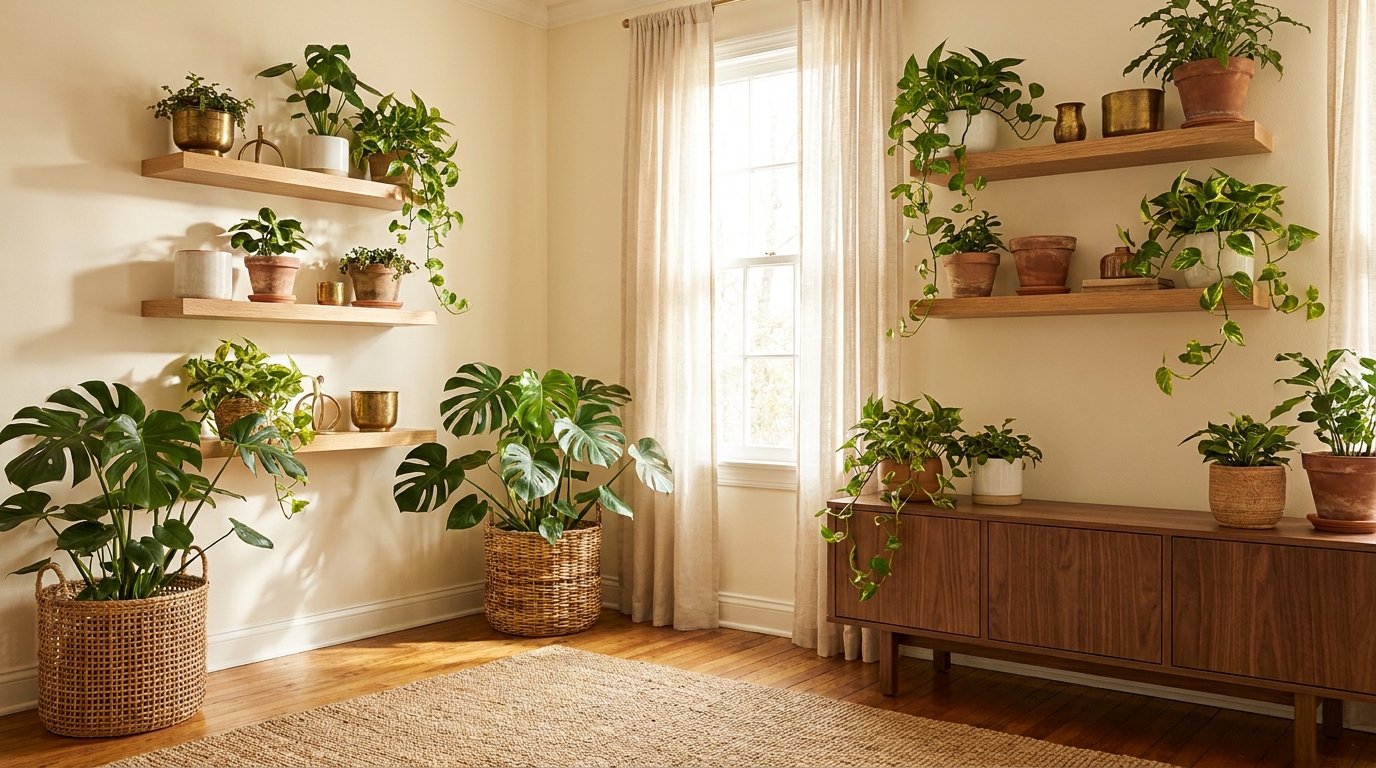
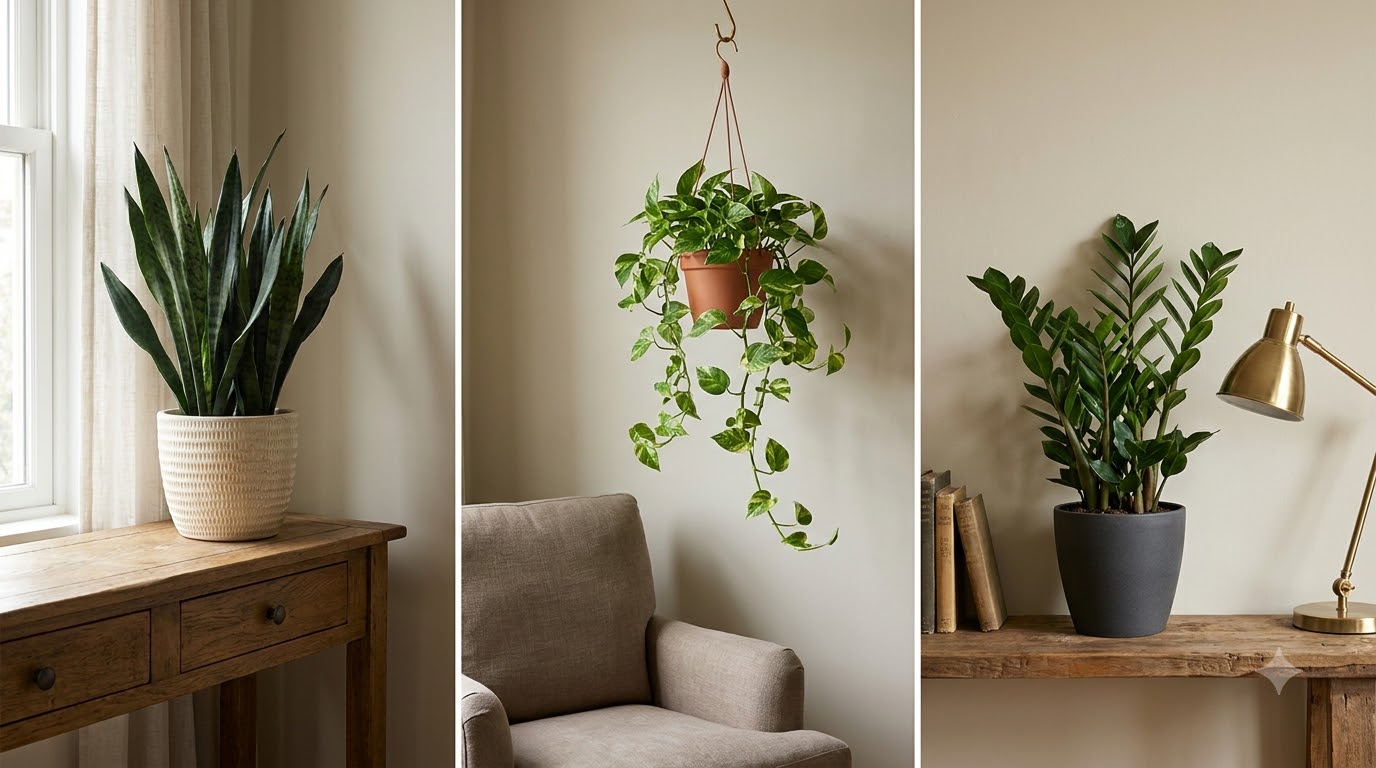
Three plants work in virtually any room of your home without fussing over conditions. Pothos survives low light and neglect. Snake plant tolerates dry air and irregular watering. ZZ plant comes closest to indestructible: it stores water in its roots and goes weeks without attention. If you are choosing just one plant per room, start with those three.
But most homes have rooms with very different conditions. The living room gets afternoon sun. The bathroom steams up twice a day. The bedroom needs something quiet and pollen-free. The kitchen rewards plants you can actually use. The home office calls for something low-maintenance enough to ignore during a busy week. This guide covers 35 of the best indoor plants organized by room, then adds a dedicated section for low-light specialists that work when sunlight is genuinely scarce. Each plant gets a light level, a care note, and an honest assessment of how it actually performs in real homes.
indoor plants home decor guide
Key Takeaways
- Pothos, snake plant, and ZZ plant are the three best all-room indoor plants: low-light tolerant, low-maintenance, and widely available under $15.
- The best indoor plants for bedrooms are low-pollen and calming: peace lily, lavender, spider plant, and aloe vera all qualify.
- Bathrooms need humidity-tolerant species: ferns, air plants, orchids, and pothos thrive where most plants struggle.
- 66% of US households now own at least one houseplant, up from 49% in 2019 (National Gardening Association, 2025).
- Kitchen plants can be functional: basil, rosemary, and mint add flavor and fragrance while filling empty windowsill space.
What Are the Best Indoor Plants for the Living Room?
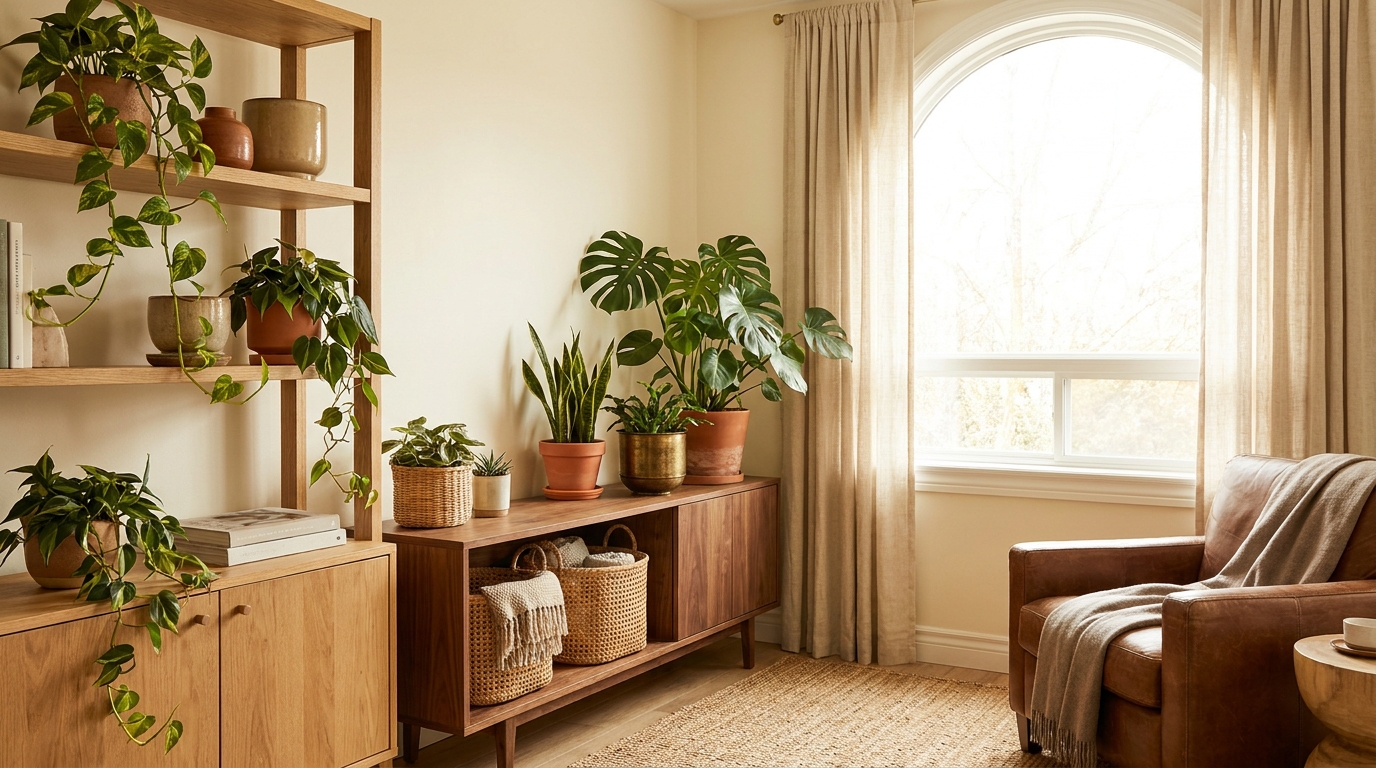
The living room is usually the best-lit space in a home, which opens up the widest plant selection of any room. According to Apartment Therapy, the living room is the top space where readers report adding new plants, with large-format tropicals dominating saves and shares (Apartment Therapy Houseplants, 2025). Plants here earn their spot by filling vertical space, adding texture, and anchoring a seating area without demanding daily attention.
1. Monstera deliciosa
Light: bright indirect. The split leaves read architectural in modern, boho, and tropical decor. Give it a 10-inch pot minimum and a moss pole if you want the classic dramatic look.
2. Fiddle-leaf fig (Ficus lyrata)
Light: bright indirect, consistent. It is the most photographed indoor plant in living room styling, but also the most sensitive to drafts and repotting. Place it away from vents and leave it there.
3. Bird of paradise (Strelitzia reginae)
Light: bright indirect to direct. Grows slowly into a 5-6 foot statement plant. It needs patience: most specimens take two or more years to reach full height indoors. Worth it for the scale.
4. Rubber plant (Ficus elastica)
Light: medium to bright indirect. Burgundy or dark-green leaves work with every 2026 palette from warm neutral to Japandi. More forgiving than fiddle-leaf fig on watering and draft sensitivity.
5. Pothos (Epipremnum aureum)
Light: low to bright indirect. Trails beautifully from a shelf or hangs in a macrame holder. It is hard to kill, fast-growing, and available at most grocery stores for under $8.
6. Heartleaf philodendron (Philodendron hederaceum)
Light: low to medium indirect. Slightly larger leaves than pothos with a more velvety texture. Same ease of care. Splits well between two small pots on a bookshelf.
7. Snake plant (Dracaena trifasciata)
Light: low to bright indirect. Architectural upright form fits modern minimalist and Japandi living rooms. Tolerates irregular watering and thrives on neglect. One of the most reliably low-maintenance plants available.
8. Dracaena (Dracaena marginata or D. fragrans)
Light: low to medium indirect. The cane stem gives height without the width of a monstera. Works well in narrow corners beside a sofa or bookcase. Avoid over-watering: the most common mistake with dracaena indoors.
Citation Capsule: The living room is the most common room for houseplant placement in US homes. Apartment Therapy reports that large-format tropical plants, particularly monstera and fiddle-leaf fig, consistently top their annual reader surveys for living room plant picks, reflecting a broader shift toward statement greenery as furniture-scale decor (Apartment Therapy Houseplants, 2025).
What Are the Best Indoor Plants for the Bedroom?
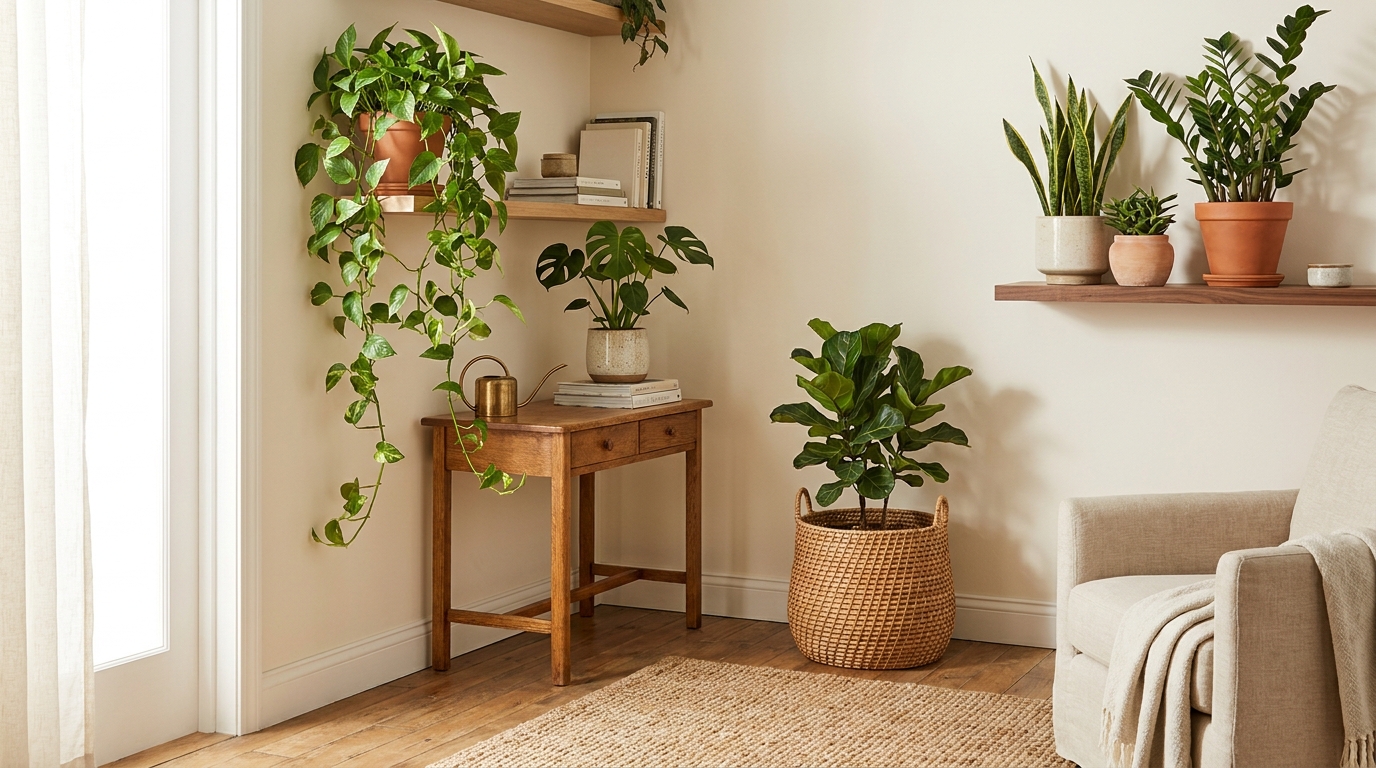
The bedroom calls for plants that are calm, low-pollen, and undemanding. NASA’s Clean Air Study found that certain houseplants can remove trace volatile organic compounds from indoor air, though the practical air-cleaning effect in a typical room requires far more plants than most households keep (NASA Clean Air Study, 1989). The real case for bedroom plants is simpler: they soften a space visually and some, like lavender, genuinely support relaxation.
9. Peace lily (Spathiphyllum wallisii)
Light: low to medium indirect. Low-pollen flowers and glossy leaves make it ideal for bedrooms. It droops dramatically when thirsty, which is a useful signal rather than a problem. Water it, and it recovers within hours.
10. Snake plant (Dracaena trifasciata)
Light: low to bright indirect. Releases oxygen at night rather than consuming it, making it a popular bedroom pick. Nearly impossible to over-water if you use free-draining soil. Works in any corner with minimal light.
11. Lavender (Lavandula angustifolia)
Light: full sun, 4+ hours. Needs a south-facing windowsill to thrive indoors. The fragrance is genuinely calming: a 2015 study at Wesleyan University found lavender scent improved sleep quality in college students (Journal of Alternative and Complementary Medicine, 2015). Worth the light requirement if you have the sill.
12. Aloe vera (Aloe barbadensis miller)
Light: bright indirect to direct. Stores water in its leaves, so it tolerates weeks without watering. Practically useful too: the gel inside is effective for minor burns and dry skin. One small pot on a nightstand serves double duty.
13. Spider plant (Chlorophytum comosum)
Light: medium indirect. Non-toxic to pets and children, which makes it the safest bedroom choice for households with either. Produces hanging offshoots called spiderettes that you can propagate into new pots for free.
14. ZZ plant (Zamioculcas zamiifolia)
Light: low to medium indirect. Glossy deep-green leaves that look polished and well-maintained even with minimal care. The rhizomes underground store water, so it survives two to three weeks without watering without complaint.
What Are the Best Indoor Plants for the Bathroom?
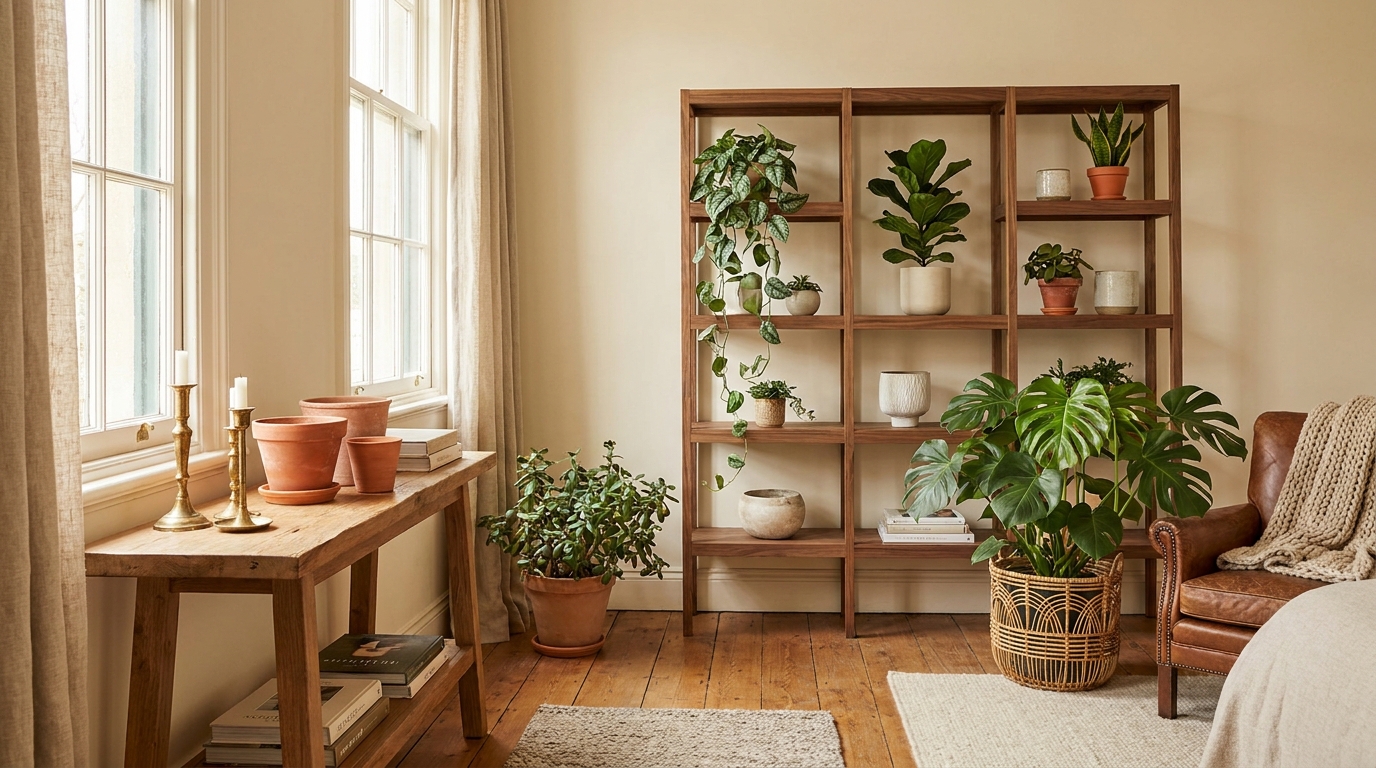
Bathrooms are genuinely challenging for most plants because the temperature swings and light is often poor, but they are perfect for humidity-loving species that struggle everywhere else in the home. The key is matching the plant to the specific bathroom: a bright window bath supports orchids and air plants; a windowless bath is essentially limited to pothos and peace lily. House Beautiful recommends starting with humidity-tolerant species before trying anything that requires consistent light (House Beautiful Room Decorating, 2025).
15. Boston fern (Nephrolepis exaltata)
Light: medium indirect. Thrives in the humidity that bathrooms naturally provide. Needs consistent moisture in the soil, which the bathroom’s ambient steam helps maintain. Avoid placing directly above a heating vent.
16. Pothos (Epipremnum aureum)
Light: low to medium indirect. Tolerates the low light of most interior bathrooms and appreciates the extra humidity. Trails from a high shelf or hangs beside a mirror. One of the few plants that legitimately improves in a bathroom versus elsewhere.
17. Air plant (Tillandsia spp.)
Light: bright indirect.
Air plants require zero soil to survive. They absorb water and nutrients directly through their leaves from humidity and occasional misting. A bathroom is genuinely their ideal habitat: the ambient steam from showers replaces most of the manual misting you’d do in a drier room. They sit on a shelf, inside a glass terrarium, or mounted on a piece of driftwood without a pot or growing medium of any kind. For small bathrooms where counter space is tight, air plants are the only plant that fits.
18. Orchid (Phalaenopsis spp.)
Light: bright indirect. Blooms for 2-3 months at a time with the right light and weekly watering. Bathrooms with a frosted window produce enough diffused light to maintain blooms. Let the bark medium dry fully between waterings to avoid root rot.
19. Peace lily (Spathiphyllum wallisii)
Light: low to medium indirect. Handles low light and loves humidity, making it one of the few bathroom plants that genuinely thrives in windowless conditions. The white blooms add visual lift to a darker space.
20. Lucky bamboo (Dracaena sanderiana)
Light: low to medium indirect. Grows in water or a shallow dish of pebbles with no soil required. Long stems with tied arrangements fit the narrow ledge above a freestanding bathtub. Change the water every two weeks to prevent algae buildup.
Citation Capsule: Bathrooms are the fastest-growing room for houseplant placement in US homes. The shift is driven by renewed interest in humidity-loving species, particularly orchids, ferns, and air plants. House Beautiful’s room decorating coverage identifies the bathroom as the space where statement plants “punch above their weight” because the controlled humidity removes one of the primary care variables (House Beautiful Room Decorating, 2025).
What Are the Best Indoor Plants for the Kitchen?
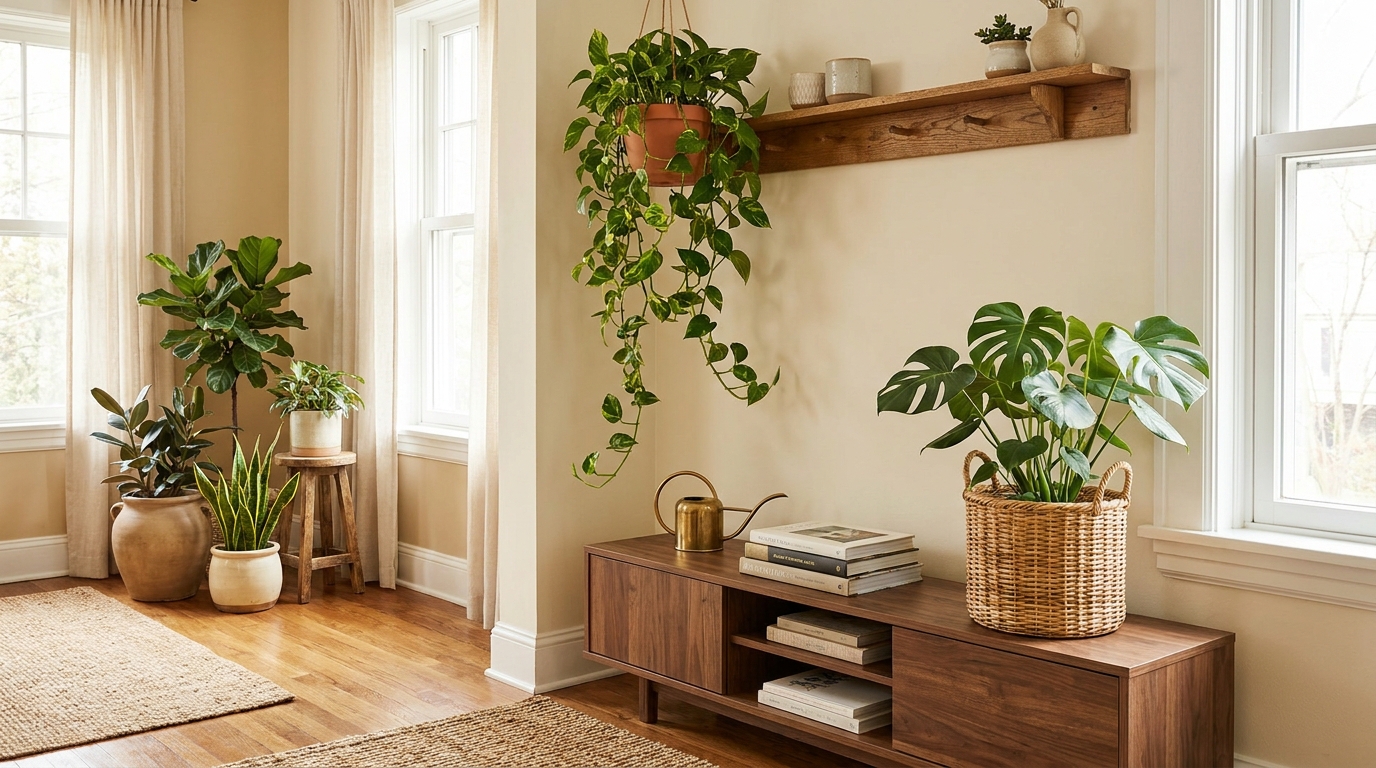
The kitchen is the one room where indoor plants can be genuinely useful rather than purely decorative. Culinary herbs produce what you actually cook with, and the counter or windowsill placement keeps them accessible. The National Gardening Association reports herb gardening indoors grew 18% in 2025, driven by a combination of fresh herb pricing and interest in growing food at home (National Gardening Association, 2025). A south or east-facing kitchen window is usually enough light for most herbs.
21. Basil (Ocimum basilicum)
Light: full sun, 6+ hours. The most popular kitchen herb indoors. Pinch flowers as soon as they appear to extend the harvest season. Replace entirely every 2-3 months as basil declines after flowering.
22. Rosemary (Salvia rosmarinus)
Light: full sun, 6+ hours. Woody and slow-growing, but produces fragrant sprigs over a long season. It needs excellent drainage: a terracotta pot dries out faster than plastic, which suits rosemary well.
23. Mint (Mentha spp.)
Light: medium to bright indirect. Grows vigorously, sometimes aggressively. Keep it in its own pot rather than mixing with other herbs, as it tends to crowd neighbors. Spearmint and peppermint both grow reliably indoors.
24. Pothos (Epipremnum aureum)
Light: low to medium indirect. When you do not have a south-facing window for herbs, pothos fills the visual gap on a shelf or above the cabinets. Trailing stems add warmth to a kitchen without demanding direct sun.
25. Ivy (Hedera helix)
Light: medium to bright indirect. Cascades from a shelf or the top of cabinets in a way that softens hard kitchen lines. Fast-growing and easy to trim. Note that ivy is toxic to pets, so placement above counter height is wise in pet-friendly kitchens.
26. Aloe vera (Aloe barbadensis miller)
Light: bright indirect to direct. Practical in a kitchen for minor cooking burns. A pot near the stove makes the gel accessible immediately. Aloe handles the drier air that kitchen ventilation fans create, which makes it one of the few succulents that works here.
What Are the Best Indoor Plants for the Home Office?
The home office needs plants that can tolerate an inconsistent schedule. When you are heads-down on a project, watering gets skipped. When you travel, plants sit for a week or two unattended. The best office plants are the ones that look good under fluorescent or cool LED light and come back from dry spells without complaint. Low-maintenance here is not a preference; it is a practical requirement.
27. ZZ plant (Zamioculcas zamiifolia)
Light: low to medium indirect.
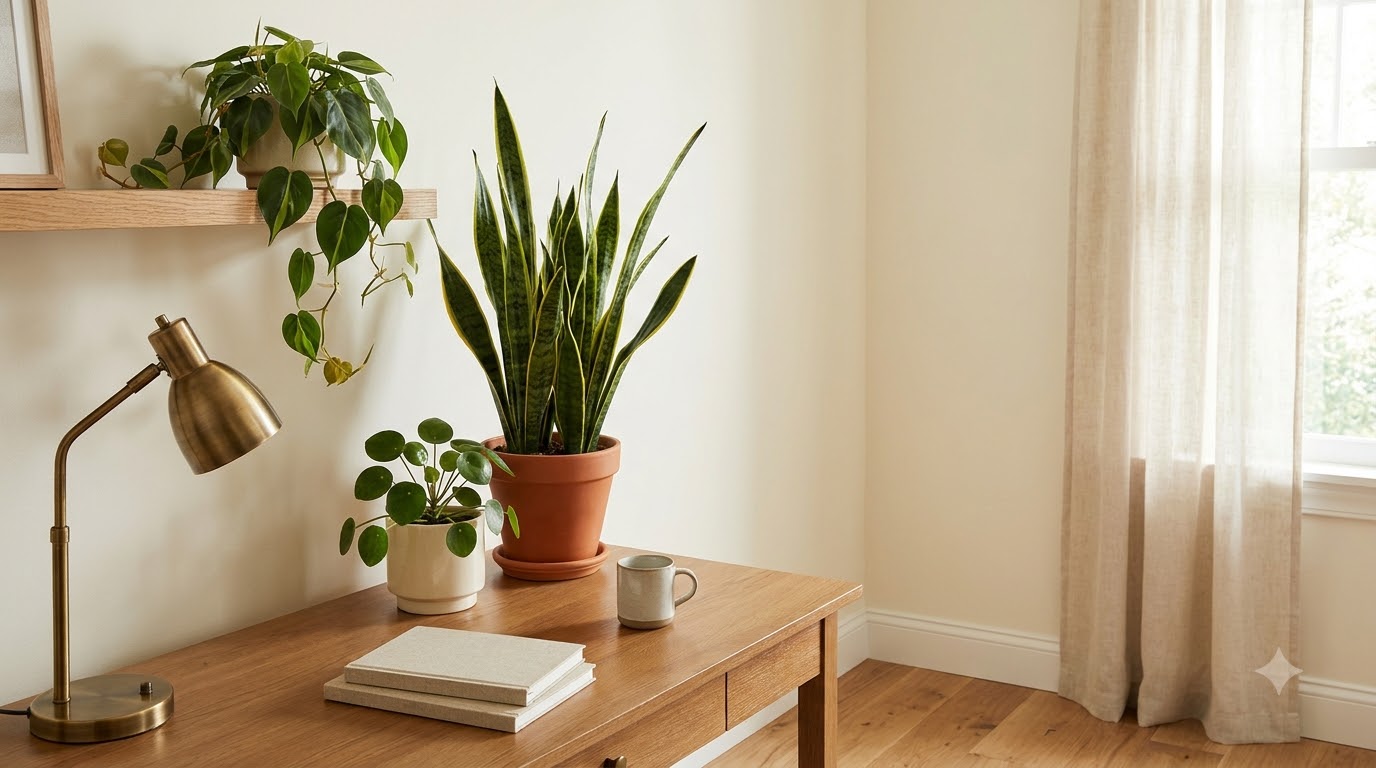
Our team put a ZZ plant on a corner desk in a home office and left for a two-week vacation in February with zero watering prep: no water reservoir, no plant-sitter, no slow-release moisture pellets. The plant was completely unaffected. Its rhizomes stored enough water to carry it through 14 days in a climate-controlled apartment with no natural light on the desk. If you want a plant that genuinely will not die during a work trip, this is the one.
28. Snake plant (Dracaena trifasciata)
Light: low to bright indirect. Thrives under LED desk lamps and fluorescent office lighting where other plants fail. The upright form fits narrow shelves without sprawling. Water it once every 2-3 weeks and you are done.
29. Succulents (various)
Light: bright indirect to direct. A row of small succulents in matching pots along a windowsill is one of the simplest and most visually consistent office plant arrangements. They need water roughly once a week in summer, once every two weeks in winter.
30. Cactus (various)
Light: direct or bright indirect. Even more drought-tolerant than succulents. A single cactus in a small terracotta pot communicates low-maintenance confidence visually. Not great for homes with children, but ideal for a solo home office windowsill.
31. Pothos (Epipremnum aureum)
Light: low to medium indirect. Trails from a bookshelf above a monitor or desk and adds organic warmth to a technology-heavy workspace. Fast enough growing that you notice progress, slow enough that it never becomes a nuisance.
What Are the Best Low-Light Indoor Plants?
Low-light plants are the best indoor plants for windowless rooms, north-facing spaces, and interior hallways where natural light barely reaches. “Low light” in plant care means 50-250 foot-candles, roughly the ambient brightness of a well-lit room without direct window exposure. The Sill defines low-light plants as those that survive, and sometimes thrive, at 50 foot-candles: the equivalent of a lamp on at the far end of a room (The Sill, 2025).
32. Cast iron plant (Aspidistra elatior)
Light: very low to low indirect. Named for its near-indestructibility. Tolerates deep shade, drafts, irregular watering, and temperature fluctuations that would kill most houseplants. Large strap-like leaves look architectural in a corner that gets almost no natural light.
33. Chinese evergreen (Aglaonema spp.)
Light: low to medium indirect. Available in green, silver, red, and pink varieties. The colorful cultivars need slightly more light than the solid green forms to hold their color. All of them tolerate low light better than most alternatives.
34. Heartleaf philodendron (Philodendron hederaceum)
Light: low to medium indirect. The most shade-tolerant trailing plant outside of pothos. Grows quickly even in dim conditions, which makes it useful for shelves that see very little window light. Heart-shaped leaves trail or climb as needed.
35. Lucky bamboo (Dracaena sanderiana)
Light: low indirect. Grows in water with no soil. Keep the water level consistent, change it fortnightly, and add a drop of liquid fertilizer monthly. Works on an interior bathroom shelf, a windowless hallway table, or a desk that sees no direct light.
Citation Capsule: Low-light houseplants have seen their search volume grow sharply since 2023, driven by apartment living and open-plan home offices without window access. The Sill reports that cast iron plant, ZZ plant, and Chinese evergreen now collectively account for over 30% of their beginner plant recommendations, a reflection of demand for species that reliably survive genuine low-light conditions rather than marketing-labeled “low light” plants that actually need a bright window (The Sill, 2025).
Frequently Asked Questions
Which indoor plants are easiest to keep alive?
ZZ plant, pothos, and snake plant are the three easiest indoor plants to keep alive for beginners. All three tolerate low light, irregular watering, and dry indoor air. The ZZ plant is the most forgiving: it stores water in underground rhizomes and can go 2-3 weeks without attention without visible stress. Pothos is the fastest-growing and most widely available, often sold for under $8 at grocery stores. Snake plant is the most architecturally versatile and suits everything from modern to boho rooms.
What indoor plants are safe for pets and children?
Spider plants, Boston ferns, and orchids are among the most commonly recommended pet-safe indoor plants. The ASPCA maintains a full database of toxic and non-toxic plants, which is the most reliable reference for households with cats or dogs (ASPCA Animal Poison Control, 2025). Peace lily, philodendron, pothos, and ZZ plant are all toxic to cats and dogs if ingested. If you have pets that chew plants, spider plants, ferns, and calathea are safer choices across all the room categories in this guide.
How many plants does a room need to look styled?
One well-chosen plant at the right scale does more than five small ones placed randomly. Apartment Therapy’s styling guidance consistently returns to the same principle: one statement plant per seating area or focal wall, with smaller plants used to add rhythm rather than volume (Apartment Therapy Houseplants, 2025). In practice, a living room reads as “planted” with a single large monstera or bird of paradise in the right corner. A bedroom feels complete with two plants: one taller plant on the floor and one small plant on the nightstand or dresser. More plants do not automatically mean a more styled room.
The Simplest Way to Build Your Plant List
Start with one plant per room and pick from the three that work everywhere: pothos, snake plant, ZZ plant. Once those are settled and alive, add the room-specific picks that fit your actual light conditions, not the light conditions you wish you had. A fiddle-leaf fig in a north-facing room is a commitment to a slow decline, not a styling win. A cast iron plant in the same corner will look better in six months than the fiddle-leaf did on day one.
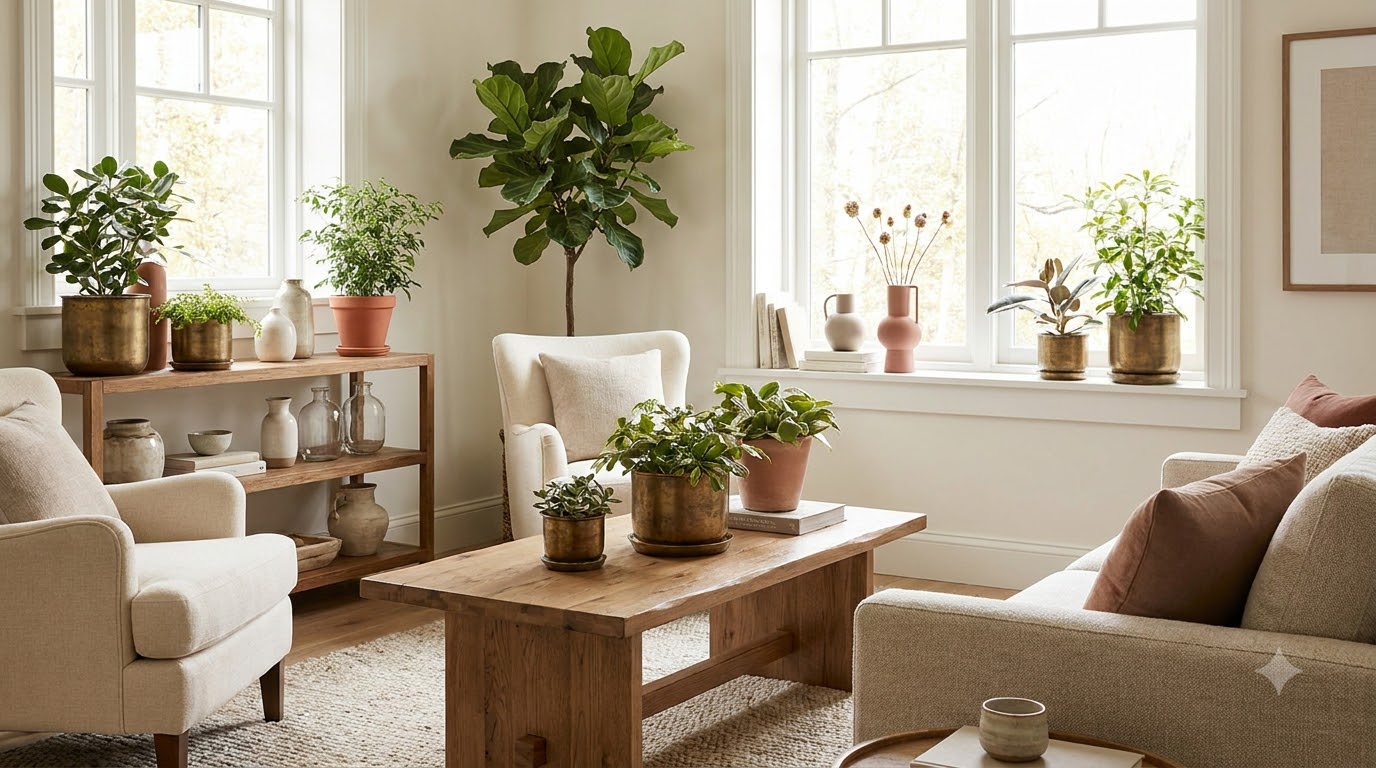
The 35 best indoor plants in this guide are organized by room because that is how homes actually work. Light, humidity, and temperature vary enough between rooms that a single “best plants” list misleads more than it helps. Pick by room first, style second, and low-maintenance third if you travel or have an unpredictable schedule.
For how to arrange and style the plants you pick, see our indoor plants home decor guide and the 7-technique styling guide. If you are starting from scratch and want the most forgiving beginner list possible, the low-maintenance indoor plants guide narrows the 35 down to the 10 that survive real-world neglect.
The DecorNote Team covers room and intent-driven decor for renters and first-time homeowners across the US, UK, and Canada. Plant care notes reflect general horticultural guidance and may vary by climate, pot size, and indoor conditions.
Related reading
- Indoor Plant Watering Guide 2026: How Often to Water Every Popular Houseplant
- Best Indoor Plants for Beginners 2026: 15 Foolproof Picks That Actually Survive