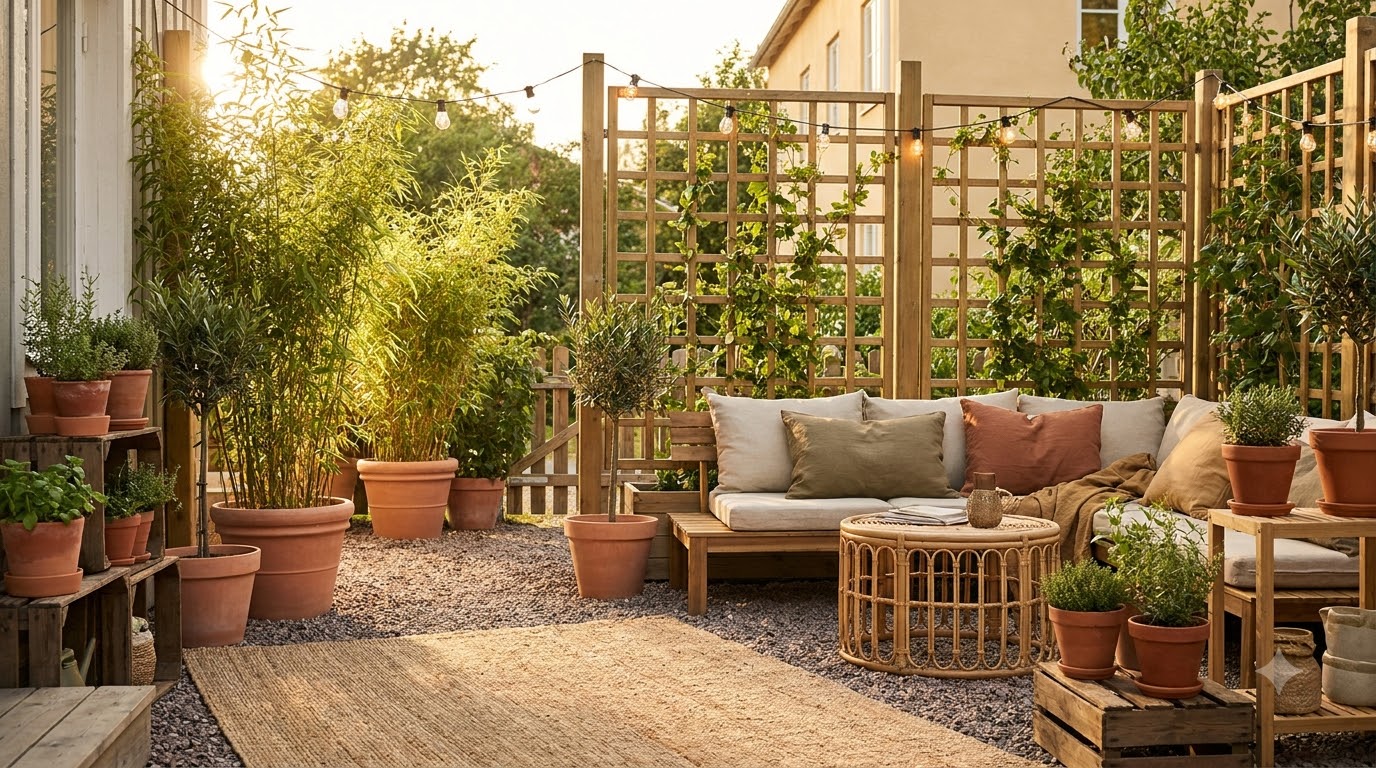
You can add real backyard privacy without building anything permanent. The renter-friendly playbook is simple: block sightlines with tall planters, lean or freestanding trellis screens, hang outdoor curtains from freestanding rods, set up folding privacy panels, and layer in fast-growing plants in pots. Every one of these methods is reversible, needs no post holes or landlord approval, and can go up in an afternoon. In our own rented yards we have used a mix of 6-foot trellis panels, a pair of tall planters flanking a lounge chair, and a run of weatherproof curtains to turn an exposed patio into a screened-off corner nobody can see into. No drilling into the fence, no concrete, nothing we could not pack up on moving day.
Key Takeaways
- Go freestanding, not fixed. Trellis screens, folding panels, and tall planters deliver privacy with zero permanent changes.
- 6 feet is the sweet spot. A 6-foot screen blocks standing sightlines from neighbors and passersby for most yards.
- Fastest fix: an outdoor curtain rod. Freestanding curtain setups screen a patio in under an hour, no tools required.
- Plants buy privacy over time. Bamboo, clumping grasses, and climbers in pots fill in a screen within one to two seasons.
- Budget range is wide. Expect roughly $30 for a single trellis panel up to $300+ for a full curtained enclosure.
- Weight down everything. Renters trade permanence for stability, so heavy bases and pots matter more than posts.
How do renters add backyard privacy?
Renters add backyard privacy by choosing screens that stand on their own weight instead of being anchored into the ground. The whole strategy hinges on one rule we live by: nothing that leaves a hole. That single constraint rules out fence extensions bolted to a neighbor’s structure and permanent lattice, but it still leaves a surprising number of options that look intentional and hold up in wind.
When we scan a rented yard, we look at three sightlines: the neighbor at ground level, the neighbor on a second-floor deck, and the gap where a gate or low fence lets the whole street peek in. Different problems need different heights, which is why we almost always combine two or three methods rather than relying on one wall of anything.
- Freestanding trellis screens — flat panels on feet or in weighted bases, usually 5 to 6 feet tall, that lean against a wall or stand alone.
- Tall planters with built-in trellis — a container plus a vertical lattice back, giving you a green screen you can slide anywhere.
- Outdoor curtains on freestanding rods — fabric panels that soften a corner and pull closed when you want cover.
- Folding privacy panels — hinged room-divider-style screens (wood, resin, or metal) you unfold and reposition at will.
- Potted plants and climbers — bamboo, arborvitae, tall grasses, or a climber trained up a moveable trellis.
What is the fastest privacy screen?
The fastest privacy screen is an outdoor curtain hung on a freestanding rod, which you can assemble and hang in under an hour with no tools beyond what comes in the box. Freestanding curtain rods clamp to a railing, slot into a weighted base, or extend as a tension pole between two posts you already have. Thread on a pair of weatherproof panels and you have an instant wall of fabric you can open and close.
On our last balcony we clamped a rod between the existing railing uprights, hung two grommet-top outdoor panels rated for sun exposure, and had the whole thing screening us from the walkway before our coffee went cold. If curtains are not your look, a single 6-foot folding panel is the runner-up for speed: unfold it, set it where you need cover, done. For a more finished corner, pair the panels with the layered layout ideas in our guide to patio decor ideas for small spaces.
- Under 1 hour: outdoor curtains on a clamp or tension rod.
- Under 30 minutes: a pre-assembled folding privacy panel, unfolded in place.
- An afternoon: a pair of tall planters plus a leaning trellis, arranged and weighted.
- One to two seasons: a living screen of potted bamboo or climbers filling in for full coverage.
Privacy methods compared: height, cost, and renter-friendliness
Here is how the main options stack up so you can match a method to your budget and your yard’s weak spots. Costs reflect typical US retail for a single unit or panel; a full enclosure usually means buying two to four.
| Privacy method | Typical height | Cost range (per unit) | Renter-friendly? |
|---|---|---|---|
| Outdoor curtains + freestanding rod | 6–7 ft | $40–$120 | Yes — clamps on, no drilling |
| Freestanding trellis screen | 5–6 ft | $30–$90 | Yes — leans or sits in a base |
| Tall planter with trellis back | 5–6 ft | $60–$150 | Yes — fully moveable |
| Folding privacy panel (3-panel) | 5–6 ft | $70–$200 | Yes — unfolds, no install |
| Potted bamboo / clumping grass | 6–10 ft | $40–$120 per pot | Yes — grows in containers |
| Climbing vine on moveable trellis | 6 ft + | $25–$80 (plant + trellis) | Yes — no ground planting |
The best no-dig privacy screens for renters
No-dig is the whole game for renters, and the good news is that the sturdiest options never touch the soil. A no-dig screen gets its stability from a heavy base rather than a buried post. That means concrete-filled umbrella stands, weighted planter feet, sandbags tucked behind a panel, or the sheer mass of a large container.
- Trellis in a planter box: a 6-foot lattice mounted to the back of a filled container is heavy enough to stand alone; grow a climber up it for a green wall.
- Panels in umbrella bases: slot a flat screen’s legs into two 30 to 50 lb umbrella stands for a wall that shrugs off a breeze.
- Weighted folding screens: set a folding panel in a zig-zag so it braces itself, then anchor the end feet with pavers.
- Sandbag-backed lattice: lean a lightweight lattice against a wall and hide two sandbags behind the base.
- Grouped tall pots: cluster three or more oversized planters to build a staggered, dig-free hedge line.
We learned the weighting lesson the hard way when a lightweight trellis blew flat in the first real gust of spring. Now our rule is simple: if a child could tip it, it needs more weight at the bottom. Filling planters with a base layer of gravel before potting mix adds ballast exactly where you want it. If you are also trying to make a compact yard feel bigger while you screen it, the layout tricks in our roundup of small backyard ideas on a budget pair nicely with these screens.
Fast-growing plants for a living privacy screen in pots
Plants are the most forgiving privacy tool a renter has, because they travel. Everything here grows happily in a container, so it moves with you and never puts a root in your landlord’s lawn. For living screens you want two things: height in a hurry and a growth habit that behaves in a pot.
- Clumping bamboo (Fargesia): reaches 6 to 10 ft, stays put in a large pot, and does not run and invade like the notorious running types.
- Arborvitae ‘Emerald Green’: a slim evergreen that holds a 6-foot screen year-round in a deep 20-inch-plus container.
- Ornamental grasses (Miscanthus, feather reed grass): hit 5 to 6 ft in a single season and sway for a soft, moving screen.
- Climbing vines (clematis, star jasmine, black-eyed Susan vine): race up a trellis, covering 6 ft of lattice in one to two seasons.
- Mandevilla or morning glory: fast annual climbers for renters who want quick coverage and do not mind replanting.
Our favorite renter combo is a pair of tall planters holding clumping bamboo flanking the seating area, with a jasmine-covered trellis filling the gap between them. The bamboo gives instant vertical mass while the vine knits everything together by mid-summer. If you are new to container growing, start with the fundamentals in our container garden ideas for beginners before you invest in a full row of pots.
Styling privacy screens so they look intentional
A privacy screen should read as decor, not as a barricade you threw up in a panic. The difference is almost always in the layering. A single bare panel looks temporary; the same panel with a planter at its foot, a string light along its top, and a curtain beside it looks like a designed outdoor room.
- Layer heights: pair a 6-foot screen with mid-height planters and a low bench so the eye steps down naturally.
- Repeat a material: match wood trellis to a wood bench, or resin panels to resin pots, for a pulled-together look.
- Add soft light: run warm string lights along the top edge of a screen to define the space after dark.
- Mix in fabric: hang one curtain panel beside a solid screen to break up the wall and add movement.
- Anchor a purpose: place the screen behind a focal point, like a lounge chair or a small dining set, so it frames something.
Privacy also pairs naturally with a gathering spot. Screening one side of a seating zone makes it feel like a cocoon, which is exactly the effect we chase when we set up a lounge corner. If a cozy focal point is your goal, the seating layouts in our backyard fire pit ideas and seating guide show how a screen and a circle of chairs work together.
Frequently asked questions
How tall should a backyard privacy screen be?
For most yards, aim for 6 feet, which blocks the sightline of a standing adult next door. If your neighbor overlooks you from a raised deck or second floor, go taller with potted bamboo or arborvitae that reaches 8 to 10 feet. For seated-only privacy on a patio, a 5-foot screen is usually plenty.
Can I put up a privacy screen without asking my landlord?
Freestanding screens, curtains on clamp rods, folding panels, and potted plants make no permanent change, so they typically fall outside anything your lease restricts. Trouble only starts when you drill, bolt into a fence, or pour concrete footings. When in doubt, a quick message to your landlord confirming “nothing permanent” keeps everyone comfortable.
What is the cheapest way to get backyard privacy?
The cheapest route is a single freestanding trellis panel, often around $30, leaned against a wall and softened with a fast annual climber like morning glory for a few dollars in seed. Reed or bamboo fencing rolls zip-tied to an existing railing are another low-cost option, usually under $40 for a long roll.
Will a privacy screen survive wind if it is not anchored?
Yes, as long as you weight the base properly. Slot panels into heavy umbrella stands of 30 pounds or more, fill planters with a gravel layer for ballast, or brace folding screens in a zig-zag so they support themselves. We learned to over-weight everything after a light trellis toppled in one spring gust.
How fast do potted privacy plants fill in?
Ornamental grasses and annual climbers can reach 5 to 6 feet in a single growing season, giving you real coverage the first summer. Clumping bamboo and evergreens like arborvitae take one to two seasons to fully knit together but then hold their screen year-round with minimal fuss in a large container.