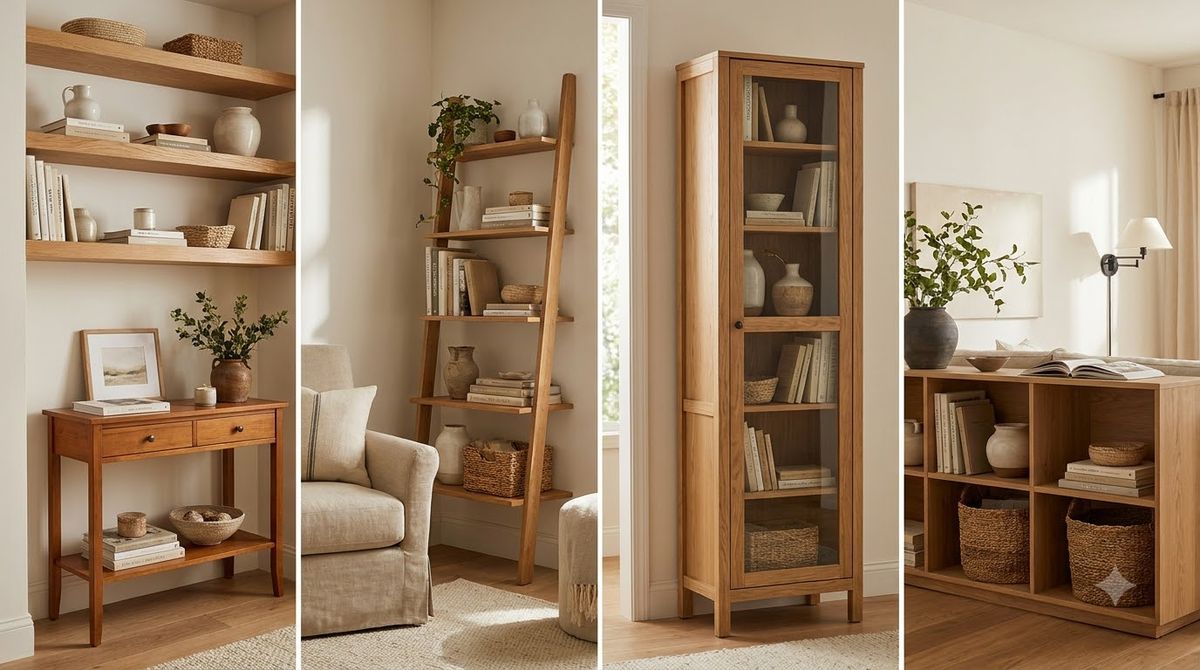
The best bookshelf ideas under $150 come down to matching the type of shelf to your space: choose a ladder shelf ($60–$130) for airy corners, a cube/cubby unit ($50–$140) for renters who move often, a tall narrow bookcase ($70–$150) to steal vertical inches in small rooms, a low horizontal shelf ($60–$140) to double as a media console, floating shelves ($20–$90 per set) for zero-footprint storage, or an etagere ($90–$150) when you want an open, decorative statement. In this guide we walk through each type by size, material, and weight capacity so you can buy once and buy right.
The Short Answer: Best Bookshelf by Type
If you only remember one thing, remember this: the “best” bookshelf is the one sized for your wall and honest about what it can hold. Each type below earns its place for a different reason. Here’s the fast version before we get into the details.
Key Takeaways
- Most versatile: the cube/cubby shelf — reconfigures, adds bins, and works in any room for $50–$140.
- Best for tiny rooms: a tall narrow bookcase (10–13 in. deep) that grows up, not out.
- Best for renters: freestanding cube units and leaning ladder shelves — no wall anchors needed to stand, though anchoring is still safest.
- Weight matters: laminate particleboard holds roughly 10–25 lb per shelf; solid wood and metal-framed units handle 40 lb or more.
- Budget range: every type on this list lands under $150, with floating shelves the cheapest entry point.
Bookshelf Types Compared (At a Glance)
| Type | Best For | Typical Price Range |
|---|---|---|
| Ladder shelf | Corners, decor-forward display, small entryways | $60–$130 |
| Cube / cubby | Renters, kids’ rooms, flexible storage with bins | $50–$140 |
| Tall narrow bookcase | Small rooms, hallways, maximizing vertical space | $70–$150 |
| Low horizontal shelf | Under windows, media consoles, room dividers | $60–$140 |
| Floating shelves | Zero-footprint storage, above desks and sofas | $20–$90 / set |
| Etagere | Open, airy statement pieces; layered styling | $90–$150 |
1. Ladder Shelves: Airy and Corner-Friendly
Ladder (or leaning) shelves tilt against the wall with shelves that step wider toward the bottom. They feel light because the open back lets the wall color show through. Expect widths of 20–24 inches, heights around 60–70 inches, and four to five tiers. Materials range from engineered wood with a woodgrain laminate to powder-coated metal frames with wood shelves.
- Price range: $60–$130
- Footprint: shallow at the base, roughly 14–18 in. deep
- Weight capacity: about 10–20 lb per shelf; keep heavy hardcovers on the bottom two tiers
- Best for: plants, framed art, a few books, and objects rather than a full library
- Watch out: it must lean, so always anchor the top rail to a stud or drywall anchor
2. Cube & Cubby Shelves: The Renter’s Workhorse
The cube shelf is a go-to piece for a first apartment. A standard 2×2 unit is about 30 x 30 inches; a 2×4 stretches to roughly 30 x 58 inches. Each cube is usually 13 inches square, which happens to be the sweet spot for fabric bins, vinyl records, and paperbacks. You can stand it vertically or lay it horizontally under a window as a bench-height display, which is exactly why it’s so forgiving when you move.
- Price range: $50–$140 depending on cube count
- Material: laminate-wrapped particleboard or MDF; some come in faux-woodgrain or matte white
- Weight capacity: roughly 15–25 lb per cube
- Flexibility: add fabric drawers, wire baskets, or cube inserts to hide clutter
- Orientation: works vertical, horizontal, or as a low room divider
Because cubes hide as much as they show, they pair beautifully with a styled reading nook. If you’re building one, our guide to aesthetic living room coffee table and bookshelf setups shows how to balance closed bins with open display.
3. Tall Narrow Bookcases: Vertical Wins in Small Rooms
When floor space is precious, height is free real estate. A tall narrow bookcase typically measures 24–31 inches wide, 70–72 inches tall, and only 10–13 inches deep, so it hugs the wall while holding five to six shelves of books.
- Price range: $70–$150
- Shelves: 5–6 tiers, many with one or two adjustable shelves
- Weight capacity: 20–40 lb per shelf for units with a solid back panel
- Material: engineered wood is common; open metal-and-wood versions feel lighter visually
- Safety: tall + narrow = tip risk, so anti-tip straps are non-negotiable
4. Low Horizontal Shelves: Double-Duty Surfaces
Low, wide bookcases sit around 28–36 inches tall and 30–48 inches wide, giving you a flat top that works as a TV stand, an entryway drop zone, or a plant ledge. They keep sightlines open, which makes a small living room feel larger. It is a strong pick for studios because one piece quietly does three jobs.
- Price range: $60–$140
- Top surface: flat and sturdy enough for a 32–43 in. TV or styling vignette
- Weight capacity: 20–30 lb per shelf; check the top rating separately if placing a TV
- Placement: under windows, behind a sofa, or as a partial room divider
- Style tip: leave one shelf half-empty so it reads as design, not storage
A low shelf under a window is the perfect anchor for a cozy layout. We break down the full arrangement in our cozy living room ideas and decor layout guide if you want the whole room to come together.
5. Floating Shelves: Zero-Footprint Storage
Floating shelves mount directly to the wall with a hidden bracket, so they take up no floor space at all — ideal above a desk, sofa, or bed. Individual shelves run 16–36 inches wide and 6–10 inches deep, usually sold in sets of two or three. They’re the cheapest way to add book storage, but they demand the most attention to how you mount them.
- Price range: $20–$90 per set
- Material: solid pine or oak, MDF with veneer, or metal-and-wood pipe styles
- Weight capacity: 15–40 lb per shelf only when anchored into a stud; far less in drywall alone
- Renter note: patching a few screw holes is usually cheaper than a full bookcase
- Best use: lightweight books, framed prints, and small plants above furniture
Floating shelves and framed art are natural partners on a blank wall. Pair them with pieces from our roundup of the best large wall art prints under $80, or fold both into a full gallery wall for a display that mixes books and art.
6. Etageres: The Open, Decorative Statement
An etagere is an open shelving unit — typically a metal frame with wood or glass shelves and no solid back or sides. It’s the most decorative type here, meant to be styled rather than packed. Standard sizes run 28–36 inches wide and 60–72 inches tall, with the see-through frame keeping a room feeling breezy.
- Price range: $90–$150
- Frame: powder-coated steel in black, gold, or bronze finishes
- Weight capacity: 20–35 lb per shelf, though the look favors lighter styling
- Best for: curated books, ceramics, and greenery rather than dense storage
- Style rule: leave part of each shelf empty so the open frame stays airy
What Size Bookshelf for a Small Room?
For a small room, prioritize depth and width over height caps. A shelf that’s 10–13 inches deep barely intrudes into a walkway, and keeping the width to 24–31 inches leaves room for other furniture. Going tall (70–72 inches) draws the eye upward and adds capacity without eating floor space. As a rule of thumb, leave at least 30 inches of clear walking path in front of any bookcase, and never block a window’s lower third if you can help it.
- Studios & hallways: tall narrow bookcase, 10–13 in. deep
- Under windows: low horizontal shelf, 28–36 in. tall
- Blank walls with no floor to spare: floating shelves, 6–10 in. deep
- Awkward corners: ladder shelf, which tapers as it rises
For more ways to squeeze storage from a tight layout, our small apartment storage ideas cover the tricks that help when square footage is the enemy.
Which Bookshelf Type Is Most Versatile?
The cube/cubby shelf is the most versatile type, and it isn’t especially close. You can stand it up as a tall bookcase, lay it flat as a media console or bench, add fabric bins to hide clutter, or split a 2×4 into two 2×2 units when you move. It ranges $50–$140, holds roughly 15–25 lb per cube, and adapts to a bedroom, entryway, home office, or kids’ room without looking out of place. If you want one shelf that follows you through several apartments, buy the cube.
That said, “versatile” depends on your constraint. If your limit is floor space, floating shelves win; if it’s budget, floating shelves win again; if it’s style, the etagere and ladder shelf pull ahead. Match the type to the constraint you actually have, not the one a catalog photo suggests.
How to Judge Quality Under $150
At this price you’re mostly choosing between engineered wood (particleboard or MDF with laminate) and open metal-and-wood construction. Neither is “bad” — they just fail differently. Here’s what to check before buying.
- Shelf thickness: look for at least 5/8 in.; thinner laminate shelves bow under books over time
- Back panel: a full back panel adds rigidity and raises real-world weight capacity
- Stated capacity: trust the per-shelf lb rating, and load heavy items low
- Anti-tip hardware: included straps signal the maker expects you to anchor it — do it
- Adjustable shelves: more reconfiguration options extend the life of the piece
Frequently Asked Questions
Can I get a good bookshelf for under $150?
Yes. Under $150 you can buy a solid tall narrow bookcase, a flexible cube unit, or a leaning ladder shelf. The trade-off is usually material: expect laminate-wrapped engineered wood rather than solid hardwood. Choose a full back panel and a 5/8-inch shelf thickness, and the piece will hold books reliably for years.
How much weight can a budget bookshelf hold?
Most budget bookshelves hold roughly 10–25 lb per shelf, while sturdier solid-wood or metal-framed units reach 40 lb or more. Weight ratings assume the shelf is properly assembled and, for wall-mounted styles, anchored into a stud. Keep your heaviest hardcovers on the lower shelves to reduce sag and lower the center of gravity.
Are floating shelves strong enough for books?
They can be, but only when mounted into wall studs. Anchored properly, a quality floating shelf holds 15–40 lb; in drywall alone it holds far less and may pull loose. Space brackets to hit studs, use the largest anchors that fit, and stick to lighter paperbacks and decor if you can’t reach solid framing.
Do I need to anchor a bookshelf as a renter?
Yes, especially for tall or leaning units. Anti-tip straps use one small screw and a wall anchor, and the patch when you leave is minor. Freestanding cube shelves are the most forgiving, but any bookcase over about 48 inches tall should be strapped, particularly in homes with kids or pets.
What’s the best bookshelf type for a first apartment?
Start with a cube shelf. It costs $50–$140, needs no wall to stand, and reconfigures from tall bookcase to low console when your layout changes. Add fabric bins for anything you’d rather hide. When you move, a 2×4 cube can even split into two smaller units, so it adapts to whatever space comes next.
Our Bottom Line
Every type here fits under $150, so the decision is really about your room’s biggest constraint. Tight on floor space? Go tall and narrow, or mount floating shelves. Moving soon or unsure of your layout? The cube shelf adapts endlessly. Want the piece to look as good empty as full? Reach for a ladder shelf or etagere. Buy for the constraint you actually have, anchor it properly, and a budget bookshelf will earn its keep for years.