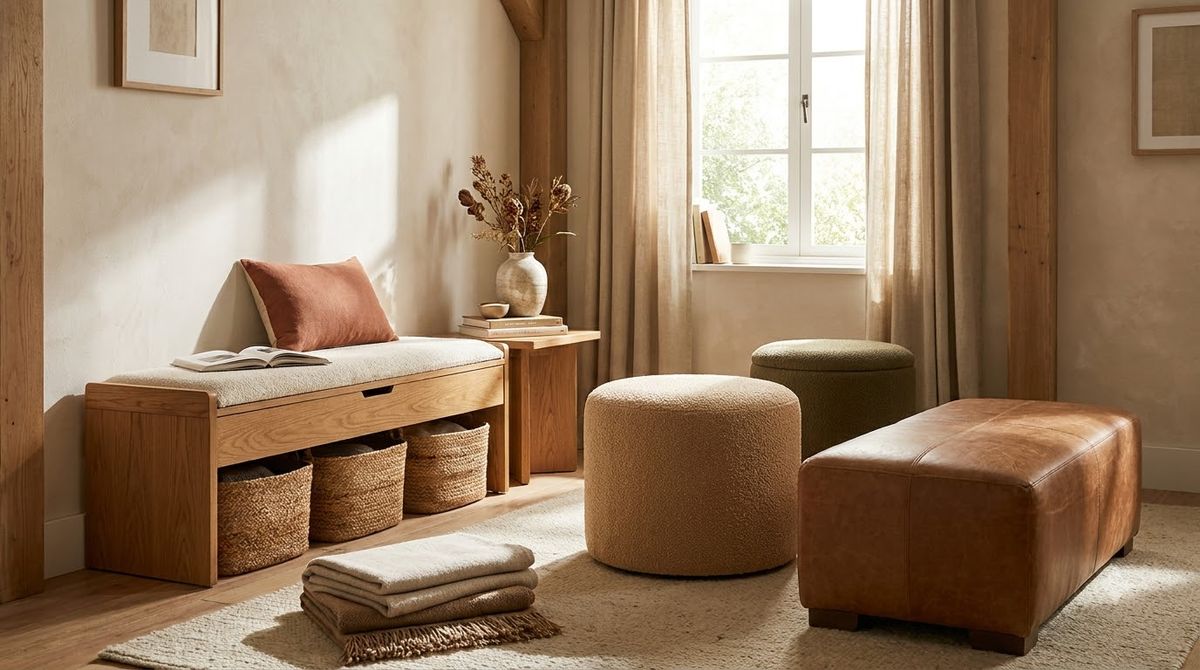
The best storage ottoman for a renter on a budget is one that pulls double duty: a padded seat you actually want to sit on, plus a hollow interior deep enough to swallow the clutter you’d rather not see. In the $40 to $120 range, you can find genuinely useful pieces in nearly every category, from soft fabric cubes to sturdy entryway benches. The trick is matching the type to your room and your storage problem, and that’s exactly what we’ll walk you through below.
This guide is organized by type rather than by brand. That way you can shop confidently at any store and know what a fair price, size, and weight capacity looks like before you hand over your card.
Key Takeaways
- Best all-rounder: A standard storage ottoman (16-18″ tall, ~$50-$90) works as a footrest, extra seat, and a bin for blankets or toys.
- Best for narrow rooms: A storage bench slides against a wall or under a window and seats two, usually $70-$120.
- Best for tight budgets: Folding fabric cube ottomans start around $40 and collapse flat when not in use.
- Best for hosting: A tray-top coffee ottoman replaces a coffee table and hides remotes and cords inside, $80-$120.
- Best for entryways: A shoe-storage entryway bench keeps the doorway tidy for $60-$110.
- Size rule of thumb: Match ottoman height to your sofa seat (16-18″), and leave 14-18″ of walking clearance around it.
The five types of storage ottomans and benches
Almost everything under $120 falls into one of five categories. Each solves a slightly different problem, so start with the room you’re furnishing and let that guide you rather than falling for the first cute cube you see online.
1. The standard storage ottoman
This is the classic: a cushioned box, usually square or rectangular, with a hinged or fully removable lid. It’s the most flexible piece in the category because it can float anywhere. Kept at the end of the sofa, it doubles as a footrest most nights and a spare seat when friends come over.
- Typical size: 15-30″ wide, 15-18″ tall
- Price range: $50-$90
- Weight capacity: 220-330 lb as a seat
- Storage volume: roughly 2-4 cubic feet, enough for two throw blankets and a few pillows
- Best materials: linen-blend or polyester fabric for living rooms; faux leather or velvet if you want it to feel a step up
2. The storage bench
Longer and lower than an ottoman, a storage bench is built to sit against something: the foot of a bed, a hallway wall, or under a window. Because the footprint is linear, it eats up very little floor and still seats two adults comfortably.
- Typical size: 30-48″ long, 15-16″ deep, 17-19″ tall
- Price range: $70-$120
- Weight capacity: 250-440 lb
- Storage volume: 3-6 cubic feet, good for spare bedding, seasonal clothes, or kids’ gear
- Watch for: a lid that lifts on a safety hinge so it won’t slam on little fingers
3. The cube ottoman
The cube is the budget hero. Many are collapsible fabric boxes with a padded lid that doubles as a small tray, and they fold flat in seconds when you need the space back. They’re light enough to move with one hand, which makes them perfect for renters who rearrange often.
- Typical size: 15″ cube is the standard; 13″ and 18″ versions exist
- Price range: $40-$65
- Weight capacity: 150-250 lb (folding models sit at the lower end)
- Storage volume: about 1.5-2 cubic feet per cube
- Bonus: buy two matching cubes and line them up as a bench, or tuck one under a console
4. The tray-top coffee ottoman
This is an ottoman sized and shaped to replace a coffee table. A flat, firm removable tray-top lets you set down drinks and a laptop, then flip it over to reveal a soft surface and a deep storage well underneath. In a small living room it saves you from owning both a coffee table and a footrest.
- Typical size: 30-40″ wide, 16-18″ tall
- Price range: $80-$120
- Weight capacity: 300-400 lb
- Storage volume: 4-6 cubic feet, the roomiest option on this list
- Look for: a reversible or serving-tray lid so you get both a hard and a cushioned top
5. The entryway bench
Purpose-built for doorways, these benches pair a seat (handy for pulling on boots) with open cubbies, a lift-up lid, or slide-out bins for shoes. The best ones keep the entry from becoming a pile of sneakers without demanding a full mudroom’s worth of space.
- Typical size: 24-40″ long, 12-15″ deep, 18-20″ tall
- Price range: $60-$110
- Weight capacity: 220-350 lb
- Storage type: open shelf for 3-6 pairs of shoes, or a hidden compartment for gloves, leashes, and umbrellas
- Material tip: wood or MDF frames hold up to wet shoes better than all-fabric builds
Quick comparison: which type fits your room?
| Type | Best use | Typical price |
|---|---|---|
| Standard storage ottoman | Footrest + spare seat + blanket storage in a living room | $50-$90 |
| Storage bench | Foot of the bed or under a window; seats two | $70-$120 |
| Cube ottoman | Smallest budgets, movable extra seat, kids’ toys | $40-$65 |
| Tray-top coffee ottoman | Coffee-table replacement in a small living room | $80-$120 |
| Entryway bench | Shoe storage and a seat by the front door | $60-$110 |
What size storage ottoman do I need?
Height is the number most people get wrong. If you plan to use it as a footrest, aim for an ottoman the same height as your sofa’s seat cushion, which is almost always 16 to 18 inches. Too tall and your legs angle awkwardly; too short and your feet dangle. For a coffee-table stand-in, stay within a couple of inches of your sofa seat so reaching a drink feels natural.
Footprint matters just as much in a rental. Before you buy, tape out the ottoman’s dimensions on the floor and make sure you still have 14 to 18 inches of walking clearance on the sides people pass. Use this quick checklist:
- Footrest use: 16-18″ tall, placed 12-16″ from the sofa edge
- Extra seating: at least 15″ wide per person and a 250 lb+ capacity
- Coffee-table use: length roughly two-thirds of your sofa’s width
- Bedroom bench: a few inches narrower than your mattress width
- Storage-first: prioritize interior depth (10″+) over exterior good looks
If you’re squeezing furniture into a studio, our guide to small apartment layout ideas pairs nicely with this one; getting the layout right first tells you exactly how big a piece your floor can spare.
Ottoman vs bench: which is better for small spaces?
For most small spaces, a bench wins on square footage and an ottoman wins on flexibility. A bench has a narrow depth (usually 15-16″) and lives flat against a wall, so it never interrupts a walking path. An ottoman floats in the middle of a room and can be nudged wherever you need it, but that also means it takes up open floor.
Here’s the short version:
- Choose a bench if you have wall space, a bed foot, or a window to fill, and you want the piece out of the traffic flow.
- Choose an ottoman if you need a movable footrest, occasional extra seat, or a soft coffee-table alternative.
- Choose a cube if your needs change week to week and you want to fold it away.
- Choose a tray-top if you’re trying to delete a separate coffee table entirely.
Swapping a bulky coffee table for a tray-top ottoman can give you a clear walking lane plus a home for every stray remote and charger. For more of those dual-duty swaps, see our living room storage hacks for renters and broader small apartment storage ideas.
What to check before you buy
Under $120, build quality varies a lot, so a two-minute inspection saves you from a wobbly regret. Whether you’re shopping in a store or reading a product listing, run through these points:
- Weight capacity: look for a stated 250 lb or more if anyone will sit on it.
- Lid style: a fully removable lid is easiest for deep storage; a hinged lid is safer around kids.
- Legs: screw-in wooden or metal legs feel sturdier and lift the piece off the floor for cleaning.
- Interior finish: a lined or non-woven interior keeps blankets from snagging on staples.
- Assembly: most fabric models need only leg attachment; benches with cubbies take 20-40 minutes.
- Fabric: tighter weaves and faux leather wipe clean; loose linen looks great but shows spills.
Check whether the lid sits inside the frame or rests on top. A lid that drops inside can shift when you sit, while one that overlaps the rim stays put. It’s a small detail that separates a $45 cube that lasts from one that feels flimsy by month three.
Styling your storage piece so it doesn’t shout “storage”
The whole point of hidden storage is that it disappears into the room. A few easy moves keep your ottoman or bench looking intentional rather than utilitarian:
- Match the fabric tone to your sofa or curtains so the piece reads as part of a set.
- Top a coffee ottoman with a stack of books and a small tray to anchor it visually.
- Drape a folded throw over one corner of a bench to soften a hard edge.
- Keep an entryway bench styled with just a plant or a basket so the cubbies stay the focus.
For a full walk-through of pulling a comfortable room together around pieces like these, our cozy living room ideas and layout guide is a natural next read, and renters furnishing a whole place will get a lot from our small apartment decor ideas.
Frequently asked questions
How much weight can a storage ottoman hold?
Most storage ottomans under $120 are rated for 220 to 330 pounds as a seat, and sturdier benches climb to about 440 pounds. Folding fabric cubes sit lower, often 150 to 250 pounds. Always check the stated capacity before letting an adult sit, and treat a soft, unframed lid as a footrest rather than a chair.
Are storage ottomans worth it for small apartments?
Yes, because they do at least two jobs in one footprint. A single ottoman can be a footrest, a spare seat, and a bin for blankets or toys, which means one purchase replaces two or three. In a rental where every square foot counts, that dual-purpose math is exactly what makes them worth the $40 to $120 spend.
What can I store inside a storage ottoman?
Anything you want out of sight but within reach: throw blankets, extra pillows, board games, kids’ toys, remote controls, chargers, or off-season clothing. With 2 to 6 cubic feet of interior space depending on type, a coffee ottoman easily holds a couple of folded quilts, while a cube is better suited to smaller everyday clutter.
How do I keep a fabric ottoman clean?
Vacuum the surface weekly with an upholstery attachment to stop dust from setting into the weave. Blot spills right away instead of rubbing, and spot-clean with a mild soap-and-water solution on a damp cloth. Faux-leather and tight-weave polyester wipe clean fastest, so lean toward those materials in high-traffic or kid-heavy rooms.
Can two matching cube ottomans replace a bench?
They can, and it’s a good budget trick. Line up two 15-inch cubes and you get roughly a 30-inch bench for around $80 to $130 total, with the flexibility to split them apart for extra seats when guests arrive. Just confirm both have firm, framed lids so they feel like one solid surface.
The bottom line
The best storage ottoman or bench for you comes down to the shape of your space and the clutter you’re hiding. Reach for a standard ottoman when you want a flexible do-everything piece, a bench when you have a wall to fill, a cube when the budget is tight, a tray-top when you want to lose the coffee table, and an entryway bench when the front door needs taming. Stay in the $40 to $120 window, check the weight capacity and lid style, and you’ll land something that earns its footprint for years.