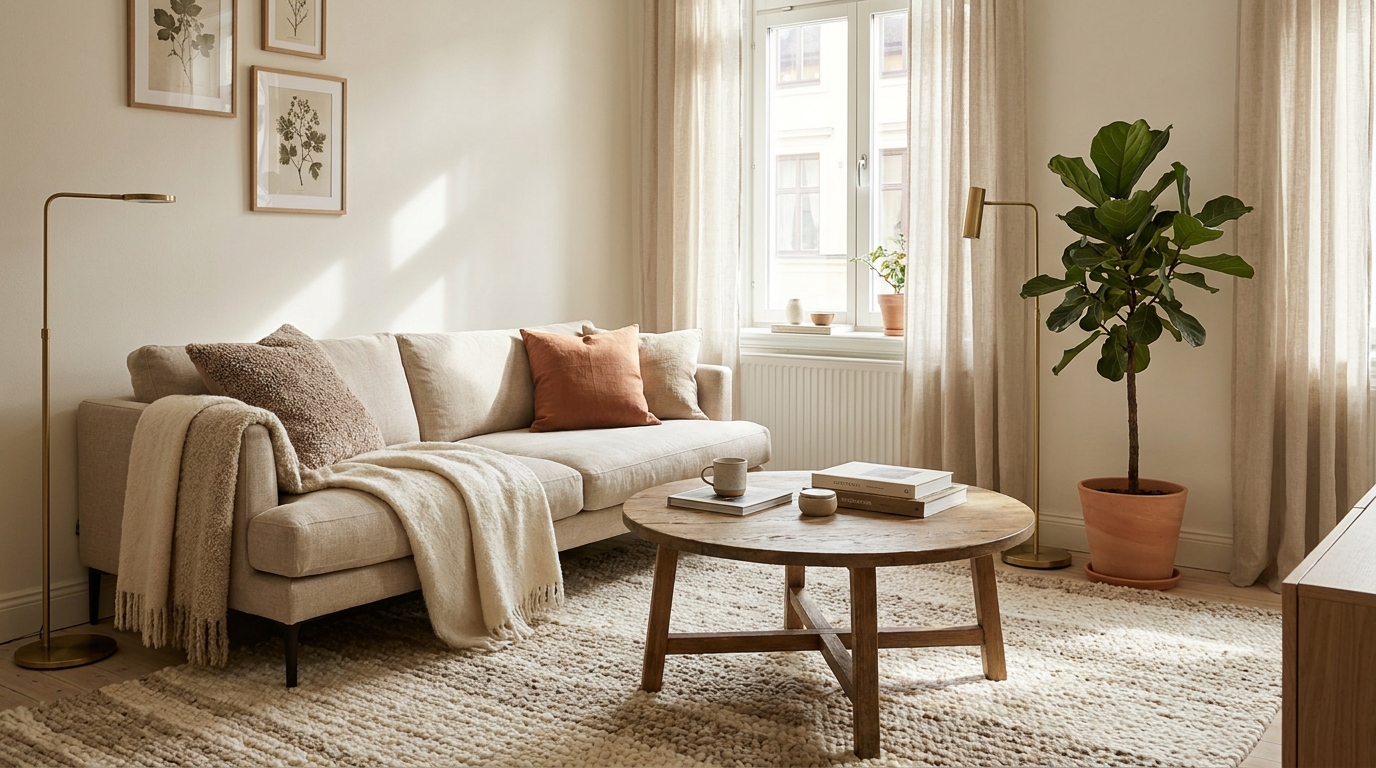
The best small apartment layout ideas zone a single room into “sleep, work, eat, lounge” using furniture as walls, leave a 30–36 inch walkway between zones, and float the largest piece (sofa or bed) away from the longest wall to double perceived square footage. Every plan below assumes a rental — no drilling, no built-ins, no landlord calls.
If you live in a 300–700 sq ft studio, an L-shaped one-bedroom, or a railroad apartment, the layout matters more than the décor. A $200 rug placed correctly will outperform a $2,000 sofa shoved against the wrong wall. This guide walks through 15 tested floor plans, the math behind each one, and the exact mistakes that make small spaces feel even smaller.
Key Takeaways
- Float, don’t shove. Pulling a sofa or bed 6–12 inches off the wall creates a “breathing zone” that tricks the eye into reading more space.
- The 30-inch rule. Every walkway in a small apartment should be 30–36 inches wide. Tighter than 24 inches feels like a hallway in your own home.
- Zones beat walls. Use rugs, bookshelves, and lighting to separate sleep from work — open-plan studios feel larger when the zones are visually distinct but physically connected.
- One tall piece per zone. A single vertical element (tall lamp, plant, bookshelf) per zone anchors the eye upward and stops the room from feeling squat.
- The 60/30/10 furniture rule. 60% of your furniture should be low-profile, 30% medium-height, 10% tall — this layering creates depth in tight rooms.
How to choose a small apartment layout (the 4-step method)
Before you scroll the 15 plans, run your floor through this checklist. The plans below assume you’ve done this work.
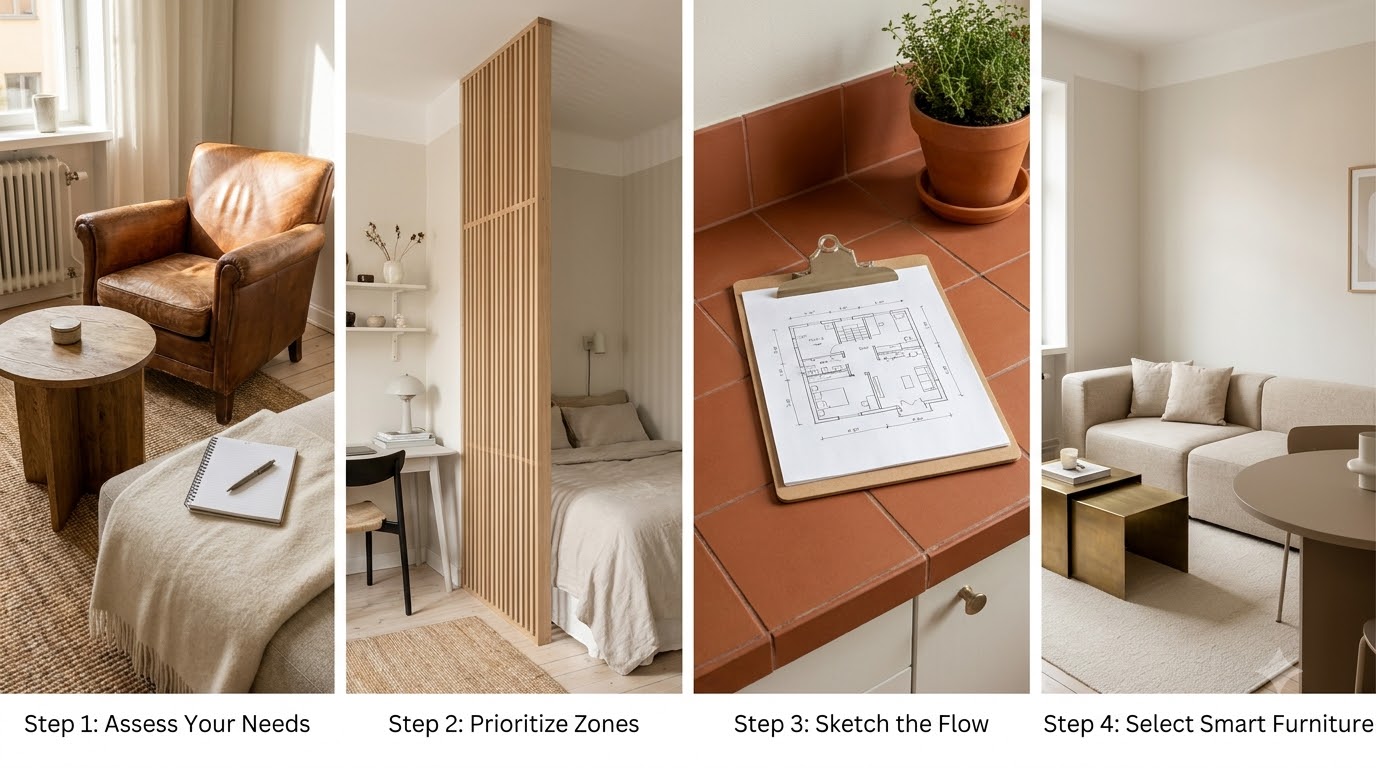
Step 1: Map the fixed points. Mark windows, radiators, outlets, the front door swing, and any closet doors. These never move and they dictate everything.
Step 2: Identify your traffic spine. The “spine” is the straight line from your front door to your most-used spot (usually the kitchen or sofa). Keep it clear. A 2024 IKEA Life at Home report found that 64% of small-space dwellers cite “feeling cramped while walking through their home” as their top frustration — and it’s almost always a blocked spine.
Step 3: Define 3–4 zones. Even a 350 sq ft studio needs at least four: sleep, lounge, work, and a transition zone near the door. Anything fewer and the apartment feels like a dorm room.
Step 4: Pick your anchor piece. This is the biggest item — usually the bed in a studio or the sofa in a one-bedroom. Every other piece arranges around it.
The 15 small apartment layout ideas
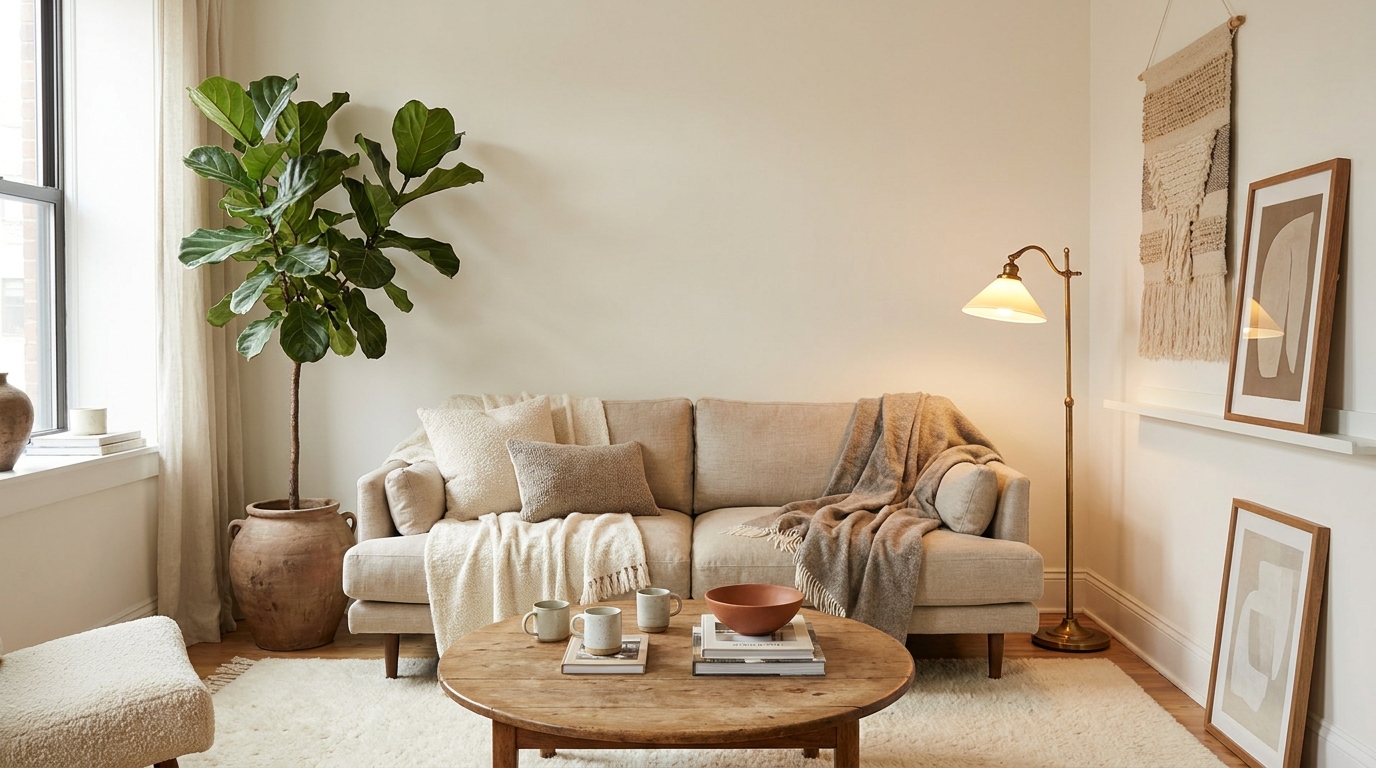
1. The “Floating Bed Studio” (best for 350–500 sq ft studios)
Push the bed perpendicular to the longest wall, with the headboard floating two feet into the room. Behind the headboard, place a low console or bookcase (max 42 inches tall) that doubles as a room divider. In front, you get the “living room” half — a small sofa, a media console, and a 5×7 rug.
Why it works: The console acts as a partial wall without blocking light. The bed is hidden from the front door, so guests don’t walk into your bedroom.
Walkway check: Leave 32 inches between the foot of the bed and the wall, and 30 inches on the “getting in/out” side.
2. The L-Sofa Lounge Anchor (best for 1-bed apartments under 600 sq ft)
In a one-bedroom where the living room is the smallest room, an L-shaped sectional placed in the corner opposite the window does more than a 3-seat sofa ever could. It seats four, holds a throw blanket cache, and creates a visual “wall” along two sides without taking up two walls of floor space.
Place a 4×6 rug under the front legs only, and a slim console table behind the long side for a lamp and a tray. Avoid sofas deeper than 36 inches in rooms under 11 feet wide.
3. The Galley Studio Layout (best for long, narrow studios)
Railroad and shotgun apartments need a single-line layout. Run everything down one long wall in this order: bed, nightstand, dresser, desk, lounge chair, console. The opposite wall stays mostly empty except for one piece of art or a tall mirror.
The mirror trick: A leaning floor mirror (60+ inches tall) placed on the empty wall reflects the window and visually widens the room by 30–40%, according to lighting designers at the IES (Illuminating Engineering Society).
4. The Murphy Bed Zone (best for studios under 400 sq ft)
A wall-mounted Murphy bed is the single highest-ROI piece of furniture for a true micro-studio. When the bed folds up, you reclaim 35 sq ft of floor — enough for a real lounge area with a 72-inch sofa and a coffee table.
Renter-safe version: freestanding Murphy beds now exist (no wall mounting). Resource Furniture and Expand Furniture make versions that ship in a box and assemble in under 3 hours.
5. The Studio “Quad Zone” Layout
Divide the studio into four corner zones:
- Top-left: Bed
- Top-right: Closet/wardrobe + dressing area
- Bottom-left: Kitchen (usually fixed)
- Bottom-right: Sofa + TV
Place a 6×9 rug in the dead center of the room — this becomes the “lobby” that connects all four zones. The empty center reads as luxury in a studio.
6. The Bed-Behind-Sofa Split
The sofa floats in the middle of the room with its back facing the bed. The sofa back becomes the bedroom “wall.” Behind the sofa, leave 18–24 inches for a console table that serves both zones (charging station for the bed, lamp for the sofa).
This layout is the most-pinned small apartment configuration on Pinterest in 2025 and 2026 because it photographs well — but it only works if your sofa back is at least 32 inches tall. Lower than that, and the bed is visible from the front door.
7. The One-Wall Kitchen Extension
If your kitchen is a single galley wall, extend it visually with a 36-inch-wide bistro table placed perpendicular to the counter. The table becomes a peninsula, a workspace, and a 2-person dining area. A pair of counter-height stools (24–26 inches) tucks fully under when not in use.
This adds roughly 12 sq ft of usable surface without taking floor space from any other zone.
8. The Diagonal Sofa Layout
Place the sofa on a 45-degree angle in the corner opposite the door. Behind the angled sofa, a tall plant fills the awkward triangle. In front, a round rug (5 ft diameter) softens the diagonal.
Counter-intuitive but effective: angles break up the “box” feeling of a square room. Use this when your living room is roughly square and feels static. Avoid in narrow rectangular rooms.
9. The Loft Bed with Office Below
For studios with ceilings 9 ft or higher, a loft bed clears the entire floor footprint below it. Use the under-loft for a full desk setup, a reading nook, or a small closet. IKEA’s Stora and Vitval loft beds remain the most common renter-friendly choices because they don’t require ceiling anchoring.
Safety check: Leave at least 30 inches of clearance between the top of the loft mattress and the ceiling. Tight clearance leads to head injuries when sitting up at night.
10. The “Two Rugs” Studio
Rather than one massive rug, define two zones with two smaller rugs in coordinating but different patterns. A 5×7 under the bed area and a 5×8 under the sofa zone. The bare floor between them becomes the walkway — about 24–30 inches of strip flooring.
This layout reads as intentional rather than improvised. The American Society of Interior Designers (ASID) has noted that “zone-defining rugs” are the most common entry-level intervention in small-space consultations.
11. The “No Coffee Table” Living Zone
In a living room under 100 sq ft, the coffee table is often the piece that ruins the flow. Skip it. Replace with two C-shaped side tables (one per sofa end) that slide under the sofa cushion edge. You get the same surface for drinks and laptops, but the floor stays open.
This single swap creates roughly 8–10 sq ft of visual floor space — a 10–12% gain in a 100 sq ft room.
12. The Pocket Office Nook
A 24-inch-deep desk slotted into any unused corner — between a closet and a wall, behind a sofa, or in a hallway alcove — becomes a dedicated workstation that doesn’t eat into your main zones. Pair with a wall-mounted floating shelf above and one slim task lamp.
A 2025 Buildremote remote-work report found that 41% of remote workers still don’t have a dedicated workspace at home, and the productivity gap between dedicated and non-dedicated setups is significant. A 24-inch corner desk costs under $100 and closes that gap.
13. The Mirror-Wall Bedroom
In a small bedroom (under 110 sq ft), mount or lean a wall-to-wall arrangement of mirrors on the wall opposite the window. This isn’t about vanity — it’s about doubling the perceived window count.
Renter-safe version: a row of three identical leaning floor mirrors. No drilling, full effect.
14. The Reverse Studio (sleep up front, lounge in back)
Most studios put the bed in the back corner and the lounge near the entry. Try the reverse: lounge near the door, bed in the back. The first thing you see when you enter is a sofa and a coffee table, not your unmade bed.
This layout works best when the back of the apartment has the only windows — the natural light pulls you toward the bedroom zone, which feels more like a “destination” than a “default.”
15. The Modular Cube System
For maximum flexibility, build the apartment around a 4×4 or 5×5 grid of modular cubes (such as IKEA Kallax or West Elm modular shelving). The cubes serve as a media console, a room divider, a bookshelf, a bench (with cushions), and a nightstand — all from the same product line.
When you move, the cubes reconfigure into whatever the next apartment needs. This is the single most rental-friendly system on the market.
The traffic-flow rules every small layout needs
Layouts fail when the math is wrong. Use these clearances as non-negotiable minimums.
| Walkway type | Minimum width | Comfortable width |
|---|---|---|
| Primary path (door to main zone) | 36 inches | 42 inches |
| Secondary path (between furniture) | 30 inches | 36 inches |
| Tight squeeze (one-time access) | 24 inches | 28 inches |
| Behind dining chairs (pulled out) | 36 inches | 42 inches |
| In front of a sofa to coffee table | 14 inches | 18 inches |
| Between bed and wall (getting out) | 24 inches | 30 inches |
Source: American National Standards Institute (ANSI) residential clearance guidelines and the National Kitchen & Bath Association (NKBA) planning standards.
What top studios get wrong (3 mistakes to skip)
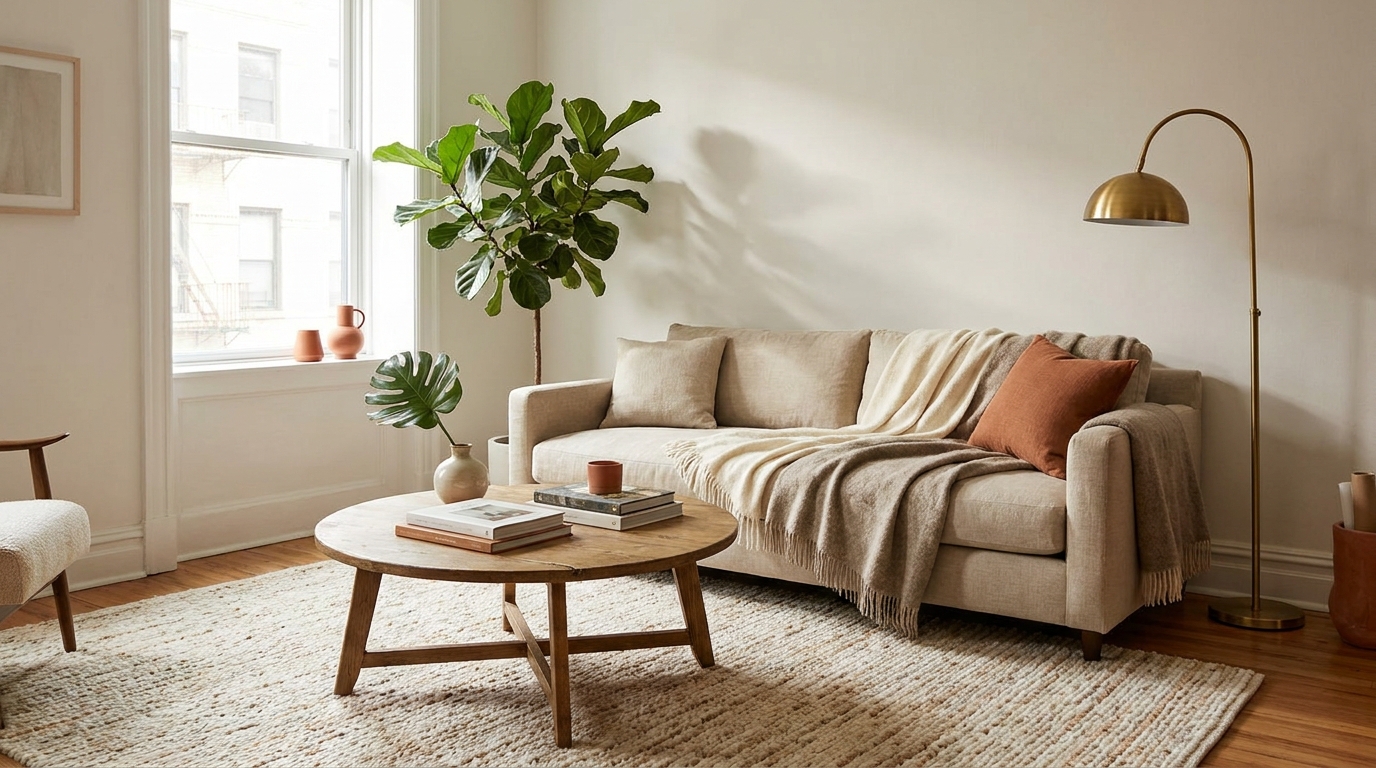
Mistake 1: Symmetry obsession. Small rooms don’t need matching nightstands or twin lamps. Asymmetry — one nightstand, one tall floor lamp on the opposite side — reads as designed, not under-budget.
Mistake 2: Too many short pieces. When every piece of furniture is the same height (sofa back, dresser top, console), the eye has nowhere to land. Add at least one piece that’s 60+ inches tall.
Mistake 3: Centered rug, off-center furniture. The rug should anchor the furniture, not float around it. At least the front legs of every major piece in a zone should sit on the rug.
How big does your rug need to be?
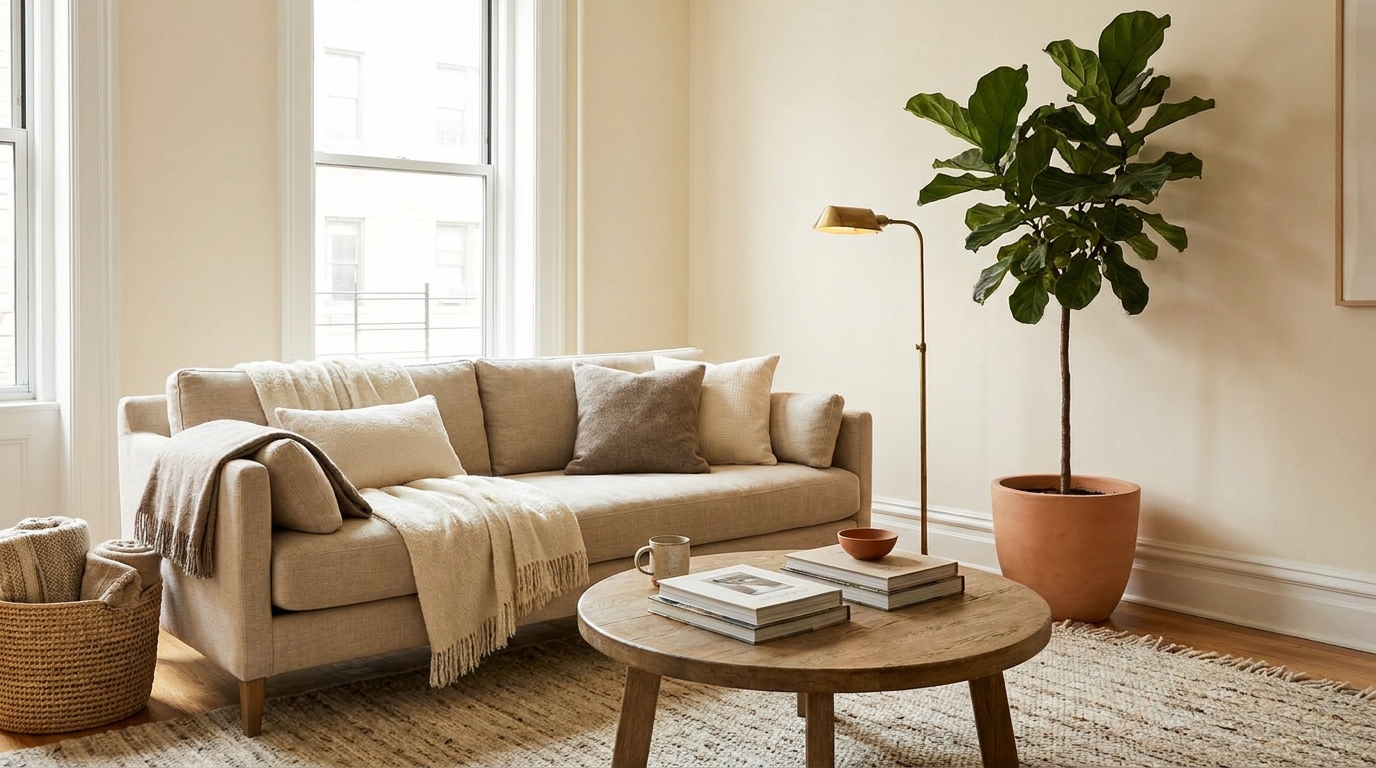
The single most common layout mistake in small apartments is an undersized rug. Use this guide:
| Room | Minimum rug size | Better rug size |
|---|---|---|
| Studio main zone | 5×7 ft | 6×9 ft |
| 1-bed living room | 5×8 ft | 8×10 ft |
| Bedroom (queen bed) | 6×9 ft | 8×10 ft |
| Bedroom (full/double) | 5×7 ft | 6×9 ft |
| Dining area (4-top) | 6×9 ft | 8×10 ft |
A 4×6 rug under a full-size sofa is the most common “shrinking” mistake — the rug looks like a bath mat and the room looks half-furnished.
Lighting layers that make small layouts work
A great layout in flat, ceiling-only lighting still feels like a dorm. The U.S. Department of Energy’s Lighting Facts guide recommends a minimum of three light sources per room — the “lighting triangle.”
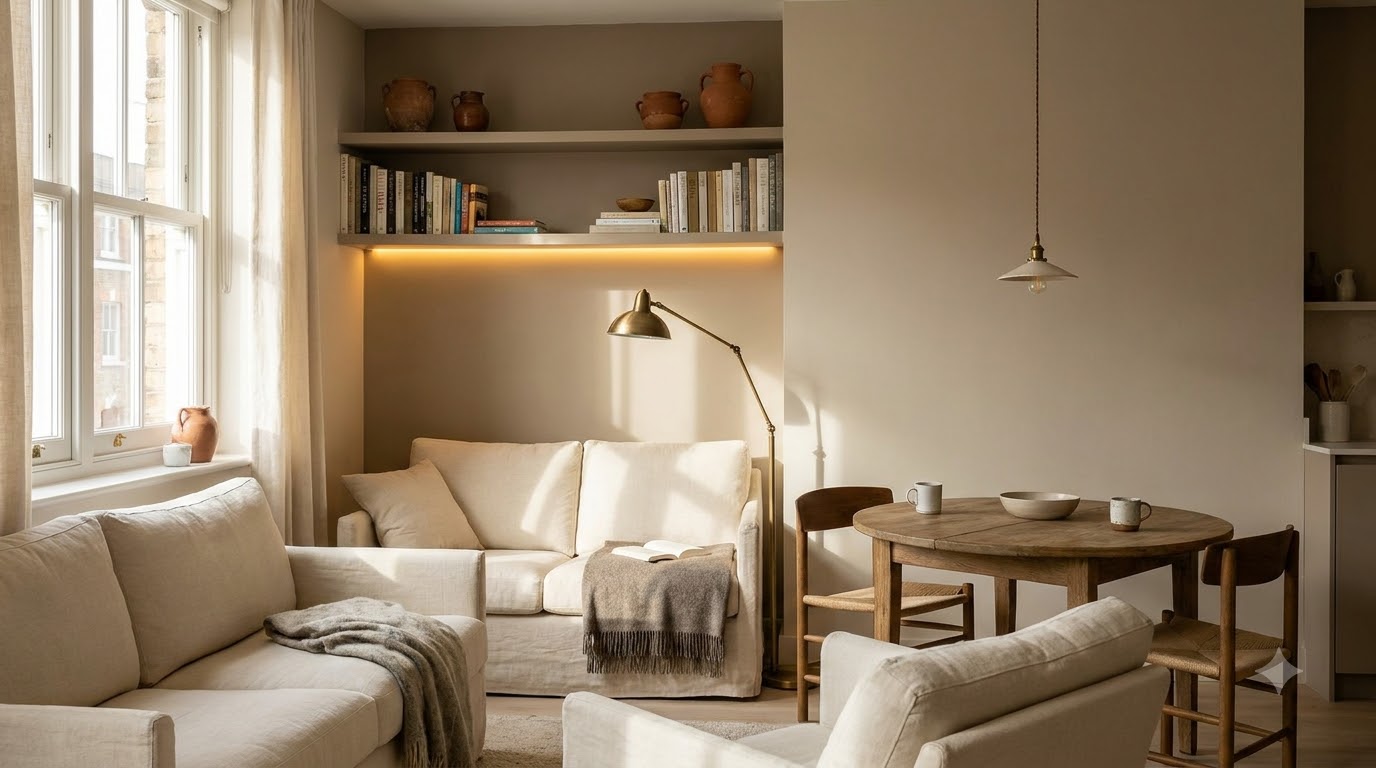
- Ambient: Overhead fixture, dimmable
- Task: Desk lamp, kitchen under-cabinet, reading sconce
- Accent: Floor lamp, table lamp, candles, picture light
In a studio, place at least one lamp in each zone. The visual cue of “this zone has its own light” reinforces the zoning more than any rug or shelf.
Storage logic for small layouts
Every piece of furniture in a small apartment should do at least two jobs. If a piece does only one, replace it.
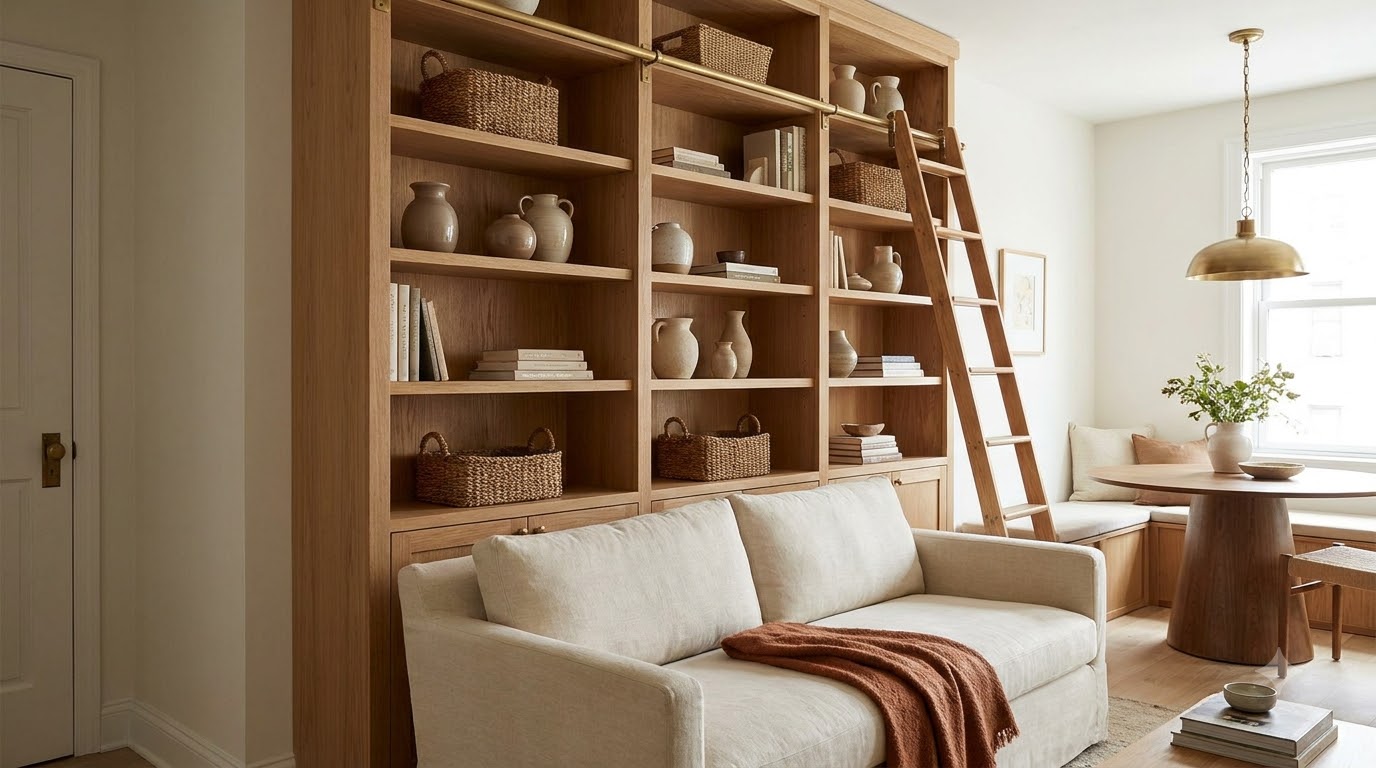
- Coffee table → lift-top coffee table with storage
- Bed → bed with under-mattress drawers or 12+ inches of clearance for bins
- Sofa → sofa with hidden storage chaise
- Console → bookshelf-back console
- Ottoman → storage ottoman with tray top
The double-duty rule sounds obvious, but a 2025 IKEA survey of urban renters found that 58% of small-space dwellers have at least three single-purpose furniture items in their apartment — usually because they were inherited or hand-me-downs.
How to test a layout before you buy
Don’t buy furniture for a layout you haven’t tested. Use one of these methods:
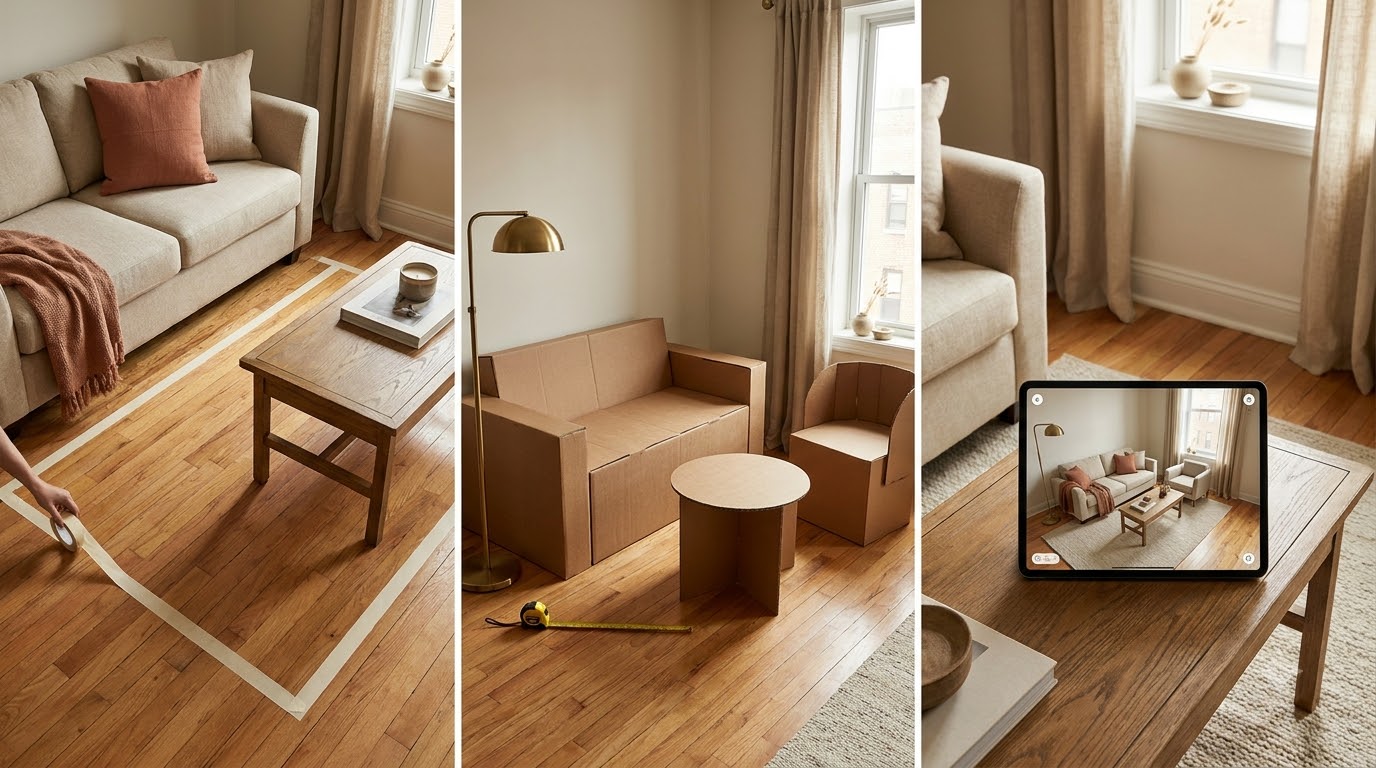
Painter’s tape method. Tape the footprint of every piece directly on your floor. Live with the tape for 48 hours. If you trip over the tape or have to step around it awkwardly, the real piece will be worse.
Cardboard method. For larger pieces (sofas, beds), cut cardboard boxes to the exact footprint and arrange them. Sit on the cardboard “sofa” to confirm your sightlines to the TV, the window, and the door.
Free apps. RoomSketcher, MagicPlan, and IKEA’s Kreativ all let you scan your room and drag in real furniture models. Worth the 20 minutes before a $1,200 sofa purchase.
Small apartment layout by square footage
The right layout depends entirely on what you have to work with. Here’s a quick guide:
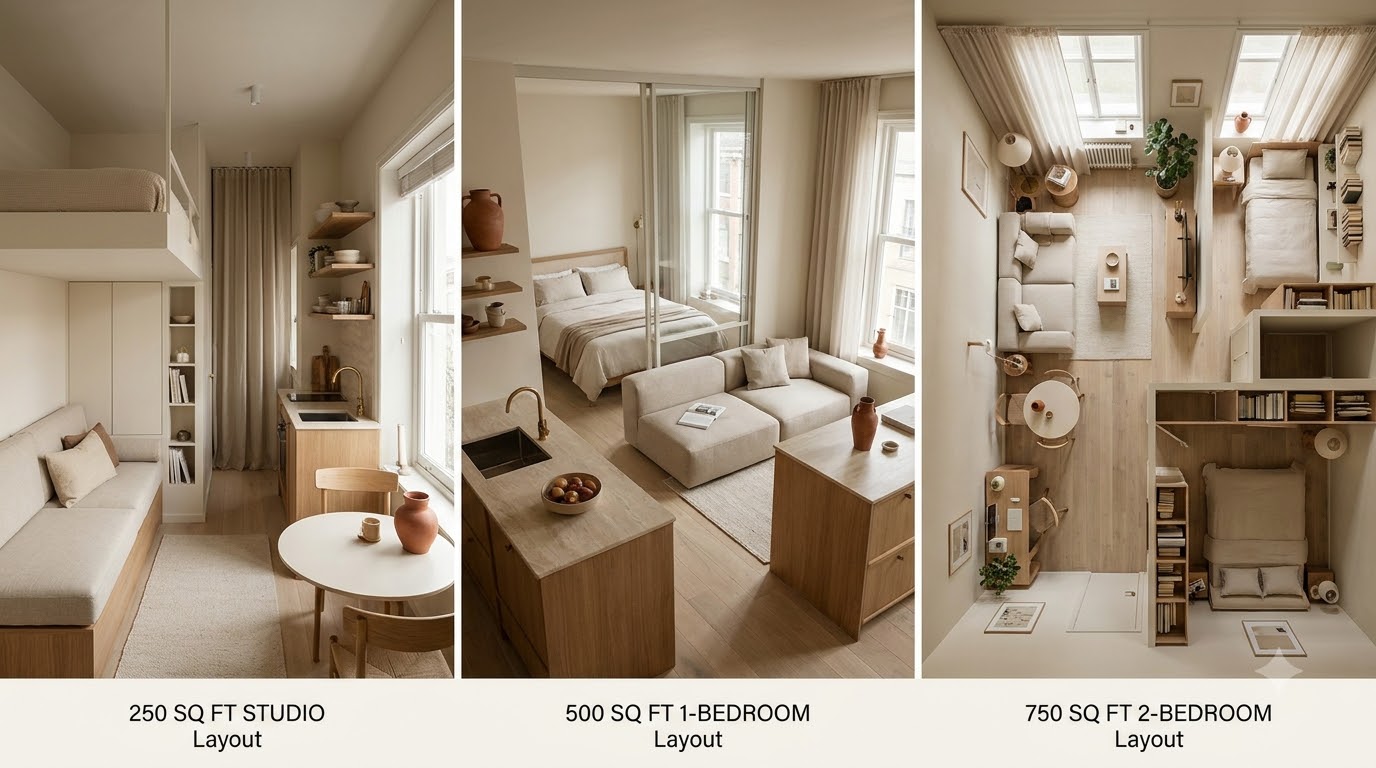
Under 300 sq ft (micro-studio): Murphy bed + one armchair + folding table. Anything else is too much.
300–450 sq ft (small studio): Plans 1, 4, 5, or 10 from the list above. Define 3 zones max.
450–600 sq ft (large studio or jr 1-bed): Plans 6, 9, or 14. You can afford a real sofa and a real bed.
600–800 sq ft (1-bed): Plan 2 (L-sofa) plus one of the studio plans applied to the bedroom.
800+ sq ft (large 1-bed or 2-bed): Mostly traditional layout rules apply — but the 30-inch walkway rule and the “float the bed” trick still help.
Why open-plan studios feel cramped (and how to fix it)
An “open” floor plan in 380 square feet is not the same as an open floor plan in 3,800. Without zones, the whole space reads as one cluttered room. The fix is counterintuitive: divide the open space.
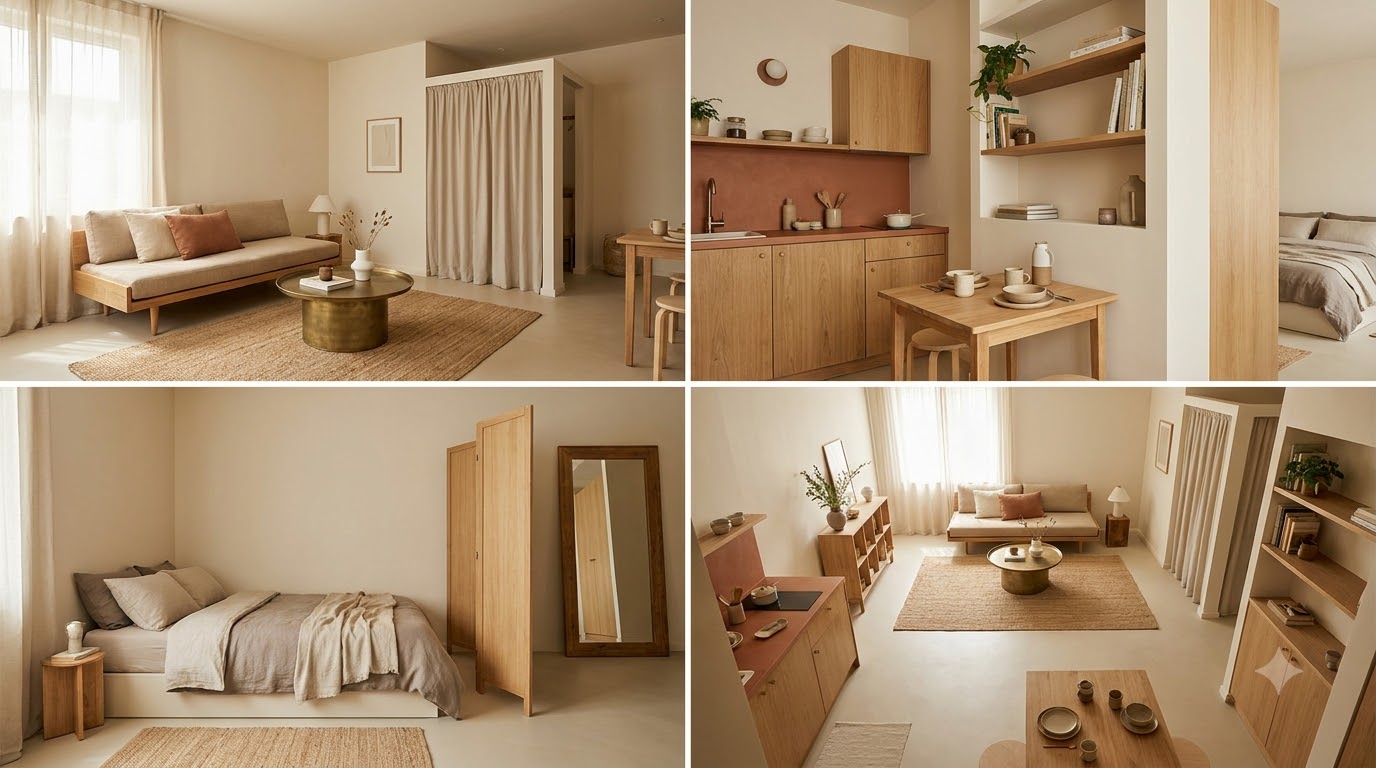
A 2024 study from the University of Reading’s School of Architecture found that residents of small open-plan apartments reported higher satisfaction scores when at least three “implied zones” were visible from the entry. The implication: humans want to feel like there are multiple rooms, even if there are not.
Use rugs, shelves, lighting, ceiling treatments (a fabric panel or curtain on a tension rod), and color blocking on the walls to imply rooms within the room.
Color and layout: the hidden link
Layout decisions aren’t just about furniture. Wall color affects how big a room feels and how clearly the zones read.
The 2025 Sherwin-Williams Color Forecast and the 2026 Benjamin Moore Color of the Year both highlight a return to “enveloping” warm neutrals for small spaces — replacing the previous decade’s stark whites. Warm neutrals (Edgecomb Gray, Accessible Beige, White Dove) reflect natural light without the clinical flatness of pure white.
For zoning, paint a single accent wall behind your bed or sofa one shade darker than the rest of the room. The contrast defines the zone without dividing the space.
What’s changing in 2026
Three small-apartment trends to know:
Furniture-as-architecture. Rather than buying pieces and arranging them, renters are buying “systems” — modular kits that serve as walls, storage, and seating in one. Resource Furniture, Ori, and Bumblebee Spaces are leading this category.
Curved everything. Curved sofas, round dining tables, and arched mirrors are dominating 2026 small-apartment design because curves move the eye through a room rather than stopping it at corners.
Multi-zone lighting on smart switches. Smart bulbs (Philips Hue, Lutron Caséta) now let you set “zone scenes” — work zone bright, lounge zone dim, sleep zone off — from one switch. This sells the zoning illusion even in identical-lighting layouts.
FAQ
What’s the best layout for a 400 sq ft studio apartment?
The “Floating Bed Studio” (Plan 1 above) works for most 400 sq ft studios. Float the bed perpendicular to the longest wall with a 42-inch console behind the headboard as a room divider. This creates two distinct zones — sleep and lounge — without walls or built-ins. Leave 30–36 inches of walkway on the entry-side of the bed.
How do I make my small apartment look bigger without buying anything?
Three free moves: pull your largest piece of furniture 6 inches off the wall, move any short piece (under 30 inches tall) away from the entry sightline, and add a mirror to the wall opposite your largest window. These three changes together can shift the perceived size of a room by 20% or more.
Should I put my bed against the wall or in the middle of the room?
In a studio under 500 sq ft, float the bed 1–3 feet off the wall to create a back-of-bed zone for storage or a divider. In a one-bedroom with a dedicated bedroom under 110 sq ft, the bed goes against the wall — there’s not enough room to float without blocking the walkway.
What furniture should I avoid in a small apartment?
Skip oversized sectionals (anything over 96 inches), deep sofas (over 38 inches deep), upholstered ottomans without storage, dining tables wider than 36 inches in a non-dedicated dining area, and any piece between 30–48 inches tall that isn’t pulling double duty. These pieces “eat the room” without giving back enough function.
How do I separate the bedroom from the living room in a studio?
Four renter-friendly options, ranked: (1) a floating bookcase that’s open on both sides, (2) a heavy curtain on a ceiling-mounted track or tension rod, (3) a tall folding screen, or (4) a back-to-back furniture arrangement (sofa back facing the foot of the bed). Avoid anything that requires drilling or permanent installation unless your lease allows it.
How wide should walkways be in a small apartment?
The primary walkway from the front door to the main zone should be 36 inches. Secondary walkways between furniture should be 30 inches minimum. Tight squeezes that you use once a day (like behind a dining chair) can drop to 24 inches. Anything under 24 inches feels uncomfortable and slows down daily movement.
Do small apartments need a coffee table?
Not always. In living rooms under 100 sq ft, two C-shaped side tables that slide under the sofa edge often work better than a coffee table — they provide drink-holding surface without blocking the walkway. Coffee tables become worthwhile in rooms over 120 sq ft.
What’s the cheapest way to improve my small apartment layout?
Rearrange first, buy second. The single highest-impact free change is moving your largest furniture piece 6–12 inches off the wall and into the room. If you’re buying one thing, make it a properly sized rug (5×7 minimum, 6×9 better) — a rug anchors the layout for under $200.
Sources
- IKEA Life at Home Report 2024 — ikea.com/global/en/newsroom
- American National Standards Institute (ANSI) Residential Clearance Standards — ansi.org
- National Kitchen & Bath Association (NKBA) Planning Guidelines — nkba.org
- Illuminating Engineering Society (IES) Residential Lighting Guide — ies.org
- U.S. Department of Energy Lighting Facts — energy.gov
- American Society of Interior Designers (ASID) Industry Outlook 2025 — asid.org
- Buildremote Remote Work Statistics Report 2025 — buildremote.co
- Sherwin-Williams 2025 Color Forecast — sherwin-williams.com
- Benjamin Moore 2026 Color Trends — benjaminmoore.com
- University of Reading School of Architecture, Small-Space Living Study 2024 — reading.ac.uk
This is a pillar guide for our Small Apartment hub. Up next in this cluster: studio apartment zone planning, renter-safe room dividers, the L-shaped apartment workbook, double-duty furniture rankings, and lighting layouts for tight spaces.
For more inspiration, see our complete hub guide. For more inspiration, see our complete hub guide. For more inspiration, see our complete hub guide.