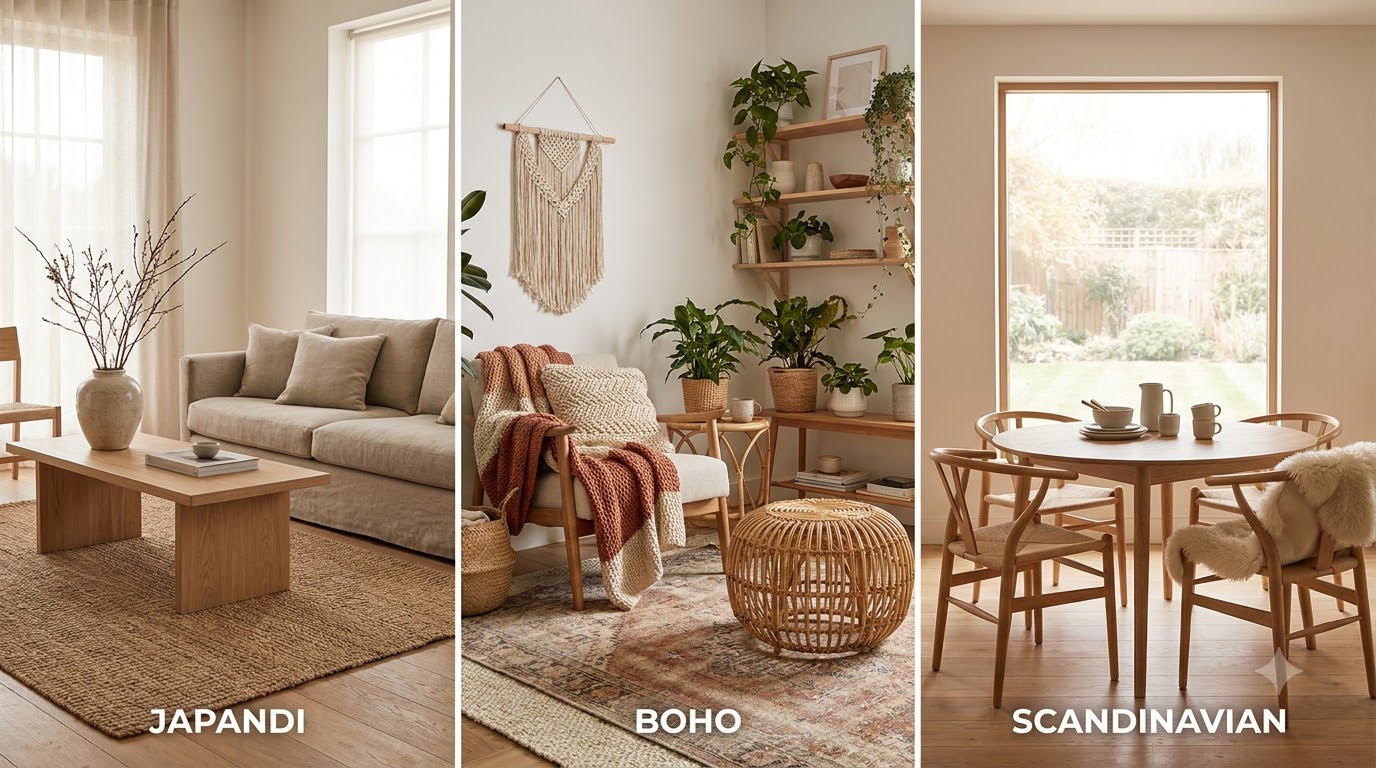
Japandi is the calm, intentional middle ground between two decorating worlds: it borrows the warmth and natural materials of Scandinavian design and the organic, handmade soul of Boho, then strips away the clutter. If you want the quick verdict: choose Japandi for a serene, low-item, small-space home that still feels warm; choose Scandinavian for bright, cozy, budget-friendly practicality; and choose Boho when you want color, layered texture, and a room that tells a personal story. All three love natural light, plants, and honest materials, which is exactly why they blend so beautifully.
How to pick in one minute
We tell renters and small-space dwellers to pick by the feeling they want the moment they walk in the door. Japandi rewards restraint and rewards you with visual quiet. Scandinavian is the friendliest starting point if your apartment is dark or tight on budget. Boho is the choice when a blank, beige rental makes you feel nothing and you crave personality. The good news for renters: every one of these looks is achievable with removable, resale-friendly pieces, so you are never locked in.
Key Takeaways
- Japandi = warm minimalism. Muted earth tones, low furniture, few high-quality pieces. Best for calm-seeking renters in small spaces.
- Scandinavian = bright and cozy. White walls, blonde wood, soft wool. The easiest and most affordable to pull off in a rental.
- Boho = layered and personal. Warm colors, mixed patterns, plants, and thrifted finds. Best for injecting personality on a budget.
- Small space? Japandi and Scandinavian win because low visual clutter makes rooms feel bigger.
- Tight budget? Start Scandinavian or Boho; both thrive on secondhand and DIY. Japandi asks you to buy less but better.
- Can’t decide? Blend Japandi’s calm palette with a few Boho textures for a warm, personal, uncluttered room.
What is Japandi style?
Japandi is a hybrid of Japanese and Scandinavian design. From Japan it takes wabi-sabi, the appreciation of imperfect, natural, handmade things, plus a love of low, grounded furniture. From Scandinavia it takes hygge, that sense of cozy contentment, along with light wood and functional simplicity. The result is a space that feels intentional rather than empty. Nothing is loud, but everything has weight and purpose. In our own apartment, switching to a Japandi palette made the living room feel twice as restful, even though we barely moved any furniture.
The Japandi starter palette (hex):
- Warm White
#F2EDE4— walls and large surfaces - Oatmeal
#D8CBB6— upholstery and rugs - Clay Taupe
#A89684— secondary textiles - Charcoal
#3C3A36— grounding accents and hardware - Muted Sage
#8A9A82— one plant-inspired accent
Signature materials: light oak and dark-stained ash, matte black metal, linen, paper, ceramic, and bamboo. Key pieces: a low platform bed, a spindle or slat-back chair, a floor cushion, a ceramic vase with a single stem, and a paper pendant light. If you love a serene sleep space, our Japandi home decor guide walks through a full room build.
What is Scandinavian style?
Scandinavian design was built for long, dark Nordic winters, so it is obsessed with light. Walls stay white or pale, wood stays blonde, and every surface is chosen to bounce daylight around a room. It is cozy without being cluttered, and it is famously affordable because flat-pack furniture and simple silhouettes are its whole vocabulary. For a first apartment, we almost always recommend starting here: it is forgiving, bright, and the pieces resell easily when you move.
The Scandinavian starter palette (hex):
- Bright White
#FBFBF8— walls - Soft Grey
#DDE1E3— sofa and textiles - Blonde Wood
#E7D3B1— furniture tone - Dusty Blush
#E8C9C1— gentle accent - Ink Black
#2B2B2B— thin graphic lines and legs
Signature materials: birch and beech, wool, sheepskin, cotton, and powder-coated steel. Key pieces: a light-wood coffee table, a wishbone-style chair, a chunky knit throw, geometric line-art prints, and simple paper or glass pendant lights.
What is Boho style?
Boho, short for bohemian, is the free-spirited opposite of minimalism. It layers warm colors, global patterns, natural fibers, and plenty of plants into a room that feels collected over years, not bought in one weekend. It is the most personal of the three styles and arguably the most budget-friendly, because thrift stores, markets, and DIY macrame are its native habitat. When we styled our first rental on almost nothing, Boho was the only look that turned a beige box into somewhere we wanted to spend time.
The Boho starter palette (hex):
- Warm Cream
#F3E9D2— backdrop - Terracotta
#C4693D— signature warm accent - Mustard
#D9A441— pillows and throws - Rust Brown
#8C4A2F— rugs and wood - Olive
#6E7A4E— plant-driven green
Signature materials: rattan, jute, macrame, seagrass, brass, and layered vintage textiles. Key pieces: a rattan accent chair, a patterned kilim rug, a fringed wall hanging, stacked floor cushions, and a cluster of trailing plants. For a fuller style face-off, see our Boho vs Cottagecore vs Minimalist bedroom breakdown.
The big comparison: Japandi vs Scandinavian vs Boho
| Style | Palette | Signature materials | Mood | Best for |
|---|---|---|---|---|
| Japandi | Warm white, oatmeal, clay taupe, charcoal, muted sage | Light oak, dark ash, matte black metal, linen, ceramic, paper | Serene, intentional, grounded, quiet | Calm-seeking renters, small spaces, minimalists who still want warmth |
| Scandinavian | Bright white, soft grey, blonde wood, dusty blush, ink black | Birch, beech, wool, sheepskin, cotton, steel | Bright, cozy, cheerful, practical | First apartments, dark rooms, tight budgets, easy resale |
| Boho | Warm cream, terracotta, mustard, rust, olive | Rattan, jute, macrame, seagrass, brass, vintage textiles | Warm, layered, personal, relaxed | Personality lovers, thrifters, plant people, expressive renters |
What is the difference between Japandi and Scandinavian?
They share a family tree, so the differences are about warmth, contrast, and restraint. Scandinavian keeps things light and airy; Japandi darkens and grounds that same base until it feels more meditative. Here is the quick contrast we give clients:
- Contrast: Scandinavian is low-contrast and bright; Japandi adds deep charcoal and dark wood for drama.
- Wood tone: Scandinavian favors blonde birch; Japandi mixes light oak with dark-stained ash or walnut.
- Furniture height: Scandinavian sits at standard height; Japandi goes low and grounded.
- Item count: Scandinavian layers cozy extras; Japandi edits ruthlessly to a few beautiful pieces.
- Feeling: Scandinavian says “cheerful and cozy”; Japandi says “calm and considered.”
Which style is best for small spaces?
For small apartments and studios, Japandi and Scandinavian win, because both keep visual clutter low and let light travel across the room. Boho can absolutely work in a small space, but it needs discipline: too many patterns and objects will shrink a tight room fast. When we styled a 400-square-foot studio, we used a Scandinavian base for brightness and added just three Boho textures so it still felt personal. A few space-savvy rules we live by:
- Choose low furniture and exposed legs so the floor stays visible and the room reads larger.
- Limit yourself to one hero pattern; let everything else stay solid and calm.
- Use tall, narrow shelving to draw the eye up and free the floor.
- Pick a single warm neutral for walls and large textiles to avoid choppy color breaks.
- Add one or two plants for life, not a jungle that eats the square footage.
Want more layout tricks for tight rooms? Our cozy living room ideas and layout guide covers small-space arrangements in depth.
Budget swaps: get the look for less
You do not need a designer budget for any of these looks. These are the swaps we reach for again and again when the goal is high impact for low spend:
- Japandi: Skip the $1,200 solid-oak platform bed. Buy a $180 low pine bed frame and stain it with a $15 can of dark walnut stain for the same grounded look.
- Japandi: Trade a $90 designer ceramic vase for a $12 thrifted stoneware jug with a single dried branch.
- Scandinavian: Swap a $600 wishbone chair for a $70 flat-pack version, or thrift a real one for $40.
- Scandinavian: Replace a $150 wool throw with a $25 chunky-knit acrylic blend; from across the room it reads the same.
- Boho: Instead of a $400 vintage kilim, layer a $30 jute rug under a $20 patterned runner for the same collected depth.
- Boho: DIY a macrame wall hanging with $8 of cotton cord instead of buying a $75 finished one.
How to blend all three without clashing
Most renters do not want a textbook version of one style; they want a room that feels like them. Because these three share natural materials and a love of light, they blend more easily than they look. Our go-to formula is to let one style lead and the others whisper:
- Pick Japandi as your base palette for calm and cohesion.
- Borrow Scandinavian’s blonde wood and a cozy knit throw for warmth.
- Add two or three Boho textures, like a jute rug or a rattan chair, for personality.
- Keep the color story to five hues total so nothing fights.
- Edit at the end: remove one object from every surface until it breathes.
This blended, warm-minimalist look also translates beautifully into the bedroom. For more mood-driven ideas, browse our aesthetic bedroom ideas guide.
Which style matches your personality?
Sometimes the fastest way to choose is to be honest about how you actually live. After styling dozens of rentals, we have noticed the happiest rooms are the ones that match the person, not the trend. Here is the shortcut we use when a client is stuck between all three:
- Choose Japandi if you crave order, you feel calmer with clear surfaces, and you would rather own five things you love than fifty you tolerate.
- Choose Scandinavian if your space is dark, you want a friendly and low-stress starting point, and you value comfort and daylight above statement pieces.
- Choose Boho if you collect things you love, you find plain rooms cold, and you want your home to feel like a scrapbook of travels, colors, and finds.
- Choose a blend if you nodded at more than one of these, which honestly describes most of us.
Whatever you land on, start with the walls and the largest textile first, because those two surfaces set the palette for everything else. Get the base neutral right and the rest of the room falls into place with far less trial and error, and far less wasted money on returns.
Frequently asked questions
Is Japandi just a trend that will date quickly?
We do not think so. Japandi is rooted in two enduring traditions, Japanese minimalism and Scandinavian function, rather than a passing color or shape. Because it relies on natural materials and restraint instead of novelty, a Japandi room tends to age gracefully. Buy fewer, well-made pieces and it will feel current for years.
Which style is cheapest to start with as a renter?
Boho and Scandinavian are the friendliest on a tight budget. Boho thrives on thrifted and DIY finds, so you can build a full room slowly for very little. Scandinavian leans on affordable flat-pack basics. Japandi costs less over time because you buy fewer items, but each piece is usually a bigger upfront investment.
Can I use these styles in a rental without damaging walls?
Absolutely. All three depend on furniture, textiles, and freestanding decor rather than permanent changes. Use peel-and-stick hooks for wall hangings, lean art instead of nailing it, and choose rugs and lamps to set the mood. Everything can leave with you and resell well, which makes each look genuinely renter-safe.
What is the easiest style for a decorating beginner?
Scandinavian is the gentlest entry point. Its rules are simple: keep walls light, choose blonde wood, add cozy textiles, and avoid clutter. Because the palette is forgiving and the pieces are widely available and affordable, it is very hard to get wrong, which builds confidence before you experiment with bolder Boho or refined Japandi rooms.
Do I have to commit to just one of these styles?
Not at all, and we rarely do. These three share natural fibers, warm neutrals, and a love of daylight, so they layer well. Let one style lead your palette, then borrow a few textures or pieces from the others. A Japandi base with Boho warmth is one of our favorite renter-friendly combinations.