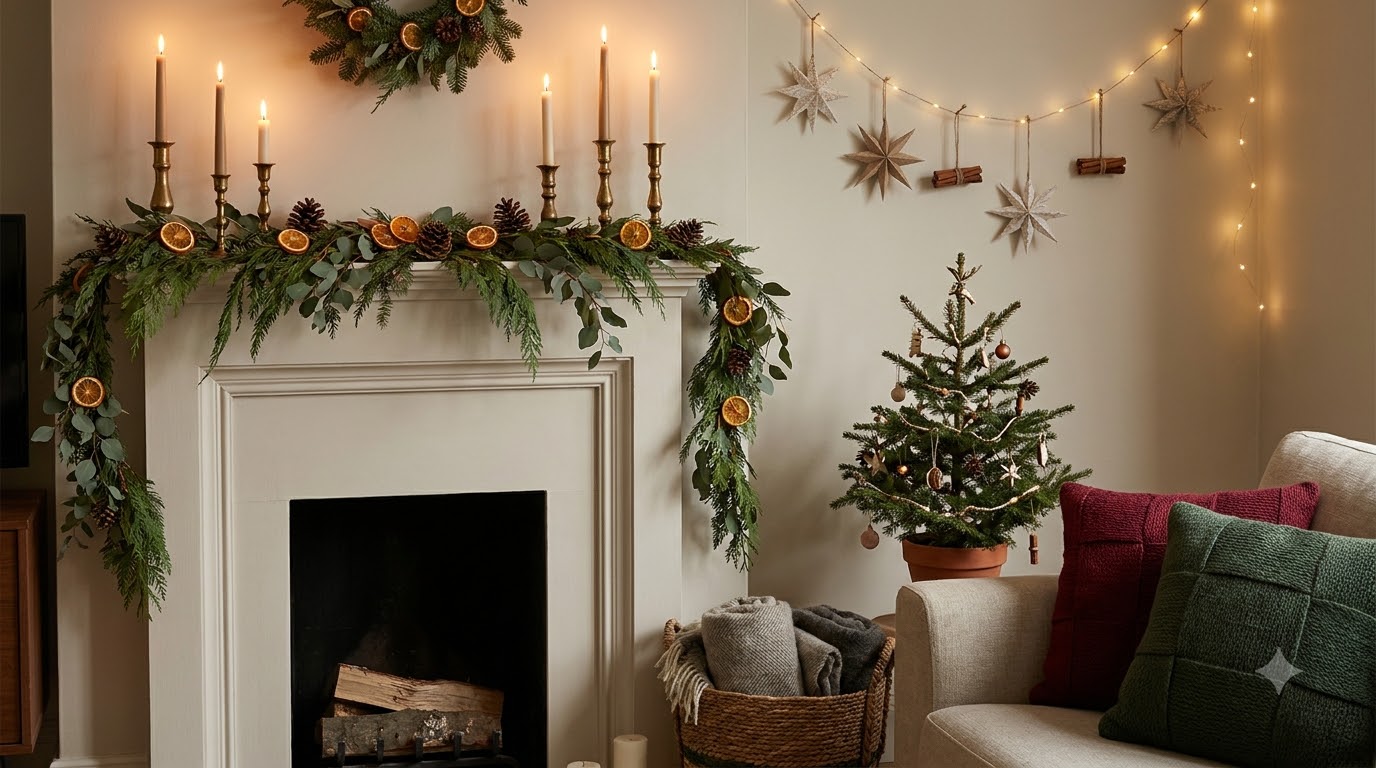
To pull off christmas decor on a budget under $50, put your money into three high-impact buys first: one warm-white string-light set for a focal window or mantel, one full 9-foot garland to anchor the eye, and a small cluster of matching ornaments in a tight two-color palette. Skip the trees-worth of tinsel and instead concentrate light and greenery in a single spot people actually look at, then fill in with things you already own. That is how we consistently make a room feel finished for the price of a large pizza.
Key Takeaways
- Concentrate, don’t scatter: one glowing focal point (window, mantel, or door) reads richer than thin decorations spread across a whole room.
- Warm white wins: a 100-count LED string in warm white (hex
#FFF3D6) does more visual work than any single object under $10. - Two colors, that’s it: pick a palette like deep green
#0B3D2Eplus antique gold#C8A951and buy only to it. - Shop the running total: our sample build below lands at roughly $47 for lights, garland, ornaments, stockings, and candles.
- Reuse ruthlessly: pinecones, jars, and last year’s ribbon stretch a small budget further than any new purchase.
What should you buy first for christmas decor on a budget?
When we redecorate a small rental each December, we start by asking one question: where do people’s eyes land when they walk in? That single spot gets the biggest share of the budget. Everything else is supporting cast. Buying in this order keeps you from blowing $20 on filler before you have a focal point.
- String lights first ($8–$12): one 100-count warm-white LED set, roughly 30–33 feet, covers a window frame or a 6-foot mantel with light to spare.
- One statement garland ($10–$15): a single 9-foot faux pine or eucalyptus garland, 10–14 inches wide, anchors a mantel, banister, or doorway.
- A tight ornament set ($6–$10): 12–24 shatter-resistant balls in two matching colors, so nothing clashes.
- Two to four stockings ($3–$6 each): knit or felt, hung from the same mantel you already lit.
- Two pillar or LED candles ($4–$8): for warmth on a side table or windowsill.
Follow that sequence and you never overspend on the wrong layer. For a room-by-room plan once your focal point is set, our christmas living room decor ideas break down exactly where each of these buys does the most work.
How many string lights do you actually need?
String lights are where budget decorators either win or waste money. The mistake we made early on was buying three cheap 50-count sets to cover a mantel; the seams showed, and half a set failed by New Year’s. One longer, denser set almost always looks better and costs less than piecing short strands together.
- Mantel (6 feet): one 100-count set, ~33 feet, drapes and doubles back with slack for a full look.
- Single window frame: one 100-count set outlines a standard 3-by-5-foot window with a soft glow.
- Small tabletop or potted plant: a 50-count set, ~18 feet, is plenty and often runs $4–$6.
- Warm white vs. cool white: choose warm white (
#FFF3D6), not the blue-tinted cool white (#EAF2FF), which reads clinical indoors. - Battery vs. plug-in: battery sets free you from outlet placement but budget for AAs; plug-in sets stay brighter all season.
In our experience, one well-placed 100-count set is the single most cost-effective decoration you can buy. It turns a bare mantel into the room’s centerpiece for under $12.
How do you size garland and greenery without overspending?
Greenery is the cheapest way to make a space feel intentionally decorated, but sizing it wrong wastes money fast. We buy one generous piece rather than several skimpy ones. A single full 9-foot garland reads lush; two thin 6-foot strands read sparse and cost more combined.
- Standard mantel: one 9-foot garland, 10–14 inches wide, with a little draping at each end.
- Staircase banister: measure the rail; a 9-foot garland covers most short flights, longer runs need a second piece.
- Doorway or window top: a 6-foot garland spans a standard frame; add three foraged pinecones for texture at $0.
- Tabletop runner look: lay a 6-foot garland flat down the center and nestle candles between the greenery.
- Fluff before you judge it: bend every branch outward; a $12 garland looks like $30 once the tips are spread.
If square footage is tight, sizing matters even more. Our guide to small-space christmas decor ideas shows how a single garland and one light set can carry an entire studio or apartment.
What’s the smartest color palette for a cheap holiday look?
A disciplined two-color palette is the closest thing to a free upgrade. When everything matches, cheap pieces look curated instead of random. We pick two colors and refuse to buy anything outside them, which also stops impulse purchases at the checkout aisle.
- Traditional: deep green
#0B3D2Eplus antique gold#C8A951for a classic, warm feel. - Modern neutral: warm white
#F3EDE1plus matte sage#9CA98Bfor calm, minimal rooms. - Cozy rustic: cranberry red
#8C1C13plus natural kraft/twine tones#C9A66B. - Icy elegant: soft silver
#C9CDD2plus deep navy#1B2A4Afor a cooler scheme. - One metal only: commit to gold or silver, never both, so mixed ornaments still look coordinated.
Not sure which direction fits your home? Weighing the two most common routes in our comparison of neutral vs. traditional christmas decor makes the palette choice much faster.
Can you build a full display for under $50?
Yes, and here is the exact build we use for a living-room mantel plus a nearby window. The trick is keeping a running total in your head at the store. Every item type below has a realistic price range; the table shows a single sample build that lands under budget with a few dollars to spare for tax.
| Item type | Quantity / size | Sample price | Running total |
|---|---|---|---|
| Warm-white LED string lights | 1 set, 100-count / ~33 ft | $10 | $10 |
| Faux pine garland | 1 piece, 9 ft x 12 in | $13 | $23 |
| Shatter-resistant ornaments | 1 box, 24 count, 2 colors | $8 | $31 |
| Knit stockings | 3 stockings | $4 each = $12 | $43 |
| LED pillar candles | 2 candles | $4 | $47 |
| Total | $47 | $47 |
That leaves roughly $3 of headroom under $50. For context on typical seasonal spending, holiday shoppers spend about $890.49 per person on average, with $262.56 going to seasonal items including decorations (NRF, Oct 2025) — so a $47 refresh is a fraction of the norm and still transforms a room.
What can you decorate with for free?
The cheapest decorations cost nothing because you already own them or can gather them outdoors. We stretch our budget every year by leaning on these before we buy a thing, and they add the texture that separates a warm room from a store-bought one.
- Foraged pinecones and bare branches: free from a walk, they fill baskets, jars, and garland gaps instantly.
- Mason jars plus a short light strand: drop a 20-count wire set inside for an instant tabletop lantern.
- Kraft paper and twine: wrap empty boxes as faux gifts to stack under a console table.
- Citrus and cinnamon sticks: a bowl of oranges studded with cloves adds color and scent for pocket change.
- Last year’s ribbon: re-tie it into fresh bows on the banister; nobody remembers December to December.
A dining table dressed with free citrus, candles, and a length of leftover garland can look genuinely special. Our walkthrough on how to decorate a christmas table layers these no-cost touches into a centerpiece that photographs well.
Where should you spend versus save?
Not every category deserves the same dollar. After several tight-budget Decembers, we have a clear rule: spend where light and eye-level texture live, save on anything seen from a distance or used briefly. That split keeps the display looking richer than its receipt.
- Spend on lights: a reliable warm-white set is used nightly and defines the whole mood.
- Spend on one hero garland: it sits at eye level and gets touched, so quality shows.
- Save on ornaments: shatter-resistant multipacks look identical to pricey glass from three feet away.
- Save on filler picks and berries: free pinecones and branches do the same job.
- Save on wrapping and bows: reuse or make your own from kraft paper and twine.
The fastest way to waste a small budget is spreading it thin and repeating errors like overloading a mantel or mismatching metals. We rounded up the ones that cost the most in our christmas decorating mistakes guide so you can avoid re-buying.
Frequently Asked Questions
How many ornaments do I need for a small display?
For a mantel, a garland accent, or a tabletop tree, one 24-count box of shatter-resistant balls in two matching colors is plenty. If you are dressing a full-size tree, plan for roughly 20 ornaments per foot of tree height, but a small focal display rarely needs more than a dozen visible pieces.
Are LED string lights worth it over cheaper incandescent?
Yes, for budget decorators LEDs are the better buy. They run cooler, use far less power over a long season, and rarely have a single bulb take out the whole strand. Choose warm white rather than cool white so the glow stays cozy indoors instead of looking blue and harsh at night.
What if I only have $25 to spend?
Buy just two things: one 100-count warm-white light set (about $10) and one 9-foot garland (about $13). Light and greenery on a single focal point deliver most of the impact. Fill the rest with free foraged pinecones, citrus bowls, and candles you already own to complete the look for nothing extra.
How do I make cheap decorations look more expensive?
Commit to a strict two-color palette, use a single metal finish, and fluff every garland branch fully before judging it. Concentrate light in one spot rather than scattering it. Grouping items in odd-numbered clusters and keeping surfaces uncluttered does more for a high-end feel than spending extra money ever will.
Should I decorate the front door on a tight budget?
The entryway is high-return because everyone sees it first. A single 6-foot garland over the frame plus one battery light strand can transform it for under $20. For layered, low-cost ideas that still look welcoming, see our christmas front door and entryway ideas.
Sources
- National Retail Federation (NRF), Winter Holiday Spending Survey, October 2025 — average per-person holiday spend of $890.49, including $262.56 on seasonal items such as decorations.