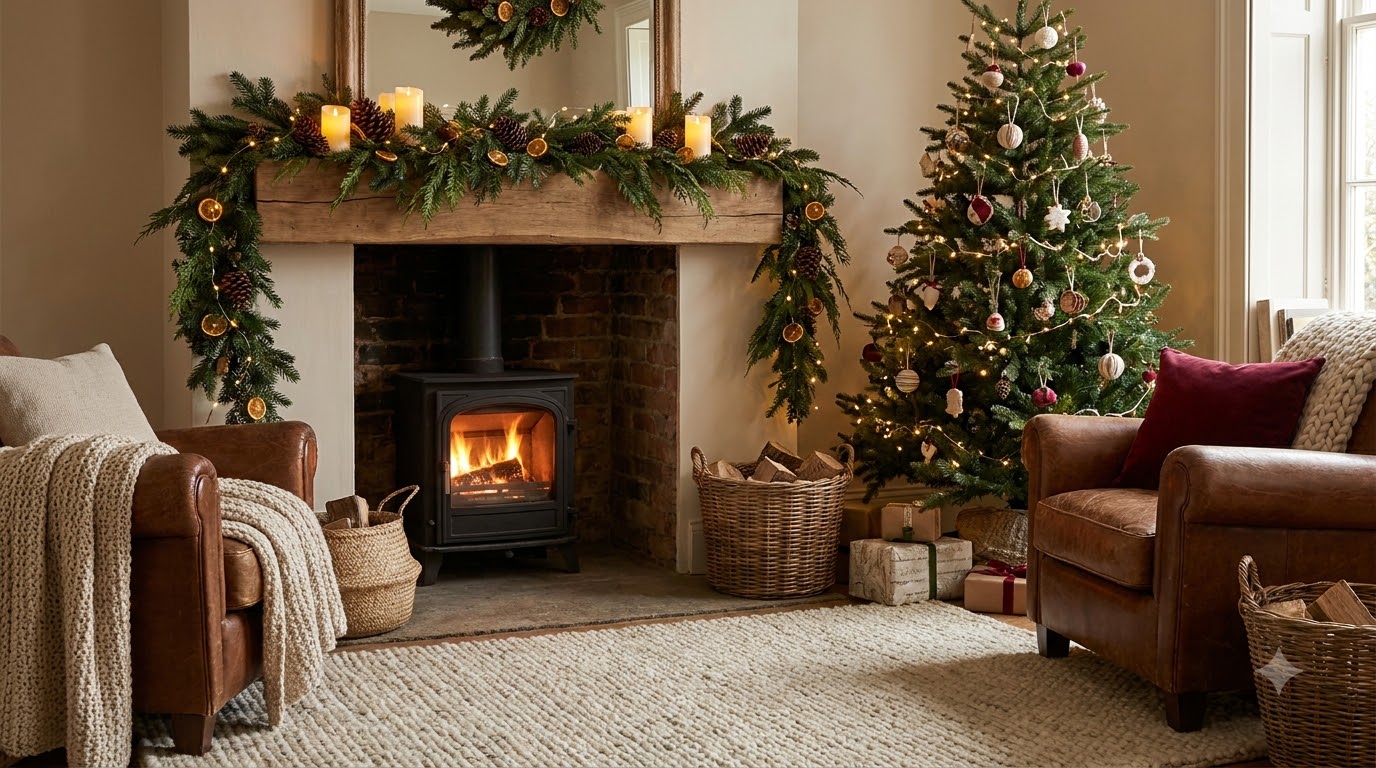
To decorate a christmas living room, work four key zones in order: the tree (the anchor), the mantel or focal wall, the seating area (sofa, throws, coffee table), and the windows or entry sightlines. Start with the tree because it sets your color story and scale, then layer greenery on the mantel, soften the sofa with textiles, and finish with warm lighting that ties every zone together. Handle those four areas well and the room reads as fully styled without touching every surface.
Key Takeaways
- Decorate in four zones: tree, mantel/focal wall, seating area, and windows.
- Size the tree to the room: a 7.5 ft tree suits 8-9 ft ceilings and needs roughly 100 lights per vertical foot.
- Cut mantel garland at about 1.5x the mantel width so it drapes instead of stretching flat.
- Pick a 3-color palette and repeat it across all zones for a pulled-together look.
- Warm-white lighting (2700K) at three heights makes a living room feel cozy, not clinical.
How do you decorate a christmas living room without overdoing it?
The fastest way to overwhelm a room is to decorate every surface equally. In our own living room, we learned to give each zone a clear job: the tree carries the color story, the mantel carries the greenery, the sofa carries texture, and the windows carry light. When we tried to make all four zones equally loud one December, the room felt chaotic; the year we let the tree lead and kept the seating area calm, guests actually noticed more. Restraint reads as intention.
We start every setup by choosing three colors and refusing to add a fourth. A classic combination is deep evergreen (#0B3D2E), warm red (#8C1C13), and antique gold (#B8860B); a quieter route swaps red for cream (#F5F0E6) and brushed brass. Repeating just three colors across the tree, throw pillows, and mantel is what makes a space look styled rather than accumulated. If you are weighing a traditional palette against something softer, our guide to neutral vs traditional christmas decor breaks down how each mood behaves in a lived-in room.
- Zone 1 – The tree: your color anchor and light source.
- Zone 2 – The mantel or focal wall: greenery, stockings, candles.
- Zone 3 – The seating area: throws, pillows, coffee-table vignette.
- Zone 4 – The windows and sightlines: string lights, a small wreath, a lantern.
What size Christmas tree fits your living room?
Tree scale is where most rooms go wrong. The rule we use: leave 6-12 inches of clearance between the top of the tree (including the topper) and the ceiling. For standard 8-9 ft ceilings, a 7.5 ft tree is the sweet spot; for 10 ft ceilings you can push to a 9 ft tree, and in apartments with 8 ft ceilings a 6 ft slim profile keeps the floor from disappearing. The American Christmas Tree Association reports that 83% of households displaying a tree now choose an artificial one (ACTA/Ipsos, Oct 2025), which makes matching a consistent size year to year far easier.
Lighting a tree well is a numbers game. Plan for roughly 100 lights per vertical foot, so a 7.5 ft tree wants about 750 lights minimum, and we happily double that for a glowing, full look. Wrap lights on each branch from trunk to tip rather than draping them around the outside; it takes longer but gives the tree depth. If your living room is tight on floor space, a corner placement and a slim tree free up walking room, an approach we detail in our small-space christmas decor ideas.
- 8 ft ceiling: 6-6.5 ft tree, slim profile, ~600-650 lights.
- 8-9 ft ceiling: 7.5 ft tree, full profile, ~750-1,000 lights.
- 10 ft ceiling: 9 ft tree, ~900-1,200 lights.
- Tabletop / rental: 3-4 ft tree, ~150-200 lights.
How do you style a Christmas mantel or focal wall?
The mantel is the second zone we tackle, and garland length is the detail that makes or breaks it. Measure your mantel width and cut or buy garland at about 1.5x that measurement: a 60-inch mantel needs roughly 90 inches of garland so it can swag and pool at the corners instead of stretching in a tight straight line. We anchor the center first, then let the two ends cascade about 8-10 inches below the mantel edge. A single 9 ft garland ($15-$40 for a good faux one) covers most standard mantels.
If you do not have a fireplace, a console table, bookshelf, or a bare wall behind the sofa becomes your focal zone. The same layering logic that works for autumn transfers directly to Christmas, and our how to style a fall mantel walkthrough covers the height-and-triangle method we reuse every holiday. Build in odd numbers, vary the heights, and let candles or a small string of warm lights add the glow.
- Layer garland first, then tuck in stems: eucalyptus, pinecones, berry sprigs.
- Add three candle heights (tall taper, medium pillar, short votive) for dimension.
- Hang stockings on evenly spaced holders, weighting corners visually.
- Place one larger anchor object (a wreath, mirror, or framed art) above center.
- Finish with a short strand of warm-white lights woven through the greenery.
How do you make the seating area feel cozy?
The seating area is where a christmas living room earns its warmth. We swap everyday throw pillows for seasonal covers in our three-color palette (18×18 inch covers run about $12-$25 each) and drape one oversized knit throw over the arm of the sofa. Talker Research found that 86% of Americans embrace a cozy, hygge mood in colder months (Talker Research/Naturepedic, Nov 2025), and textiles are the cheapest way to deliver it. A chunky throw does more for the mood per dollar than almost any ornament, and our roundup of the best cozy throw blankets under $50 covers weights and fibers we actually keep out all winter.
Do not forget the coffee table. We build a small tray vignette: a stack of two or three books, a short candle, a bundle of faux greenery, and one seasonal object like a ceramic tree or a bowl of ornaments. Keeping it on a tray means the whole arrangement lifts off in one motion when you need the table for guests. For layout logic that works year-round and then flexes for the holidays, our cozy living room layout guide pairs well with this zone.
- Sofa: 3-5 pillows in two textures, one oversized throw draped diagonally.
- Coffee table: tray + book stack + candle + greenery + one accent object.
- Floor: a low basket of extra blankets within arm’s reach of seating.
- Side table: a single lamp or lantern for a warm pool of light.
What is the right way to light a living room for Christmas?
Lighting is the zone people underestimate most. The single biggest upgrade is switching everything to warm white, around 2700K, so the tree, string lights, and lamps all glow the same color instead of clashing between cool blue and yellow. In our own living room we run light at three heights: the tree (low-to-mid), a table lamp or lantern (mid), and a strand across the window or mantel (high). That layering removes the harsh overhead glare that flattens a room and makes it feel like a showroom.
Put lamps on a simple plug-in timer so the room greets you already glowing at dusk. Avoid mixing warm-white and multicolor strands in the same sightline unless multicolor is a deliberate, committed theme; the accidental blend is one of the most common missteps we see, along with several others in our list of christmas decorating mistakes.
- Standardize on warm white (~2700K) across tree, lamps, and strands.
- Light at three heights: floor/tree, table, and window/mantel.
- Use a plug-in timer so lights turn on at dusk automatically.
- Skip the overhead light at night; lamps and strands do the work.
- Keep cords tucked with adhesive clips along baseboards for a clean look.
Christmas living room zones, treatments, and approximate cost
Here is how we budget a full room. Prices are typical ranges for mid-market faux and reusable pieces, not any specific brand, and most items carry over year to year.
| Living-room zone | Christmas treatment | Approx. cost |
|---|---|---|
| Tree | 7.5 ft artificial tree + ~750-1,000 warm-white lights | $120-$350 |
| Mantel / focal wall | 9 ft garland (1.5x width), stockings, 3 candles | $45-$120 |
| Seating area | 4 pillow covers + 1 oversized knit throw | $60-$150 |
| Coffee table | Tray vignette: books, candle, greenery, accent | $25-$70 |
| Windows / lighting | 2-3 warm-white strands + a lantern + timer | $30-$80 |
Can you decorate a living room for Christmas on a budget?
Yes, and the trick is spending on the zone people see first. We put most of a small budget into the tree and its lights, then lean on greenery and textiles for everything else, since faux garland and pillow covers cost a fraction of new furniture and reappear every December. Reusing what you already own, editing rather than buying, is the highest-value move; for a full plan under a fixed number, our christmas decor under $50 guide stretches a small spend across a whole room.
A few habits keep costs down without looking cheap. Buy greenery and lights in the after-Christmas clearance for next year, choose neutral base pieces you can restyle, and add one small statement item annually instead of replacing everything. Over three seasons we built a full room this way, and the per-year cost dropped sharply once the core pieces were owned.
- Prioritize the tree and lights; they anchor the whole room.
- Use faux garland and pinecones you can store and reuse for years.
- Swap pillow covers, not whole pillows, to change the look cheaply.
- Shop clearance after December 25 for next season’s greenery and strands.
- Add one statement piece per year rather than a full annual refresh.
Frequently Asked Questions
How many lights do I need for a 7.5 ft Christmas tree?
Plan for about 100 lights per vertical foot, so a 7.5 ft tree needs roughly 750 lights at minimum. For a fuller, glowing look we use closer to 1,000 or more, wrapping each branch from trunk to tip rather than draping strands around the outside for real depth.
How long should mantel garland be?
Buy or cut garland at roughly 1.5 times your mantel width so it can swag and drape instead of stretching flat. A 60-inch mantel needs about 90 inches of garland. Anchor the center first, then let each end cascade 8-10 inches below the mantel edge for a natural, layered shape.
What are the best colors for a Christmas living room?
Choose three colors and repeat them across every zone. A traditional trio is evergreen (#0B3D2E), warm red (#8C1C13), and gold (#B8860B); a calmer version swaps red for cream (#F5F0E6) with brass. Repetition of just three colors is what makes a room look styled rather than cluttered or accidental.
Where should the Christmas tree go in a living room?
Place the tree where it is visible from the main entry sightline and ideally near a window so it glows from outside. A corner works well in small rooms, freeing up walking space. Keep it away from heat sources and high-traffic paths, and leave 6-12 inches of clearance above the topper.
How do I make my living room feel cozy for the holidays?
Layer textiles and warm light. Add a chunky knit throw, two textures of pillow, and a basket of extra blankets, then standardize all lighting to warm white around 2700K at three heights. Skipping the overhead light at night and letting lamps glow instead is the single biggest cozy upgrade.
Sources
- American Christmas Tree Association / Ipsos, October 2025 – artificial tree adoption.
- Talker Research / Naturepedic, November 2025 – cozy/hygge mood in colder months.