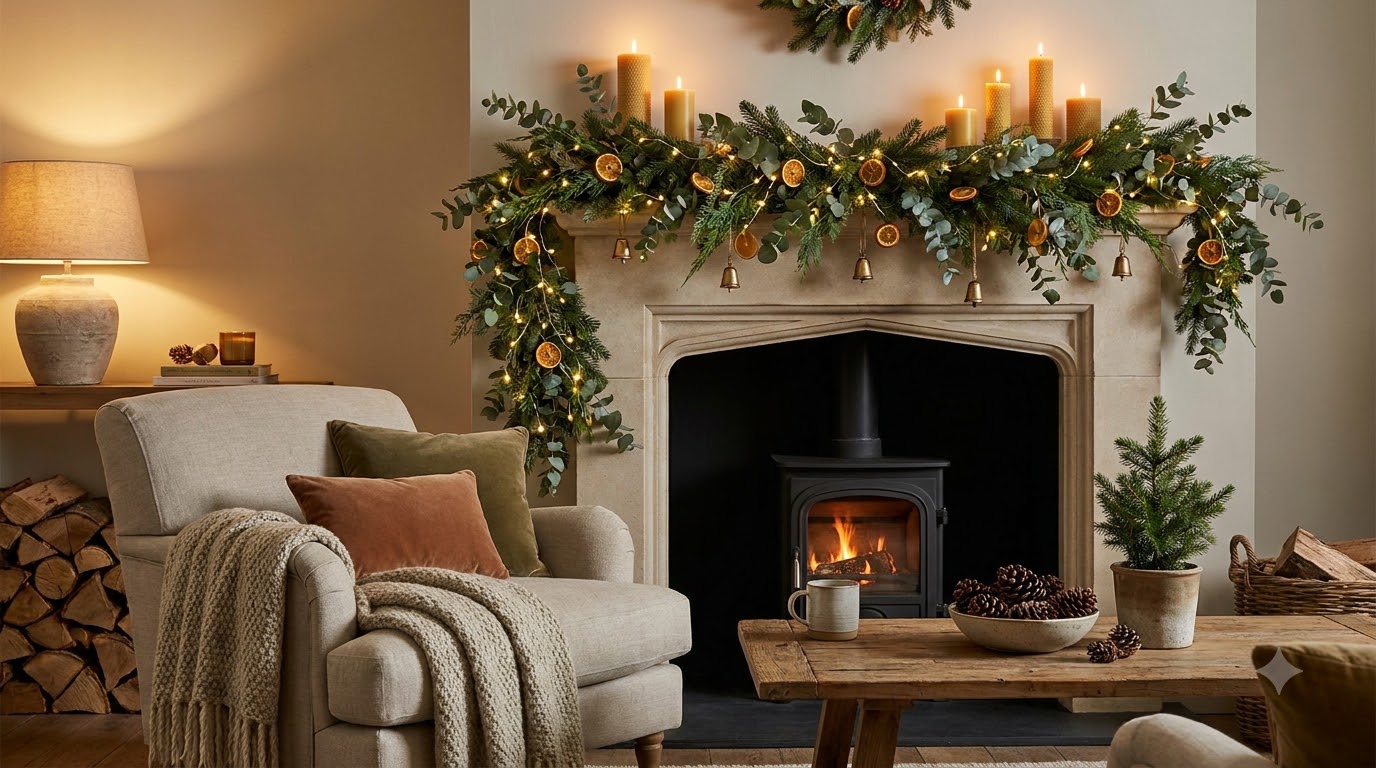
The most common Christmas decor mistakes are stringing too few lights, hanging garland that is too short for the mantel, overcrowding small rooms, mixing too many competing colors, and choosing a tree that crowds the ceiling. The core fix is simple: plan by measurement, not by eye. Decide your light count, garland length, and tree-to-ceiling clearance before you buy a thing, and layer one dominant palette instead of five. Every mistake below comes with the exact number or ratio we use to get it right.
Key Takeaways
- Use roughly 100 lights per vertical foot of tree; under-lighting is the single most common miss.
- Buy garland at about 1.5x your mantel width so it can drape and swag, not stretch flat.
- Leave 6-12 inches of clearance between the treetop and ceiling for the topper.
- Limit yourself to two or three colors plus a metallic, and repeat them in odd-numbered clusters.
- In small spaces, decorate vertically and edit hard; empty surface space is a feature, not a failure.
What Are the Most Common Christmas Decor Mistakes?
After a decade of decorating our own home and helping friends redo theirs, we noticed the same handful of errors repeat every December. They are almost never about taste. They are about scale, quantity, and restraint. We used to buy decorations impulsively at the store, get them home, and discover the garland was too short or the ribbon disappeared into a busy tree. Now we measure first and shop second. Great Christmas decor is far more about proportion than about spending more, and most of these fixes cost nothing.
- Mistake: Treating the tree as the only project and ignoring sightlines through the whole room.
- Why it hurts: A single decorated zone makes the rest of the space read as unfinished, and the eye keeps searching for a second focal point.
- The fix: Pick two or three anchor spots (tree, mantel, entry) and repeat one shared element (a color, a ribbon, a greenery type) across all of them so the room feels intentional.
If your tree is the centerpiece, build the surrounding room around it. Our Christmas living room decor ideas walk through how to tie the tree, sofa styling, and mantel into one cohesive scene instead of three unrelated displays.
Why Does Your Christmas Tree Look Unbalanced?
An unbalanced tree usually comes down to two measurements people skip: light density and ceiling clearance. We used to eyeball both and always came up short. A tree needs about 100 lights per vertical foot to look full after dark, so a 7-foot tree wants roughly 700 lights, not the two 100-count boxes most people grab. For clearance, leave 6-12 inches between the top branch and the ceiling so the topper has room to stand up straight instead of bending against the plaster.
- Mistake: Under-lighting the tree and buying a tree that is too tall for the room.
- Why it hurts: Sparse lights leave dark voids that flatten the shape, and a tree jammed against the ceiling looks squashed with a crumpled topper.
- The fix: Budget ~100 lights per vertical foot, wrap them branch by branch toward the trunk and back, and cap tree height so you keep 6-12 inches of topper clearance below the ceiling.
Ornament placement matters just as much as height. We hang the largest ornaments deep near the trunk to create shadow and dimension, mid-size ones in the middle, and the smallest and most delicate at the tips. It is worth noting that 83% of tree-displaying households now choose an artificial tree (American Christmas Tree Association/Ipsos, Oct 2025), which means most of us are decorating a shape that stays identical year to year, so a measured lighting formula pays off every single season.
How Much Garland Do You Need for a Mantel?
The mantel is where scale mistakes show up fastest. Garland cut to the exact width of the mantel pulls tight and looks stingy, with no drape and no movement. We learned to buy garland at about 1.5 times the mantel width so it has enough slack to swag in the center and cascade at the ends. For a 60-inch mantel, that means roughly 90 inches of garland, or two 4.5-foot sections joined and fluffed.
- Mistake: Buying garland the same length as the mantel and spacing accents evenly in a straight line.
- Why it hurts: A flat, taut garland has no depth, and perfectly even spacing reads as stiff and store-display rather than collected.
- The fix: Buy garland at ~1.5x mantel width, anchor the center swag first, then cluster candles, ornaments, and stems in odd-numbered groups of three or five at varying heights.
Ribbon is the cheap upgrade most people skip. A single 10-yard spool of wired ribbon runs about $8-$15 and does more for a mantel or tree than another box of ornaments. Tuck it in loose loops rather than tight bows so it catches the light. For more ways to stretch a small budget, our guide to Christmas decor under $50 breaks down where a few dollars deliver the biggest visual return.
Are You Overcrowding a Small Space?
In smaller rooms, more decor almost always reads as clutter. We used to fill every flat surface until the room felt frantic, then realized the fix was subtraction. Decorate up, not out: a slim tree, a garland climbing the stair rail, and stockings on the mantel deliver holiday feeling without swallowing the floor. Keep at least one-third of every surface clear so the eye has somewhere to rest.
- Mistake: Covering every table, shelf, and windowsill with figurines and filler in a compact room.
- Why it hurts: Small rooms have limited visual breathing room, so wall-to-wall decor makes the whole space feel smaller and chaotic.
- The fix: Choose a slim or half-tree, move decor vertical (mantel, rail, walls, doors), and leave roughly one-third of each surface empty as intentional negative space.
Scale the tree to the footprint, too. A pencil or slim tree with a 30-38 inch base fits a corner that a full 60-inch-wide tree would dominate. Our small-space Christmas decor ideas cover slim-tree sourcing and door-and-wall tricks that keep tight apartments feeling festive rather than crammed.
Is Your Color Palette Working Against You?
Color is where good intentions go sideways. Red, green, gold, silver, blue, and white on one tree cancel each other out and the whole display looks accidental. We cap ourselves at two or three colors plus one metallic, then repeat that palette everywhere. The restraint is what makes a room look designed rather than decorated-over-the-years.
- Mistake: Mixing every holiday color you own and distributing ornaments in a scattered, one-of-each pattern.
- Why it hurts: Competing colors give the eye no hierarchy, and single scattered ornaments never build the visual weight that makes a tree feel full.
- The fix: Limit to two or three colors plus a metallic, and hang ornaments in clusters of three to five of the same color so each shade forms a clear rhythm.
Deciding between a calm modern look and a classic red-and-green scheme is a common sticking point. We compare both approaches, including which furniture and rooms each suits, in neutral vs traditional Christmas decor so you can commit to one direction before you shop.
What Goes Wrong at the Table and Front Door?
Two zones get decorated last and worst: the dining table and the entry. On the table, tall centerpieces block conversation across dinner. We keep centerpieces below 12 inches or above 24 inches, so guests can see each other in the eye-line gap between. At the front door, an undersized wreath is the giveaway. A wreath should span roughly two-thirds of the door’s usable width, which usually means 24-30 inches on a standard 36-inch door.
- Mistake: Using a centerpiece that sits right in the sightline and hanging a wreath that is too small for the door.
- Why it hurts: A tall centerpiece kills across-table conversation, and a small wreath looks lost on a full-size door, shrinking the whole entry.
- The fix: Keep centerpieces under 12 inches or raised above 24, and size the wreath to about two-thirds of the door width (24-30 inches on a 36-inch door).
For a full runner-and-place-setting plan, see our walkthrough on how to decorate a Christmas table. And because the entry sets the tone before anyone steps inside, our Christmas front door and entryway ideas cover wreath sizing, porch layering, and lighting the path.
Christmas Decor Mistakes and Quick Fixes at a Glance
| Mistake | Quick Fix |
|---|---|
| Too few tree lights | Use ~100 lights per vertical foot (700 for a 7-ft tree) |
| Garland pulled tight across the mantel | Buy ~1.5x the mantel width so it can swag and drape |
| Tree crowding the ceiling | Leave 6-12 in of clearance for the topper |
| Too many competing colors | Cap at 2-3 colors plus one metallic, cluster by shade |
| Overcrowded small room | Go vertical and keep ~1/3 of each surface clear |
| Oversized or centered centerpiece | Keep it under 12 in or above 24 in, off the sightline |
| Undersized front-door wreath | Size to ~2/3 of the door width (24-30 in) |
Frequently Asked Questions
How many lights do I need for my Christmas tree?
Plan for about 100 lights per vertical foot of tree. A 6-foot tree wants roughly 600 lights and a 7.5-foot tree closer to 750. Wrap them branch by branch toward the trunk and back out to the tip, which doubles the depth of glow and eliminates the dark voids that make a tree look sparse.
How much garland should I buy for a mantel?
Buy garland at about 1.5 times your mantel width so it has the slack to drape and swag. A 60-inch mantel needs roughly 90 inches of garland. Anchor the center dip first, then fluff and shape the ends into gentle cascades before you add ornaments, candles, or ribbon accents on top.
What is the biggest Christmas decorating mistake?
Under-lighting the tree is the most common and most visible error we see. People buy two small light boxes for a tree that needs six or seven. The fix costs a little more up front but transforms the display after dark, giving the tree the full, glowing depth that makes every ornament and ribbon read clearly.
How many colors should a Christmas theme use?
Stick to two or three core colors plus one metallic accent. More than that and the eye loses its focal point, making the display feel accidental. Repeat the palette across the tree, mantel, and table, and cluster same-color ornaments in groups of three to five so each shade builds a clear, deliberate rhythm.
How big should a front-door wreath be?
Aim for a wreath that spans about two-thirds of your door’s usable width. On a standard 36-inch door, that means a 24-to-30-inch wreath. Anything smaller looks lost and shrinks the entry. Hang it slightly above center, at eye level, and add a ribbon loop rather than a plastic hook for a finished look.
Sources
- American Christmas Tree Association / Ipsos, “Annual Christmas Tree Survey,” October 2025 — 83% of tree-displaying households choose an artificial tree.