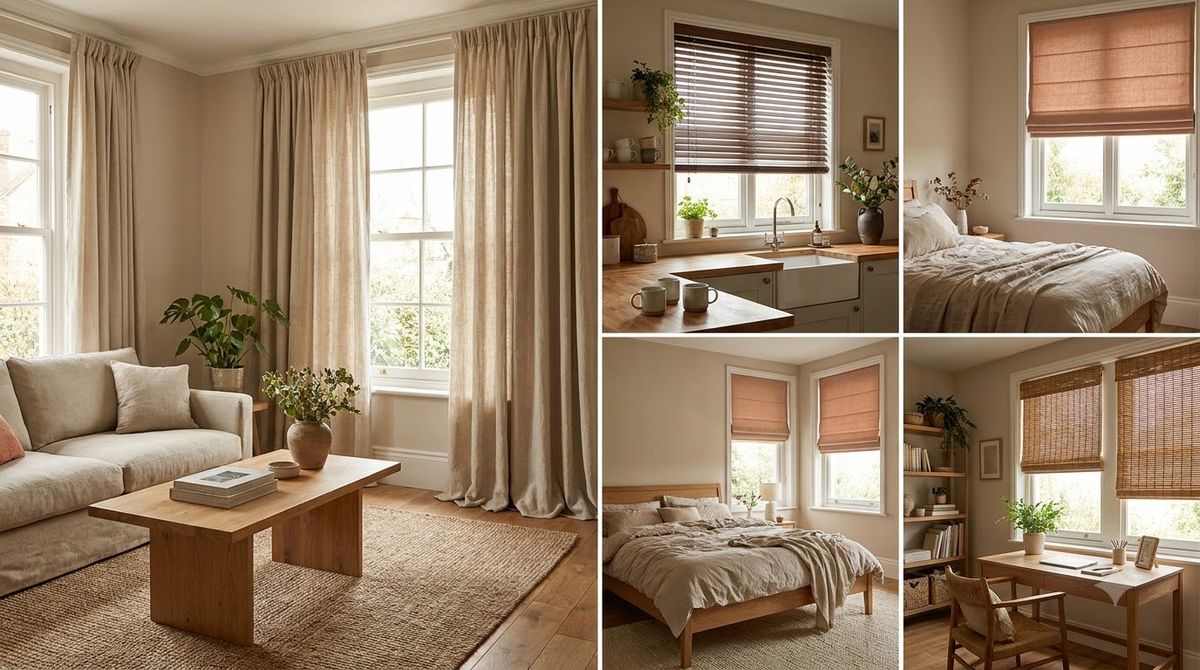
Here’s the quick verdict on curtains vs blinds: curtains give you soft, warm rooms and the coziest feel; blinds give you the most precise light control and a crisp, tailored look; shades land in the middle, offering clean lines with softer texture. If you rent, you don’t have to choose just one. The best-looking rooms layer them together, and most renter-friendly options install with tension rods or adhesive hooks, so you protect your security deposit.
Below we break down what each one does best across bedrooms, living rooms, kitchens, and bathrooms, share the standard hanging measurements, and give you a full comparison table so you can match the right window treatment to the right room and your budget.
Curtains vs Blinds vs Shades: What’s the Difference?
Before we get into rooms, here’s the plain-language version. Curtains (and drapes) are fabric panels that hang from a rod and move side to side. Blinds are hard slats, usually horizontal, that tilt open and closed and raise up. Shades are a single piece of soft material that rolls, folds, or pleats up and down. Each behaves differently in a room, and each has a very different relationship with your wallet and your lease.
Key Takeaways
- Curtains win on warmth, softness, and renter flexibility. Best for living rooms and bedrooms where you want cozy.
- Blinds win on precise light control and privacy in tight spots. Best for kitchens, bathrooms, and home offices.
- Shades win on clean, minimal looks with a little softness. Best for small spaces and windows you want to disappear.
- Renters: tension rods, adhesive hooks, and no-drill brackets let you hang curtains and many shades without touching the walls.
- Layering blinds or shades under curtains gives you both function and warmth, and it’s the setup we recommend most.
Curtains vs Blinds vs Shades: The Big Comparison Table
Skim this table to find your room, then read the sections below for the details.
| Feature | Curtains | Blinds | Shades |
|---|---|---|---|
| Light control | Good with blackout lining; sheers filter softly | Excellent; tilt slats to dial light precisely | Very good; from sheer to full blackout roller |
| Privacy | Good when closed; sheers show silhouettes at night | Excellent; close slats fully for total privacy | Good to excellent depending on opacity |
| Price (per window) | $20-$80 budget; $100+ custom | $25-$60 faux wood; $150+ real wood/custom | $30-$90 roller/cellular; $200+ custom |
| Renter-friendly | Very high; tension rods, no-drill brackets | Medium; most need drilling unless no-drill | High; many no-drill and cordless options |
| Best room | Living room, bedroom | Kitchen, bathroom, office | Small spaces, nurseries, minimalist rooms |
| Warmth & softness | Highest; adds texture and insulation | Lowest; crisp and functional | Medium; soft fabric, tidy profile |
Are Curtains or Blinds Better for Renters?
For most renters, curtains win, and it comes down to installation. Blinds usually require drilling into the window frame, which many leases discourage and which means patching holes when you move. Curtains can go up on a tension rod inside the frame or on no-drill brackets that clamp on, leaving zero damage. In a rental with painted-shut trim you don’t want to touch, tension rods and a set of linen panels can transform a room in an afternoon with nothing but a level.
That said, no-drill blinds and cordless shades exist and work well on standard windows. If you crave that tailored, slatted look, look for tension-mounted or adhesive-bracket blinds before you rule them out. Here’s how we’d rank the no-damage options:
- Tension rod + curtains — cheapest, fastest, and works inside almost any window recess.
- No-drill curtain brackets — clamp onto the trim to hang a full-width rod for panels wider than the window.
- Cordless no-drill shades — spring-tension roller and cellular shades that press into the frame.
- Adhesive-mount blinds — command-strip brackets hold lightweight faux-wood or aluminum blinds.
- Static-cling or removable film — a privacy backup for bathrooms when you can’t hang anything at all.
If you’re furnishing a whole rental on a budget, our small apartment decor ideas guide pairs these no-drill treatments with the rest of the room.
Which Is Best for Bedrooms?
For bedrooms, go for curtains with blackout lining, ideally layered over a simple shade or blinds. Curtains bring the warmth and quiet a bedroom needs, and blackout panels block the streetlight-and-sunrise problem that thin shades can’t fully solve on their own. Running blackout curtains over a cheap roller shade adds a second layer that helps with early sunrise.
When you shop, match the treatment to how dark you actually need the room:
- Blackout (no light): lined blackout curtains or blackout roller/cellular shades. Best for shift workers, nurseries, and light sleepers.
- Room-darkening (small glow at edges): thick woven curtains or a room-darkening shade. Comfortable for most sleepers.
- Light-filtering (soft daylight): linen curtains or a light-filtering shade. Great for a bright morning room.
- Sheer (privacy by day only): sheer panels. Layer these under blackout curtains for flexibility.
For a deeper breakdown of blackout, sheer, and linen options by sleep style, see our guide to the best bedroom curtains, and if you’re styling the whole room, our aesthetic bedroom ideas guide shows how window treatments tie the look together.
Which Is Best for Living Rooms?
Living rooms are where curtains shine. Floor-length panels add height, softness, and that lived-in warmth a hard treatment can’t match, and they frame a big window like nothing else. Layer sheers with heavier curtains here so you can flood the room with soft daylight or close up for a movie night. Blinds and shades still have a place as the functional layer underneath, but the fabric is what makes the room feel finished.
The single biggest upgrade is hanging curtains correctly. Follow these numbers and even budget panels look custom:
- Hang the rod 4 to 6 inches above the window frame (or higher, toward the ceiling, to make walls feel taller).
- Extend the rod 8 to 12 inches past each side of the window so open panels clear the glass and light.
- Buy panel width equal to about 2x the window width combined, so curtains look full and gathered, not stretched flat.
- Let panels reach the floor — a slight kiss to the floor or a half-inch break looks intentional; floating short looks unfinished.
For more ways to build warmth around those windows, our cozy living room ideas guide walks through layout and layering.
Which Is Best for Kitchens and Bathrooms?
In wet, splash-prone, grease-prone rooms, blinds and roller shades beat curtains. Faux-wood blinds wipe clean, resist moisture, and won’t wick water like fabric does over a sink. A vinyl or faux-wood roller shade does the same job with a smoother look. Fabric over a sink also tends to hold onto cooking smells.
Quick picks for these rooms:
- Over the kitchen sink: faux-wood blinds or a wipeable roller shade you can raise for prep.
- Bathroom window: a moisture-resistant shade or blinds; add a privacy film if the window faces a neighbor.
- Renter no-drill fix: a tension-rod cafe curtain in a washable fabric for the bottom half of the window only.
- Small windows: an inside-mount roller shade keeps sightlines clean and counters uncluttered.
How to Choose on a Budget
You rarely need custom anything. Off-the-shelf sizes cover most windows, and the price gaps are real: budget curtain panels run about $20 to $80 per window, faux-wood blinds about $25 to $60, and roller or cellular shades roughly $30 to $90. Custom versions of all three climb past $150 to $200. The budget strategy is simple:
- Spend on the room you live in most — usually the living room or bedroom. Put curtains there.
- Buy function cheap where it’s hidden — a $30 roller shade behind curtains does the light-blocking work invisibly.
- Standardize sizes so you can reuse panels and rods when you move.
- Choose neutral colors that survive a move to a new wall color and a new lease.
Frequently Asked Questions
Are curtains or blinds cheaper?
Budget curtain panels and faux-wood blinds land in a similar range, roughly $20 to $80 per window off the shelf. Curtains can be cheaper if you already own rods, while blinds add up when you buy the no-drill hardware. For renters, tension-rod curtains are usually the lowest total cost.
Can I put curtains over blinds or shades?
Yes, and we recommend it. Layering curtains over blinds or a roller shade gives you precise daytime light control from the hard treatment plus warmth, softness, and full blackout at night from the fabric. It’s the most flexible setup for bedrooms and living rooms, and it hides a cheap functional shade behind nicer panels.
What window treatment is best for small apartments?
In small spaces, inside-mount roller or cellular shades keep windows tidy and walls clear, which makes rooms feel bigger. If you want warmth, hang light curtains high and wide so the window reads larger. Cordless, no-drill options are safest and easiest to remove when your lease ends.
Do curtains or blinds block more light?
Blackout curtains and blackout roller shades block the most light, especially when sized to overlap the frame. Standard blinds let thin lines of light leak between and around the slats. For a truly dark room, layer blackout curtains over a shade so no gaps remain at the edges.
Which lasts longer, curtains, blinds, or shades?
Faux-wood blinds tend to last longest because they wipe clean and resist moisture and fading. Quality curtains last for years but need occasional washing. Roller and cellular shades fall in between; their mechanisms can wear over time. For high-use, humid rooms, blinds are the most durable choice.
Our Bottom Line
To sum up the whole curtains vs blinds question in one line: choose curtains for warmth and rental flexibility, blinds for precision and wet rooms, and shades when you want clean and simple. But the real secret is that you don’t have to pick just one. Layer a cheap functional shade or blind under curtains you love, hang everything high and wide, and lean on no-drill hardware so the whole setup moves with you.
Start with the room where you spend the most time, get the measurements right, and add the softer or harder layer as your budget allows. A window treatment is one of the fastest, most affordable ways to make a space feel finished, and none of it has to be permanent. For more small-space ideas that work with any of these treatments, our small apartment decor ideas guide is a good next stop. That’s how a rental starts to feel like home.