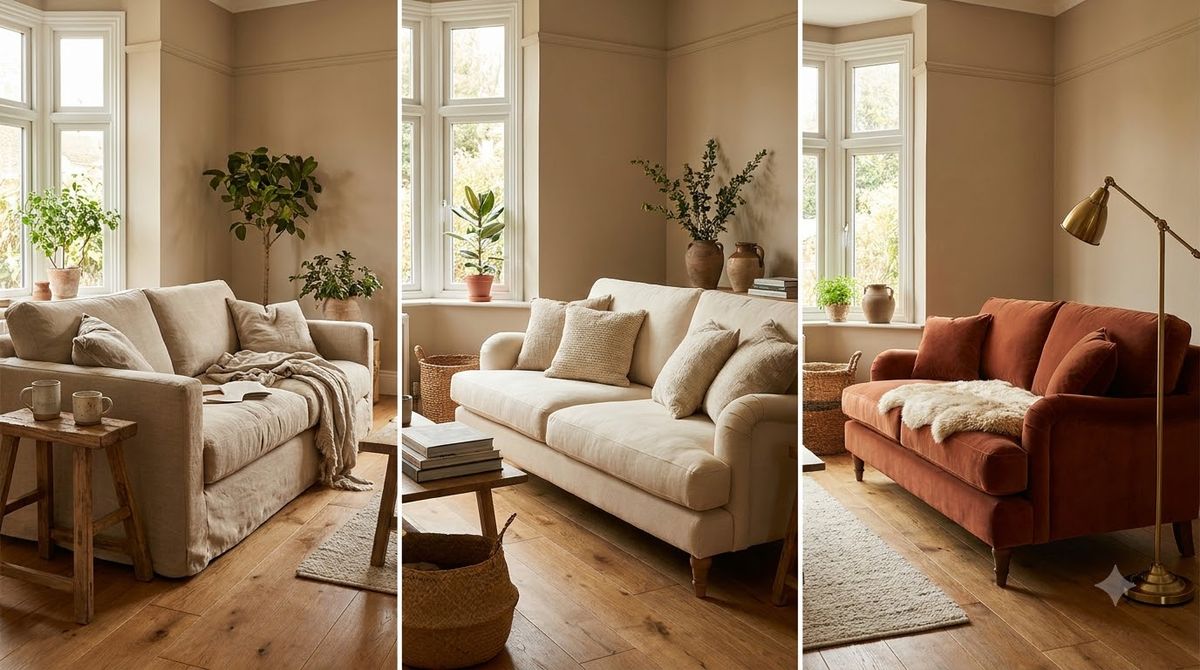
If you want the short answer before you fall down a swatch-ordering rabbit hole: linen gives you an airy, casual, slightly rumpled look that suits bright rooms and relaxed renters; cotton is the soft, affordable, easygoing middle child that plays well with kids and tight budgets; and velvet is the plush, moody, light-catching drama piece that makes a small living room feel like a boutique hotel.
There is no universal “best sofa fabric” — the right pick depends on your pets, your light, your budget, and how forgiving you need the surface to be. Below, we break down all three honestly, plus where performance weaves and microfiber fit in.
Key Takeaways: linen vs cotton vs velvet
Here is the fastest way to choose. If your apartment gets flooded with sunlight and you love a lived-in, coastal-casual feel, go linen. If you are furnishing on a budget, have a rotating cast of kids and snack crumbs, and want something soft you can slipcover and wash, go cotton.
If you have a north-facing or dim room that needs richness and you want a sofa that reads as more expensive than it was, go velvet. Everything after this is nuance.
Key takeaways
- Linen: airy and breathable, wrinkles and relaxes (a feature, not a flaw), best in bright rooms, prone to snags around cats.
- Cotton: softest to the touch, most budget-friendly, easy to slipcover and clean, but shows stains and can pill over time.
- Velvet: plush and light-reflecting, surprisingly kid-friendly on synthetic weaves, hides pet fur poorly but resists scratches and crushing on performance versions.
- Performance fabrics and microfiber outperform all three on stain resistance and are the safest bet for pets and toddlers.
- Check the cleaning code (W, S, W/S, or X) and the rub count before you buy — those two numbers matter more than the fiber name.
The full comparison table
Before we get into the texture and mood of each fabric, here is the head-to-head. Rub count refers to the Martindale or double-rub abrasion test — a rough durability yardstick where higher numbers survive more wear.
| Fabric | Durability (rub count) | Cleaning | Feel | Price range* | Best for |
|---|---|---|---|---|---|
| Linen | Moderate; snags near claws | Usually code W or S; professional clean for whole-cushion spills | Cool, crisp, breathable, relaxed with wrinkles | $$–$$$ | Bright rooms, casual coastal looks, warm climates |
| Cotton | Moderate; can pill | Code W; slipcovers often machine washable | Soft, matte, familiar, cozy | $–$$ | Budgets, kids, renters who want washable slipcovers |
| Velvet | Wide range: cotton velvet lower, performance/synthetic velvet high (30,000+ double rubs) | Code S for cotton velvet; W/S for performance velvet; brush the nap | Plush, dense, light-catching, warm | $$–$$$$ | Dim or moody rooms, small-space drama, adults |
| Performance / microfiber | High (often 50,000–100,000+ double rubs) | Code W or W/S; most spills wipe up | Soft to suede-like, less “natural” hand | $$–$$$ | Pets, toddlers, worry-free everyday use |
Linen: airy, casual, and unapologetically relaxed
Linen is a natural flax fiber, and its whole personality is breeziness. It feels cool to sit on, which is why it shines in warm climates and sun-drenched rooms, and it drapes with a soft, slightly imperfect slouch. That rumpled quality is the thing people either adore or fight.
Embrace it — the gentle creasing across the seat cushions is exactly what makes linen read as effortless and expensive rather than stiff. Think faded oatmeal (roughly #D8CBB4), soft greige (#B9AE9C), or a muted sage (#A7B0A0) that all photograph beautifully in daylight.
Durability is moderate. Linen is strong for a natural fiber, but the open weave means loose loops can snag — a real consideration if you have a cat who treats furniture as a scratching post. Sunlight is linen’s friend in terms of looks but a slow enemy over years, as any natural fiber will gradually fade in direct exposure.
- Choose linen if: your room is bright, you like a casual coastal or Scandinavian look, and you run warm.
- Skip linen if: you want a crisp, wrinkle-free look or you have cats that scratch.
- Pro move: look for a linen blend (linen + cotton or linen + poly) for better wrinkle recovery and abrasion resistance.
Cotton: soft, affordable, and easy to live with
Cotton is the fabric most of us grew up with, and it earns its popularity honestly: it is soft, matte, endlessly available, and typically the most budget-friendly of the three. It takes dye brilliantly, so you will find cotton in the widest color range, from crisp white to deep denim navy (#2E3B4E) to warm terracotta (#C1694F). For renters and first-apartment furnishing, cotton is often the smart starting point.
Its big advantage for families is the slipcover. Many cotton sofas come with removable, machine-washable covers, which means a juice spill is a laundry problem, not a professional-cleaning emergency. The trade-offs are real, though: cotton shows stains readily, can wrinkle, and tends to pill or thin at high-contact spots over years of heavy use. It is comfort-first, not bulletproof.
- Choose cotton if: you are on a budget, you want washable slipcovers, or you crave that soft, broken-in feel.
- Skip cotton if: you need heavy stain resistance without a slipcover, or you hate visible wear.
- Pro move: a cotton-poly blend keeps the softness while cutting down on wrinkling and pilling.
Velvet: plush, moody, and made for small spaces
Velvet is the one that stops people mid-scroll. Its dense pile catches light and shifts tone as you move, which is why a jewel-toned velvet sofa — emerald (#1E4D3B), inky navy, or a dusty blush (#C99DA3) — can make a small, dim living room feel intentional and rich rather than cramped.
Here is the nuance most people miss: not all velvet is delicate. Traditional cotton velvet crushes and marks more easily and usually carries an S (solvent-only) cleaning code.
But modern performance velvet is woven from polyester and is genuinely tough — high rub counts, resistant to crushing, and often rated W/S so water-based spills wipe up. That version is far more kid-friendly than its reputation suggests. The honest downside for pet owners: velvet’s pile shows fur and lint clearly, so you will be reaching for a lint roller.
- Choose velvet if: your room needs warmth and depth, you love a moody or glam look, or you have a small space to elevate.
- Skip velvet if: you have heavy shedders and hate lint-rolling, or you only want a low-maintenance cotton-velvet with an S code.
- Pro move: insist on performance velvet (polyester pile) for durability and easier cleaning.
Where do performance fabrics and microfiber fit in?
If you skimmed the table, you noticed the fourth column quietly outscoring everyone on durability and cleaning. Performance fabrics (branded and generic) and microfiber are engineered for exactly the mess that natural fibers dread. Microfiber’s tightly packed synthetic threads resist liquid absorption, so most spills bead up long enough to blot. Performance weaves add stain-shield finishes and very high abrasion resistance.
The trade-off is the hand-feel. A natural linen or cotton has a texture and breathability that synthetics approximate but rarely match, and some performance fabrics can feel warmer to sit on. But if your real question is “what survives a puppy and a two-year-old,” this is the category to shortlist — often as a performance-linen-look or performance-velvet, so you get the aesthetic without the fragility.
Which sofa fabric is best for pets?
For pets, the fiber name matters less than the weave and finish. That said, there is a clear ranking based on how claws, fur, and accidents behave on each surface. Tight, low-texture weaves beat loose, loopy ones, and synthetics beat naturals for stain cleanup.
- Performance fabric / microfiber — the safest choice; tight weave resists claws, spills wipe up, fur brushes off.
- Performance velvet — surprisingly scratch-resistant (no loops to catch), but shows fur, so plan on lint-rolling.
- Cotton (with washable slipcover) — accidents become laundry, but the surface stains and can snag.
- Linen — the trickiest with cats because the open weave snags; better with dogs than clawing kittens.
Whatever you pick, choose a mid-tone that camouflages fur (a fawn or heathered gray for light-haired pets, a warm brown for dark) rather than a color that turns every shed hair into a spotlight.
Is velvet hard to clean?
It depends entirely on the cleaning code, which is the single most useful thing on a sofa’s spec sheet. Cotton velvet often carries an S code (solvent-only), which does make it fussier — water can leave rings, so you are looking at a dry-cleaning solvent or a professional.
Performance velvet frequently carries a W or W/S code, meaning water-based cleaners are safe and most everyday spills blot right out. The maintenance quirk unique to velvet is the pile: it can flatten or show water marks, so you brush the nap back into alignment with a soft brush after cleaning. It is not hard — it is just a different routine.
- W — clean with a water-based cleaner.
- S — solvent only; no water. Common on cotton velvet and some linens.
- W/S — either water-based or solvent is safe. The most forgiving.
- X — vacuum or professional clean only; no home liquids at all.
How we would choose, room by room
The choice keys off two things you can check in five minutes: how much natural light the room gets, and who lives there. Match those to the fabric and you rarely regret it.
- Bright, sunny room + adults or older kids: linen or a linen blend for that airy, relaxed feel.
- Any light + tight budget + young kids: cotton with a washable slipcover.
- Dim or small room + wanting drama: performance velvet in a jewel tone.
- Pets and toddlers together: performance fabric or microfiber, full stop.
- Frequent redecorators / renters: a neutral cotton or performance weave that moves between apartments without clashing.
If you are still weighing shapes as well as fabrics, our sectional vs. sofa guide pairs well with this one, and our roundup of the best living room sofas under $1,500 shows how these fabrics play out at a real budget.
For the full picture of pulling a room together, the cozy living room ideas and layout guide covers color and arrangement, and if you fell in love with the linen-versus-cotton question, our 2026 bedding guide on linen, cotton, and bamboo carries the same debate into the bedroom.
Frequently asked questions
What is the most durable sofa fabric overall?
Performance fabrics and microfiber are the most durable in daily use, often rated for 50,000 or more double rubs and finished to resist stains. Among the three naturals here, a performance velvet with a polyester pile is the toughest, while traditional cotton velvet and open-weave linen are the most delicate.
Which sofa fabric is cheapest?
Cotton is generally the most affordable, which is why it is the go-to for first apartments and tight budgets. Linen usually sits a step up, and velvet spans the widest range — cotton velvet can be moderate, while high-end performance velvet reaches the top of the price ladder. Construction and frame quality affect price as much as fiber.
Does linen wrinkle too much for a sofa?
Linen does wrinkle, and it always will — that soft creasing is part of its casual charm. If a rumpled look bothers you, choose a linen-cotton or linen-poly blend, which recovers better and keeps a smoother surface. Fighting linen’s natural texture usually leads to disappointment, so it is best to embrace it.
Is velvet a good idea in a small living room?
Yes, it is often a great pick for small spaces. Velvet’s light-catching pile adds depth and richness that makes a compact or dim room feel intentional rather than cramped. A jewel-toned velvet in emerald or navy acts almost like a piece of art, so you can keep the rest of the room simple and let the sofa lead.
What cleaning code should renters look for?
Renters juggling spills and eventual moves should favor a W or W/S code, which allows safe water-based cleaning at home for most accidents. An S code means solvent-only and usually a professional, and an X code means no home liquids at all. Checking that single letter before buying saves a lot of future stress.
The bottom line
There is no single best sofa fabric — only the best fabric for your light, your budget, and your household. Reach for linen when you want airy and casual in a bright room, cotton when you want soft and affordable with washable slipcovers, and velvet when you want plush drama that flatters a small or moody space.
And if pets and toddlers are running the show, let a performance fabric or microfiber quietly win the day. Order swatches, check the rub count and cleaning code, and trust the surface you will actually want to sink into every night.