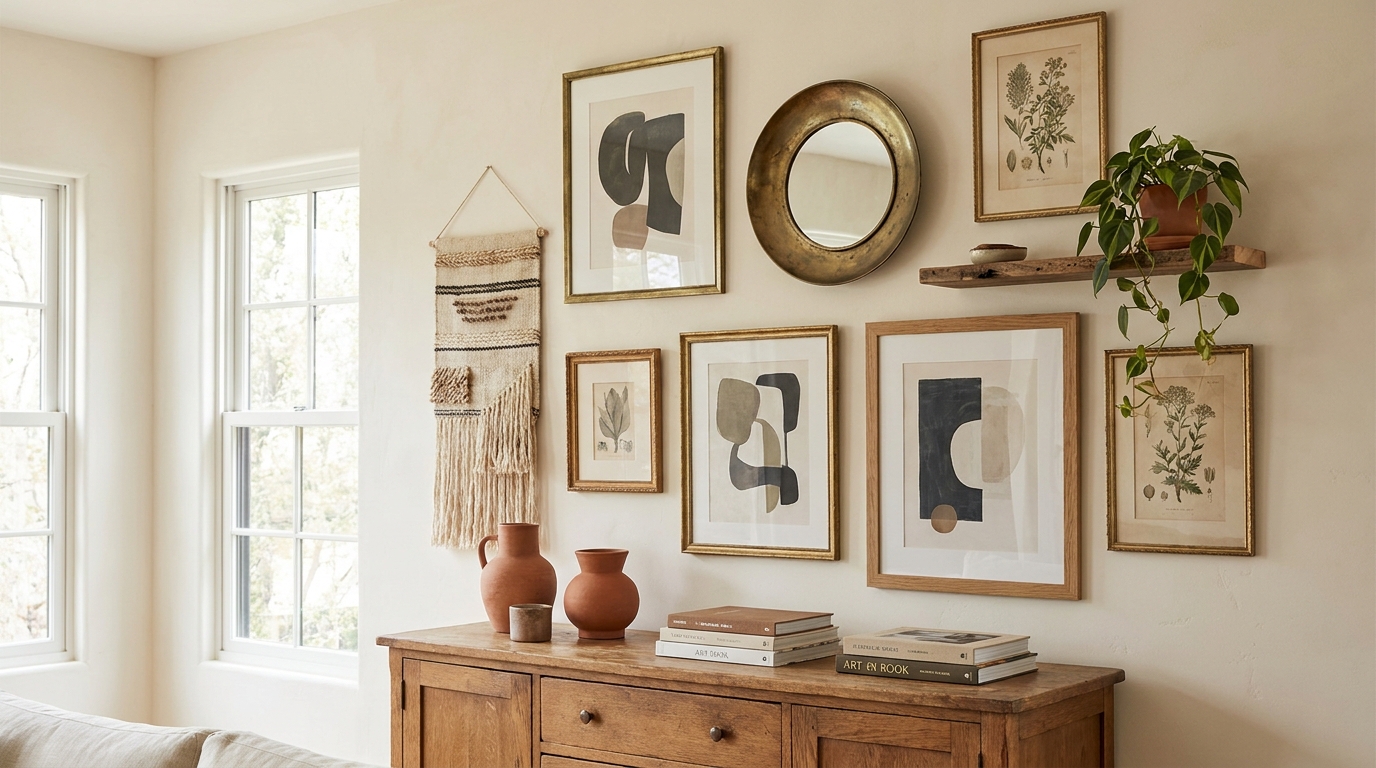
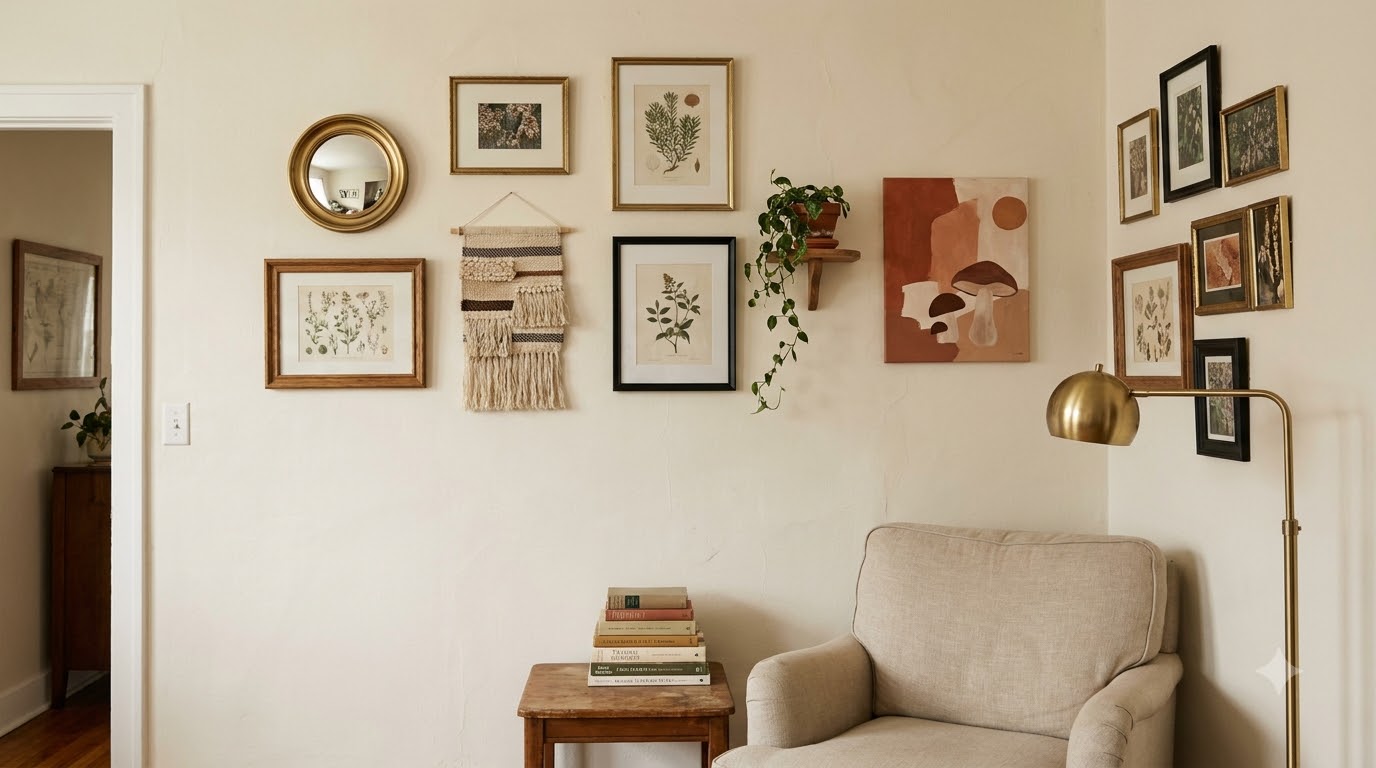
The fastest way to build an eclectic gallery wall is to anchor it with one large mirror or oversized print, then layer in 6–9 mixed items at varying scales — combining 60% framed art, 25% mirrors or sculptural objects, and 15% plants or trailing greenery. Keep frame spacing between 2 and 3 inches, and let no single style dominate more than half the wall.
That formula sounds simple, but the difference between a gallery wall that looks intentional and one that looks chaotic comes down to ratio, rhythm and restraint. If you rent or just moved into your first home, you also need a layout that survives changes of mind — and the occasional security deposit inspection.
This guide walks through the exact mix that works, layout templates you can copy, where to source eclectic pieces under $50, and the hanging hardware that won’t damage drywall.
Key Takeaways
- The 60/25/15 rule: Roughly 60% framed art, 25% mirrors or 3D objects, 15% plants or organic elements creates visual balance without feeling staged.
- Anchor first, fill second: Place your largest piece (mirror or statement print) slightly off-center, then build outward in decreasing size.
- Mix three frame finishes max: Black, natural wood, and brass/gold is the most forgiving combination. Adding a fourth tone usually reads as cluttered.
- Plants belong in the wall, not just near it: Wall-mounted planters and small trailing pothos cut the rigidity of a grid layout.
- Renters: use removable strips for anything under 4 lb, picture-hanging hooks for heavier mirrors. Test wall material first — strips fail on textured paint.
What Makes a Gallery Wall “Eclectic” (and Not Just Messy)
An eclectic gallery wall deliberately mixes styles, eras, media and subjects. That’s the definition designers and home decor writers agree on — a curated collision of formats rather than a coordinated set. A coordinated wall uses six matching black frames with botanical prints; an eclectic wall has a brass-framed thrift portrait next to a woven basket, a hand-pressed flower, a small round mirror and your grandmother’s embroidered linen.
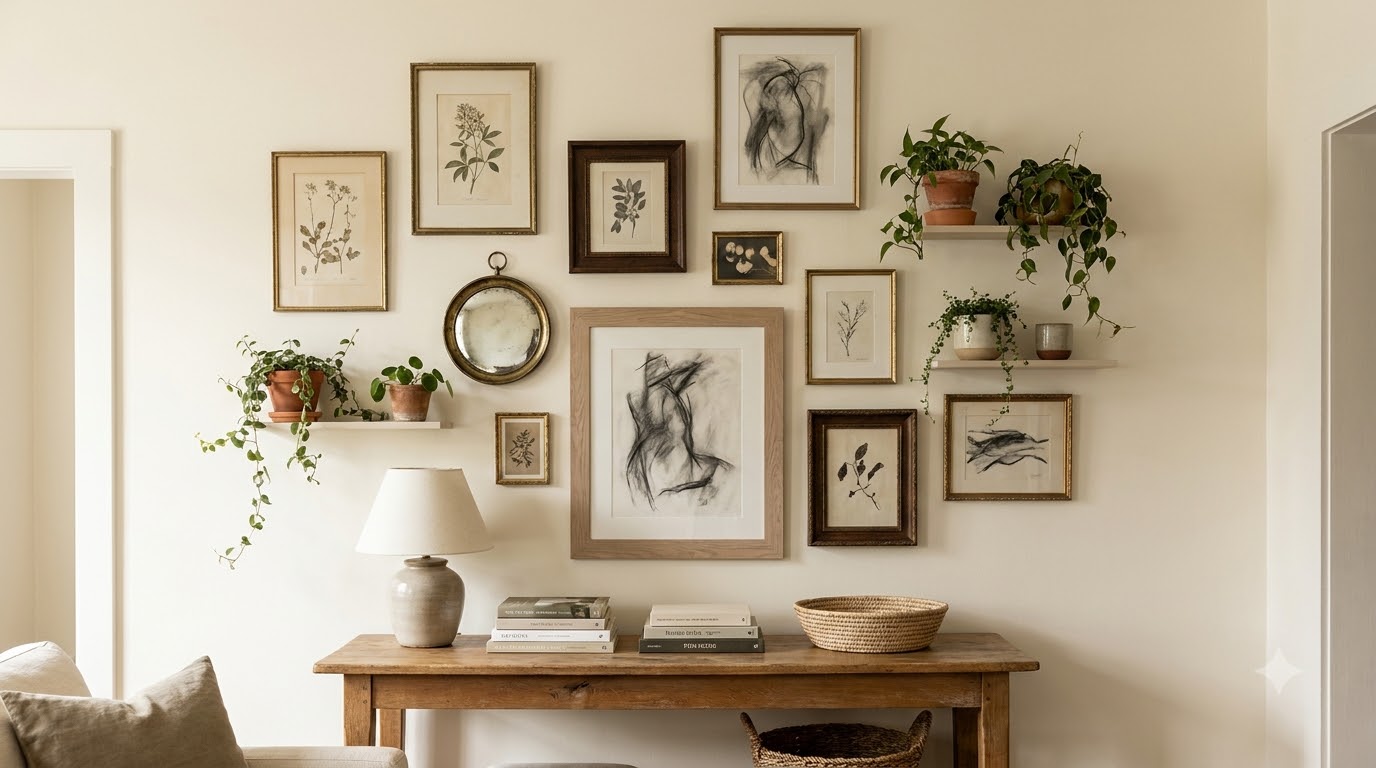
The trick is that “eclectic” still requires a system. Without one, the wall reads as visual noise. Three constraints make the difference:
-
A repeated element — usually color, frame finish, or subject matter — that ties unrelated pieces together.
-
A weight distribution that balances heavy and light objects across the wall instead of clustering them.
-
A controlled palette — typically 3–4 dominant colors plus neutrals.
According to the American Society of Interior Designers’ 2025 residential trends overview, “personality-driven walls” and curated maximalism continue to outpace minimalism in client requests, particularly among 25–40 year-old homeowners furnishing first properties. The takeaway: eclectic done well is now a mainstream style, not a niche one.
The 60/25/15 Mix: Art, Mirrors, Plants
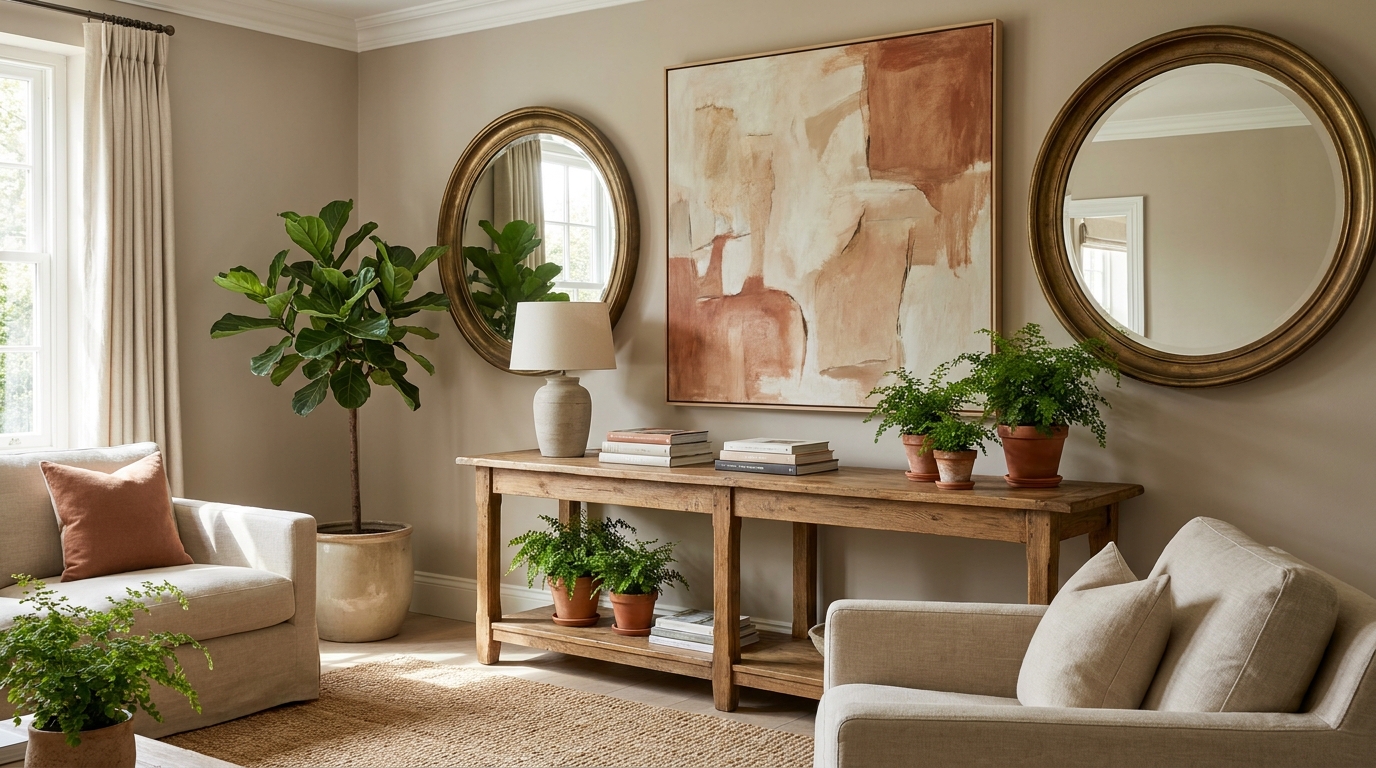
The simplest way to build an eclectic gallery wall is to plan the types of objects before you plan the layout. A reliable starting ratio:
| Element | Share of Wall | Why It’s There |
|---|---|---|
| Framed art, prints, photos | 60% | The narrative core — this is what people read first |
| Mirrors, sculptural objects, baskets | 25% | Adds depth and reflects light; breaks up flat surfaces |
| Plants, dried botanicals, organic textures | 15% | Softens edges and brings the wall to life |
For a typical 6 ft × 4 ft gallery wall with 10 objects, that translates to roughly 6 framed pieces, 2–3 mirrors or 3D objects, and 1–2 plants. Scale up or down proportionally.
Why mirrors matter more than people think
Mirrors do double duty: they reflect natural light (which makes small rental spaces feel larger) and they break the visual pattern of frame-after-frame. A 2024 RIBA-cited daylighting study found that strategically placed mirrors can increase perceived room brightness by up to 20% in interior rooms without north-facing windows. In a gallery wall context, even a 12-inch round mirror anchored low-left will visibly lift the brightness of a dim hallway or rental dining nook.
Why plants belong on the wall, not beside it
Plants beside a gallery wall stay separate. Plants in the gallery wall — mounted in wall planters, trailing from a small shelf, or as a single dried eucalyptus stem in a wall vase — integrate the arrangement. They also solve a common rookie mistake: hard right angles. Frames and mirrors are rectilinear; greenery introduces the curves and organic lines that keep the wall from feeling like a museum.
Six Eclectic Gallery Wall Layouts That Work
If you’re nervous about freestyling, copy one of these layout templates. All six work in 5–10 ft wide spaces and accommodate the 60/25/15 mix.
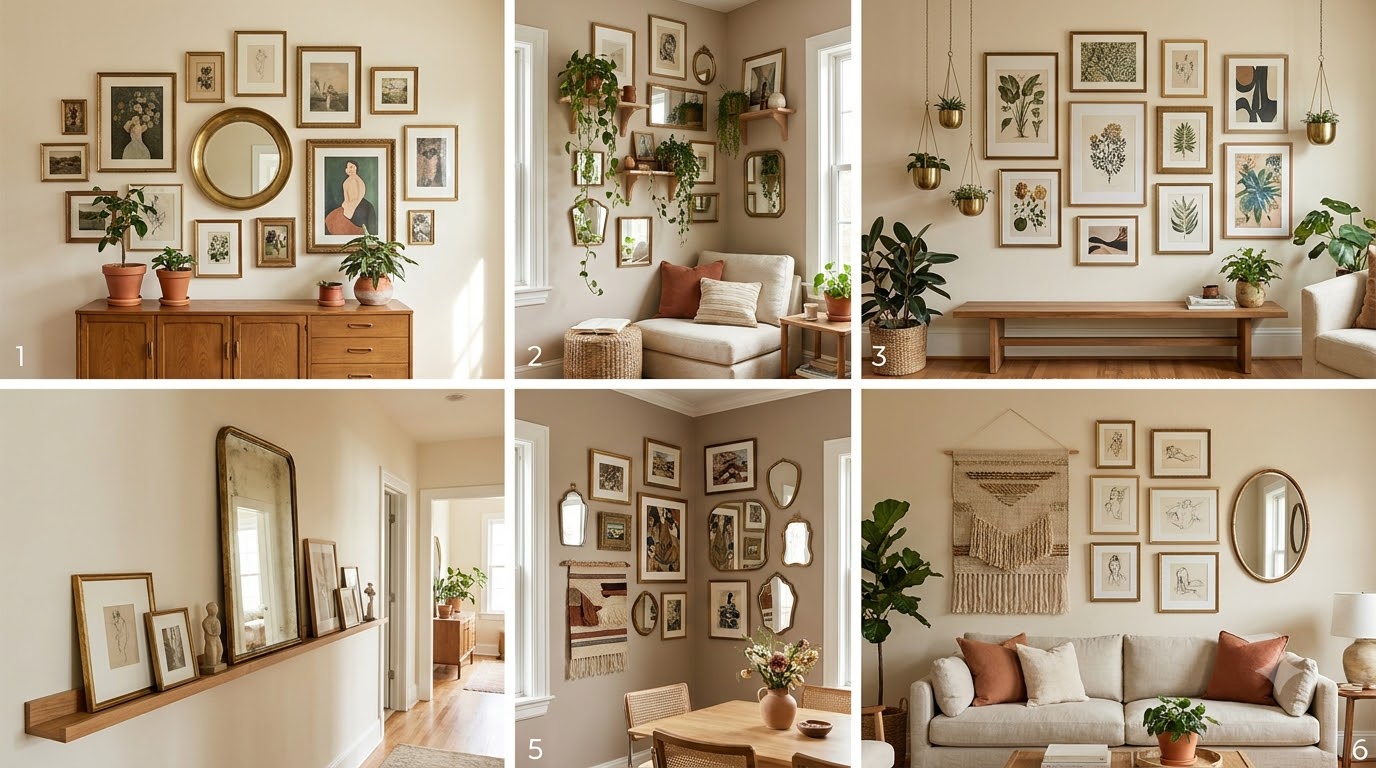
1. The Off-Center Anchor
Place a large mirror (24–30 inches) about one-third in from the left edge. Cluster 5–7 smaller items radiating out to the right. Add one small trailing plant in the upper right. Best for: living room sofas, console tables.
2. The Salon Stack
Inspired by 19th-century Parisian salons, this layout fills a wall floor-to-ceiling with 12–18 items in a loosely rectangular shape. Mix frame sizes from 5×7 up to 24×36. Best for: stairwell walls, dining rooms with high ceilings.
3. The Horizontal Line
Run a single row of mixed items at eye level (57–60 inches to center). Vary heights but keep the horizontal midline consistent. Add one or two pieces that break the line above or below for visual interest. Best for: narrow hallways, above headboards.
4. The Asymmetric Cluster
Build a tight cluster on one side (say, the left two-thirds) and let the right third breathe with just one or two items. Counterintuitively, the empty space makes the cluster feel more deliberate. Best for: entryways, awkward corners.
5. The Grid-Broken Eclectic
Start with a loose 3×3 grid of framed art, then “break” the grid by replacing two squares with a mirror, a hanging plant, or a small shelf with a sculptural object. Best for: beginners who want eclectic energy without abandoning structure.
6. The Floating Shelf Hybrid
Mount two narrow picture ledges and lean (don’t hang) most items. Add 2–3 wall-mounted pieces above and below the ledges to break the line. Best for: renters — leaning art means zero nail holes for half the wall.
Frame Finish Combinations That Don’t Clash
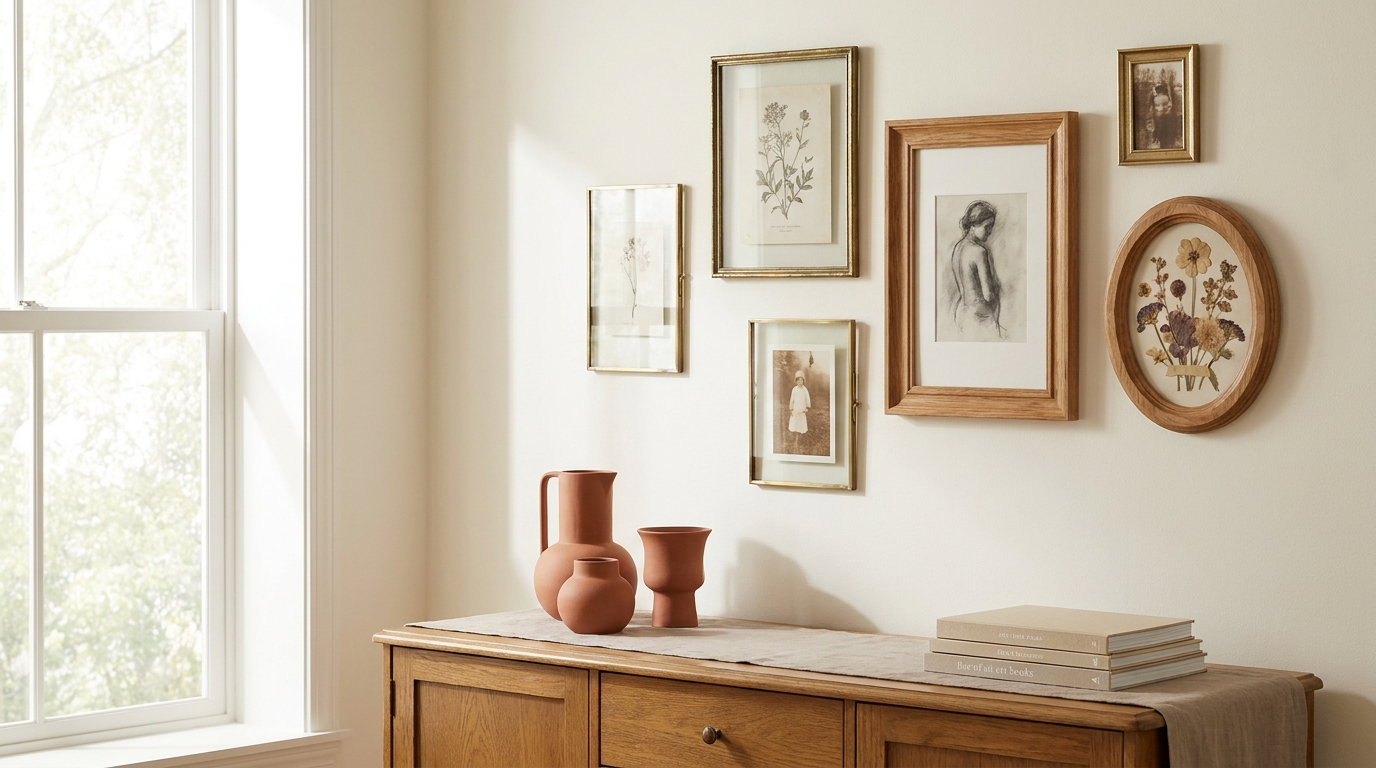
The fastest way to make an eclectic gallery wall look cohesive is to limit frame finishes to three. After testing dozens of combinations across reader-submitted spaces, three pairings consistently work:
- Warm neutral: Natural oak + matte black + antique brass
- Cool modern: White + brushed nickel + clear acrylic
- Vintage layered: Distressed gold + walnut + cream painted wood
If you inherit or thrift a frame that doesn’t match, paint it. A $4 can of matte black spray paint solves most frame-mismatch problems in 15 minutes. For renters worried about overspending on frames, IKEA, Target’s Threshold line, and HomeGoods consistently carry the three combinations above at $8–25 per frame.
Sourcing Eclectic Pieces Under $50
The eclectic look depends on objects with history or character — which means thrift stores, estate sales and online marketplaces beat big-box retailers for this style. A few reliable sources:
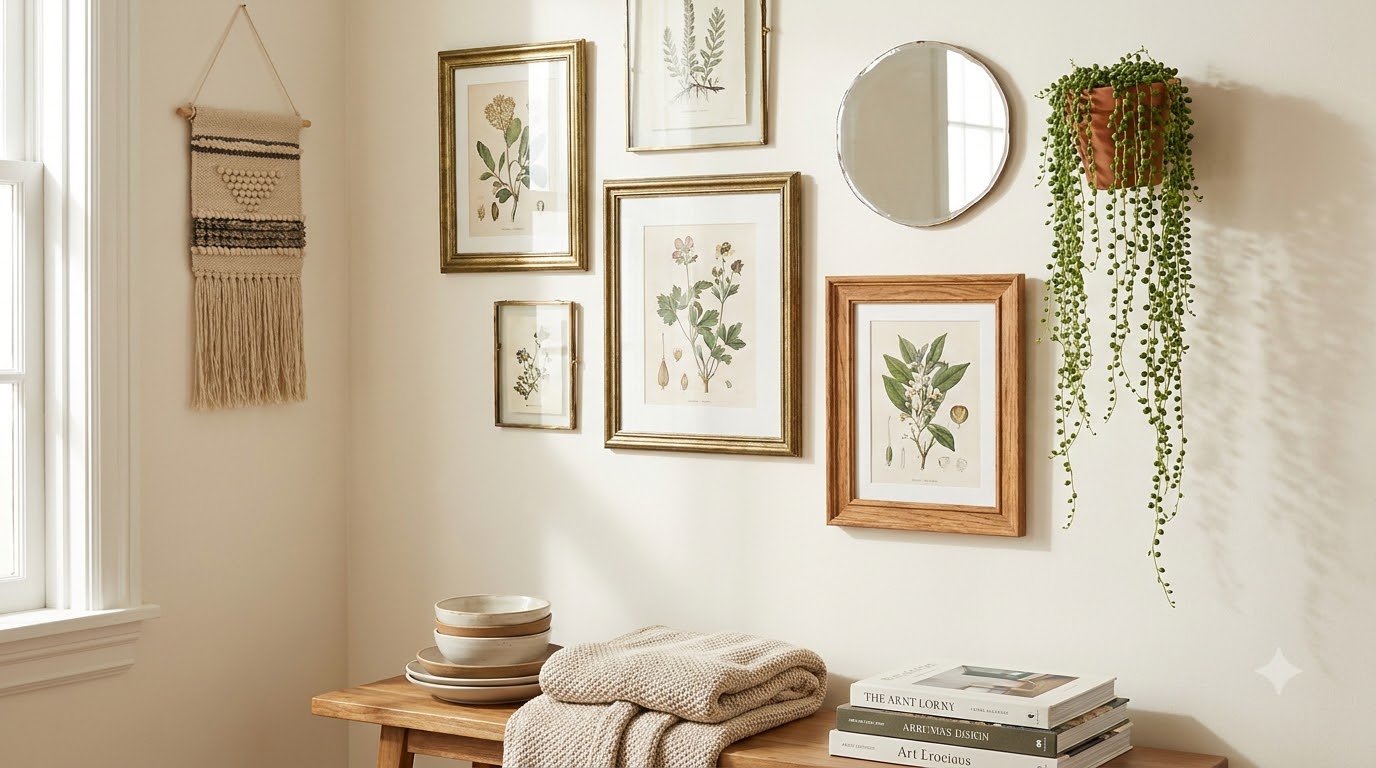
- Etsy vintage section: Botanical prints from $8–18, vintage portraits from $15–40.
- Facebook Marketplace: Local pickups of framed art and mirrors, often $5–25 each.
- eBay “lot” listings: Vintage postcards, pressed flowers, and small prints sold in bulk for under $20.
- Thrift stores (Goodwill, Savers): Frames are the real win — $2–6 per frame regardless of what’s inside.
- Public-domain art: Download free high-resolution images from the Met Open Access collection or Rijksmuseum Rijksstudio, then print at Walgreens or Walmart for under $10 per print.
Mix one or two pieces of personal photography or a hand-lettered quote with these found objects. Personal items prevent the wall from feeling like generic stock styling.
Hanging Hardware: What Actually Holds (and Won’t Damage Walls)
Renters lose security deposits over gallery walls more often than any other decor project. The mistake is almost always using the wrong hardware for the wall material. Here’s what works:
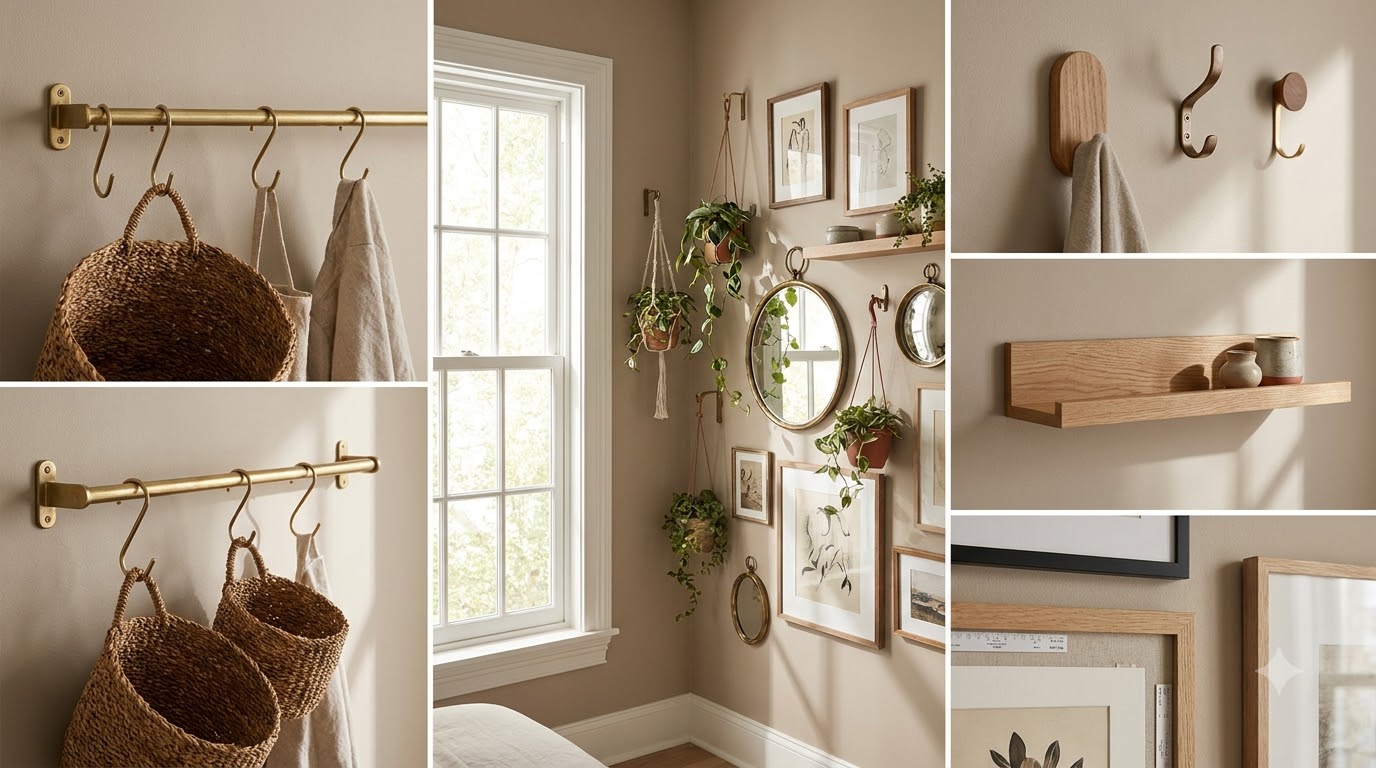
| Wall Type | Item Weight | Recommended Hardware |
|---|---|---|
| Smooth drywall, painted | Under 4 lb | Removable adhesive strips (Command brand) |
| Smooth drywall, painted | 4–20 lb | Standard picture hooks with nails |
| Smooth drywall, painted | 20+ lb | Toggle bolts or wall anchors |
| Textured paint or popcorn | Any weight | Picture hooks only — strips fail on texture |
| Plaster (older buildings) | Any weight | Pre-drill pilot holes; strips peel plaster paint |
| Brick or concrete | Any weight | Hardwall hooks or masonry anchors |
For renters: removable strips are tempting for everything, but they reliably fail on textured walls, semi-gloss paint over 2 years old, and humid bathrooms. For anything mirrored or sentimental, use a small nail hole and patch it with $3 spackle when you move out — that’s a smaller deposit hit than a shattered heirloom.
The U.S. Consumer Product Safety Commission also notes that wall-mounted mirrors over 10 lb should always be secured to a stud or with an anchor rated for the weight — adhesive strips alone are not appropriate for glass mirrors above that threshold.
How to Lay It Out Before You Hang Anything
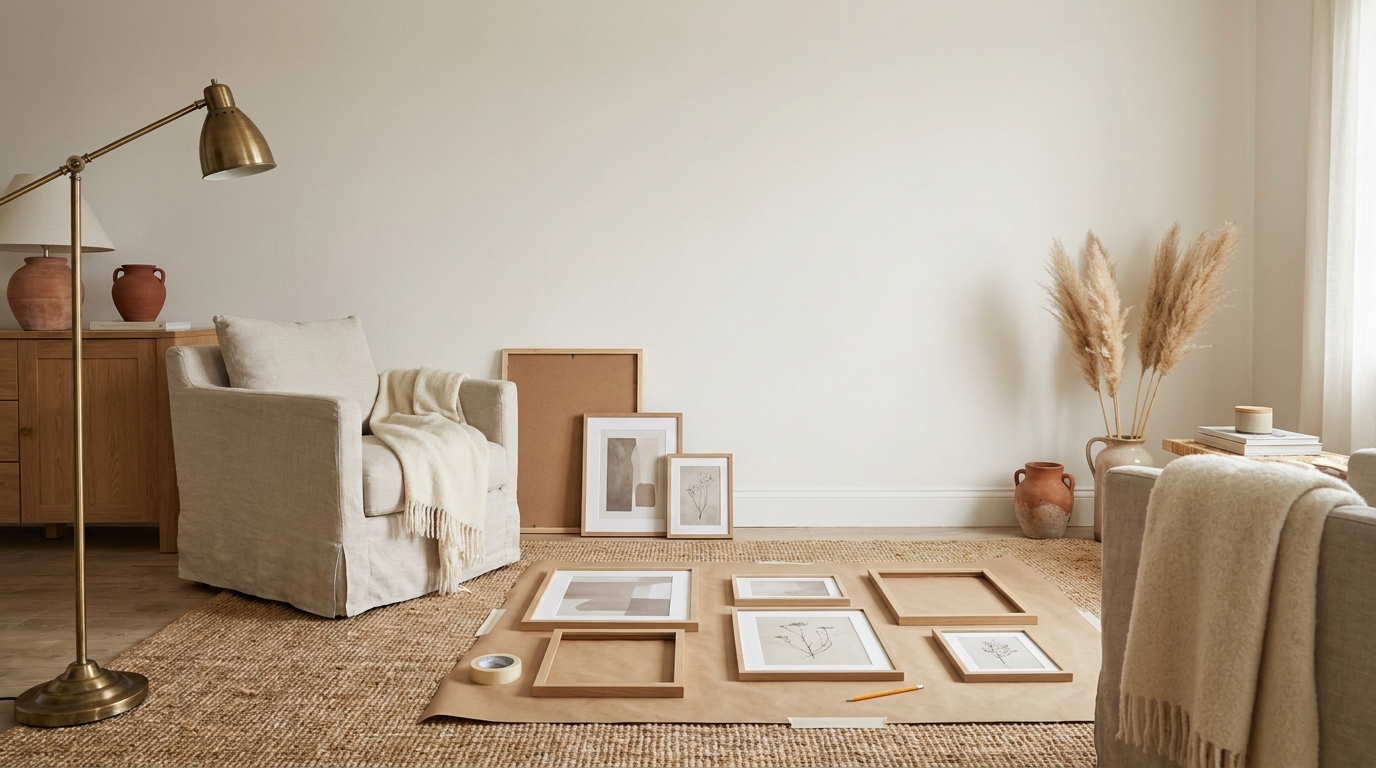
Don’t start with a hammer. Start with paper.
-
Trace each frame or object onto kraft paper or newspaper. Cut out the shapes.
-
Tape the cutouts to the wall with painter’s tape. Move them around for at least 24 hours.
-
Photograph the wall from across the room. Photos reveal imbalance the eye misses in person.
-
Mark hanger positions through the paper before removing it. Hang directly through the marks.
This 30-minute process saves an average of 4–6 unnecessary nail holes per wall.
Common Eclectic Gallery Wall Mistakes
A few patterns show up over and over in submitted reader photos that don’t quite work:
- Too many small items, no anchor. Without one piece at least 18–24 inches on its longest side, the wall reads as scattered.
- Even spacing everywhere. Eclectic walls need some tight clusters and some breathing room. Uniform 3-inch spacing is for grid walls.
- All frames at the same depth. Mix shadowbox frames with flat frames, and add at least one object that protrudes 2+ inches from the wall (a small shelf, a basket, a wall vase).
- Hanging too high. Center the cluster at 57–60 inches, not each individual piece.
- Forgetting the bottom edge. A ragged bottom line drags the eye down. Align at least three pieces along a soft horizontal at the base.
FAQs
How many pieces should an eclectic gallery wall have?
For a typical 5–8 ft wide wall, 8–12 objects is the sweet spot. Fewer than 6 reads as undercommitted; more than 15 starts crowding unless the wall is over 10 ft wide.
Can I mix portrait and landscape orientations?
Yes — mixing orientations is essential for an eclectic feel. Aim for roughly 60% portrait, 30% landscape, 10% square or round shapes.
Do mirrors and art really need to be the same style?
No. The whole point of eclectic is style collision. A modern abstract print can hang next to an ornate gilt-framed mirror. The unifying element should be a repeated color or frame finish, not subject matter.
What’s the best wall color behind an eclectic gallery wall?
A muted, slightly warm neutral — think soft cream, warm white, mushroom gray, or a dusty sage. Pure white can flatten the arrangement; dark walls (deep green, navy, charcoal) can dramatize it beautifully if you’re willing to commit.
How do I add plants without water damage to the wall?
Use planters with built-in drip trays, or insert a plastic liner cup between the plant and the wall-mounted holder. Trailing pothos and air plants are the lowest-risk options — neither needs frequent watering, and air plants need no soil at all.
Is an eclectic gallery wall renter-friendly?
Yes, with planning. Stick to items under 4 lb where possible (removable strips work), use leaning shelves to reduce nail holes, and keep one large statement piece on standard picture hooks. Patching 3–5 small holes at move-out takes 20 minutes and a $3 tub of spackle.
Where to Go Next
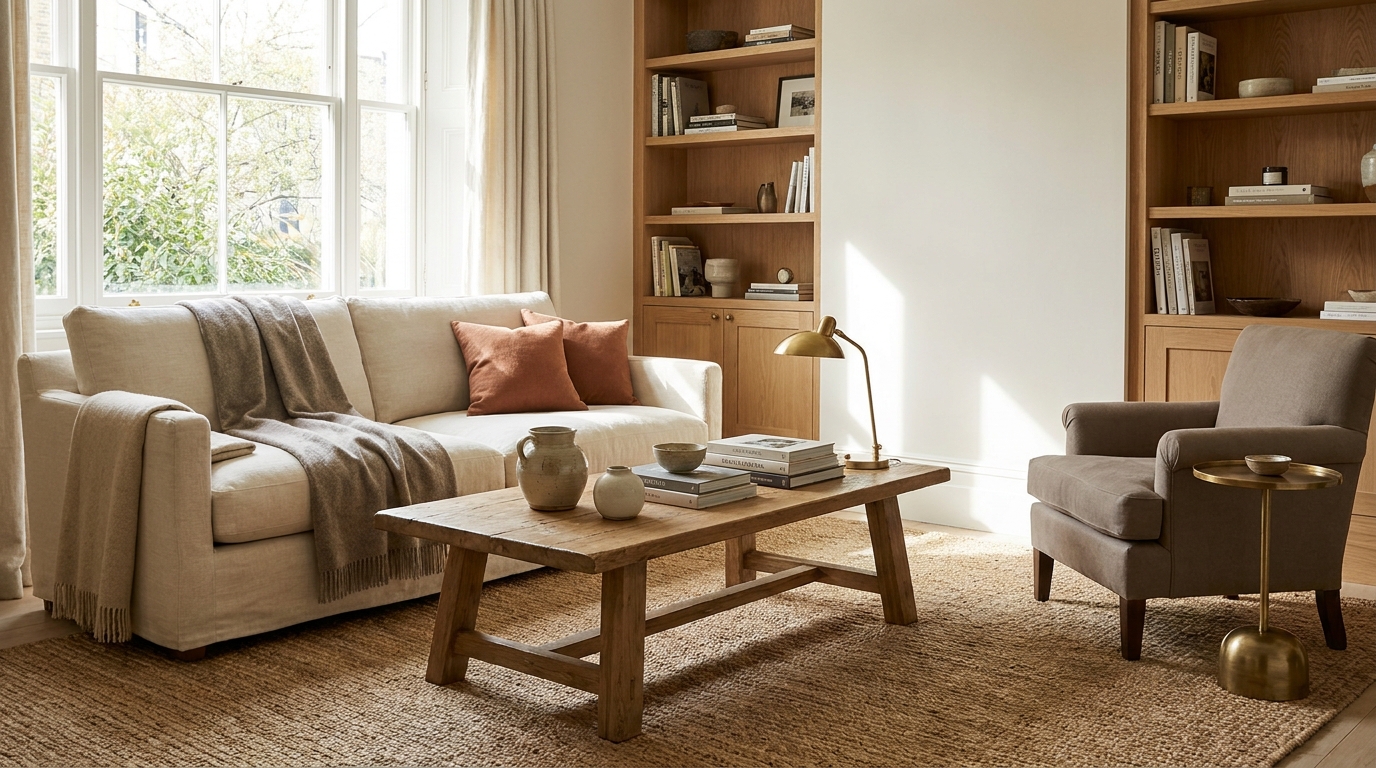
If you’re just getting started, pair this guide with our broader gallery wall planning checklist and our breakdown of small living room gallery wall layouts. For the budget side, our thrifted wall art sourcing guide covers exactly what to look for at Goodwill and estate sales.
An eclectic gallery wall isn’t built in one weekend — it grows. Start with the anchor piece, live with it for a week, add the next three items, live with those, and keep layering. The walls people love most are the ones that took six months to settle into themselves.
Last updated June 2026. The Decor Note independently researches and tests every product and technique referenced in our guides.