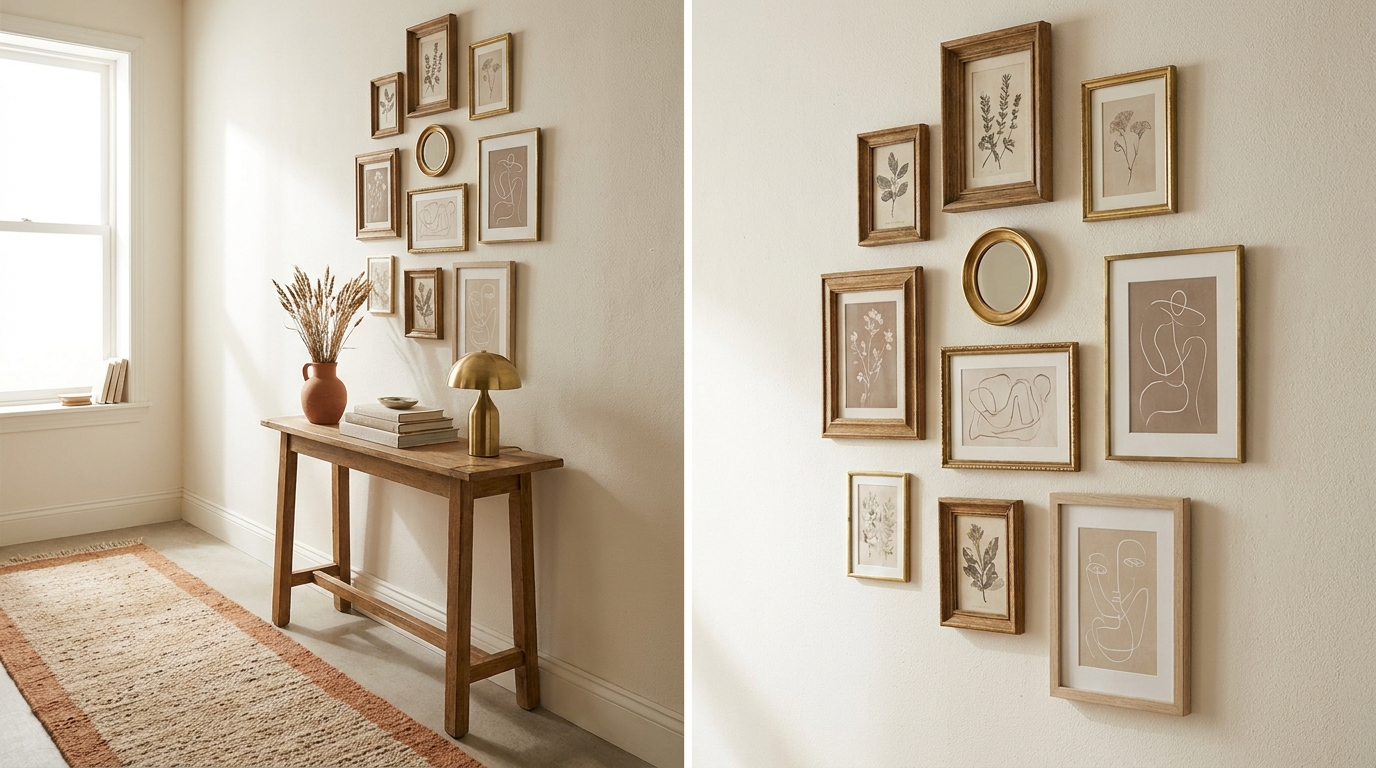
Small gallery wall ideas work best when you commit to a tight grid (2×2 or 3×3), keep frame spacing between 2 and 3 inches, and anchor the centerpoint at 57 inches from the floor. That single rule turns a cramped wall into a focal point instead of a cluttered afterthought, and it works whether you have 24 inches of bathroom wall or a narrow stairwell landing.
If you’re renting a 600-square-foot apartment, decorating a starter home, or trying to dress up the only wall in your bedroom that isn’t blocked by furniture, the standard “go big” gallery wall advice doesn’t apply. You need layouts engineered for tight spaces—and ideally ones you can hang without spackle, holes, or a security deposit fight.
This guide walks through 17 small-space-friendly layouts, the math behind making them look professional, and the renter-safe hardware that holds them up.
Key Takeaways
- Spacing matters more than size. Keep 2–3 inches between frames for cohesion; anything wider reads as accidental.
- The 57-inch rule still works in small spaces. Center your arrangement (not each frame) at eye level.
- Symmetrical grids hide small-space flaws. A 2×2 or 3×3 grid makes a narrow wall feel curated, not crowded.
- Frame width matters. Thin metal or 0.5-inch wood frames visually expand tight walls; chunky frames shrink them.
- Command Strips hold up to 16 pounds. That covers most 8×10 and 11×14 frames without damaging rental walls.
- Plan on the floor first. Lay your arrangement on the floor or use kraft paper templates before committing to a single nail.
What Counts as a “Small” Gallery Wall?
For the purposes of this guide, a small gallery wall is any arrangement that fits within roughly 30 inches wide by 40 inches tall, uses 3 to 7 frames, and lives in a space where you cannot step more than 4 feet back to view it. That covers:
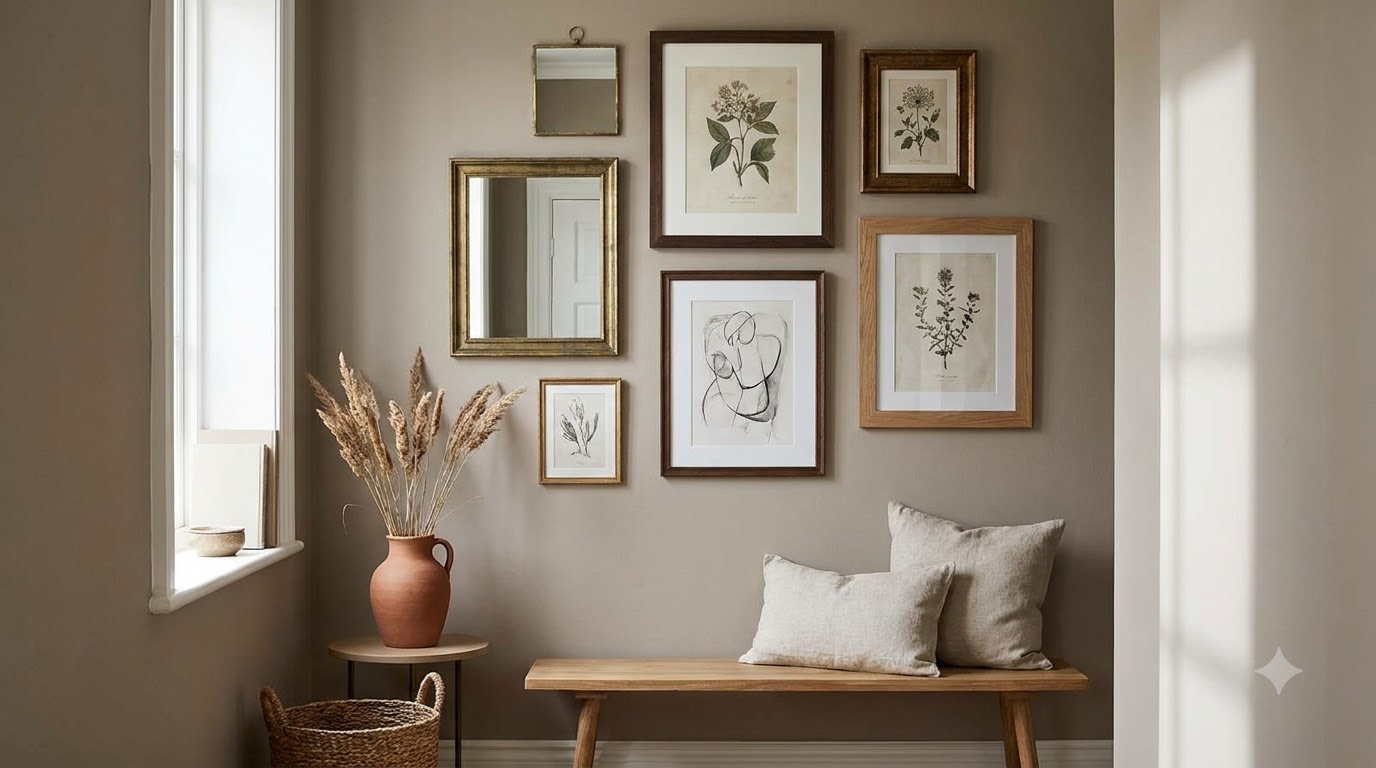
- Powder rooms and half baths
- Apartment entryway walls
- Narrow hallways (under 36 inches wide)
- Above-desk and above-nightstand vignettes
- Stairwell landings
- The strips of wall flanking doorways
- Above-toilet shelving zones
If your wall is bigger than that, you have room for a traditional salon-style gallery and don’t need to compress your layout. This article is for everyone else.
The Spacing Math That Makes Small Walls Look Designed
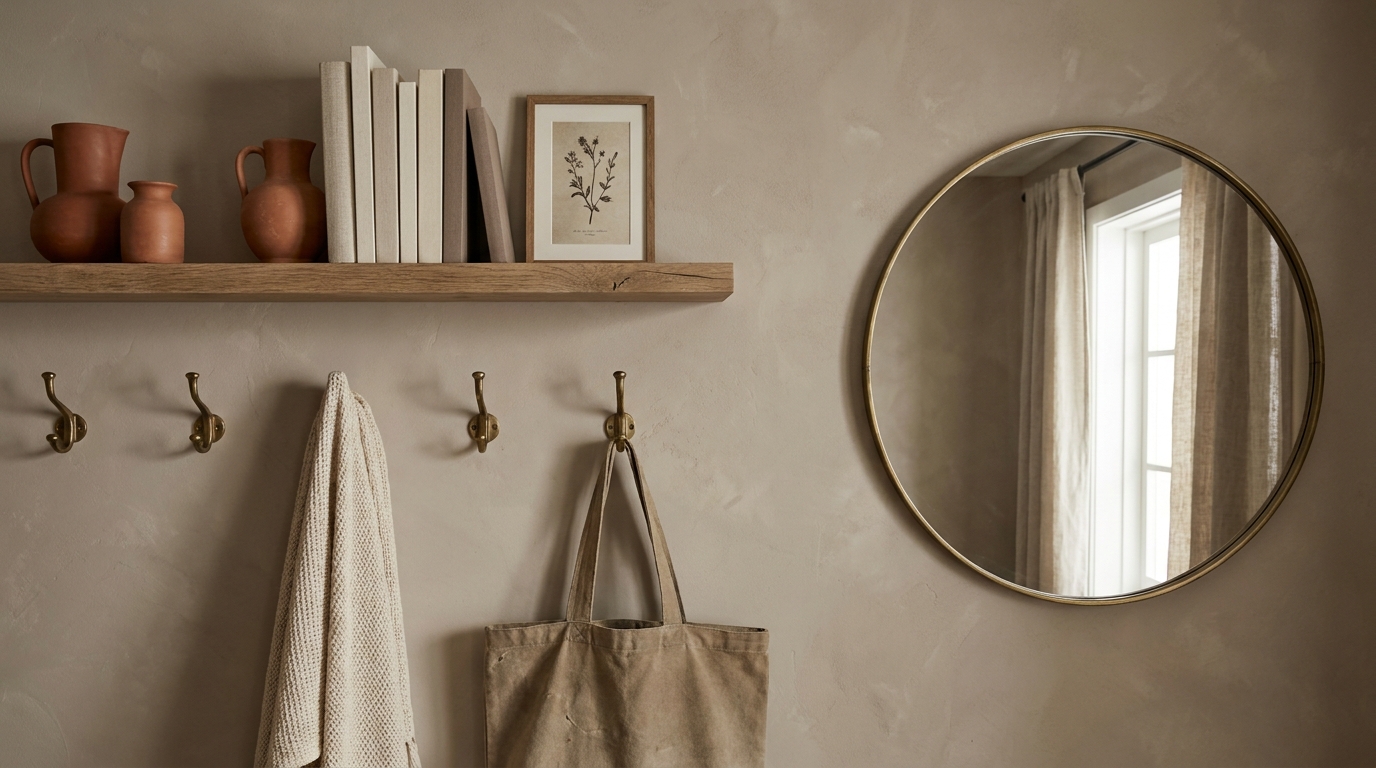
Designers consistently land on 2 to 3 inches between frame edges for small arrangements. Less than 2 inches feels claustrophobic; more than 3 inches makes the frames look like strangers at a party. The Architectural Digest editors and most professional art installers default to this range, and it’s the single most repeated rule across high-authority decor sources.
For hanging height, the museum standard is to center the arrangement’s midpoint at 57 inches from the floor—roughly average adult eye level. In a small gallery wall, that means measuring the total height of your arrangement, dividing by two, and placing that midline at 57 inches.
Quick formula: Total arrangement height ÷ 2 = distance from center to top edge. Add 57 inches from the floor to find where the center sits.
For above-furniture gallery walls (sofa, bed, desk, console), shift the rule: place the bottom edge of your arrangement 6 to 10 inches above the furniture. Closer and it looks crammed; farther and the art floats untethered.
17 Small Gallery Wall Ideas, Layout by Layout
1. The 2×2 Square Grid
Four identical frames in a tight square. This is the most forgiving layout in existence because the symmetry covers any artwork mismatch. Best for above-desk, above-nightstand, or flanking a window.
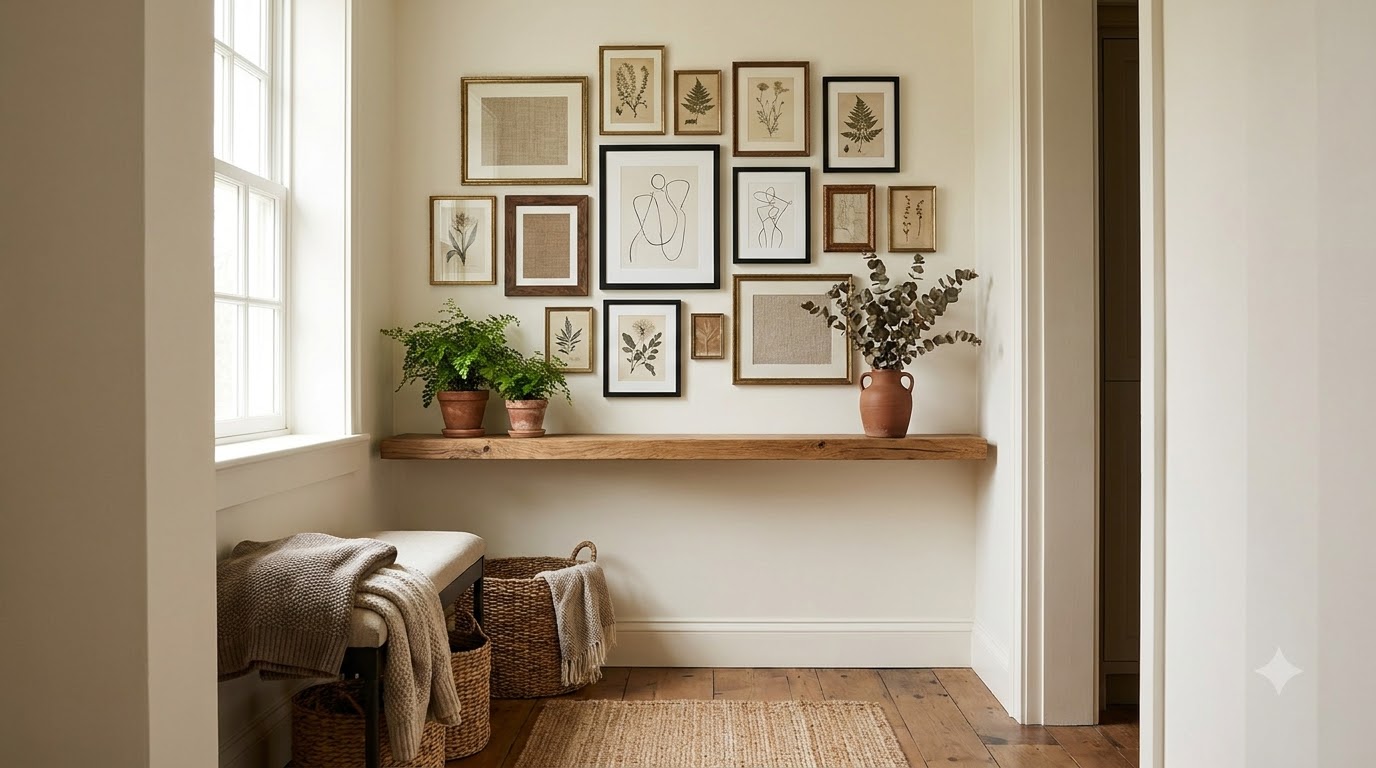
Recommended frame size: Four 8x10s or four 11x14s.
Total footprint: Roughly 22 x 26 inches (with 2-inch gaps).
2. The 3×3 Tight Grid
Nine small prints in a perfect square. Works beautifully with botanical illustrations, vintage postcards, or black-and-white film photography. The repetition creates rhythm without overwhelming a narrow wall.
Recommended frame size: Nine 5x7s.
Total footprint: Roughly 25 x 33 inches.
3. The Vertical Stack (3 Frames)
Three frames stacked directly above each other. Ideal for the slim wall next to a doorway or between two windows. Choose a vertical theme—architectural sketches, abstract verticals, or three portrait-orientation photos.
4. The Horizontal Trio
Three same-size frames in a row, used above a bed, console table, or sofa where height is limited but width allows breathing room. Triptychs (one image split across three frames) work especially well here.
5. The Asymmetrical L-Shape
Four to six frames arranged in an L that hugs a corner. This is the only “irregular” layout that still looks intentional in small spaces because the L visually anchors the arrangement to an architectural feature (the corner itself).
6. The Salon-Style Cluster (Compressed Version)
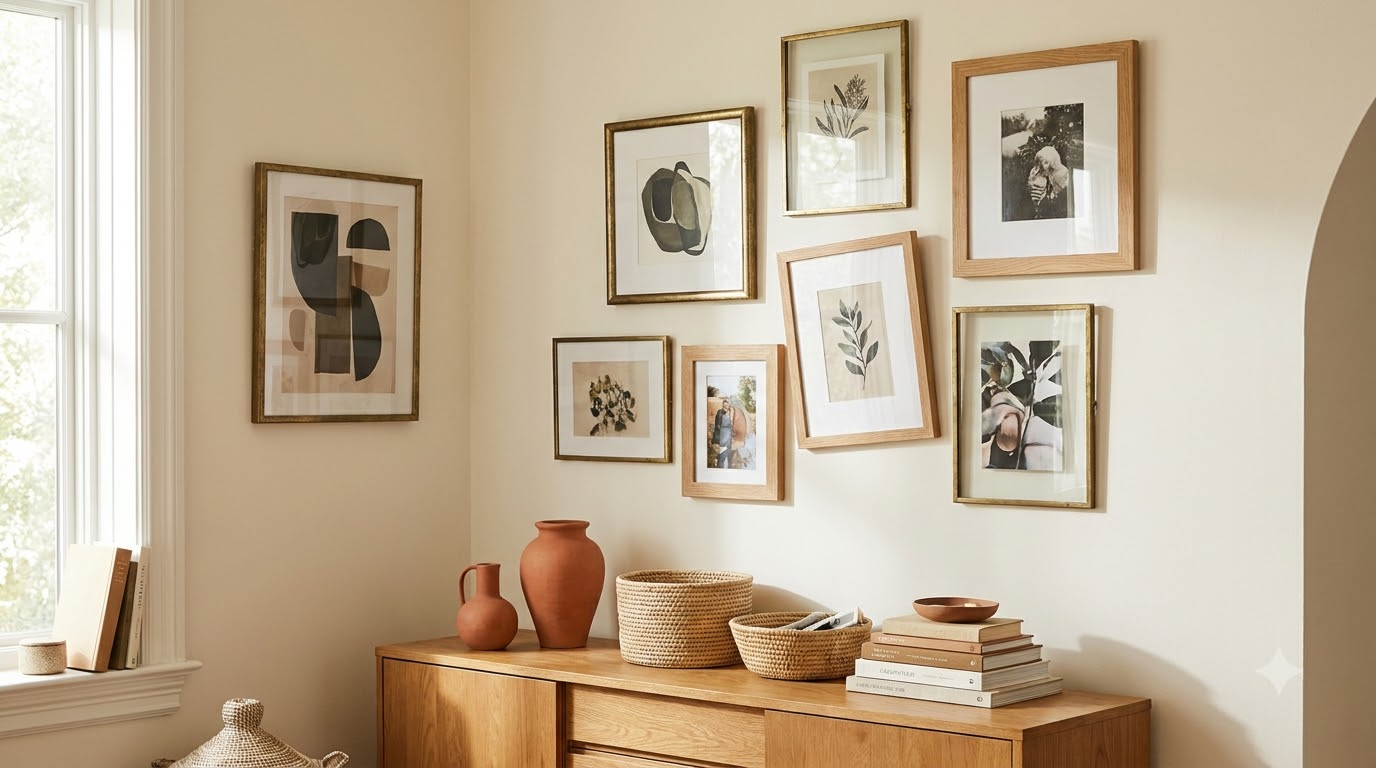
The classic salon look, scaled down to 5–7 frames inside a 30×30-inch invisible box. Mix sizes (one large 11×14 anchor, surrounded by 5x7s and 8x10s), but keep every frame in the same color family—all black, all white, or all natural wood.
7. The Picture Ledge Stack
Two floating shelves stacked 14 inches apart, each holding 3–4 leaned frames. This is the most renter-friendly small gallery wall idea—you only put two holes in the wall instead of seven, and you can swap art weekly without re-hanging anything.
8. The Hallway Runner
A long horizontal line of 5–7 small frames at a single height, running down a narrow hallway. Keep frames identical in size and shape, vary the art inside. This works because the hallway forces a side-on viewing angle.
9. The Powder Room Triptych
Three small frames (5×7 or 8×10) stacked vertically above the toilet or beside the vanity mirror. Botanical prints, vintage maps, or three black-and-white architectural photos perform best in tight bathroom moisture.
10. The Stairwell Diagonal
Frames that climb a staircase wall, each one stepping up to match the rise of the stairs. Keep the same vertical distance between frame and stair tread (typically 60 inches) to maintain the diagonal rhythm.
11. The Single Statement + Two Supporting
One 16×20 or 18×24 frame as the anchor, with two 5x7s tucked into the lower-right corner. Looks editorial and modern, takes up half the space of a full gallery wall.
12. The Mixed-Media Mini Wall
Three frames plus one small mirror, one wall-mounted ceramic plate, or one small woven basket. The non-frame element adds dimension without adding width, perfect for entry nooks.
13. The Monochrome Column
5–6 frames in a tight vertical column, all featuring black-and-white photography or all the same color (think botanicals against cream backgrounds). The monochrome palette tricks the eye into reading the arrangement as one large object.
14. The Above-Headboard Diamond
Four frames in a diamond shape (one top, two middle, one bottom) above a bed. Works beautifully because the diamond echoes the headboard’s geometric weight without competing with it.
15. The Tiny Hallway Pair
Just two frames side by side, perfectly level, perfectly spaced 2 inches apart. Sometimes restraint is the answer. This is ideal for the awkward 18-inch wall section near a coat closet.
16. The Floating Frame Cluster
Frameless or float-mounted prints arranged in a 3-frame asymmetric cluster. The absence of frames lightens the visual weight, which is why this works in walls under 24 inches wide.
17. The Corner Wrap-Around
A 3-frame vertical column on one wall that turns the corner and continues with a single frame on the adjacent wall. Use this only when both walls are visible from the main viewing angle (entryways, bedroom corners).
Frame Choices That Make Small Walls Look Bigger
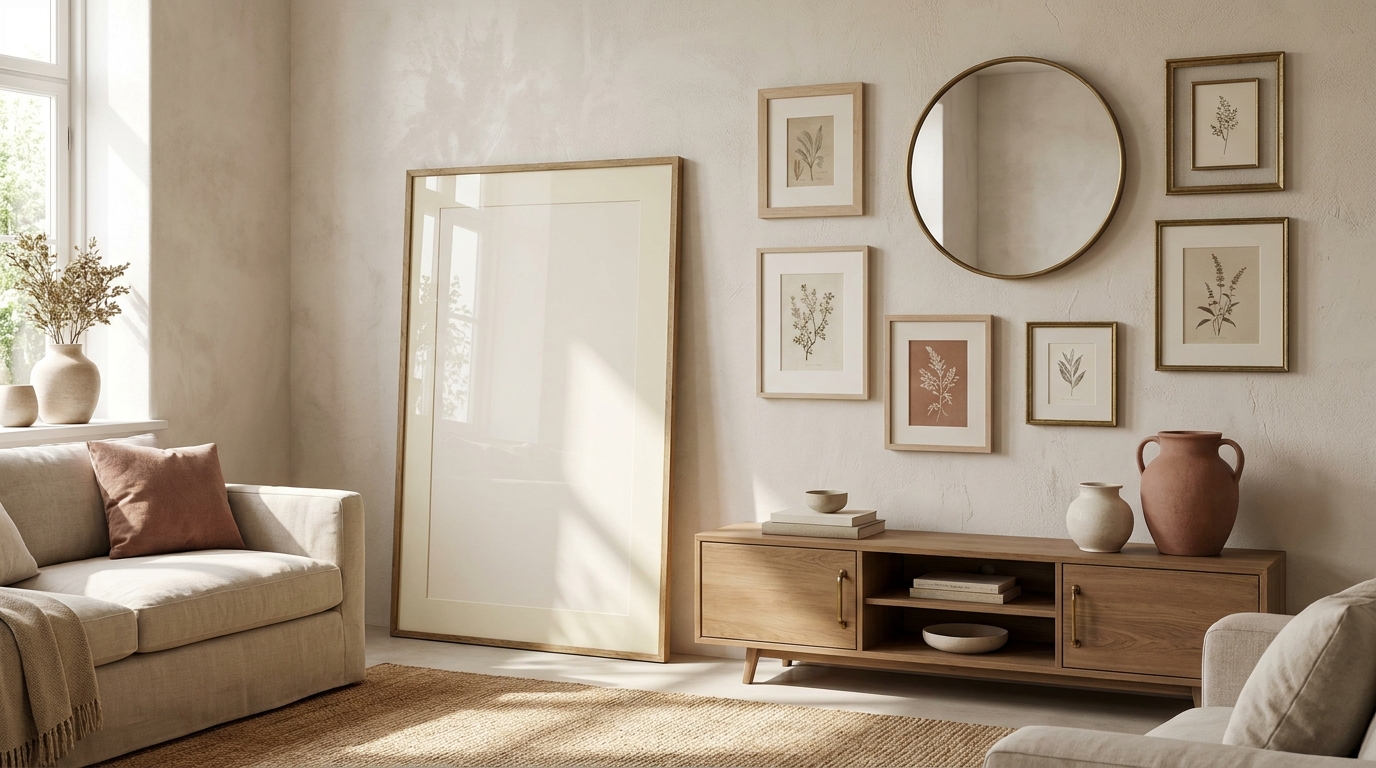
Thin frames are non-negotiable in tight spaces. A chunky 2-inch farmhouse frame around an 8×10 print eats so much visual real estate that the art inside disappears. Look for:
- Metal frames with 0.25- to 0.5-inch profiles (gold, black, or brushed brass)
- Float-mount frames that show the print edge surrounded by clear glass
- Wood frames under 0.75 inches wide in white, natural ash, or matte black
Mix frame finishes only when you’re committing to an eclectic salon-style cluster. For grids and stacks, keep every frame identical—it’s the single biggest cheat code for making a small gallery wall look professional instead of pieced-together.
Renter-Friendly Hanging Hardware (Tested Weight Limits)
The biggest barrier to small gallery walls for renters isn’t art selection—it’s putting holes in walls you don’t own. Here’s what works without damage:
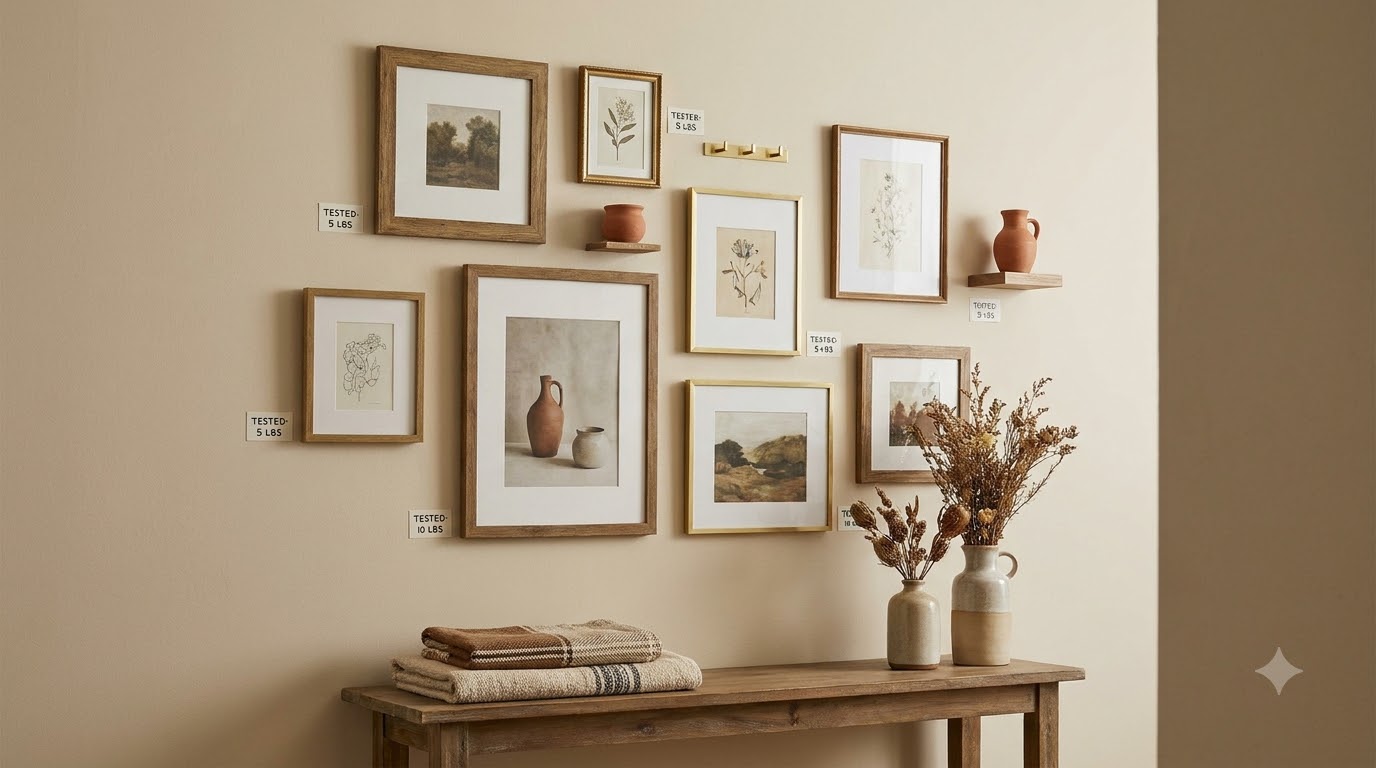
| Hardware | Weight Capacity | Best For |
|---|---|---|
| Command Picture Hanging Strips (large) | Up to 16 lbs per pair | 8×10, 11×14, 16×20 framed prints |
| Command Picture Hanging Strips (small) | Up to 4 lbs per pair | 4×6, 5×7 frames |
| 3M Hangman Picture Hangers | Up to 30 lbs | Heavier framed canvases |
| Monkey Hook (drywall only) | Up to 35 lbs | Single nail-sized hole, easy patch |
| Tombow Mono Adhesive Tabs | Up to 1 lb | Unframed prints, postcards |
For most small gallery walls using lightweight 5×7 to 11×14 frames, Command Strips handle the job entirely. Use a level and a pencil to mark placement, press the velcro strips together, then peel and stick. Frames come off cleanly if you pull the tab straight down, slowly.
If your rental has plaster walls (common in pre-1950 buildings), test Command Strips in an inconspicuous spot first—they can pull plaster paint with them on rougher surfaces.
The “Floor Layout” Step Most People Skip
Before you put anything on the wall, lay your entire arrangement on the floor. Move frames around until the spacing feels right. Take a photo from directly above. Compare to a reference image you like.
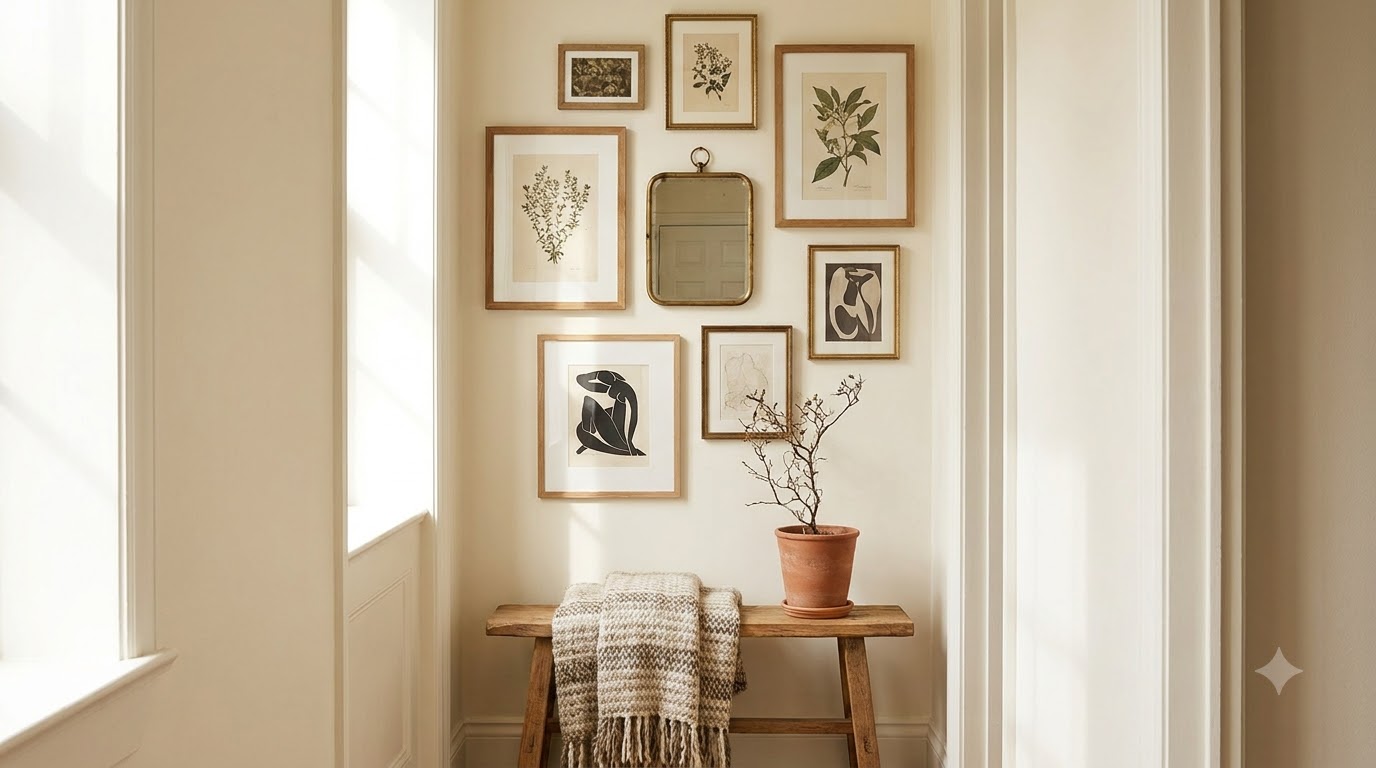
For extra precision, cut kraft paper or newspaper to the exact size of each frame, write the frame’s position on each piece, and tape the templates to the wall with painter’s tape. Live with the arrangement for 24 hours. Adjust. Then hang.
This step takes 30 minutes and prevents the most expensive mistake in DIY gallery walls: hanging six frames, hating the layout, and patching six holes.
Art Sources That Don’t Require a Trust Fund
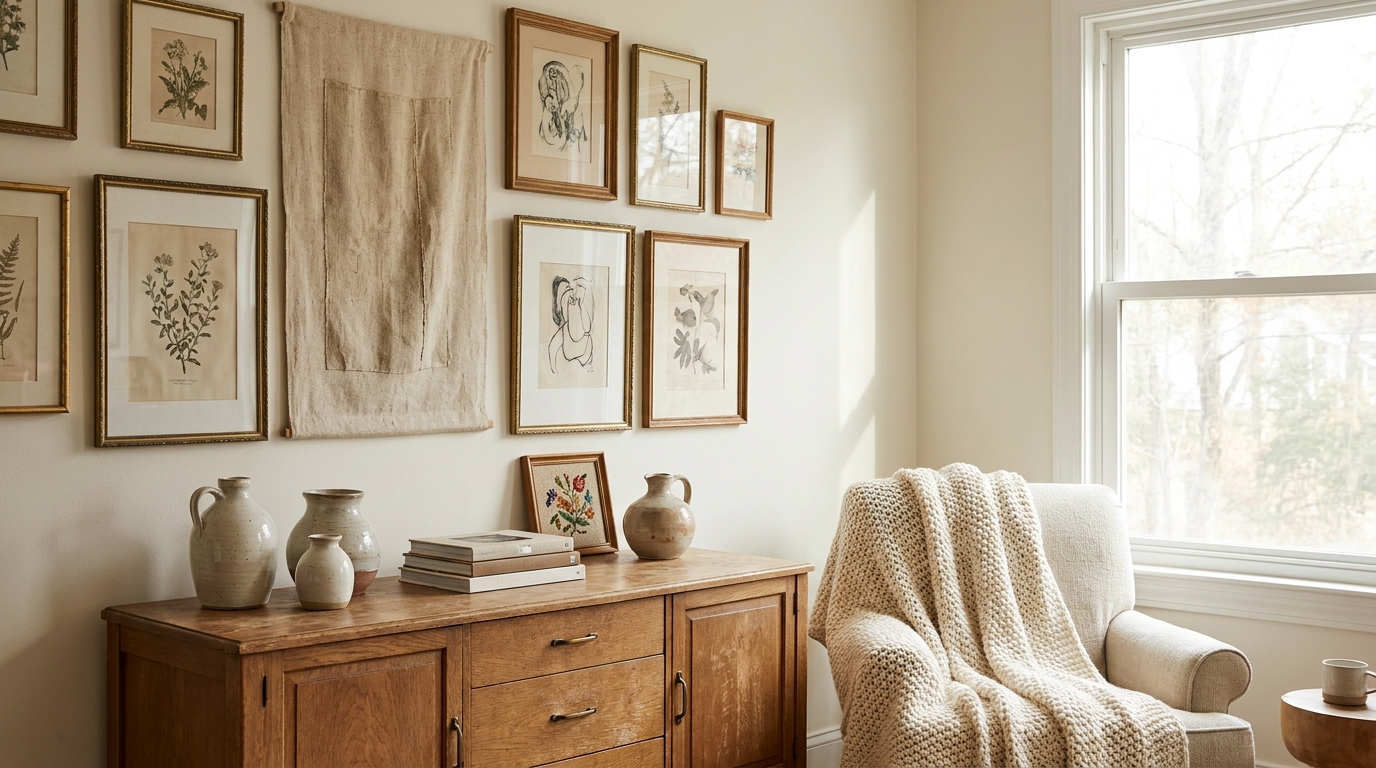
Small gallery walls thrive on affordable art because you’re buying multiple pieces. Sources that consistently deliver quality under $25 per print:
- Pixabay, Unsplash, and Pexels for free high-resolution downloads you can print at home or at any photo lab
- Etsy digital downloads ($3–$10 per print, instant access)
- Society6 and Minted for curated artist prints
- Your camera roll—black-and-white film photos printed at 5×7 cost under $1 per print at most drugstore photo labs
- Library book sales—old botanical and architecture books for $1–$3, frame individual pages
For frames, IKEA’s Ribba and Knoppäng lines, Target’s Threshold series, and Amazon Basics gallery frames all run $8–$25 per frame in the small-to-medium sizes you need.
Common Small Gallery Wall Mistakes
Hanging too high. The most common error in small spaces is hanging gallery walls at 65+ inches because the wall feels “empty” up there. Stick to 57 inches at the arrangement’s center.
Inconsistent spacing. Random gaps between frames signal “I gave up measuring.” Use a ruler. Every gap should match within a quarter-inch.
Wrong scale for the wall. A 3×3 grid on a 24-inch-wide wall will overflow. Measure your wall first, subtract 6 inches from each side for breathing room, and design your layout to fit inside that smaller box.
Too many frame styles. In small arrangements, frame variety reads as chaos. Pick one frame color and stick to it.
Ignoring the room’s light. Glossy frames near a window create glare that hides the art. Choose matte frames or non-glare glass for walls that catch direct sunlight.
FAQ
How many frames should a small gallery wall have?
Three to seven frames is the sweet spot. Three frames feel minimal and editorial; seven frames is the maximum before a small wall starts looking crowded. Avoid even numbers higher than four in asymmetric layouts—five and seven create more visual interest than six.
What’s the minimum wall size for a gallery wall?
You can build a gallery wall on a 20-inch-wide wall using three 5×7 frames stacked vertically. Below 20 inches, you’re better off with a single statement piece.
Should small gallery walls have matching frames?
For grids and stacks: yes, matching frames look intentional. For salon-style clusters: mixed frames work if they share a single color (all black, all gold, all white). Mixing both color and style in a small space reads as cluttered.
Can I hang a gallery wall over a couch in a small apartment?
Yes. Keep the arrangement’s width to roughly two-thirds of the couch’s length, position the bottom edge 6–10 inches above the back cushion, and use Command Strips rated for your frames’ weight to avoid drywall damage.
How do I plan a gallery wall without making holes?
Cut paper templates the size of each frame, label them with frame names, and tape them to the wall with painter’s tape. Adjust until the layout works, then hang frames using the template positions as guides.
Putting It All Together
The best small gallery wall ideas share three traits: they commit to one organizing principle (grid, stack, cluster), they use consistent spacing, and they fit the wall instead of fighting it. Pick one of the 17 layouts above, measure twice, lay it out on the floor first, and use renter-safe hardware so you can change your mind without consequences.
The smallest gallery walls often end up being the most photographed ones in a home—because constraint forces clarity, and clarity is what makes a wall look designed instead of decorated.