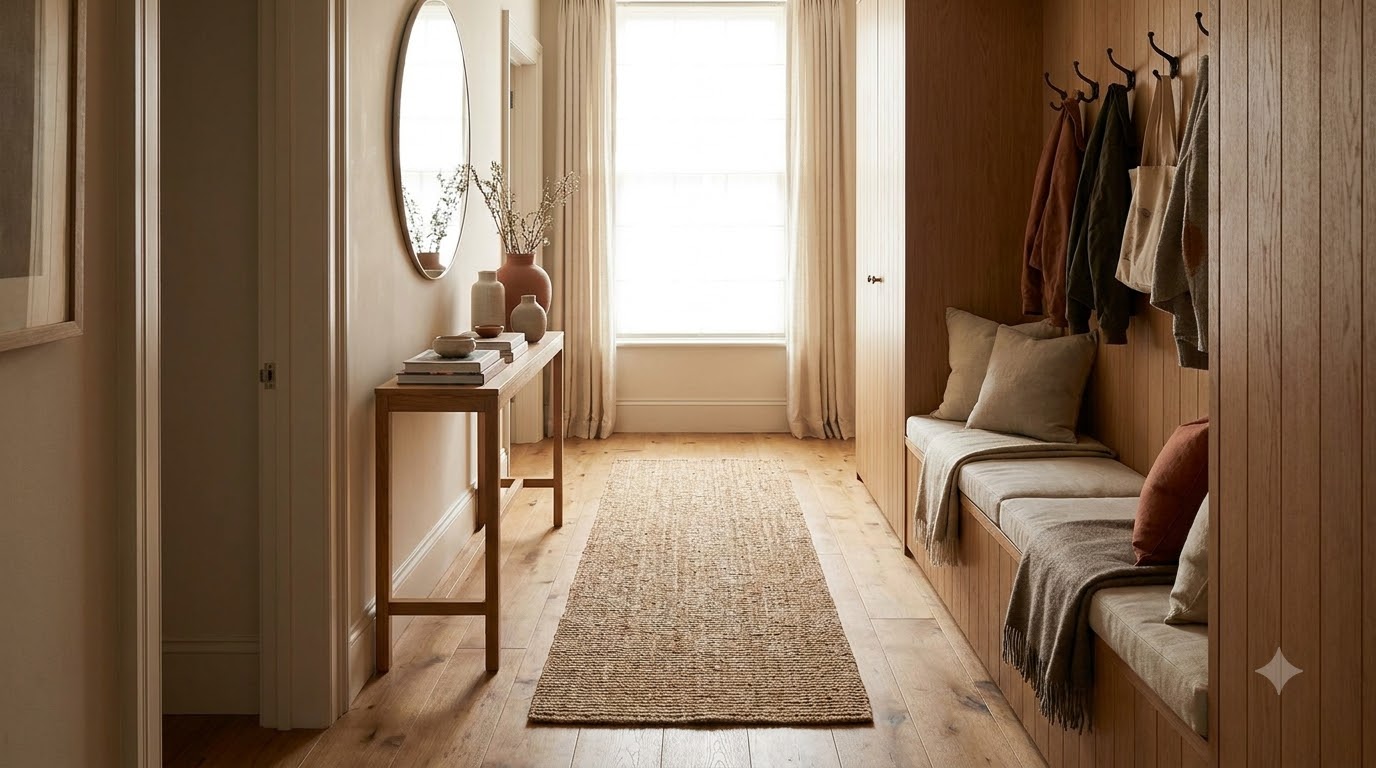
Narrow hallways want four things: light, a runner to ground the floor, slim furniture that hugs the wall, and vertical art that pulls the eye up. Get those right and a corridor that once felt like a squeeze starts to read as an intentional, styled room. In our own rentals we have learned that the tightest hallways respond best to restraint. You are not filling the space; you are guiding people through it. Below we walk through the exact widths, depths, and hanging heights we use, plus budget-friendly picks that work whether you own your place or need everything to come back off the wall on move-out day.
Key Takeaways
- Maximize light first. A mirror and a pale wall color do more for a narrow hallway than any accessory.
- Choose a runner that leaves 4 to 5 inches of floor on each side so the corridor reads wider, not cramped.
- Keep console depth to 10 to 12 inches or less so nothing juts into the walking path.
- Hang art at 57 to 60 inches on center and stack it vertically to draw the eye upward.
- Budget-friendly wins: peel-and-stick hooks, a $30 to $60 runner, and one statement mirror transform a hallway for under $150.
How do you decorate a narrow hallway?
Start with light and flow, then layer in personality. A narrow hallway usually has one job during the day (getting you from A to B) and one job at night (not feeling like a tunnel). When we moved into a rental with a 34-inch-wide hallway, our instinct was to hang lots of small frames to “fill” it. That was the wrong move. The clutter made the walls feel like they were closing in. Once we swapped to a single large mirror and one vertical column of art, the whole corridor breathed.
Here is the order of operations we follow every time, because tackling these in sequence keeps you from over-decorating:
- Fix the light. Add a mirror opposite or near a light source, and choose a warm bulb around 2700K so the space feels inviting after dark.
- Ground the floor. Lay a runner that runs most of the length but stops 8 to 12 inches short of each end wall.
- Add one slim surface. A narrow console or floating shelf gives you a landing spot for keys and mail without stealing the path.
- Hang art vertically. Stack two or three pieces in a column, or run a single tall print to pull sightlines up.
- Finish with function. Hooks, a small basket, or a tray keep the hallway working as hard as it looks.
If you want a deeper primer on squeezing style out of tight square footage, our guide to small apartment decor ideas covers the same restraint-first mindset applied to living rooms and bedrooms.
What furniture fits a narrow hallway?
The golden rule is depth, not width. In a narrow hallway you can often go long, but you almost never have room to go deep. We measure our clear walking path first, then subtract for furniture so at least 30 inches of passage stays open. For most rental hallways that means any piece against the wall needs to be 10 to 12 inches deep or shallower.
These are the slim pieces that consistently work in tight corridors:
- Console tables (10 to 12 inches deep): the classic hallway anchor for keys, mail, and a lamp. Look for demilune or half-moon shapes if depth is really tight.
- Floating wall shelves (5 to 8 inches deep): zero floor footprint, ideal when the path is under 36 inches wide.
- Slim bench (14 to 16 inches deep, placed only where the hall widens): a spot to sit and pull on shoes near the entry.
- Wall-mounted hooks and rails: vertical storage for bags and coats that never touches the floor.
- Narrow ladder shelf leaned flat against the wall: displays plants and books on a footprint barely 10 inches deep.
Renters, take note: floating shelves and hooks that use heavy-duty adhesive strips hold 7 to 15 pounds each and peel off cleanly, so you can add real storage without a single drill hole.
Choosing the right runner, console, and mirror
These three elements do most of the heavy lifting in a narrow hallway, so it is worth getting the dimensions exactly right rather than eyeballing them at the store.
The runner
A runner defines the floor and softens footsteps, but the wrong size backfires. We aim to leave 4 to 5 inches of bare floor showing on each side; that visible border tricks the eye into reading the hallway as wider than it is. Standard runners come in 2 to 2.5 foot widths and 6 to 12 foot lengths, and you can usually find a washable option in the $30 to $60 range. For rentals, a low-pile washable runner with a grippy backing means no rug pad and no slipping.
The console
Keep it to 10 to 12 inches deep for a narrow hall, and prioritize length over bulk. A console that is long and low visually stretches the corridor. Expect to spend $60 to $200 depending on material; a simple pine or metal-frame console lands at the lower end, while solid wood climbs higher. If even 10 inches feels like too much, skip the console entirely and mount a floating shelf at 30 inches high instead.
The mirror
A mirror is the single best tool to widen a narrow hallway. Placed across from a window or a light fixture, it bounces light down the corridor and doubles the sense of space. We favor a tall, leaning-style or wall-hung mirror at least 30 inches wide when the wall allows it. A large mirror can run $80 to $250, but thrifted and secondhand frames are a genuine budget hack here, often under $40.
Narrow hallway picks at a glance
| Hallway element | Narrow-space pick |
|---|---|
| Runner | 2 to 2.5 ft wide, leave 4 to 5 in of floor per side; washable, $30 to $60 |
| Console table | 10 to 12 in deep max, long and low; $60 to $200 |
| Alternative to console | Floating shelf 5 to 8 in deep, mounted at 30 in high |
| Mirror | 30 in wide or more, hung opposite light; $80 to $250 (or thrifted under $40) |
| Wall art | Vertical stack or single tall print, center at 57 to 60 in |
| Lighting | Wall sconces or plug-in picture lights, warm 2700K bulbs |
| Storage | Adhesive hooks and rails, 7 to 15 lb rated, no drilling |
| Flooring accent | Low-pile, grippy-backed runner (skips the rug pad) |
Hallway wall art and gallery ideas for tight spaces
Art is where a narrow hallway earns its personality, but the standard living-room approach does not translate. You rarely have the viewing distance to appreciate a wide, sprawling arrangement, so we think in vertical columns instead of horizontal spreads. Hang the center of your arrangement at 57 to 60 inches from the floor (gallery standard eye level) and let the pieces climb from there.
A few layouts that work beautifully in corridors:
- The vertical column: two or three same-size frames stacked with 3 inches of gap, drawing the eye up the wall.
- The single statement print: one tall, narrow piece that fills the wall height without demanding width.
- The tight salon strip: a slim, controlled cluster no wider than 24 inches, keeping the arrangement compact.
- The mirror-and-art pairing: a mirror at one end, a column of prints at the other, to balance light and interest.
- The picture ledge: a single narrow ledge holding overlapping frames you can rearrange without new nail holes.
For arrangement templates you can copy onto a corridor wall, our gallery wall layout ideas with 20 arrangements includes several vertical and narrow-strip options. If you want the full method from planning to hanging, the complete gallery wall guide walks through spacing and grouping in detail. And when a single big piece is the move, we lean on affordable options from our roundup of the best large wall art prints under $80.
Lighting a narrow hallway
Most narrow hallways are under-lit, and dim corridors always feel smaller. If you rent and cannot rewire, you still have good options. In our current place we used two plug-in sconces with a cord channel painted to match the wall, and the difference at night was dramatic. Aim for layered, warm light rather than one harsh overhead fixture.
- Plug-in wall sconces: add light at eye level without an electrician; hide cords with a paintable channel.
- Battery picture lights: clip onto frames to highlight your art and add a soft glow.
- Warm bulbs (2700K): swap cool white for warm white to make the corridor feel welcoming.
- Motion-sensor puck lights: stick-on lights for a windowless stretch, no wiring needed.
Frequently asked questions
How wide should a hallway runner be?
Pick a runner that leaves 4 to 5 inches of bare floor showing on each side of the rug. In most narrow hallways that means a 2 to 2.5 foot wide runner. That visible floor border makes the corridor read wider, while a runner stretched wall to wall does the opposite and closes the space in.
How high should I hang hallway art?
Hang art so its center sits 57 to 60 inches from the floor, the standard gallery eye level. In a narrow hallway, stack pieces vertically from that center point rather than spreading them wide. Because you view corridor art up close and while walking, a tall column reads far better than a horizontal arrangement.
What is the best furniture depth for a narrow hallway?
Keep any wall furniture to 10 to 12 inches deep or less, and make sure at least 30 inches of clear walking path remains. Long, low consoles work best because they add function without crowding the route. When the path is under 36 inches wide, switch to floating shelves just 5 to 8 inches deep.
Can renters decorate a hallway without drilling?
Absolutely. Heavy-duty adhesive hooks and strips hold 7 to 15 pounds and peel off cleanly, so you can hang art, mirrors, and shelves without holes. Add a grippy-backed runner, plug-in sconces with a paintable cord channel, and a leaning mirror, and you get a fully styled hallway that comes apart on move-out day.
How do I make a dark, narrow hallway feel bigger?
Combine three moves: hang a mirror at least 30 inches wide opposite a light source, paint or keep the walls pale, and add warm 2700K lighting at eye level. The mirror bounces light and visually doubles the width, while the pale surfaces and warm glow stop the corridor from reading like a tunnel after dark.
A narrow hallway is not a problem to hide; it is a chance to make a small, high-impact statement. Fix the light, lay the right runner, keep your furniture shallow, and send the art up the wall. We have done this in three rentals now, and every time the corridor went from an afterthought to one of our favorite little moments in the home.