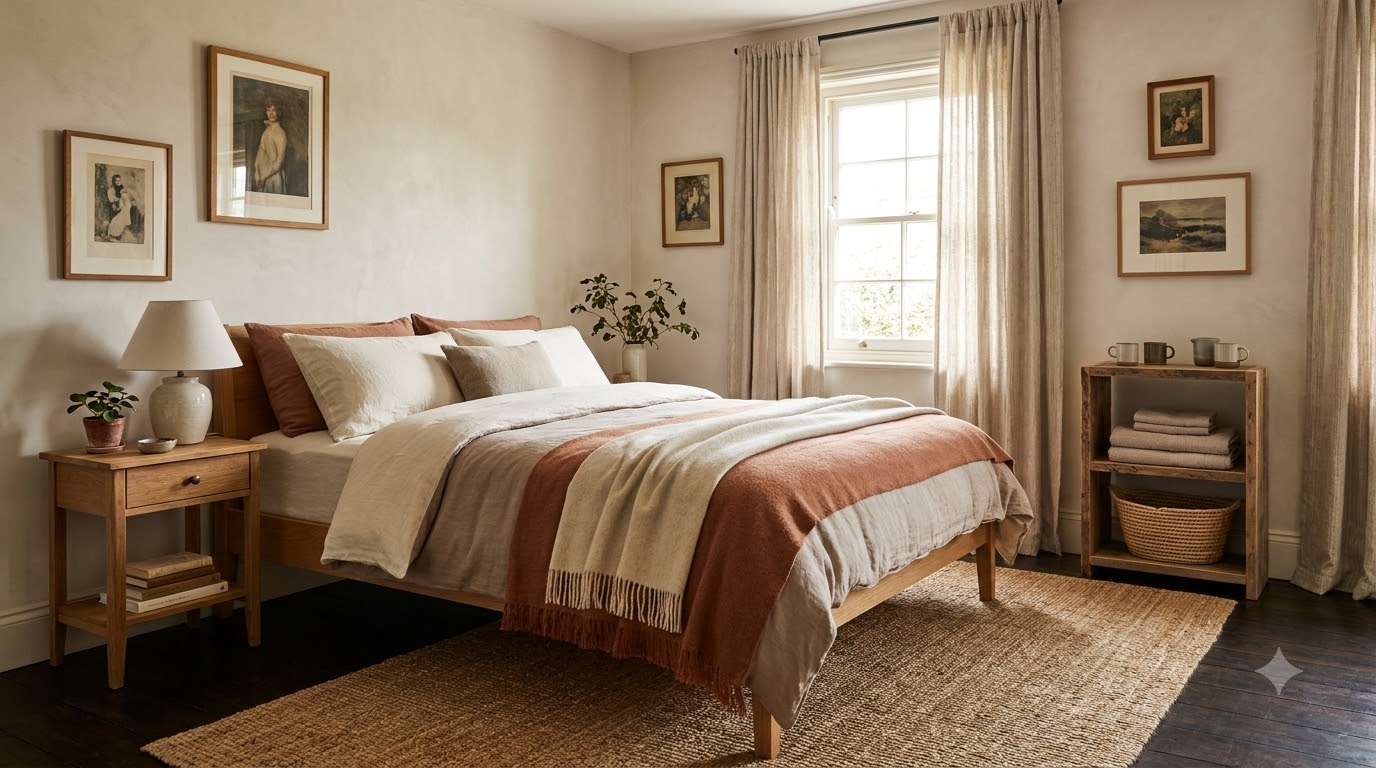
A welcoming guest room comes down to five cheap things: a comfortable bed, layered bedding, a surface and a lamp within arm’s reach, blackout curtains, and a few hotel touches. That is the whole formula. Every one of these guest bedroom ideas works in a rented apartment, a shared office, or a room the size of a walk-in closet, and most cost less than a nice dinner out. You do not need a renovation, a designer, or a spare $2,000, just thoughtful choices in the right order, which is exactly what we walk through below.
Key Takeaways
- The bed is 80% of the room. A supportive mattress and a full or queen frame matter more than any decor. For tight rooms, a full ($150-$400) fits comfort and floor space.
- Layer bedding in five parts: fitted sheet, flat sheet, quilt or blanket, comforter or duvet, and two-to-four pillows. Layers read as “cared for,” not expensive.
- Every guest needs a nightstand and a lamp. Budget the pair at $40-$90. A place to set a phone and glasses is what separates a guest room from a storage room.
- Blackout curtains ($20-$45 per panel) are the highest-impact upgrade for sleep quality and the single thing guests remember.
- One room can do double duty. An office plus guest room works with a daybed, a sleeper sofa, or a folding bed and a cleared-out drawer.
What do guests actually need?
Before spending a dollar, strip the room down to what a real overnight guest uses. When we host, people never comment on the throw pillows or the wall art. They comment on whether they slept well and whether they could find the bathroom in the dark. The essentials are shorter than most Pinterest boards suggest.
- A bed they can actually sleep on, with clean sheets that fit
- A surface beside the bed for a phone, water, and glasses
- A light they can turn on and off without getting up
- A way to darken the room for morning sleepers
- Somewhere to put a suitcase and a few clothes
- Fresh towels and an outlet to charge a phone within reach
Notice what is missing: a headboard, a matching furniture set, a gallery wall. Those are nice, but they are not needs. If your budget only covers this list, your guests will still leave happy. For a fuller look at pulling a bedroom together once the basics are handled, our complete guide to aesthetic bedroom ideas is a good next stop.
How do you decorate a guest room cheaply?
You decorate a guest room cheaply by spending where the body touches the room and saving everywhere else. Put your money into the mattress, pillows, and one good set of sheets, then fill the rest with secondhand finds and things you own. We furnished our first guest room for under $300, splurging only on a mattress topper and a lamp. Everything else came from a thrift store or a closet.
Here is the order we recommend spending in, from most to least important:
- Mattress or mattress topper ($60-$300) — comfort is non-negotiable and cannot be faked with decor.
- One good set of sheets and two pillows ($40-$80) — the layer touching skin all night.
- Nightstand and lamp ($40-$90) — function first, then looks.
- Blackout curtains ($20-$45 per panel) — quiet, dark rooms sleep better.
- A few hotel touches ($15-$40) — folded towels, a water carafe, a small tray.
Stick to that order and you will never overspend on the wrong thing. If cash runs out after step three, the room already works. For more small-space tricks that stretch a budget, our roundup of small apartment decor ideas pairs well with everything here.
What size bed fits a small guest room?
Bed size is where most people either overspend or make the room unusable. Match the mattress to the floor space so guests can still walk, open a suitcase, and reach the door. Here is how the common sizes play out in a small room, roughly 8 by 10 feet or smaller:
- Twin (38″ x 75″): Best for rooms under 8 x 8 feet or for kids. Leaves the most floor space, but two adult guests will not be comfortable.
- Twin XL (38″ x 80″): Same footprint as a twin with five extra inches of length, ideal for taller solo guests.
- Full / Double (54″ x 75″): The budget sweet spot. Sleeps one adult luxuriously or two in a pinch, and fits most rooms with room to walk.
- Queen (60″ x 80″): The comfort choice for couples, but it needs a room at least 9 x 10 feet to leave walking paths on both sides.
For most renters hosting the occasional guest, we point people toward a full. It keeps a queen-level comfort feel for a single sleeper, costs less, and leaves floor space for a nightstand and a suitcase. A daybed with a trundle is the other strong option when the room doubles as anything else.
How do you layer bedding on a budget?
Layered bedding is the cheapest way to make a plain bed look intentional. The layers let guests adjust their own temperature and create the plush, folded look people associate with hotels. You do not need matching designer linens, just the layers in the right order. From the mattress up:
- Mattress protector — waterproof, washable, and it saves the mattress between guests.
- Fitted sheet — the one that hugs the mattress corners.
- Flat sheet — the layer guests tuck under; optional but hotel-standard.
- Quilt or lightweight blanket — the mid-weight layer for mild nights.
- Comforter or duvet — the top layer, folded down a third or laid flat.
- Pillows — two sleeping pillows minimum, four if you want a fuller look.
We buy sheets in solid white or oatmeal because they mix, bleach clean, and never clash with a quilt bought a year later. Cotton percale runs cool and cheap; linen and bamboo cost a little more but feel more luxurious. If you are weighing fabrics, our comparison of the best bedroom bedding in linen, cotton, and bamboo breaks down the price-to-comfort tradeoff. Two pillows per guest, in two firmnesses, covers back and side sleepers without asking.
Why a nightstand and lamp matter more than art
Our one piece of advice to a first-time host: a nightstand and a lamp do more for a guest than anything on the wall. Think about the last spare room you stayed in. The moment you set down your phone and clicked off a light without getting out of bed, the room felt made for you. That is the whole effect, and it costs under $90.
You do not need a real nightstand. Any of these work at a fraction of the price:
- A small stool or wooden crate turned on its side ($10-$25 secondhand)
- A stack of two or three sturdy books topped with a coaster
- A folding TV tray for rooms where floor space disappears
- A wall-mounted floating shelf beside the bed in truly tiny rooms ($15-$30)
- A repurposed side table or plant stand you already own
Whatever the surface, put a lamp on it a guest can reach lying down, plus a way to charge a phone within arm’s length. A $12 warm-white bulb makes a cheap lamp feel expensive. Skip the bright overhead glare as the only light; nobody wants to cross the room in the dark to shut it off.
Are blackout curtains worth it for a guest room?
Yes, and they are the upgrade guests remember most. Traveling throws off sleep, and a room that stays dark past sunrise is a genuine kindness. Blackout panels run about $20 to $45 each and hang on a tension rod if you cannot drill into rental walls. They also muffle street noise and keep the room cooler in summer.
Quick buying notes we have learned the hard way:
- Hang the rod a few inches wider than the window on each side so light does not leak around the edges.
- Choose panels long enough to reach the floor; short curtains let a bright gap glow at the bottom.
- For renters, tension rods or adhesive curtain hooks avoid holes and deposit disputes.
- If curtains are not an option, a cordless blackout roller shade cut to the window frame does the same job.
Guest room essentials and what to buy on a budget
Here is the whole room in one table: every essential a guest actually uses, the budget-friendly pick we reach for, and a realistic price range. Buy top to bottom and stop whenever your budget runs out.
| Guest-room essential | Budget pick | Price range |
|---|---|---|
| Bed comfort | Full mattress or memory-foam topper on an existing frame | $60-$400 |
| Sheets | Cotton percale set in solid white | $25-$50 |
| Pillows | Two pillows in two firmness levels | $20-$40 |
| Top layer | Quilt plus a folded comforter | $40-$80 |
| Bedside surface | Thrifted stool, crate, or floating shelf | $10-$30 |
| Lighting | Small table lamp with a warm-white bulb | $20-$45 |
| Window | Blackout curtain panel on a tension rod | $20-$45 |
| Luggage spot | Folding luggage rack or a cleared bench | $15-$35 |
| Hotel touches | Folded towels, water carafe, small tray | $15-$40 |
How do you make a guest room feel like a hotel?
Hotel touches are the cheapest, highest-return part of the whole project. They cost a few dollars and take minutes, but they make a spare room feel deliberate. Hotels do a handful of small, repeatable things every time, and we copy them shamelessly. Set out these finishing touches the day before a guest arrives:
- A stack of two folded towels and a washcloth at the foot of the bed
- A small carafe or bottle of water with a clean glass on the nightstand
- A tray holding phone charger, a pen, and a note with the Wi-Fi password
- Extra blanket folded and visible, so guests never have to ask
- A single small plant or a few stems in a jar for a hint of life
- An empty drawer and two hangers, cleared out and obvious
The way the bed itself is made carries most of the hotel feeling, and it is free. Crisp corners, a folded-down top sheet, and plumped pillows read as luxury even on discount linens. Our step-by-step on how to make a bed look like a hotel covers the exact folds, and it is the highest-impact free upgrade here.
How do you turn an office into a guest room?
Most renters do not have a spare room sitting empty, so the real question is how to make one room do two jobs. A home office that converts a few nights a year is completely doable. The key is a sleeping surface that reads as furniture by day, plus cleared space for a guest to unpack.
Pick the sleeping solution that matches your room and budget:
- Daybed with a trundle ($200-$500): Looks like a sofa, sleeps one or two, and needs no setup.
- Sleeper sofa or futon ($250-$700): Best if the office already needs seating; folds flat at night.
- Folding or rollaway bed ($90-$250): Stores in a closet and appears only when guests do.
- Quality air mattress with a real frame ($60-$150): The cheapest path; add a topper so it does not feel like camping.
Then do the small hospitality work: clear one desk drawer, stash work clutter in a lidded bin, set out the same nightstand-and-lamp combo, and hang blackout curtains that serve you during video calls anyway. When we converted our own office, the folding bed and one cleared shelf were the whole difference between a workspace and a room a guest felt welcome in.
Frequently Asked Questions
How much does it cost to set up a guest room?
A comfortable, complete guest room runs about $250 to $500 if you buy secondhand furniture and put your money into the mattress, sheets, and pillows. You can go lower by using a good air mattress and thrifted surfaces, or higher with a new queen frame. Comfort and clean bedding matter far more than the price tag.
What is the best bed size for a small guest room?
A full-size bed is the budget sweet spot for most small rooms. At 54 by 75 inches, it sleeps one adult in comfort, fits two in a pinch, and still leaves floor space to walk. Choose a twin for rooms under 8 by 8 feet, or a daybed with a trundle when the room does double duty.
Do I really need blackout curtains for guests?
They are worth it. At $20 to $45 a panel, blackout curtains block early sunrises, muffle street noise, and cool the room, which helps travelers whose sleep is already disrupted. Guests consistently remember a dark, quiet room. If you rent, a tension rod or a cordless blackout roller shade delivers the same result without drilling holes.
How can I host guests without a spare bedroom?
Convert the room you have. A daybed, sleeper sofa, or a folding bed stored in a closet turns an office or living room into a guest space overnight. Clear one drawer, add two hangers, set out a lamp and folded towels, and the room instantly reads as welcoming rather than borrowed. Multi-use furniture pays for itself fast.
What should every guest room have?
Every guest room needs a comfortable bed with clean, layered bedding, a bedside surface with a reachable lamp, a way to darken the room, and somewhere to set a suitcase. Add a phone charger, fresh towels, and the Wi-Fi password, and you have covered everything a real overnight guest actually uses. Everything beyond that is decoration.