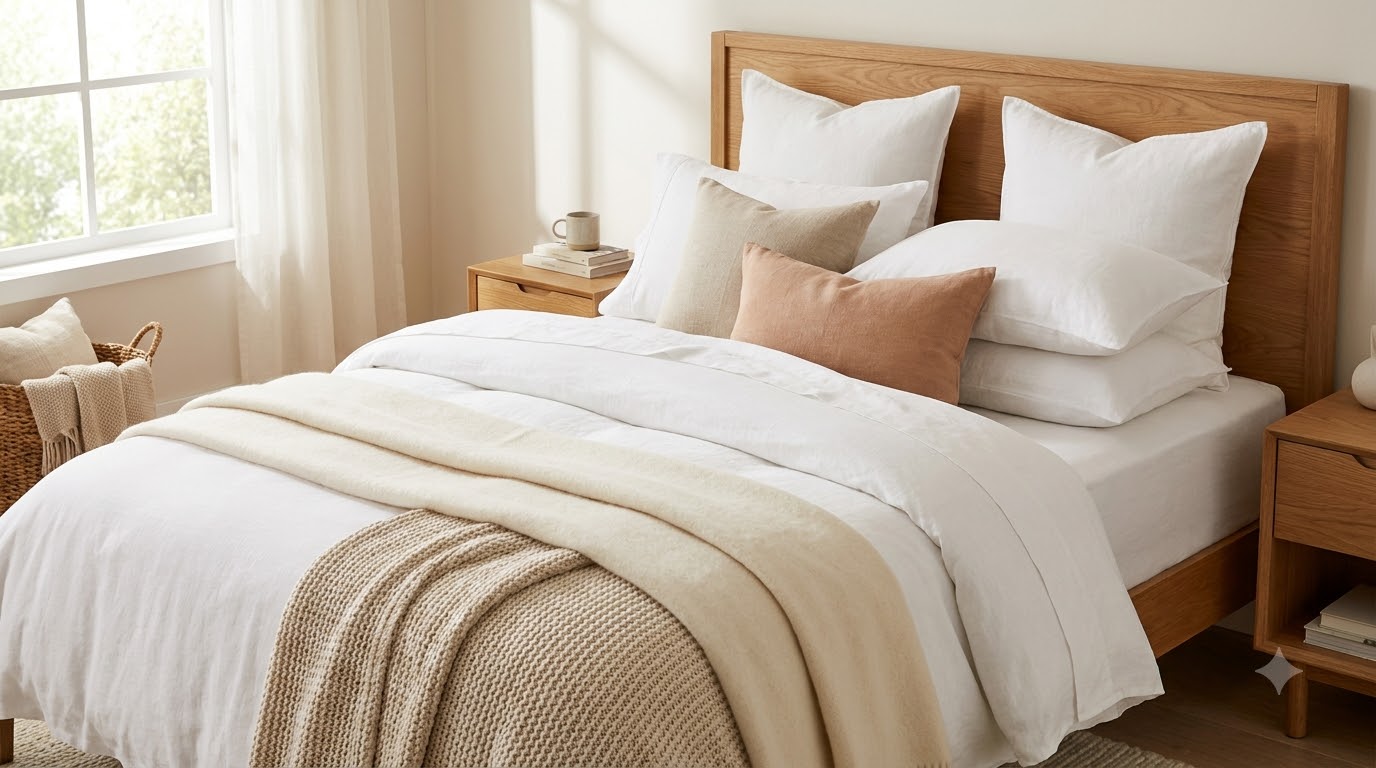
To make your bed look luxurious, layer it: start with a crisp white base, add a duvet with a folded flat sheet turned back over the top, build a wall of layered pillows, then drape a throw across the bottom third. That is the whole hotel trick in one sentence. It is not about spending more money or owning a bigger room. It is about layering and committing to crisp white as your base. Every hotel bed you have ever fallen into does exactly this, and every piece of it works in a rental studio with a tight budget.
We remake our own beds this way every morning (well, most mornings), and the difference between “slept-in” and “hotel suite” comes down to about six inches of folded sheet and one honest throw. Below is the exact method, the pillow math, and the dollar ranges we actually recommend.
Key Takeaways
- The core formula: crisp white base + duvet with a folded flat sheet + layered pillows + a throw at the bottom 1/3.
- The pillow count: 7 pillows for a full hotel look (2 sleeping, 2 Euro 26-inch, 2 standard shams, 1 lumbar).
- Thread count that matters: 300 to 400 thread count percale or sateen cotton hits the sweet spot; higher numbers are mostly marketing.
- The throw rule: fold or drape it across the bottom third of the bed, never the whole thing.
- Budget reality: a convincing hotel bed can be built for $150 to $250 total, or refreshed for under $60.
- Renter-friendly: every step here is reversible, storable, and works in a small room.
How do hotels make beds look so good?
Hotels use a system, not a splurge. The look comes from three repeatable moves: an all-white foundation that reads as clean and expensive, tight and deliberate layering so nothing sags, and a generous pile of pillows arranged largest to smallest. When we studied our favorite boutique-hotel beds, none of them used exotic bedding. They used ordinary white cotton, ironed edges, and a lot of intention.
Here is the layering order hotels build from the mattress up:
- Mattress protector: a fitted, quiet protector that keeps the base crisp and rental-safe.
- Fitted sheet: white, pulled drum-tight, corners tucked deep.
- Flat sheet: laid pattern-side down so the folded-back top edge shows the “good” side.
- Duvet or coverlet: smoothed flat, hanging evenly on both sides.
- Folded flat-sheet reveal: the top sheet turned back over the duvet by about 12 inches.
- Pillow wall: Euros first, then shams, then sleeping pillows, then the lumbar.
- Throw: draped across the bottom third to finish.
That reveal step, folding the flat sheet back over the duvet, is the single most “hotel” move most people skip at home. It signals that the bed was made on purpose. If you want the full breakdown of stacking soft goods, our guide to the bedroom layering technique for bedding, throws, and pillows walks through each layer in more depth.
Why crisp white is the whole secret
White bedding is the cheat code. It reads as clean, it photographs beautifully, and it is the most forgiving color to mix and match as pieces wear out. You never have to match a discontinued print, and a single white set can be bleached back to bright for years. For renters especially, white keeps a small room feeling larger and lighter, which is exactly the effect a hotel room engineers on purpose.
Reasons we default to white for a luxurious bed:
- It bounces light and makes tight rooms feel open and airy.
- It never clashes with wall color, flooring, or a landlord’s beige everything.
- It launders back to new with a warm wash and a splash of oxygen bleach.
- It layers with texture, not pattern, so waffle, linen, and percale can mix freely.
- It is universally cheap because every brand makes a basic white line.
If you want warmth without losing the crisp effect, add it through texture and one muted accent (a sand-colored throw, a soft grey lumbar) rather than a busy print. For choosing the base fabric itself, compare feel and price in our roundup of the best bedroom bedding in linen, cotton, and bamboo.
How many pillows for a hotel look?
Seven pillows is the magic number for a full queen or king hotel look, though you can drop to five on a smaller bed without losing the effect. The arrangement always moves from largest and tallest at the back to smallest and functional at the front. Here is the exact lineup we build and the sizes to buy:
- 2 sleeping pillows (standard or king) stood upright at the very back, hidden by shams.
- 2 Euro pillows at 26 by 26 inches, the square giants that create the tall back wall.
- 2 standard shams layered in front of the Euros for a stepped, receding effect.
- 1 lumbar pillow around 14 by 22 inches, laid flat at the front as the finishing accent.
The trick is the size step-down: 26-inch Euros, then standard shams, then the low lumbar. That descending stair is what your eye reads as “designed.” Karate-chop the Euros (a gentle dent in the top center) if you want the crisp editorial look, or leave them plump for a softer, cozier feel. We karate-chop ours because it holds shape all day even after the cat sits on them.
Bed size to pillow arrangement
| Bed size | Pillow arrangement | Total pillows |
|---|---|---|
| Twin | 1 Euro + 1 standard sham + 1 lumbar | 3 |
| Full / Double | 2 Euro + 2 standard shams + 1 lumbar | 5 |
| Queen | 2 sleeping + 2 Euro + 2 standard shams + 1 lumbar | 7 |
| King | 2 sleeping + 3 Euro + 2 king shams + 1 lumbar | 8 |
For a small-space rental, a full-size bed styled with the 5-pillow setup looks every bit as intentional as a king. You do not need a bigger bed, just the right stair-step of sizes.
What thread count and fabric actually feel luxurious?
Aim for 300 to 400 thread count in 100% cotton, and ignore anything advertising 1000+. Past roughly 400, brands inflate the number by counting multi-ply yarns, so a “1500 thread count” set often feels worse than an honest 300. What actually matters is the weave and the fiber, not a giant number on the package.
A quick fabric cheat sheet for a hotel feel:
- Percale (300-400 TC): crisp, cool, matte, the classic luxury-hotel hand-feel.
- Sateen (300-400 TC): smooth, silky, slight sheen, warmer for cooler rooms.
- Long-staple / Egyptian or Supima cotton: the fiber that makes a set feel expensive.
- Linen: relaxed and breathable, a lived-in luxury rather than crisp-hotel.
- Bamboo: exceptionally soft and cool, great for hot sleepers on a budget.
If you buy one upgrade, make it a percale flat sheet in long-staple cotton, since that is the layer your skin and your eye both notice first at the folded reveal.
The throw rule: the bottom third, always
A throw finishes the bed, but only if you keep it to the bottom third. Covering the whole bed flattens all your layering work and hides the pillow wall you just built. The 1/3 rule means the throw should sit across roughly the lowest third of the mattress, leaving the duvet and folded sheet fully visible above it.
Three ways we style the throw, easiest to most polished:
- Straight drape: lay it flat across the bottom third, edges hanging evenly on each side.
- Folded band: fold to about 18 inches deep for a clean horizontal stripe of texture.
- Casual toss: lay it on the diagonal from one corner and let it fold naturally for a relaxed suite look.
Choose a throw with visible texture (chunky knit, waffle weave, or slubby cotton) so it contrasts the smooth white base. That contrast is what makes the whole bed look layered rather than plain.
Building the look on a budget
You do not need a designer budget. Here is roughly what each piece costs when you shop mid-range or during sales, and where we tell renters to spend versus save:
- White sheet set (fitted + flat + cases): $30 to $60. Spend here first.
- White duvet cover: $30 to $70. Save; a basic cotton cover is fine.
- 2 Euro pillow inserts + covers: $30 to $50. The biggest visual payoff.
- 2 standard shams: $15 to $30. Save; match the duvet.
- 1 lumbar pillow: $15 to $30. The one place to add an accent.
- Textured throw: $20 to $50. Buy secondhand to save easily.
All in, a full hotel-style bed lands between $150 and $250. If you already own white sheets, a refresh of just Euros, a lumbar, and a throw runs under $60. Check discount home stores, outlet sections, and secondhand marketplaces for pillow inserts especially, since inserts are hard to tell apart once they are dressed in white covers.
Want the room around the bed to match the upgrade? Light control does more than anything, so pair your bed with the right window treatment from our guide to the best bedroom curtains in blackout, sheer, and linen, and pull together the whole scheme with our complete guide to aesthetic bedroom ideas for 2026.
The 5-minute daily reset
The luxurious look only holds if you can rebuild it fast each morning. Ours takes about five minutes once the system is muscle memory:
- Straighten the fitted sheet and pull the duvet flat to the head of the bed.
- Fold the flat sheet back over the duvet about 12 inches for the crisp reveal.
- Stand the Euros up at the back and give each a soft karate-chop.
- Lean the shams in front, then set the lumbar low and centered.
- Drape the throw across the bottom third and smooth the edges.
Do this daily and the bed does most of the decorating for the entire room. In a small rental, a well-made hotel bed is often the single highest-impact thing you can style.
Frequently Asked Questions
How do I make my bed look luxurious on a tight budget?
Start with crisp white sheets ($30 to $60), which do most of the work, then add two 26-inch Euro pillows and one textured throw. Layer with the folded-sheet reveal and keep the throw to the bottom third. A convincing hotel bed comes together for $150 to $250, or under $60 if you already own white bedding.
What thread count is best for a hotel feel?
Choose 300 to 400 thread count in 100% long-staple cotton, and skip anything claiming 1000 or more, since those numbers are usually inflated with multi-ply yarns. Percale weaves feel crisp and cool like a classic hotel, while sateen feels smoother and slightly warmer. The fiber quality matters far more than a big number on the label.
How many pillows do I need for a small bed?
For a twin, use three pillows: one Euro, one standard sham, and one lumbar. For a full or double, use five: two Euros, two shams, and one lumbar. The key is the size step-down from tall square Euros to a low lumbar, which reads as intentional even on a compact bed in a small room.
Where exactly should the throw blanket go?
Place the throw across the bottom third of the bed, never over the whole thing. Covering everything flattens your layers and hides the pillow wall. Drape it flat, fold it into an 18-inch band, or toss it diagonally from one corner. Pick a textured throw so it contrasts the smooth white base and adds visible depth.
Do I really need a flat sheet for the hotel look?
Yes, the flat sheet is what creates the signature folded reveal at the top of the bed. Lay it pattern-side down so the good side shows when turned back over the duvet about 12 inches. That single crisp fold is the detail most home beds skip, and it is the clearest visual cue that a bed was styled like a hotel.