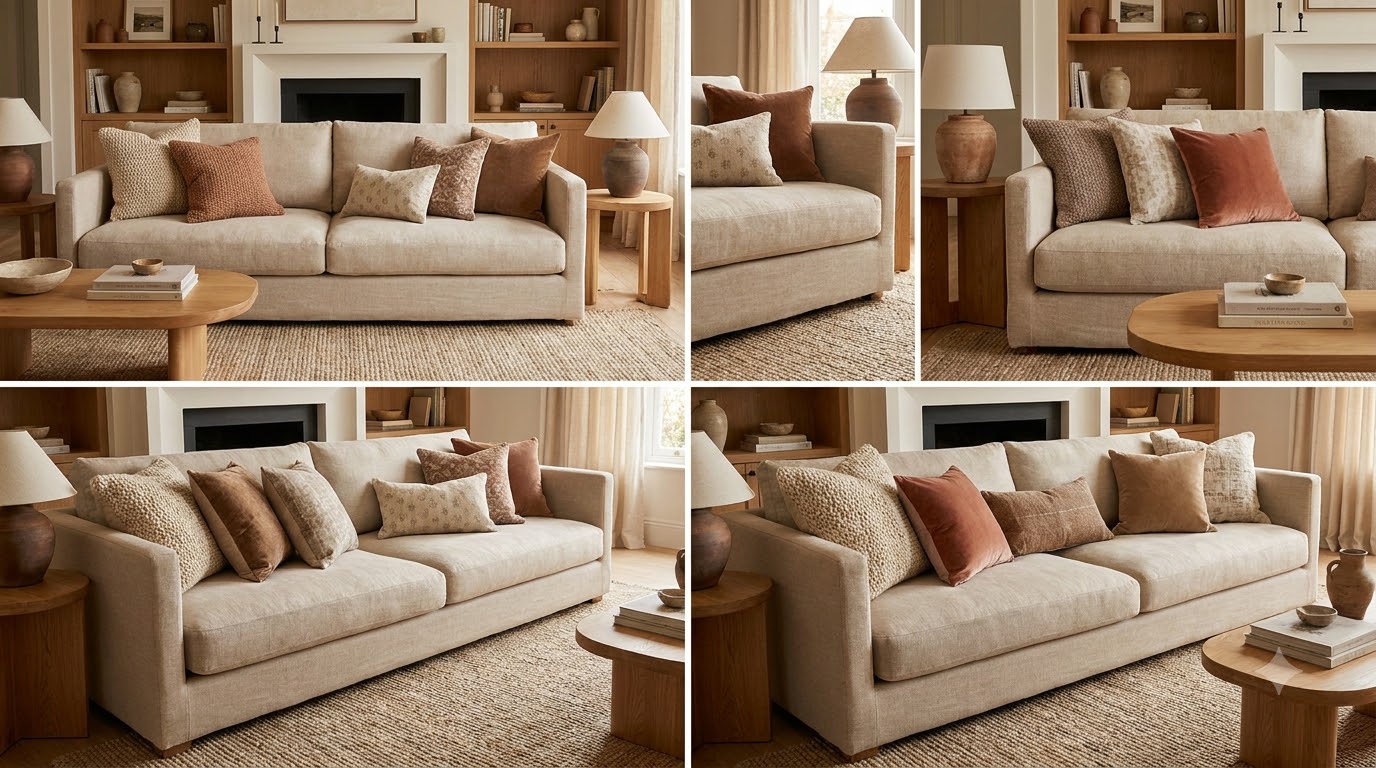
Throw Pillow Ideas: How to Arrange Them on a Sofa
The fastest way to make a sofa look styled is to work in odd numbers, vary the sizes, and mix textures and patterns. Start with five pillows on a standard three-seat sofa: two 22-inch squares anchoring the outside corners, two 20-inch squares layered in front of them, and one 18-inch or a 14-inch lumbar pillow in the center. Keep the sides symmetrical for a calm, classic look, or slide everything to one direction for a relaxed, asymmetrical feel. That single formula covers most of the throw pillow ideas you will ever need, and it costs almost nothing to swap the covers when the seasons change.
Key Takeaways
- Use odd numbers of pillows (3 or 5) so arrangements feel collected, not staged.
- Layer three sizes: 22-inch inserts in back, 20-inch in front, and an 18-inch or 14-inch lumbar to finish.
- Follow a 1 large / 1 medium / 1 small print pattern ratio so nothing competes.
- Budget covers run $8–15 each, so you can restyle a whole sofa for the price of one throw blanket.
- Buy inserts 2 inches larger than the cover for that full, karate-chop shape.
How many throw pillows on a sofa?
The right number depends on how long your sofa is, and the answer is almost always odd. A standard three-seat sofa looks best with five pillows; a loveseat wants three; and a large sectional can carry seven without looking cluttered. Odd counts read as intentional and lived-in, while even counts tend to look like a showroom display nobody is allowed to touch.
Here is the quick count we reach for in every small rental we style:
- Loveseat (under 60 inches): 3 pillows — two 20-inch squares plus one lumbar.
- Standard 3-seat sofa (72–84 inches): 5 pillows — two 22-inch, two 20-inch, one 18-inch or lumbar.
- Large sofa or small sectional (85–96 inches): 5–7 pillows across two zones.
- Full sectional (over 96 inches): 7 pillows, grouped 3 on the long run and clustered at the chaise.
One caveat for renters and anyone in a small space: leave enough clear seat for the people who actually live there. In a tight apartment we would rather run three well-chosen pillows you can toss aside than five you have to relocate every night. If you have to pile pillows on the floor to sit down, you have too many.
What size throw pillows are best?
The best throw pillows work in a range of sizes rather than one uniform square. A single size across the whole sofa flattens the arrangement; three descending sizes create depth. Think of it as building a small skyline — tallest in back, stepping down toward the middle.
Here are the insert sizes worth keeping in rotation:
- 22-inch square: the anchor. Sits in the back corners of a full-size sofa and does the heavy lifting.
- 20-inch square: the everyday workhorse. Layers in front of the 22s or anchors a loveseat.
- 18-inch square: the accent. Great for the center, for adding a bold print, or for apartment-size sofas where 22s feel bulky.
- 14-inch lumbar: the finisher. Breaks up the row of squares, adds back support, and shows off your best fabric.
One rule we never skip: always size the insert up. A 22-inch cover needs a 24-inch insert, and a 20-inch cover wants a 22-inch fill. That two-inch overstuff is the difference between a plump, magazine-ready pillow and a sad, saggy one. Down-alternative inserts hold that shape best and stay well under budget.
The best sofa-by-size pillow formula
If you remember nothing else, remember this table. It maps every common sofa length to the number and sizes of pillows that will look intentional without crowding the seat.
| Sofa size | Number of pillows | Recommended sizes |
|---|---|---|
| Loveseat (under 60 in) | 3 | Two 20 in + one 14 in lumbar |
| Apartment sofa (60–72 in) | 3–5 | Two 20 in, one 18 in, one lumbar |
| Standard 3-seat (72–84 in) | 5 | Two 22 in, two 20 in, one 18 in or lumbar |
| Large sofa (85–96 in) | 5–7 | Two 22 in, two 20 in, two 18 in, one lumbar |
| Sectional (over 96 in) | 7 | Grouped in twos and threes across zones |
For a deeper walk-through of how pillows fit into the wider room, our layering technique for rugs, pillows, and throws shows how the same odd-number logic scales from the floor up.
How do you mix patterns and textures?
Pattern mixing is where most people freeze, so we use a simple ratio: one large print, one medium print, and one small print or solid, tied together by a single shared color. The large print sets the mood, the medium supports it, and the small print keeps the eye from getting bored. Solids and textures count as the “quiet” members of the group, and every busy pillow needs a quiet neighbor to lean on.
Scale is the trick that makes clashing prints get along. A giant floral, a mid-size geometric, and a pinstripe can share a sofa happily because their motifs are different sizes — your eye reads them as a set instead of a fight. Trouble usually starts when two prints are the same scale, like two medium plaids competing for attention. When in doubt, keep the boldest pattern to one pillow and let solids and textures carry the rest.
A reliable five-pillow recipe using that ratio:
- Two solids or textures (22-inch) in the back corners — think chunky boucle, linen, or velvet.
- One large-scale print (20-inch) layered on one side.
- One medium print (20-inch) layered on the other side, sharing one color with the large print.
- One small print or stripe (18-inch or lumbar) in the center to tie it together.
- Optional throw blanket draped over one arm to repeat a color and add softness.
Texture matters as much as pattern, especially if you love a neutral palette. A row of five beige pillows can still look rich when you combine boucle, waffle-weave cotton, smooth velvet, and a nubby wool. When we style a calm, tonal room, texture does all the work that color would otherwise do. For more of that quiet, layered look, our guide to cozy living room ideas and layout leans hard on this technique.
Symmetry vs. asymmetry: which should you use?
Both work — they just set different moods. Symmetry mirrors the same pillows on each side of the sofa for a tidy, traditional, calming look. Asymmetry weights the pillows toward one side (or clusters them at one end of a sectional) for a casual, collected, of-the-moment feel.
- Choose symmetry when your sofa is the room’s centerpiece, when you like clean lines, or when a TV wall needs a calm counterweight.
- Choose asymmetry for sectionals, for small spaces where one clear seat matters, or when you want the room to feel relaxed and unfussy.
- Split the difference by keeping the back corners symmetrical and letting the front-layer and lumbar pillows lean one direction.
In our own apartment we default to that split approach: matching 22-inch anchors for structure, then an asymmetrical front layer so the sofa never feels too precious to flop onto after a long day.
Budget throw pillow ideas for renters
You do not need to buy new pillows every season — you need a few good inserts and a rotating set of covers. Covers with a hidden zipper run about $8–15 each, so a full seasonal swap for a five-pillow sofa costs less than a single premium designer pillow. Keep four to six inserts permanently and change the covers as your mood, the season, or your lease location changes.
- Invest once in inserts (two 22 in, two 20 in, one lumbar) in down-alternative fill.
- Buy covers in a shared palette so any three you grab will coordinate.
- Shop the whole store — curtain fabric, tea towels, and thrifted textiles all become covers with a basic zipper.
- Store off-season covers flat in a bin under the sofa; only the inserts stay out year-round.
- Wash covers, not inserts, so your pillows stay full-shaped for years.
If you are still choosing the sofa itself, it is worth picking one with a firm-enough back to hold pillows upright — our roundup of the best living room sofas under $1,500 flags which frames style well without a mountain of cushions. And once the sofa is set, the finishing touches in 30 cozy living room ideas for every style show how pillows tie into lamps, art, and throws for a complete look.
The 5-minute styling sequence
Arranging pillows is faster when you always build in the same order. Here is the exact sequence we use, working from the outside in:
- Anchor the corners with your two largest 22-inch pillows, one in each back corner.
- Layer the front with two 20-inch pillows resting slightly in front of the anchors.
- Add the accent — one 18-inch print or a 14-inch lumbar — in the center or leaning toward one side.
- Karate-chop the tops of the down-filled squares so they dimple slightly and look intentional.
- Drape a throw over one arm to soften the edge and repeat a color.
- Step back and edit — if it looks crowded, remove one pillow and reassess.
Frequently Asked Questions
Should throw pillows match the sofa?
No — and matching too closely usually looks flat. Pull one or two colors from the sofa and echo them in your pillows, but let the rest bring contrast in pattern, texture, or a bolder shade. The goal is a coordinated palette, not a monochrome blur. Contrast is what makes the whole grouping feel styled rather than store-bought.
What is the biggest throw pillow mistake?
Using pillows that are too small and all the same size. A row of matching 16-inch pillows disappears on a full-size sofa and reads as an afterthought. Go bigger than feels natural — 22-inch anchors surprise most people — and vary at least two sizes so the arrangement has real depth and presence.
How do I keep pillows from sliding down?
Firm inserts are the fix. Sized-up down-alternative or feather fills hold their shape and stay upright against the sofa back, while cheap polyester slabs slump within days. A slightly firmer sofa back helps too. If a pillow keeps toppling forward, its insert is too soft or a size too small for the cover.
Can I use throw pillows in a very small living room?
Absolutely, just scale down the count. In a small rental we run three pillows instead of five and lean toward 18-inch and 20-inch sizes over bulky 22s. Keep at least one seat fully clear so the sofa stays usable. Three well-chosen pillows in a small room always beat five crowded ones.
How often should I restyle my pillows?
Swap covers seasonally — roughly four times a year — to keep the room feeling fresh without spending much. Lighter linens and small prints for spring and summer, richer velvets and boucle for fall and winter. Because covers are only $8–15, a full refresh costs less than a single new pillow and takes about five minutes.