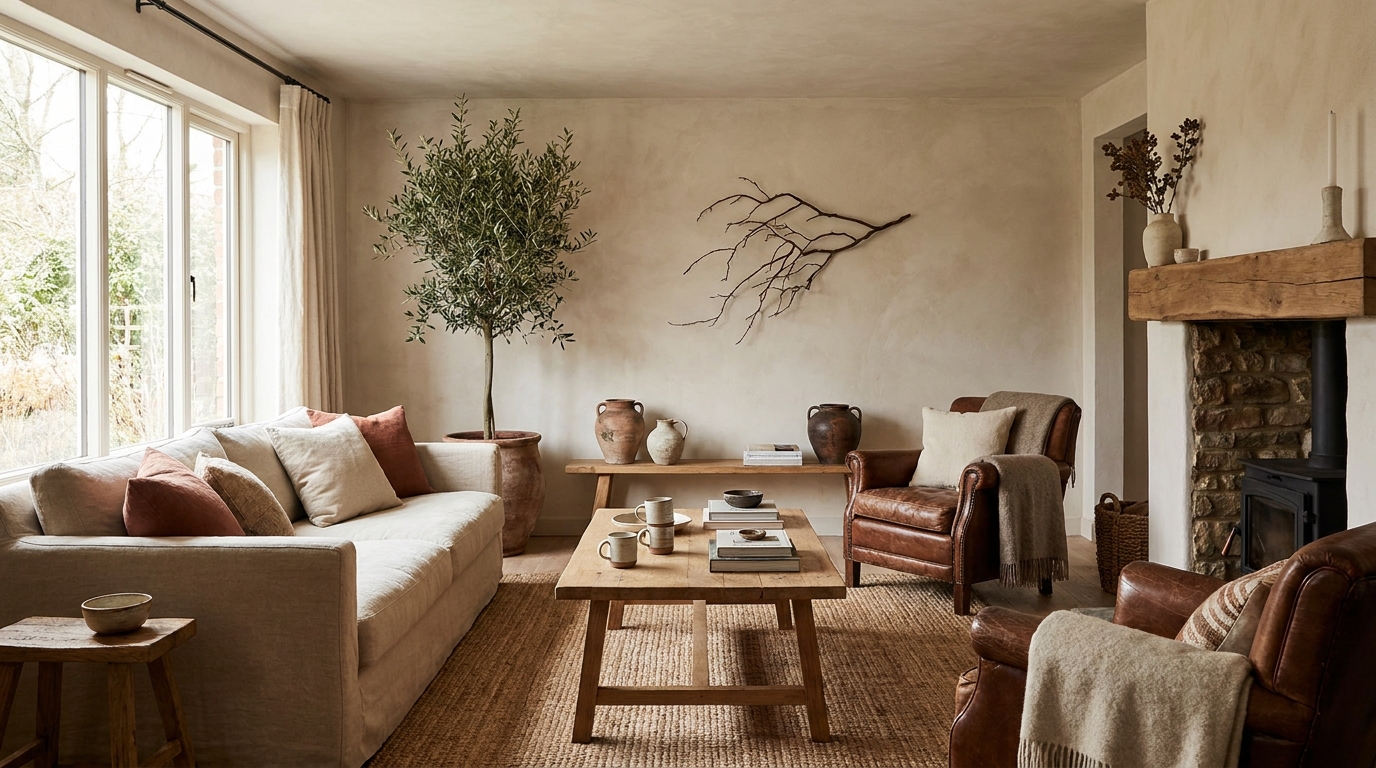
Organic modern decor is what you get when you combine the clean lines of modern design with natural materials, earthy warm neutrals, and soft curved shapes. Think a low, straight-edged oak console paired with a rounded boucle chair, a warm white wall, and a single sculptural clay vase. The look reads calm and grounded because every hard edge is balanced by something tactile and organic. If you rent, live small, or shop on a budget, this is one of the friendliest styles to pull off, because it rewards restraint and secondhand finds over expensive matching sets.
Key Takeaways
- The formula: clean modern lines + natural materials + warm earthy neutrals + curves. Get three of the four and the room already reads organic modern.
- Palette: build on warm white (#F5F1E8) and oat (#D9CBB3), then add clay (#C4785A), olive (#6B6B47), and walnut (#5C4433) in small doses.
- Materials matter more than money: oak, boucle, travertine, linen, and rattan carry the whole look, and most can be found secondhand.
- Curves do the heavy lifting: one arched mirror or a rounded chair softens an entire boxy rental room.
- Budget swaps beat big spends: a $30 linen slipcover, a $15 rattan basket, and thrifted stoneware replace hundreds in furniture.
What is organic modern style?
Organic modern style is a blend, not a single aesthetic. It takes the discipline of modern design (low profiles, uncluttered surfaces, straight and simple silhouettes) and warms it up with materials and shapes pulled straight from nature. Where mid-century modern leans on bold color and sharp geometry, and where minimalism can feel cold, organic modern sits in the comfortable middle: quiet, textural, and lived-in.
We started leaning into this style in our own rental because it hides a lot of flaws. Beige builder-grade walls, laminate floors, and boxy rooms all look intentional once you introduce natural texture and a few curves. You are working with a neutral shell rather than fighting it.
The four pillars that define the look:
- Clean lines. Furniture with low, simple profiles and minimal ornamentation. Nothing fussy or heavily carved.
- Natural materials. Real or convincing wood, stone, and plant fibers over glossy plastic and chrome.
- Warm earthy neutrals. A palette drawn from clay, sand, olive, and bark rather than gray and stark white.
- Organic curves. Arches, rounded corners, and sculptural shapes that break up straight-edged rooms.
What colors define an organic modern palette?
The palette is the fastest way to signal organic modern, and it costs nothing to plan. Skip cool grays and bright whites. Instead, anchor the room in warm neutrals and layer in muted earth tones as accents. We keep roughly 70% of a room in the two base tones, 20% in secondary warmth, and 10% in the deepest accent.
- Warm white (#F5F1E8): walls, large upholstery, and bedding. The forgiving base that makes everything else glow.
- Oat (#D9CBB3): rugs, curtains, and slipcovers. A soft mid-tone that reads as “natural” instantly.
- Clay (#C4785A): the signature accent. A terracotta-adjacent tone for a throw pillow, a vase, or a single wall.
- Olive (#6B6B47): plants, ceramics, and small textiles bring in a grounded, leafy green.
- Walnut (#5C4433): wood furniture and picture frames. The deepest note that adds contrast and weight.
Keep the whole scheme within this warm family and the room will feel cohesive even if the pieces come from five different places. That forgiveness is exactly why the style suits budget shoppers and thrifters.
Which materials and textures matter most?
If color sets the mood, materials do the real work. Organic modern lives and dies on texture, because a warm neutral palette can fall flat without something to touch. We aim for at least four distinct textures in every room so the eye keeps moving.
- Oak: light, warm wood grain for tables, shelving, and stools. The workhorse wood of the style.
- Boucle: that nubby, looped upholstery fabric on an accent chair or bench. Instantly soft and modern.
- Travertine: creamy, pitted stone for a coffee table, a tray, or small pedestals. Adds quiet luxury.
- Linen: relaxed, slightly wrinkled fabric for curtains, slipcovers, and bedding. Never crisp or shiny.
- Rattan: woven plant fiber for baskets, light fixtures, and headboards. Cheap, warm, and endlessly available.
You do not need all five at once. In our living room we paired an oak shelf, a linen slipcovered sofa, and two rattan baskets, then added a single travertine tray later. Layering slowly kept it from looking like a showroom and kept the spending spread out.
How do curves change a boxy room?
Most rentals and small apartments are boxes: square rooms, straight-edged built-ins, rectangular windows. Curves are the counterweight. A single rounded shape can shift a whole room from stiff to relaxed, and curved pieces are some of the easiest things to thrift because they never date.
- Arched mirror: leans against a wall and softens vertical, boxy space with one purchase.
- Rounded-back chair: a curved boucle or cane accent chair breaks up a room full of right angles.
- Round or organic-edged coffee table: removes sharp corners from the center of the room.
- Sculptural vases and objects: wavy, asymmetrical ceramics add curves at a small-object scale.
- Curved-frame art or a round wall clock: low-cost ways to repeat the shape up high.
A good rule: repeat a curve at least twice in a room. One arch reads like an accident; two or three read like a decision. Plants help here too, since their natural silhouettes are all soft edges. If you want the greenery to pull real weight, our indoor plants home decor guide walks through the easiest options, and a big leafy specimen from our best large indoor plants roundup can act as living sculpture in an empty corner.
Organic modern choices, element by element
When you are standing in a store or scrolling a secondhand listing, it helps to know the organic modern answer for each part of a room. Here is the cheat sheet we use.
| Room element | Organic modern choice |
|---|---|
| Sofa | Low profile in oat or warm white linen, relaxed slipcover |
| Accent chair | Rounded back in boucle or cane |
| Coffee table | Round oak or travertine with soft edges |
| Lighting | Rattan or linen shade, warm bulb, no chrome |
| Rug | Jute, wool, or oat-toned flatweave |
| Wall color | Warm white (#F5F1E8), never cool gray |
| Art | Abstract earth tones or a single arched mirror |
| Accessories | Sculptural clay vases, stoneware, woven baskets |
| Greenery | One large plant plus a couple of small trailing pots |
How do you get the look on a budget?
This is where organic modern shines for renters and small-space dwellers. The style is built on natural materials and neutral tones, which are exactly what fills thrift stores, estate sales, and clearance shelves. You are not chasing a specific expensive item; you are chasing texture and warmth, and those are cheap.
Our favorite budget swaps, most under the cost of a single new accent piece:
- $30 linen slipcover over a dated or mismatched sofa instead of a new couch that runs into four figures.
- $15 rattan baskets for storage and instant texture instead of closed plastic bins.
- $10 to $20 thrifted stoneware and clay vases instead of new sculptural ceramics.
- $25 arched mirror from a secondhand marketplace instead of a designer version many times the price.
- $8 warm-white bulbs to replace cool blue-white ones and instantly warm the whole room.
- A few dollars in oak-toned peel-and-stick or a thrifted oak stool to introduce real wood grain without built-in furniture.
Renter-friendly rules keep your deposit safe: lean the mirror instead of drilling, use tension rods for linen curtains, and choose freestanding wood pieces over anything mounted. We furnished our first organic modern living room this way over about two months, adding one texture at a time. For a full room plan built on the same principles, our cozy living room ideas and layout guide maps out where each piece should land, and the same palette carries beautifully into the bedroom using our aesthetic bedroom ideas guide.
How do you style small spaces the organic modern way?
Small spaces actually suit this style, because organic modern is restrained by nature. Clutter is the enemy of both small rooms and clean modern lines, so the two goals point the same direction. The trick is to make every piece earn its footprint.
- Choose leggy furniture in oak or cane so you can see the floor, which makes a room feel larger.
- Go vertical with a single tall plant or a slim oak shelf instead of spreading small items across surfaces.
- Limit the palette to warm white and oat so the space reads as one calm volume, not a patchwork.
- Pick dual-purpose pieces like a travertine tray that doubles as a catchall or a rattan basket that stores blankets.
- Repeat one accent such as clay in two or three small objects rather than adding many competing colors.
In our own bedroom, a single olive throw, an oat linen duvet, and one arched rattan headboard did more than a dozen small trinkets ever could. Editing down is free, and it is the most powerful organic modern move you can make in a tight space.
Frequently Asked Questions
Is organic modern the same as Japandi?
They are close cousins but not identical. Japandi blends Japanese minimalism with Scandinavian function and leans cooler and more spare. Organic modern is warmer and more textural, with bolder earthy accents like clay and olive and a stronger emphasis on curves. You can absolutely borrow from both.
Can I do organic modern with existing gray furniture?
Yes. You do not have to replace cool-toned pieces right away. Warm them up with an oat or linen throw, add oak and rattan accents nearby, and swap cool bulbs for warm white ones. Over time, layering warm textures around gray furniture pulls the whole room into the earthy palette.
What is the cheapest way to start?
Start with light and texture, not furniture. Switch to warm-white bulbs, add a rattan basket and a thrifted clay vase, and drape a linen throw over what you already own. Those three moves cost very little and shift the mood of a room toward organic modern almost immediately, before you spend on any big pieces.
Does organic modern work in a dark or small apartment?
It works especially well. The warm white and oat base reflects light and makes tight rooms feel open, while natural textures add depth without visual clutter. Keep furniture leggy, stick to one or two accent tones, and let a single large plant bring life to the darkest corner of the space.
How many curves are too many?
There is no hard limit, but balance is the point. Aim to repeat a curve two or three times per room so it feels intentional, then let straight lines carry the rest. If everything is rounded, the space loses the modern discipline that gives organic modern its structure and calm.