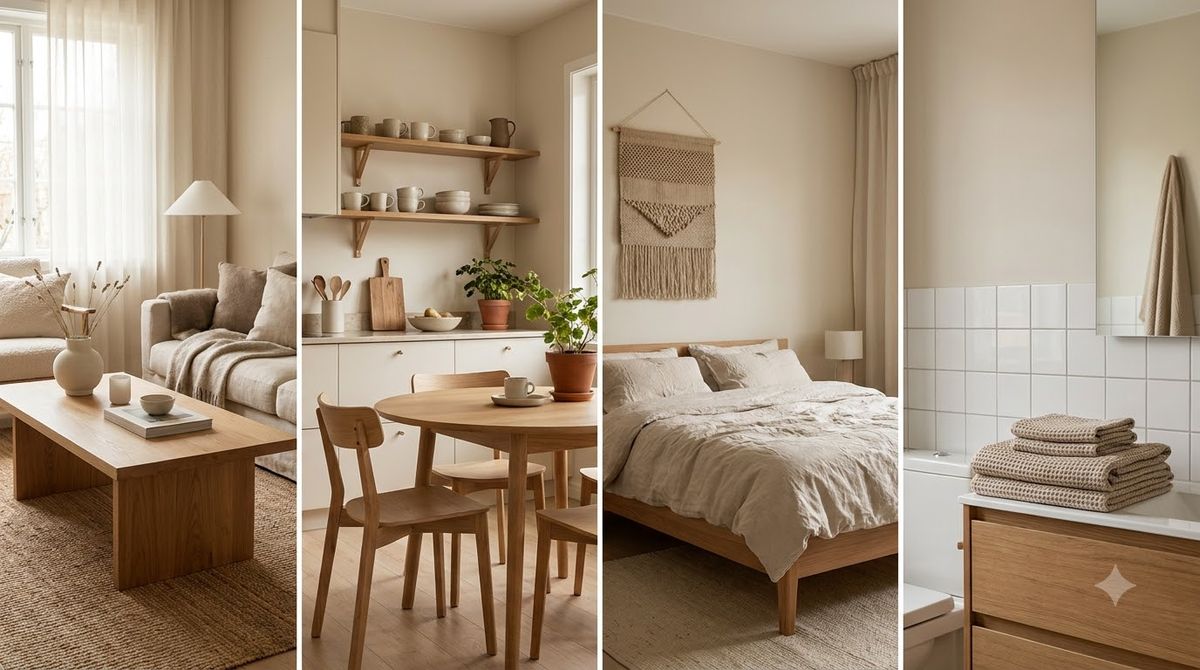
Scandinavian decor is bright whites, pale wood, and cozy natural textiles arranged for real, everyday function. That is the whole philosophy in one line: keep the palette light, let raw wood warm it up, layer in wool and linen for softness, and make sure every piece earns its place. If you rent, live small, or watch your budget, this is arguably the most forgiving style you can commit to, because it rewards restraint over spending.
The look comes from light, texture, and editing down, not from buying more. Below is a working guide to the palette, materials, furniture, textiles, and lighting that make a room read as unmistakably Scandinavian, plus honest price ranges.
Key Takeaways
- Start with light: a warm white base like #F4F2ED makes small rooms feel airy and reflects what little daylight you get.
- Warm the white with wood: pale ash, birch, and beech tones stop the palette from feeling clinical.
- Layer natural textiles: wool, linen, and sheepskin add the “hygge” softness that keeps minimal rooms from feeling cold.
- Light warm, not bright: use 2700K bulbs and candles; skip cool blue-white light entirely.
- Edit, don’t accumulate: function first, a few honest pieces, and negative space as a design choice.
- Budget-friendly: most of the look is achievable renter-safe and secondhand under a few hundred dollars.
What is Scandinavian style?
Scandinavian style is a design language rooted in the Nordic countries built around four ideas working together: light, minimalism, coziness (the Danish concept of hygge), and function. Long, dark winters shaped a look that maximizes daylight with pale surfaces, then makes those bright rooms feel warm and lived-in through soft natural materials and gentle lighting. Nothing is decorative for its own sake, and nothing is fussy.
What makes it ideal for renters and small spaces is that it is subtractive by nature. You are not building layers of ornament; you are removing clutter, choosing fewer and better pieces, and letting empty space breathe. The four pillars that define the style:
- Light: pale walls, bare or sheer windows, mirrors, and reflective surfaces to bounce daylight.
- Minimalism: clean lines, uncluttered surfaces, and a small edited number of objects.
- Hygge (coziness): tactile textiles, warm lighting, candles, and a general sense of calm comfort.
- Function: furniture and storage that genuinely work for daily life, with no wasted pieces.
What is the Scandinavian color palette?
The palette is quiet and warm-neutral. The mistake most people make is reaching for a stark, cool white that photographs well but feels cold in person. Test paint chips in your own light, especially north-facing light, before committing; a slightly warm off-white usually reads better than stark white. Build your scheme from these anchors:
- Warm white (#F4F2ED): the base for walls and large surfaces; soft rather than sterile.
- Pale ash / birch: the natural wood tone that carries warmth through the room.
- Soft grey (#D8D2C7): a greige mid-tone for textiles, a feature wall, or upholstery.
- Black accents: used sparingly in frames, hardware, lamp bases, and legs for contrast and definition.
- Muted naturals: optional dusty sage, oatmeal, or clay in small doses through a cushion or throw.
Keep most of the room in the warm white and wood range, add soft grey and natural textiles as the second layer, and use black only as a sparing accent. That balance is what keeps a Scandi room feeling intentional instead of washed-out.
Which materials make a room feel Scandinavian?
Material is where Scandi coziness actually lives. The color palette sets the stage, but it is the mix of textures that makes a minimal room feel warm rather than empty. Prioritize natural, tactile materials in these categories:
- Light wood: ash, birch, beech, and pale oak for tables, shelves, chairs, and frames.
- Wool: chunky knit throws, felted cushions, and a wool-blend rug underfoot.
- Linen: relaxed, slightly wrinkled curtains, bedding, and cushion covers.
- Sheepskin: a single real or faux sheepskin over a chair back or bench for instant softness.
- Rattan, jute, and cotton: baskets for storage, a jute rug, and cotton weaves for a lighter layer.
- Ceramic and glass: simple matte stoneware and clear glass for vases and tableware.
A good rule of thumb: if a surface feels cold or flat when you touch it, it probably needs a natural material nearby to balance it. A glass coffee table gets a chunky wool throw folded over a nearby chair; a laminate shelf gets a rattan basket and a small wood object.
What furniture defines a Scandi room?
Scandinavian furniture is defined by clean lines, tapered legs, light wood, and honest function. Pieces sit slightly off the floor on slim legs, which keeps sightlines open and makes small rooms feel larger. You do not need a full set; you need a few well-chosen pieces. What to look for:
- Tapered legs: sofas, chairs, and beds that stand on slim, angled wooden legs.
- Low, open profiles: furniture that does not visually crowd the floor.
- Pale wood grain: visible, natural grain rather than dark stains or high gloss.
- Multi-function storage: a bench with hidden storage, a nesting table set, or open shelving.
- One sculptural piece: a single curved chair or paper-shade lamp as a quiet focal point.
For renters, secondhand is your best friend here. Marketplace listings and thrift finds work well, and sanding and oiling a pale-wood side table back to life takes an afternoon. Budget guidance runs roughly like this: side tables and stools $20 to $60 secondhand, a good accent chair $80 to $200, open shelving $30 to $90, and a light-wood dining table $120 to $350 new or far less used.
How do you make a Scandi room cozy, not cold?
This is the question that trips people up, because “minimal” and “bright” can easily slide into “sterile.” The fix is lighting and texture. A room can be white and spare and still feel like a hug if the light is warm and the surfaces are soft. Coziness is engineered, not accidental.
Lighting is the single biggest lever. Overhead white light is the enemy of hygge. Instead, build layers of warm, low light:
- Choose 2700K bulbs everywhere for a soft, warm-white glow; avoid cool 4000K and up.
- Use multiple small sources: two or three table and floor lamps instead of one ceiling fixture.
- Add real candlelight: grouped pillar or taper candles are central to Danish hygge.
- Put lamps on dimmers or use smart bulbs so you can drop the light in the evening.
- Bring in string lights tucked behind a shelf or headboard for a low ambient wash.
Then stack texture on top: a chunky wool throw, two or three linen and knit cushions, a sheepskin, and a soft rug. Greenery matters too; a few plants add life and a hit of natural color against the neutrals. A reliable move is one large leafy plant in a simple ceramic pot near a light source, which instantly softens a bare corner.
Scandi elements and what to do with each
Use this quick reference to translate each core element into a concrete action for your own space.
| Scandi element | What to do |
|---|---|
| Warm white walls (#F4F2ED) | Paint or use removable peel-and-stick; keep trim the same tone for calm. |
| Pale wood | Add birch or ash through a side table, shelf, or picture ledge. |
| Soft grey (#D8D2C7) | Bring in via a rug, curtains, or one upholstered piece. |
| Black accents | Swap frames, drawer pulls, and a lamp base to matte black for contrast. |
| Wool and linen | Layer a throw plus two or three cushions in mixed weaves. |
| Sheepskin | Drape one over a chair back or the end of the bed. |
| 2700K lighting | Replace cool bulbs; add two lamps and a candle grouping. |
| Greenery | Place one large leafy plant in a plain ceramic pot near light. |
| Negative space | Clear surfaces; leave deliberate gaps rather than filling every shelf. |
How do you do Scandi decor on a budget?
Budget is where Scandinavian design genuinely shines, because the aesthetic values simplicity and craft over price tags. A calm, edited room costs less than a cluttered one. Here is where to put the money and where to save:
- Spend on: one comfortable seat, a good wool-blend rug ($60 to $150), and warm lighting.
- Save on: baskets, frames, vases, and small wood objects from thrift stores and marketplaces.
- Renter-safe swaps: peel-and-stick options, plug-in lamps, and removable hooks instead of drilling.
- Free wins: declutter, rearrange for light, and switch every bulb to 2700K (about $2 to $5 each).
- DIY: sand and oil a secondhand wood table, or hem inexpensive linen for relaxed curtains.
A realistic starter budget for a small living room or bedroom refresh lands around $150 to $400 if you mix a few new textiles and lighting with secondhand furniture. The bulb swap and declutter alone, at essentially no cost, get you most of the way to the feeling.
If you want to take the mood further room by room, our cozy living room ideas and layout guide pairs well with this palette, and our aesthetic bedroom ideas guide shows how the same light-and-texture approach translates to sleep spaces. Because greenery is so central to the Scandi look, browse our indoor plants for home decor guide, and if you are new to keeping things alive, start with our roundup of the best low-maintenance indoor plants for beginners.
A simple order of operations
If you are staring at a room and unsure where to begin, follow this sequence. It moves from the cheapest, highest-impact changes to the optional finishing touches.
- Declutter and clear surfaces so light and negative space can do their work.
- Switch all bulbs to 2700K and add a second and third lamp for layered light.
- Lighten the walls toward warm white if you can paint or use removable options.
- Add pale wood through one or two secondhand pieces.
- Layer textiles: a wool throw, linen cushions, a soft rug, one sheepskin.
- Finish with greenery and candles for the final hit of warmth and life.
Frequently Asked Questions
Is Scandinavian decor the same as minimalism?
They overlap but are not identical. Minimalism is about reducing to essentials, while Scandinavian style adds warmth, coziness, and natural texture on top of that restraint. A Scandi room is minimal in its clean lines and edited surfaces, yet it feels soft and inviting thanks to wool, wood, candlelight, and hygge, not cold or austere.
What colors should I avoid for a Scandi look?
Avoid heavy, saturated, or dark-dominant schemes and cool blue-white paints that read as sterile. Steer clear of glossy jewel tones and busy multicolor patterns. Keep to warm whites, pale wood, soft greys, and restrained black accents, adding color only in small, muted doses like dusty sage or oatmeal through a single cushion or throw.
Can I do Scandinavian style in a rental?
Absolutely, and it may be the most rental-friendly style there is. The core moves are removable: swap bulbs to 2700K, add plug-in lamps, layer textiles, bring in secondhand pale-wood furniture, and use peel-and-stick or removable hooks. Nothing requires permanent changes, and decluttering plus warm lighting alone gets you most of the effect.
How many plants should a Scandi room have?
Restraint applies to plants too. One large leafy plant near a light source, plus one or two small ones, is usually enough for a small room. The goal is a touch of natural life against the neutrals, not a jungle. Simple ceramic or terracotta pots keep the look calm and cohesive with the rest of the palette.
What is hygge and how does it fit in?
Hygge is a Danish concept of cozy, contented comfort, the feeling of a warm, calm, welcoming space. In decor terms it translates to soft 2700K lighting, candles, tactile wool and sheepskin, and unhurried, uncluttered rooms. It is the warmth that keeps Scandinavian minimalism from feeling cold, and it is arguably the heart of the entire style.
Bringing it together
Scandinavian decor rewards patience over spending. Start with a warm white base, warm it with pale wood, soften it with wool and linen, light it at 2700K with candles, and edit until each piece feels necessary. Take it one step at a time.