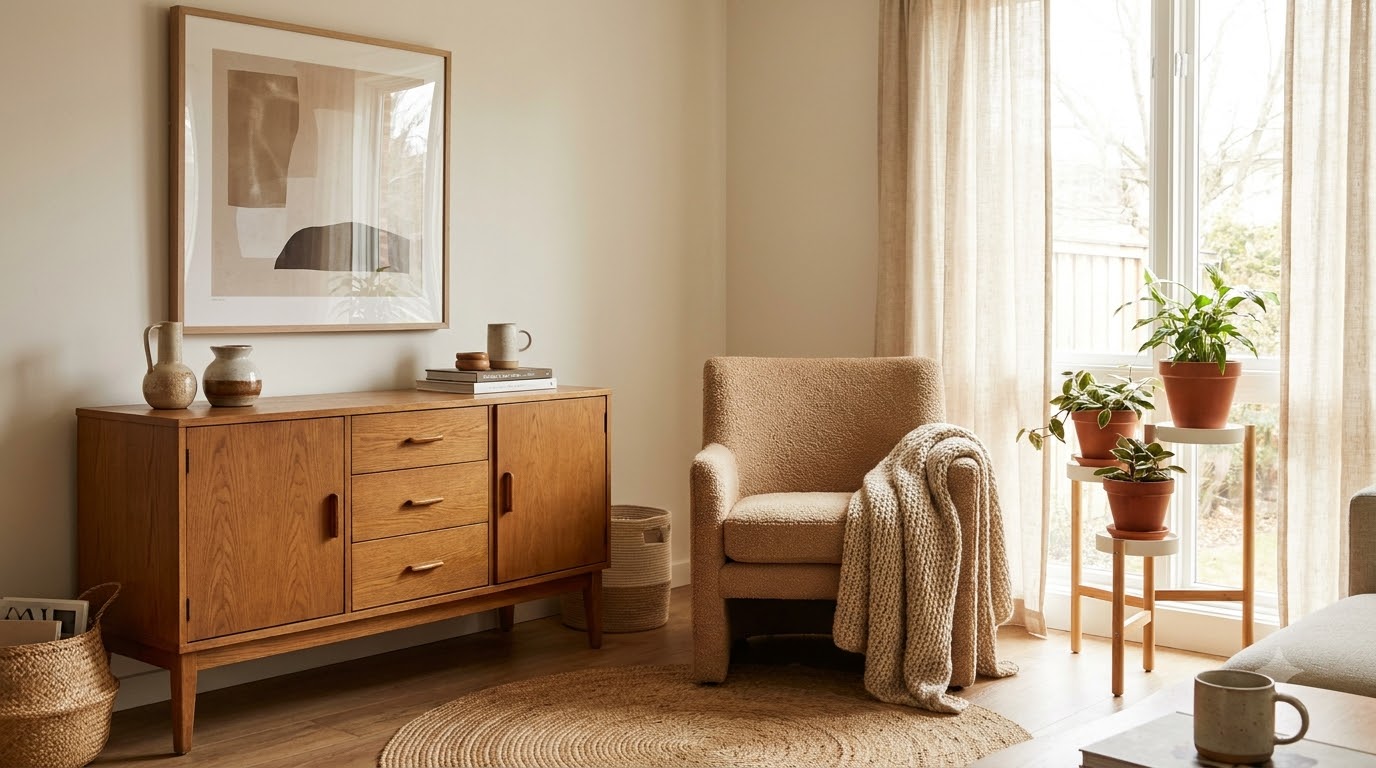
Mid-century modern decor is a look built on clean lines, tapered wooden legs, warm walnut tones, and a bold-but-warm color palette — and you can absolutely get it on a renter’s budget. At its core, MCM pairs organic curves with functional simplicity, so a small apartment reads as intentional rather than crowded. The good news for anyone decorating a rental or a first place: the style rewards restraint, secondhand shopping, and a few well-chosen shapes over big spending. Below, we share the exact colors, silhouettes, and budget swaps we lean on to get the mid-century modern look without emptying our wallets.
Key Takeaways
- Mid-century modern (MCM) = clean lines, tapered legs, warm woods like walnut, and a warm-but-bold color palette.
- You can build the look on a budget by prioritizing three or four signature shapes instead of a full furniture set.
- Anchor your palette with walnut wood, mustard #C9A24B, teal, and olive against warm white or greige walls.
- Thrift stores, estate sales, and marketplace listings are the fastest path to authentic MCM pieces under $150.
- Renter-friendly swaps — peel-and-stick, tapered furniture legs, and textiles — deliver the style without permanent changes.
What defines mid-century modern?
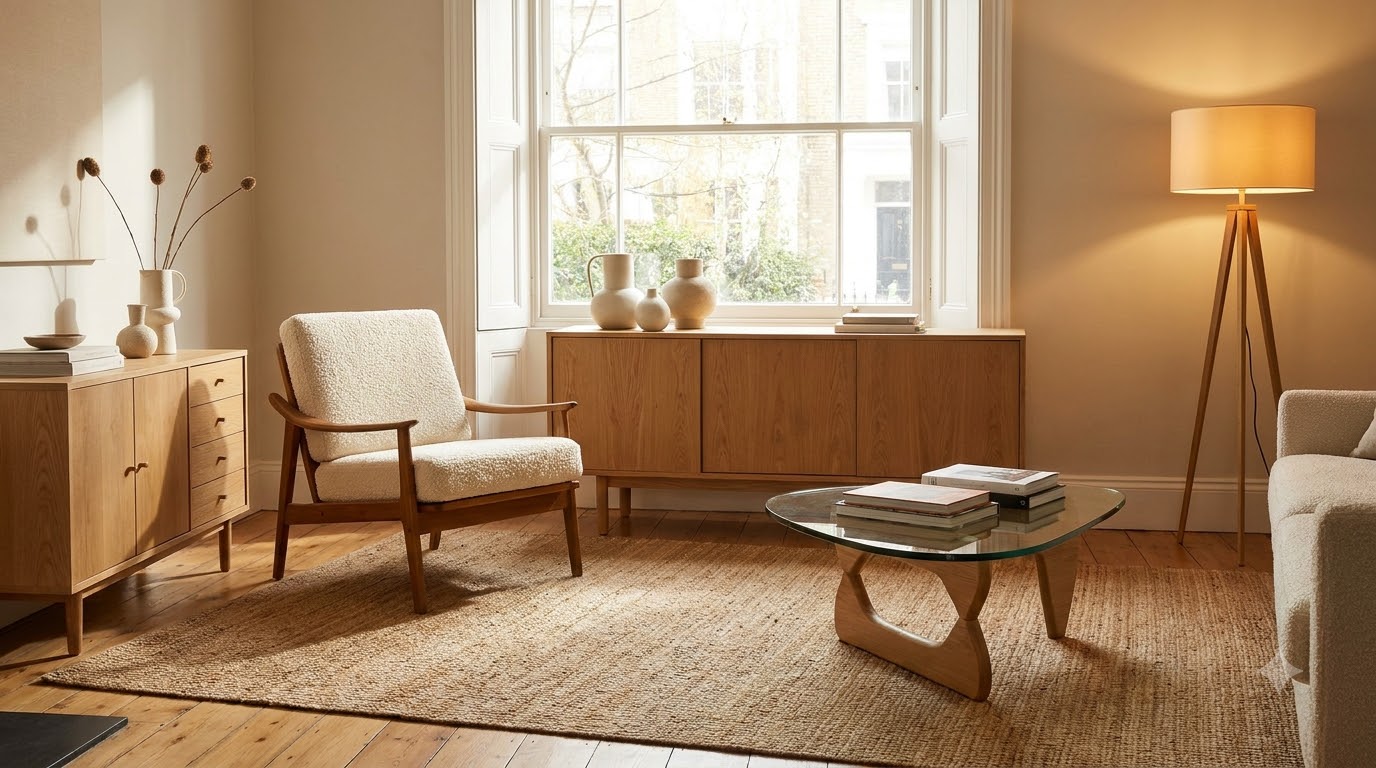
Mid-century modern is a design movement rooted in the 1940s through the 1960s, and it defines itself through a handful of instantly recognizable traits. When we scan a room and call it “MCM,” we’re usually responding to the same visual cues: low, horizontal furniture that keeps sightlines open, legs that taper to a fine point, and wood tones that glow warm rather than gray. The style celebrates function — nothing is fussy, and every curve has a reason to exist.
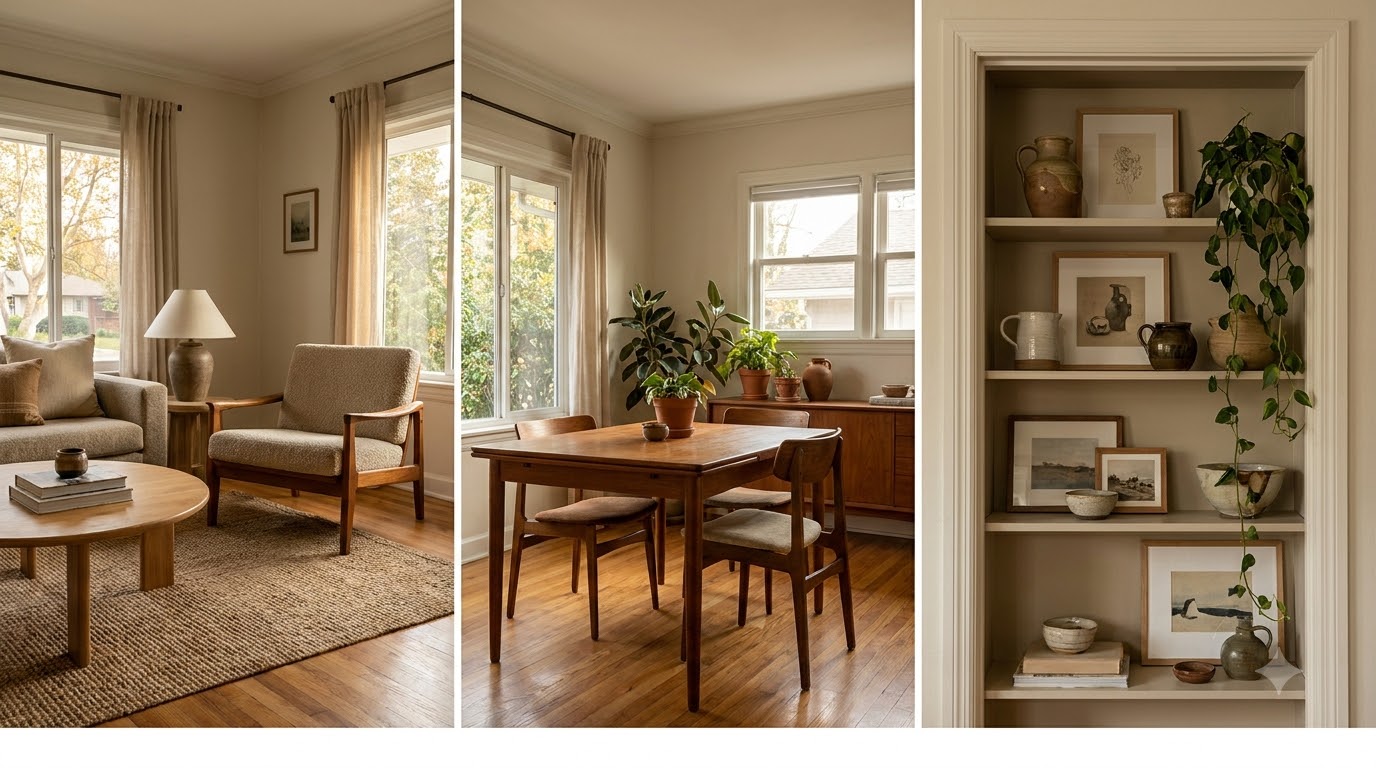
Here are the signature elements that define the look, and the ones worth memorizing before you shop:
- Clean, horizontal lines — low sofas, credenzas, and platform beds that sit close to the floor.
- Tapered legs — angled, splayed, or peg-style legs, often in solid wood, that lift furniture off the ground.
- Warm woods — walnut, teak, and oak with a honeyed finish rather than a cool or whitewashed one.
- Organic curves — kidney shapes, egg chairs, and gently rounded edges balancing the straight lines.
- Bold-but-warm color — saturated accents like mustard, teal, and olive kept grounded by neutral backdrops.
- Geometric and atomic motifs — starbursts, boomerangs, and repeating shapes on textiles and art.
If you can name these six traits, you can spot a genuine mid-century piece across a crowded thrift aisle — a skill that has saved us more than once. For a broader sense of how these shapes settle into a shared space, our cozy living room ideas and layout guide walks through arranging low-profile furniture in small rooms.
What is the mid-century modern color palette?
Color is where MCM either sings or slips into costume. The trick is warmth: even the bold hues lean earthy, so the room feels inviting instead of loud. We build every mid-century palette on a warm-neutral base — think warm white, greige, or a soft camel — and then layer in two or three saturated accents. That restraint is what keeps a small rental from feeling busy.
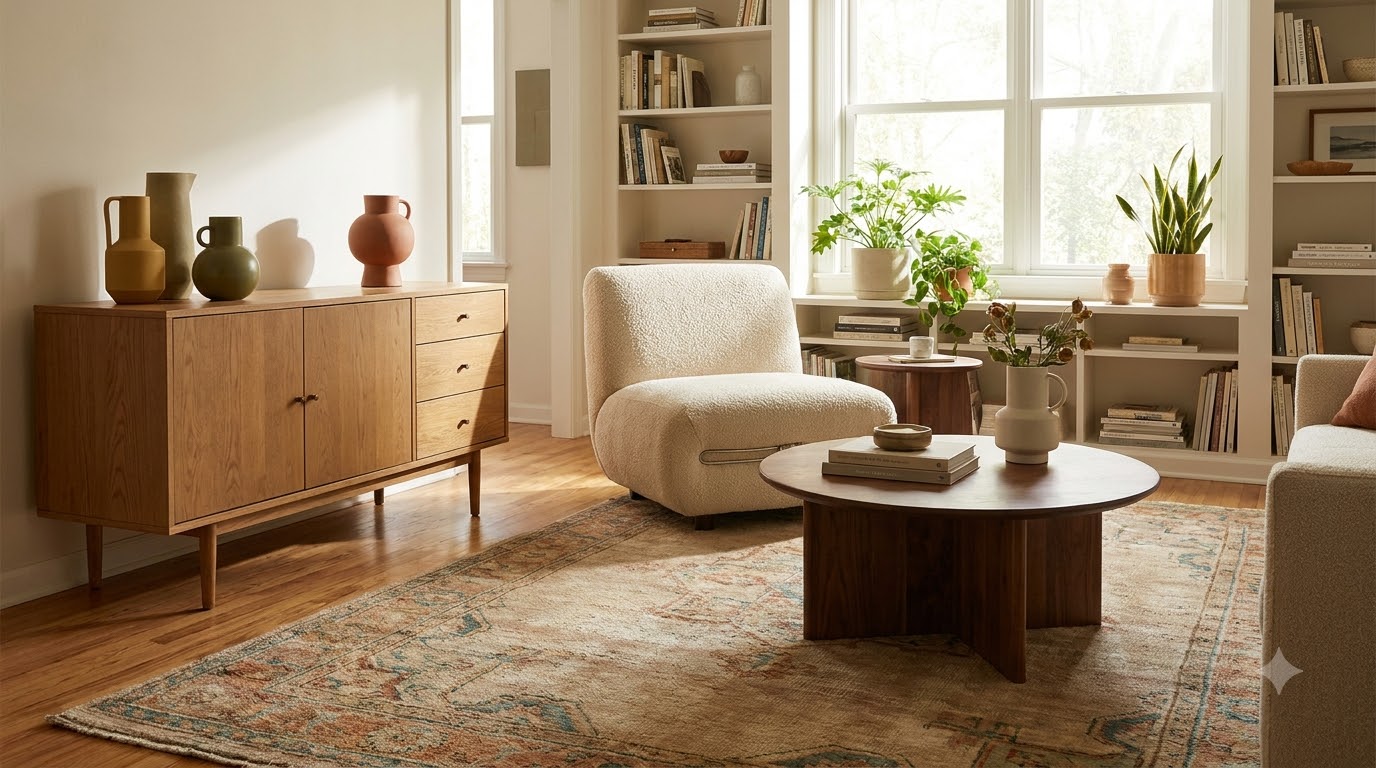
These are the core palette anchors we return to again and again:
- Walnut wood tone — the warm brown backbone of the whole scheme, carried by furniture and frames.
- Mustard
#C9A24B— the classic MCM accent for a chair, a throw pillow, or a lamp base. - Teal — a deep blue-green that pops against walnut without turning cold.
- Olive — a muted, earthy green that reads vintage and pairs with nearly everything.
- Warm white or greige — the calm backdrop that lets the accents do the talking.
A reliable formula: keep roughly 60% of the room neutral, 30% walnut wood, and 10% split between your bold accents. In our own place, we started with a single mustard cushion and an olive throw, then let the palette grow from there — proof that you don’t need to repaint anything to commit to the color story. If your walls are landlord-white, that’s a gift, not a limitation: warm white is already the ideal MCM backdrop, so every dollar can go toward wood and color instead of paint and primer.
One caution we’ve learned the hard way — resist the urge to use all three accents at full strength in the same small room. Pick one hero color to repeat two or three times, then let the others appear once each. A mustard chair, echoed by a mustard lamp base and a thin mustard stripe in the rug, reads far more polished than an even scatter of every color you own.
How do you get the MCM look cheaply?
You get the mid-century modern look cheaply by spending on shape, not on labels. A $40 secondhand credenza with tapered legs does more for a room than a full set of new furniture in the wrong silhouette. We treat budget MCM as a series of smart swaps: replace what’s easy, thrift what’s iconic, and skip anything that only mimics the style on the surface.
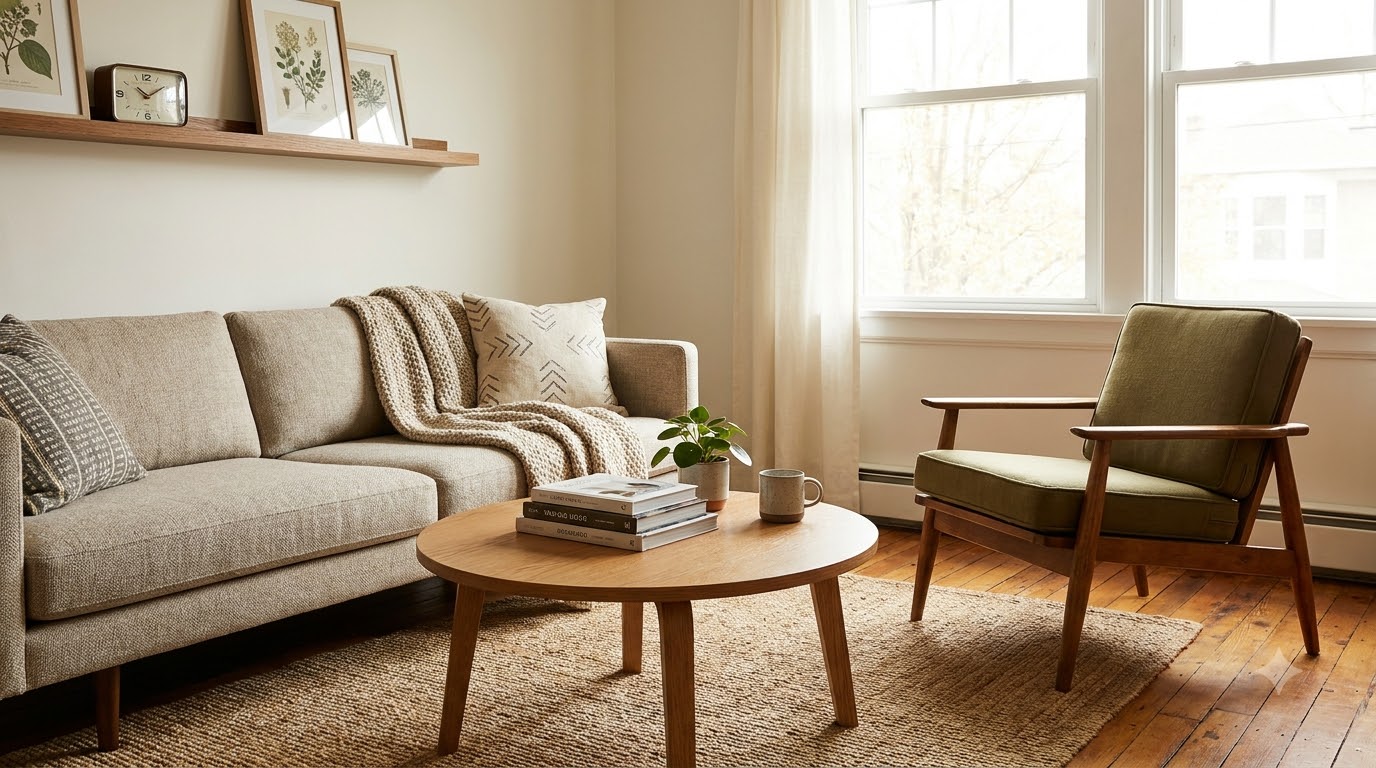
Here are the budget swaps and their typical price ranges that give the biggest visual return:
- Swap plain furniture legs for tapered wooden ones — $15–$45 for a set of four instantly modernizes a flat-pack sofa or dresser.
- Add a mustard or teal accent chair — $60–$180 secondhand versus several hundred new.
- Layer geometric-print textiles — throw pillows and a rug at $20–$90 carry the atomic-era pattern for cheap.
- Hang a starburst mirror or clock — $25–$70 delivers the single most recognizable MCM motif.
- Choose a globe or sputnik-style light — $40–$120 replaces a builder-grade fixture with real period character.
- Bring in a snake plant or rubber tree — $10–$35 for the sculptural greenery the era loved.
When it comes to the big anchor pieces, patience pays. If you would rather buy new, our roundup of the best living room sofas under $1,500 flags several low-profile, tapered-leg silhouettes that read mid-century, and our best coffee tables under $400 guide covers the walnut-toned shapes that pull a seating area together.
Which MCM elements should you buy — and where?
Not every piece deserves the same budget. Some elements are worth hunting for secondhand because the vintage versions are genuinely better; others are fine bought new or faked with an inexpensive swap. The table below is the cheat sheet we use when we’re deciding where a dollar goes furthest.
| MCM element | Best budget source | Typical price |
|---|---|---|
| Walnut credenza or sideboard | Estate sales & thrift stores | $40–$200 |
| Accent chair (mustard/teal) | Marketplace & consignment | $60–$180 |
| Tapered furniture legs | Hardware store or online | $15–$45 / set |
| Starburst mirror or clock | Thrift & flea markets | $25–$70 |
| Sputnik / globe light | Online, bought new | $40–$120 |
| Geometric-print textiles | Discount home stores | $20–$90 |
| Ceramic table lamp | Thrift stores | $15–$50 |
The pattern here is simple: buy wood and iconic shapes secondhand, buy lighting and legs new, and let textiles fill in the color. That split keeps the room authentic while the total stays low.
How do you thrift mid-century furniture without getting fooled?
Thrifting is the heart of budget MCM, but the aisles are full of near-misses — pieces that hint at the era without truly belonging to it. Over years of weekend hunts, we’ve learned to read a few quick signals that separate a real find from a lookalike. These are the thrift tips we’d hand a friend on their first estate-sale morning:
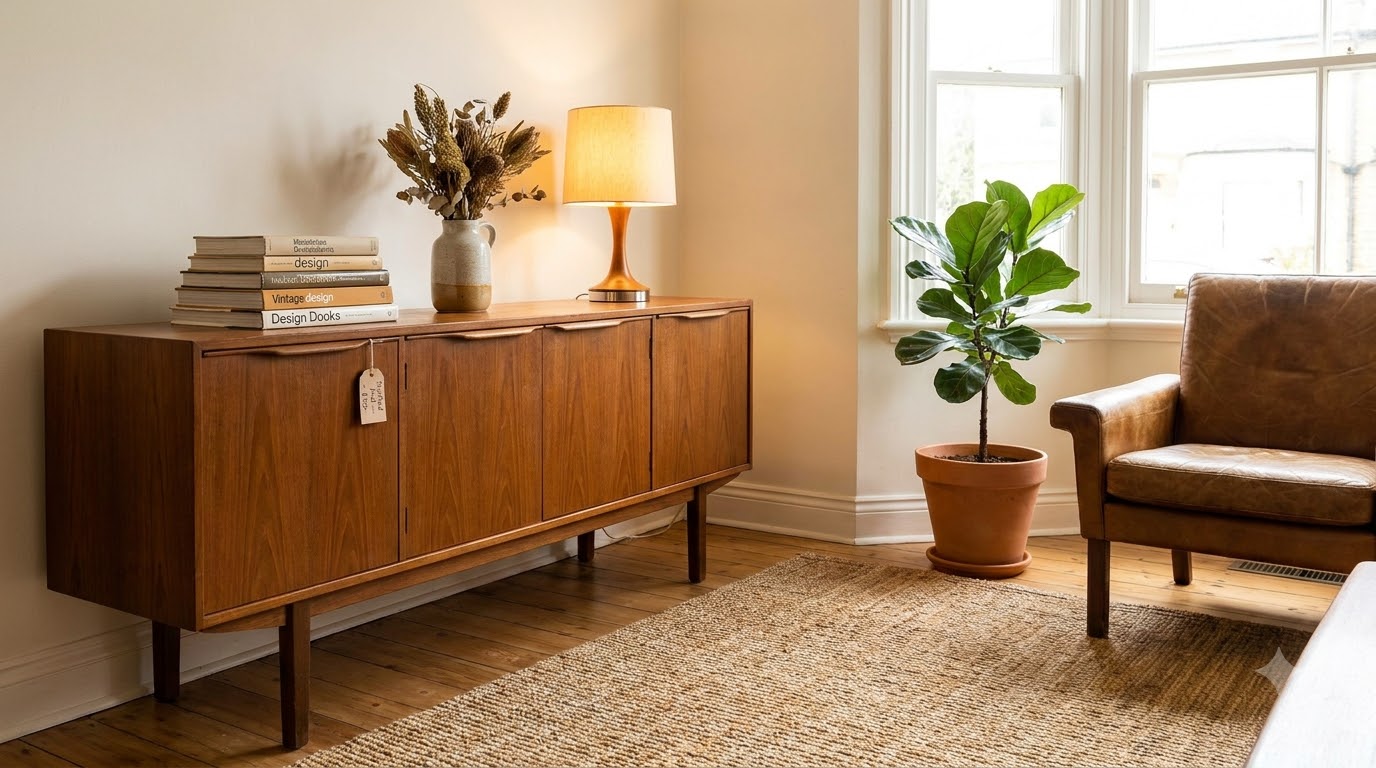
- Check the legs first. Genuine tapered, splayed, or peg legs made of solid wood are the fastest authenticity tell.
- Knock on the wood. Solid walnut or teak sounds and feels heavier than veneered particleboard; flip the piece to inspect joints.
- Look underneath and inside drawers. Dovetail joinery and old maker stamps signal an era piece worth the price.
- Shop early on estate-sale days, late for discounts. First hour gets the best selection; the final hour often brings half-price markdowns.
- Judge bones over surface. Scratches, dated fabric, and dull finish are cheap fixes; broken frames and warped wood are not.
- Bring a tape measure. Low MCM furniture can swallow a small room — confirm the footprint before you commit.
A dated but solid dresser reupholstered chair can be reborn with new legs, a light sanding, and a coat of oil. We reupholstered our first thrifted lounge chair for the cost of two yards of fabric, and it’s still the piece guests ask about.
How do renters get the look without renovating?
Renters carry an unfair reputation for being stuck with beige boxes, but MCM is actually one of the most renter-friendly styles because so much of it lives in furniture and textiles rather than walls. Everything on this list is reversible and moves with you to the next place:
- Peel-and-stick wallpaper in a geometric or atomic print for one accent wall — removable and deposit-safe.
- Freestanding room dividers or shelving with slatted wood for that classic open, airy partition.
- Plug-in wall sconces and arc floor lamps that skip hardwiring entirely.
- Area rugs to define zones and layer in warm color over rental carpet or laminate.
- Tension-mounted or leaning pieces — ladder shelves and propped art that need no drilling.
The bedroom is often the easiest room to convert, since a low platform bed, two clean-lined nightstands, and a warm palette do most of the work. Our complete aesthetic bedroom ideas guide pairs well with this approach for anyone starting there.
What ties every renter-friendly move together is restraint. Mid-century modern was never about filling a room; it was about giving a few honest shapes room to breathe. When we’re tempted to add one more piece, we ask whether it earns its footprint — and more often than not, the answer is to edit down rather than add on. That mindset is the real budget hack: an intentional, uncrowded room reads as expensive no matter what you actually spent to build it.
Frequently asked questions
What is the difference between mid-century modern and modern?
Modern is a broad umbrella for minimal, unornamented design, while mid-century modern is a specific slice of it from roughly the 1940s to 1960s. MCM adds warm woods, organic curves, and bold earthy color to modern’s clean lines, giving it more warmth and personality than sleek contemporary rooms.
What is the cheapest way to start an MCM room?
Start with textiles and one shape. A mustard or teal throw pillow, a geometric rug, and a single tapered-leg thrift find will shift a room toward mid-century for under $100. Build slowly from there, adding a walnut piece and a statement light once you spot the right deals.
What colors go with mid-century modern furniture?
Warm neutrals like greige and warm white make the safest backdrop, letting walnut wood shine. From there, layer bold-but-warm accents: mustard #C9A24B, teal, and olive are the classic trio. Keep the neutrals dominant and the accents in a few concentrated spots so the room feels curated rather than chaotic.
Is mid-century modern good for small spaces?
Yes — MCM is ideal for small spaces because its low, legged furniture keeps floors and sightlines visible, making rooms feel larger. Tapered legs let light travel underneath pieces, and the pared-back silhouettes avoid visual clutter. Choose a few multipurpose items over many small ones to keep the openness intact.
How can I tell if a thrifted piece is real mid-century?
Flip it over and inspect the construction. Solid walnut or teak, dovetailed drawers, tapered or peg legs, and old maker stamps point to a genuine era piece. Veneered particleboard, staples, and plastic legs usually signal a modern lookalike. Trust the weight and the joinery more than the surface finish.