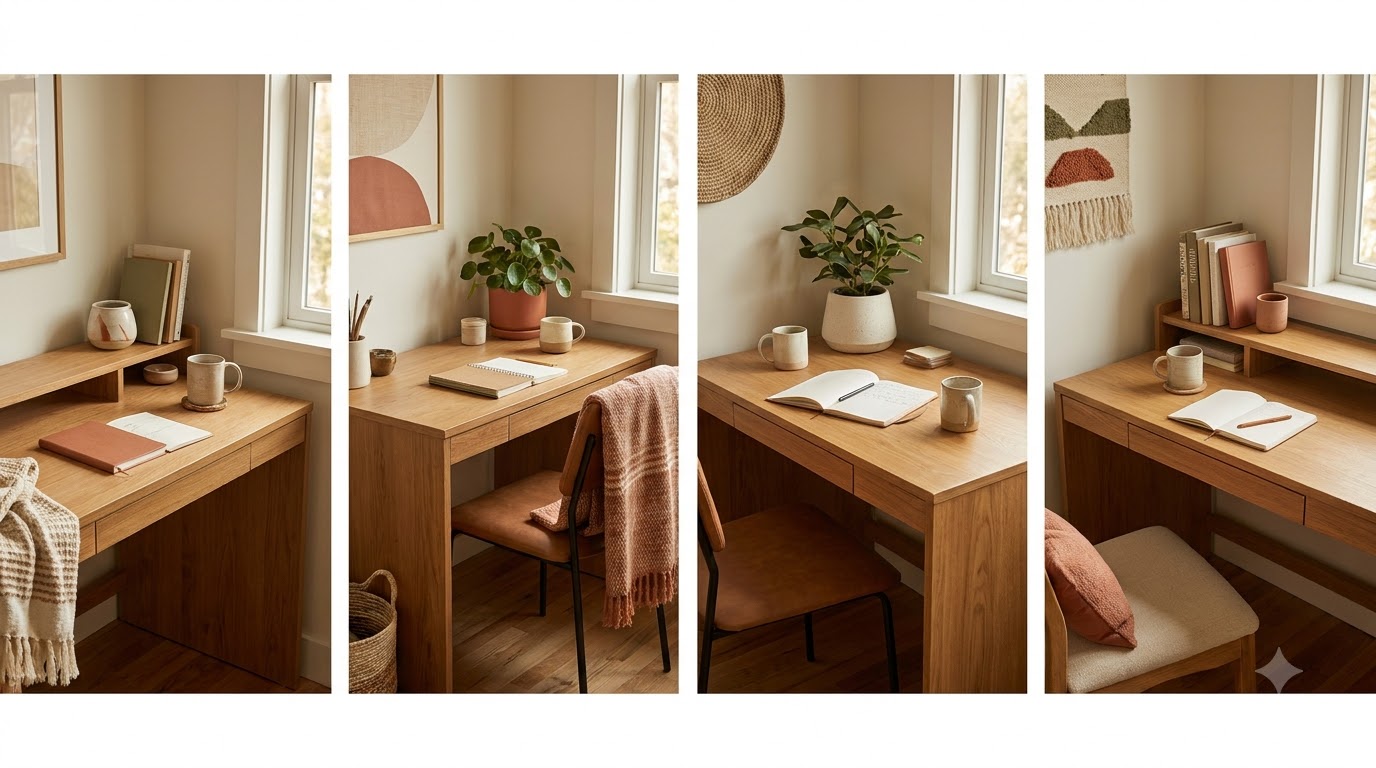
Best Desks for Small Home Offices Under $200
The best small desk for a tight home office is a writing desk between 40 and 47 inches wide and 20 to 24 inches deep, which fits a laptop, a lamp, and a notebook without eating your walkable floor. If your square footage is truly scarce, a wall-mounted fold-down desk collapses to about 4 inches of depth when closed, and a ladder or leaning desk stacks storage upward instead of outward. Every type we recommend below lands in the $40 to $200 range, and we have tested most of them in apartments where the desk had to double as a nightstand, a vanity, or a dinner-for-one table.
Key Takeaways
- Best all-rounder: a 40 to 47 inch writing desk, roughly $70 to $160, deep enough for a laptop and a monitor riser.
- Smallest footprint: a wall-mounted fold-down desk closes to about 4 inches deep and frees the floor completely.
- Most storage per square foot: a ladder or leaning desk uses vertical shelves above a 20 inch work surface.
- Best for renters: no-drill freestanding types (writing, ladder, C-table) protect your deposit.
- Budget floor: a C-table or laptop cart starts near $40 and slides over a sofa or bed.
- Measure first: leave at least 30 inches of clear space behind the desk for a chair to pull out.
What size desk for a small space?
Aim for a surface that is 40 to 47 inches wide and 20 to 24 inches deep. That width comfortably holds a 13 to 15 inch laptop, a small task lamp, and a coffee mug with room to write longhand. Depth matters more than most people expect: at 20 inches you can use a laptop and a stack of books, but if you want an external monitor at a healthy arm’s length, look for 24 inches so your eyes sit back from the screen.
Do not forget the clearance around the desk. When we set up a reading nook in a 90 square foot bedroom, the desk fit fine against the wall, but the chair could not pull out because the bed was 26 inches behind it. The rule we now follow: reserve at least 30 inches of open floor behind the seat so a standard chair can slide back.
- Micro (under 6 ft wide wall): 32 to 36 inch wide desk or a fold-down unit.
- Standard small office: 40 to 47 inch writing desk, 20 to 24 inch deep.
- Corner available: L-shaped corner desk around 40 x 40 inches on each leg.
- Seat height: desktop 28 to 30 inches from the floor pairs with most chairs.
- Legroom: keep 24 inches of clear knee space under the top.
Which desk type saves the most space?
A wall-mounted fold-down desk saves the most floor space, hands down. When closed it sits nearly flat against the wall at around 4 to 6 inches deep, and many models double as a shelf or a small cabinet, so the wall stays useful even when you are not working. The trade-off is that it needs to be anchored into studs, which not every renter can do. If drilling is off the table, a leaning ladder desk is the runner-up because its footprint on the floor is just the depth of the work surface, roughly 20 inches, while shelves climb the wall above it.
Below is how the main desk types compare on the three numbers that decide a small room: footprint, price, and who each one actually suits.
| Desk type | Typical footprint | Price range | Best for |
|---|---|---|---|
| Writing desk | 40-47 in W x 20-24 in D | $70-$160 | Everyday all-rounder, renters |
| Wall-mounted fold-down | ~4-6 in D closed, 30-40 in W open | $60-$180 | Studios, homeowners who can drill |
| Ladder / leaning desk | ~20 in D floor, shelves above | $80-$170 | Vertical storage without drilling |
| Corner / L-shaped desk | ~40 x 40 in per leg | $90-$200 | Dead corners, dual monitors |
| Secretary desk | 30-36 in W, folds to a cabinet | $120-$200 | Hiding clutter, living-room offices |
| C-table / laptop cart | ~15-20 in W, rolls or slides | $40-$90 | Sofa or bed working, tightest budgets |
The writing desk: the safe all-rounder
A writing desk is a flat top on four legs, sometimes with a shallow drawer or one small shelf. It is the type we recommend first because it is the easiest to fit, the cheapest to buy well, and the friendliest to renters since nothing gets bolted to a wall. Expect a 40 to 47 inch top, 20 to 24 inches deep, and a 28 to 30 inch height. Common materials are engineered wood (MDF or particleboard) with a laminate or melamine top over a powder-coated steel frame, which is what keeps the price near $70 to $160.
Cable management is usually DIY here, since bare-bones models skip grommets. We solve it with a $10 under-desk tray or a couple of adhesive clips, routing the laptop charger and monitor cable to a power strip velcroed to a back leg.
- Look for: a solid steel frame, not four thin tapered legs, to stop wobble.
- Storage tip: add a rolling 3-drawer cart (about 12 x 16 in) underneath instead of paying for a built-in drawer.
- Surface care: laminate resists coffee rings; raw wood needs a coaster or a felt pad.
- Skip if: you need to hide clutter fast, since an open top shows everything.
Pairing a writing desk with the right wall is half the battle. Our home office ideas for small spaces walk through where to place one so it borrows light instead of blocking it.
Wall-mounted fold-down desks: for the tightest studios
A fold-down desk is a hinged surface anchored to the wall that drops open when you need it and folds flat when you do not. Open, the work surface runs about 30 to 40 inches wide and 15 to 20 inches deep; closed, it retreats to roughly 4 to 6 inches, often with a cubby or a chalkboard face. Priced $60 to $180, it is the single best answer to “I have no floor space,” which is why it shows up so often in small-apartment tours.
The catch is installation. The bracket must hit studs or use heavy-duty anchors rated for the weight of the desk plus a laptop leaning on it. We mounted one in a galley kitchen alcove and learned to check the stud spacing before buying, because our first pick spanned two studs and the second did not.
- Confirm mounting: studs at 16 in centers, or anchors rated for 100+ lb of combined load.
- Depth when open: 20 in is the minimum for a laptop plus elbows.
- Renter workaround: some models sit on a slim floor-standing frame, no drilling needed.
- Bonus: the closed panel can hold hooks, a mirror, or a bulletin surface.
If the fold-down doubles as decor when closed, it earns its wall. For more of that double-duty thinking, our small apartment decor ideas cover pieces that work twice.
Ladder and leaning desks: storage that climbs
A ladder desk leans against the wall at a slight angle, with a desk surface at sitting height and open shelves stepping up above it. Because the shelves stack vertically, the floor footprint stays around 20 inches deep and 30 to 40 inches wide, yet you gain three or four shelves for books, a printer, or a plant. Prices run $80 to $170, usually in a metal frame with laminated wood shelves.
These are a renter favorite because gravity and a wall do the anchoring; a small safety strap is all you add. We used one as a combined desk and bookshelf in a 10 x 10 bedroom, and the top two shelves held everything that would otherwise have needed a separate unit.
- Weight rule: keep heavy items on lower shelves so the lean stays stable.
- Safety: add an anti-tip strap if you have kids or pets.
- Surface size: the desk shelf is usually shallow, so a 13 to 14 in laptop fits better than a wide monitor.
- Styling: mix books, a small lamp, and one trailing plant on the upper shelves.
Corner desks, secretaries, and C-tables
Three more types round out the field, each solving a specific problem. A corner or L-shaped desk claims a dead corner and gives you two work zones, roughly 40 by 40 inches per leg, for $90 to $200; it is the one to pick if you run dual monitors or spread out paperwork. A secretary desk is a cabinet with a drop-front lid that hides your work when closed, 30 to 36 inches wide and $120 to $200, ideal when the office lives in a living room and you want it to disappear by dinner.
Finally, a C-table or laptop cart is the budget and flexibility champion. Shaped like a C so the base slides under a sofa or bed, its small top (about 15 to 20 inches wide) hovers over your lap. At $40 to $90, often on casters, it is the least committed way to make any seat a workstation.
- Corner desk: measure both walls; L-legs are often unequal (say 47 in and 40 in).
- Secretary desk: check that the open lid clears at 28 to 30 in for legroom.
- C-table: confirm the base is thin enough (2 to 3 in) to slide under your sofa.
- All three: felt pads under the feet protect hardwood and let you nudge them aside.
Where a desk lands changes the whole room’s flow, so we plan the desk and the seating together. Our small apartment layout ideas help you route foot traffic around a work zone without crowding it.
How we would spend under $200
If we had exactly $200 to build a small home office from nothing, we would not spend it all on the desk. Here is the split we keep coming back to, because a $70 desk with good lighting beats a $200 desk in a dim corner every time.
- $90-$120: a 44 in writing desk or a leaning ladder desk in laminate over steel.
- $20-$30: a rolling under-desk drawer cart for supplies and cable overflow.
- $15-$25: a clamp task lamp to keep the surface clear.
- $10: an adhesive cable tray or a set of clips plus a slim power strip.
- Remainder: a monitor riser or a stack of hardcover books to lift the laptop to eye level.
Warmth matters as much as function in a room this small, and a work corner should still feel like part of the home. If yours borrows a living room, our cozy living room ideas for 2026 keep the desk from reading like an office intrusion.
Frequently asked questions
What is the smallest desk that still works for a laptop?
A surface about 32 inches wide and 18 to 20 inches deep is the practical minimum for comfortable laptop work. That holds a 13 to 15 inch laptop, a mug, and a notebook. Go narrower and your elbows crowd; go shallower than 18 inches and the screen sits too close for your eyes.
Can I set up a desk without drilling into the wall?
Yes. Freestanding writing desks, corner desks, ladder desks, secretaries, and C-tables all sit on the floor with no anchors, which protects a rental deposit. Only wall-mounted fold-down desks require drilling, though a few float on a slim floor frame instead. Add an anti-tip strap to any tall leaning piece for safety.
What materials should I look for under $200?
At this price, expect engineered wood (MDF or particleboard) with a laminate or melamine top on a powder-coated steel frame. Laminate resists coffee rings and scratches better than raw veneer. A steel frame beats four thin wooden legs for stability, and metal cross-braces are what stop a budget desk from wobbling.
How do I handle cables on a small desk?
Most budget desks skip built-in grommets, so plan to add your own. Velcro a slim power strip to a back leg, then route the charger and monitor cable through an adhesive under-desk tray or a few clips. Keeping cords off the floor makes a small footprint look intentional rather than cluttered.
Is a corner desk worth it in a small room?
Only if you have a genuinely unused corner and need two work zones or dual monitors. A corner desk turns dead space into a surface, but its L-shape blocks two walls at once. In a very tight room, a 44 inch writing desk against one wall usually leaves more usable floor.
Whatever type you choose, measure your wall and your chair clearance before you buy, keep the surface between 20 and 24 inches deep, and spend on lighting before you splurge on the desk. Under $200, the right small desk is less about the label and more about the fit.