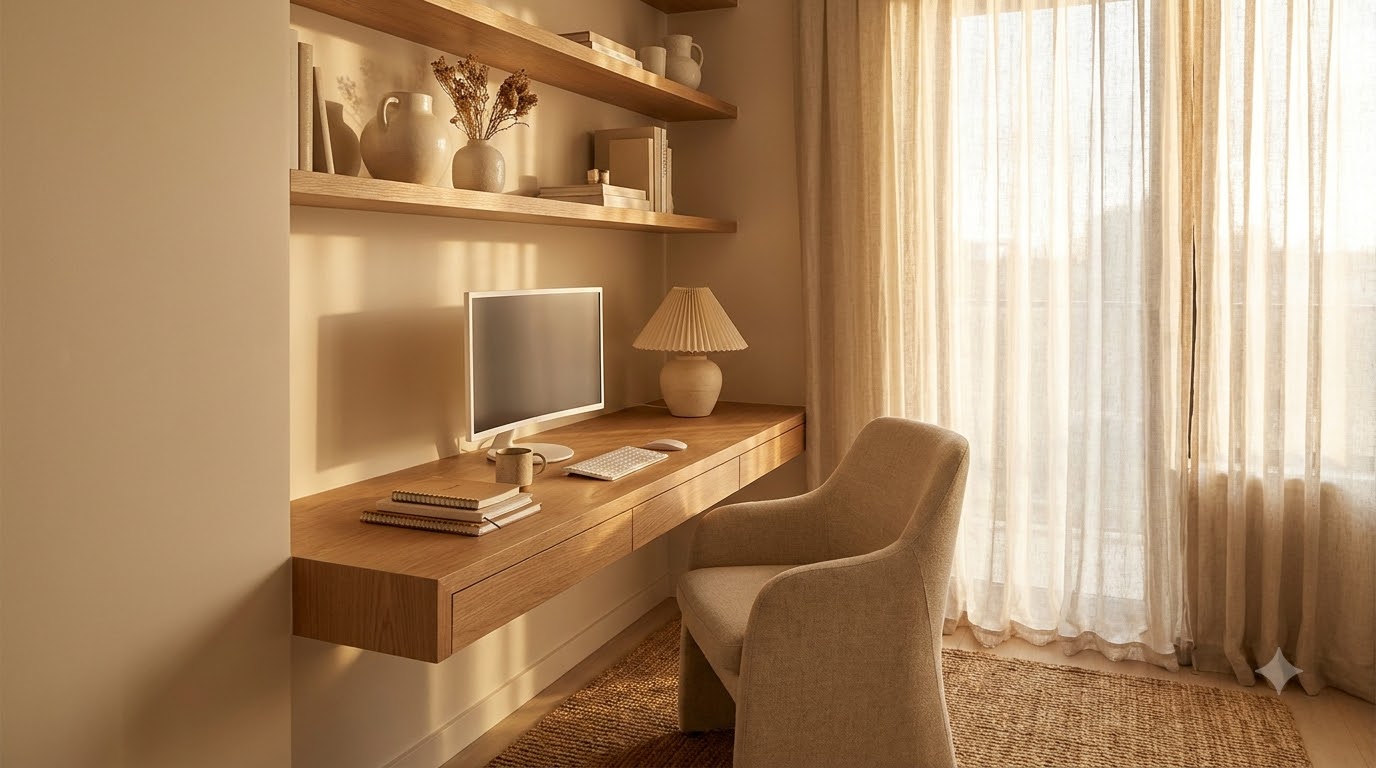
The fastest way to build a workspace when square footage is tight: carve out a dedicated zone with a compact desk (aim for 40 inches wide and at least 20 to 24 inches deep), stack your storage vertically instead of spreading it sideways, add one good task light, and use a slim divider to separate “work” from “life.” That four-part formula is the backbone of every small home office we’ve set up, and it works whether you have a closet, a corner, or a sliver of a shared bedroom. Below, we walk through the small home office ideas we keep coming back to, with real dimensions, honest price ranges, and a setup table you can match to your exact space.
Key Takeaways
- A zone beats a room. You don’t need a spare bedroom, just a defined 3-to-4-foot pocket you can claim.
- Desk math matters. 40 inches wide and 20 to 24 inches deep is the smallest comfortable footprint; leave 30 inches of chair clearance behind it.
- Build upward. Floating shelves and pegboards free the desktop and turn empty wall inches into storage.
- Light and cables are non-negotiable. One task lamp at 400 to 500 lumens and a $15 cable tray fix 80% of small-desk frustration.
- Renter-friendly wins. Every idea here uses removable, damage-free hardware so you get your deposit back.
How do you fit a desk in a small space?
You fit a desk by measuring first and buying second. In our own apartments, the mistake we made early on was falling for a beautiful 60-inch desk that swallowed an entire wall and blocked a doorway. The fix is to think in footprints, not furniture. A workspace needs three measurements to function: the desk itself, the chair pull-out zone, and a clear path to sit down.
Here’s the clearance we plan around every time, and it has never let us down in a room under 120 square feet:
- Desk depth: 20 to 24 inches is enough for a laptop or a single monitor plus a keyboard. Anything deeper is a luxury you can skip.
- Desk width: 40 inches is the comfort minimum; 32 to 36 inches works for laptop-only setups.
- Chair clearance: leave 30 inches behind the desk edge so you can push back and stand without hitting a wall or bed.
- Knee room: 24 inches of vertical clearance under the desktop keeps your legs from cramping.
- Entry path: a 30-inch-wide walkway to the chair so you’re not climbing over anything to sit down.
Once those five numbers fit, the desk fits. If you’re starting from a truly bare studio, our guide to small apartment decor ideas pairs well here, because the same wall you use for a desk often doubles as your display and storage zone.
What size desk for a small room?
For a small room, a desk that is 40 inches wide and 22 inches deep hits the sweet spot: roomy enough for a monitor and notebook, small enough to leave breathing room. If your only option is a closet or a hallway nook, drop to a 36-inch wall-mounted floating desk, which claims zero floor space and folds neatly into the room’s lines.
We break desk choices into four honest tiers by budget, because “buy the good one” isn’t advice when rent is due:
- $40 to $80: a basic 40-inch particleboard desk. Fine to start, but expect a wobble under a heavy monitor arm.
- $90 to $150: a wall-mounted floating desk or a folding writing desk. Best value for renters and the smallest footprint.
- $160 to $280: a compact sit-stand desk (many now start at 40 inches wide). Worth it if you work full days at home.
- $300 and up: a solid-wood or premium adjustable desk. Buy this only once you know the layout is permanent.
Whatever tier you land in, position your screen so the top of the monitor sits at or just below eye level, roughly an arm’s length away. Getting the monitor at eye level is the single cheapest upgrade to your posture, and a $12 stack of books does the job as well as a $40 stand.
Small office setups by space type
Not every “small space” is the same. A closet office solves different problems than a corner of the living room. We’ve built all four of these, so the table below reflects what actually held up day to day, not just what looks tidy in a photo.
| Space type | Best desk | Storage move | Divider / privacy | Typical cost |
|---|---|---|---|---|
| Closet (cloffice) | 36in floating shelf desk | Shelves above; pegboard on back wall | Curtain or bifold door | $120 to $250 |
| Corner | L-shaped or 40in corner desk | Corner wall shelves, vertical file box | Tall plant or slim bookcase | $150 to $320 |
| Nook / hallway | 32-36in wall-mounted fold-down | Two floating shelves overhead | None needed; it tucks away | $90 to $180 |
| Shared bedroom | 40in slim writing desk | Rolling cart + over-desk shelf | Folding screen or open shelf unit | $130 to $280 |
The shared-bedroom setup is the one people underestimate. The trick that changed everything for us was a folding three-panel screen: it hides the desk clutter at day’s end so the room reads as a bedroom again, which matters a lot for sleep. If your shared space is also your main living zone, our small apartment layout ideas cover how to zone a single room without walls.
How can I add storage without losing floor space?
You go vertical. The floor is the most expensive real estate in a small home, so we treat it as sacred and push everything else up the wall. In our last rental, a single pegboard above the desk replaced an entire filing cabinet and gave back a full square foot of floor.
These are the vertical storage moves we install first, all renter-safe:
- Floating shelves mounted 12 to 16 inches above the desk for books, a small plant, and a charging tray. Budget $20 to $50 per shelf.
- A pegboard (24 by 48 inches) for headphones, cables, sticky notes, and scissors. Around $25 to $45, and it hangs on two anchors.
- An over-desk hutch or riser to lift the monitor and store supplies underneath in one move.
- A slim rolling cart (12 inches wide) that tucks beside the desk and rolls out only when you need it.
- Vertical file holders mounted on the wall instead of a floor-hogging cabinet.
For rentals, use adhesive mounting strips rated for the weight you’re hanging, or 3/16-inch drywall anchors you can patch with a $5 spackle tube on move-out day. We’ve never lost a deposit over a properly patched anchor hole.
How do you make a small office feel bigger?
Light, sightlines, and a little greenery. A cramped office is usually a dark, cluttered one, and both are fixable in an afternoon. The goal is to keep the eye moving and the desktop clear so the brain reads “open” instead of “boxed in.”
Our go-to moves for stretching a tight workspace:
- Add one task lamp at 400 to 500 lumens with an adjustable arm. Even a bright room needs focused light on the work surface.
- Hang a mirror opposite a window to bounce daylight and double the sense of depth.
- Choose leggy furniture you can see the floor under; visible floor space reads as more space.
- Keep the desktop 70% clear. A clear surface is the fastest visual upgrade there is.
- Add one small plant for a hit of life without clutter; a pothos or snake plant thrives on a shelf with little light.
That last one does more than decorate. A bit of green softens all the hard edges of tech and shelving, and if you want low-maintenance picks that survive a shady desk corner, our roundup of the best indoor plants for the living room translates directly to a small office.
How do you hide cables in a small workspace?
Cable chaos is what makes a small desk feel small. When you can see six cords tangled behind a compact desk, the whole zone reads as messy no matter how nice the furniture is. Cable management is the finishing step we never skip, and it costs almost nothing.
- Under-desk cable tray ($15 to $25) to hold a power strip and gather cords off the floor.
- Adhesive cable clips ($8 a pack) to route wires along the desk’s back edge in a clean line.
- A single surge-protected power strip mounted under the desktop, so one cord runs to the wall instead of five.
- Velcro ties (not zip ties) so you can re-route as your setup changes.
- A short cable sleeve to bundle the run between desk and outlet into one tidy tube.
Do this once and the payoff is permanent: the desk wipes clean in seconds, and the floor beneath it stays open for a chair to roll. Once the workspace is dialed in, the same warm-and-tidy principles carry into the rest of the home, and our cozy living room ideas and layout guide is a natural next stop for making the whole apartment feel intentional.
A simple order to build your small office
If you’re staring at a blank corner and not sure where to start, follow the sequence we use every time. Doing it in this order stops you from buying furniture that doesn’t fit or storage you don’t need.
- Measure the zone. Confirm you have room for a 40-inch desk plus 30 inches of chair clearance before buying anything.
- Pick the desk that matches your footprint and budget tier.
- Set the chair and monitor so the screen top sits at eye level and your feet rest flat.
- Add vertical storage above and beside the desk, never on the floor.
- Install the task lamp and finish with cable management.
- Add a divider and a plant to separate the zone and bring it to life.
Six steps, one afternoon, and a workspace that earns its footage. The best small home office isn’t the one with the most gear; it’s the one where every inch is doing a job.
Frequently Asked Questions
What is the minimum size for a home office desk?
The comfortable minimum is 40 inches wide and 20 to 24 inches deep, which fits a monitor, keyboard, and notebook. For laptop-only work you can drop to 32 to 36 inches wide. Always leave 30 inches of clearance behind the desk so your chair can pull out fully.
Can I set up an office in a rental without damaging walls?
Yes. Use adhesive mounting strips rated for your shelf’s weight, or small 3/16-inch drywall anchors you patch with spackle on move-out. Pegboards, floating shelves, and fold-down desks all install with minimal, repairable holes, so you keep both your workspace and your security deposit.
How much does a small home office cost to set up?
A functional budget setup runs about $150 to $350 total: roughly $90 to $150 for a compact desk, $40 to $80 for storage, $20 to $40 for a task lamp, and around $25 for cable management. Spending more mainly buys a sit-stand desk or solid-wood build.
Where should I put a desk in a shared bedroom?
Place it against the wall farthest from the bed, ideally near a window for daylight, and use a folding screen or open shelf unit as a divider. This creates visual separation between work and sleep, which protects your rest and keeps the room from feeling like an office at bedtime.
How high should my monitor be on a small desk?
Position the top of the screen at or just below eye level, about an arm’s length away, so your neck stays neutral. On a shallow desk, a monitor riser or even a sturdy stack of books lifts it correctly while freeing the space underneath for keyboard storage or supplies.