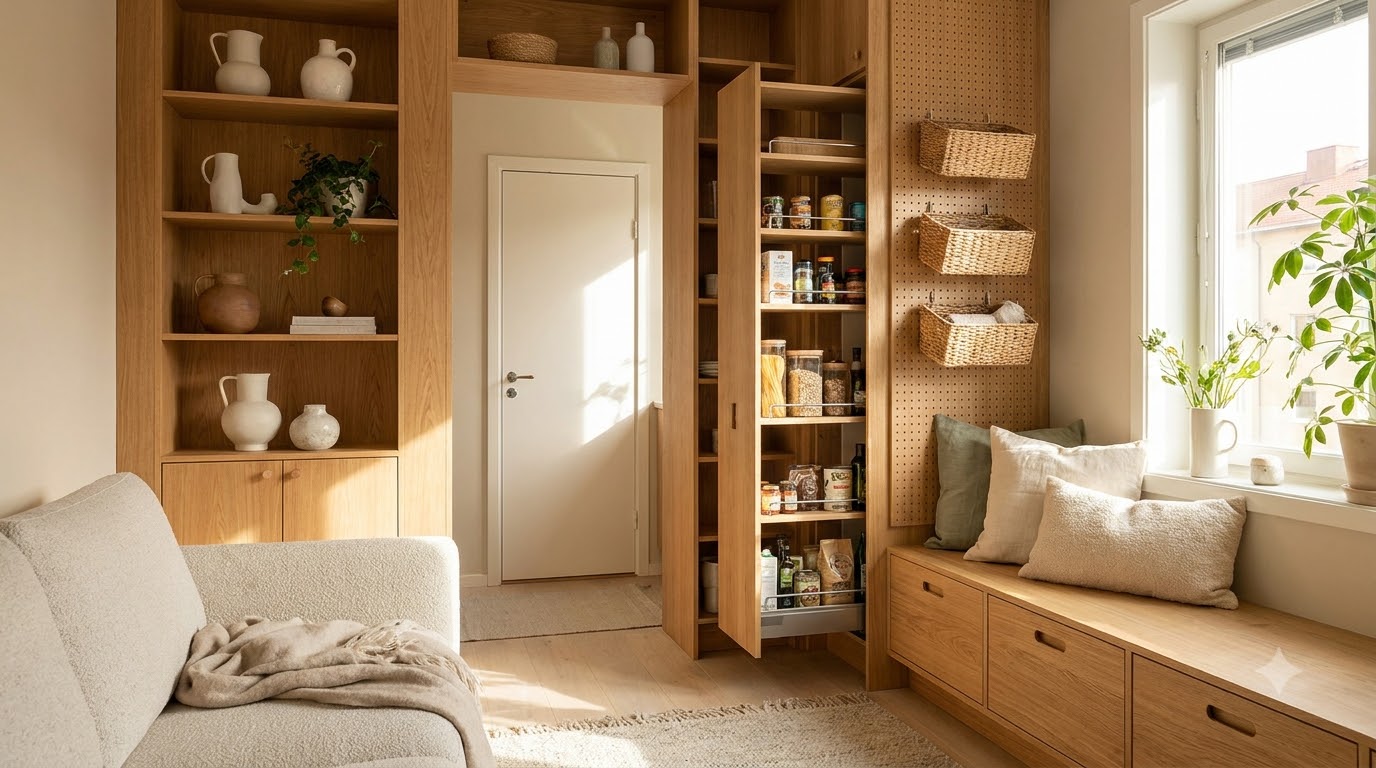
The best small space storage hides inside the furniture you already need and climbs the walls you already have, so a room reads as styled instead of stuffed. Instead of buying more bins, you swap in pieces that do two jobs at once, then send everything else upward, where floor space stays open and the eye stays calm. That single shift, hidden plus vertical, is what separates a small home that looks intentional from one that looks like it is holding its breath.
Key Takeaways
- Buy double-duty first. A storage ottoman, bed, or bench replaces a piece you already own while adding 2 to 30 cubic feet of hidden room.
- Go vertical. Shelving that reaches 84 to 96 inches uses the dead air above eye level, the cheapest square footage in any apartment.
- Hide the ugly, display the pretty. Lidded and drawer storage swallows clutter; open shelves earn their keep only when styled.
- Renter-friendly wins. Over-door racks (roughly 17 by 60 inches) and tension systems add storage with zero holes.
- Budget range. Most hidden-storage upgrades land between $25 and $600, and the highest-value buys are the ones you were going to purchase anyway.
Why “storage that looks good” beats another set of bins
Most small-space advice ends at plastic totes shoved under the bed. That works until you actually live there, and every bin becomes a thing you have to look at. The pieces we keep coming back to are the ones that disappear into the design: a bench you sit on, a coffee table you set drinks on, a headboard you lean against. The storage is a bonus feature, not a visible confession that you ran out of room.
There is a psychology to it, too. A room feels crowded when your eye has too many objects to land on, not necessarily when you own too much. Hidden storage shrinks the number of visible things without shrinking what you keep, and vertical storage moves the remaining objects out of your natural sightline. Do both and a 500-square-foot studio can feel as settled as a place twice its size, no purge required.
When we downsized into a 540-square-foot one-bedroom, we made ourselves a rule before buying anything new: every piece had to earn its footprint twice. If a console table did not also hide something, it did not come home. Two years in, that rule is the only reason the place still photographs clean on a Sunday morning. For more layout-level thinking, our guide to small apartment layout ideas pairs well with everything below.
What furniture has hidden storage?
More than you would guess, and the volumes are real. Hidden-storage furniture is the fastest way to add capacity because it replaces something rather than adding to the room. Here is what each common piece typically holds, so you can plan by cubic feet rather than by hope.
- Storage ottoman: 2 to 4.5 cubic feet inside a lift-off or hinged lid. Swallows throw blankets, board games, or a laptop bag, and doubles as a footrest or extra seat.
- Storage bed (platform with drawers): 15 to 30 cubic feet across 2 to 4 under-mattress drawers or a full lift-up frame. This is the single biggest hidden volume in most bedrooms.
- Storage bench: 3 to 6 cubic feet, ideal at the foot of a bed or in an entry for shoes and seasonal gear.
- Lift-top coffee table: 1.5 to 3 cubic feet, plus the top rises to become a laptop or dinner surface on the couch.
- Storage headboard (bookcase style): 2 to 5 cubic feet of open cubbies and closed compartments, turning the wall behind your pillow into a nightstand-free shelf.
We started with a single storage ottoman ($60) and were shocked it held an entire closet shelf of blankets. That one purchase is what sold us on the whole approach.
How do you add storage without clutter?
You add storage without clutter by hiding what is ugly and going vertical with what is not. Clutter is not caused by owning things; it is caused by things sitting on open, horizontal surfaces at eye level. Move belongings into closed compartments or up above the sightline, and the same square footage suddenly reads as roomy. Three moves do most of the work.
- Contain, then conceal. Group like items and put them behind a lid, a door, or a drawer front. A lidded ottoman beats an open basket every time for visual quiet.
- Send it up. Wall shelves, tall bookcases, and over-door racks use vertical inches you are already paying rent on but not using.
- Style the 20 percent that stays out. Keep only the prettiest fifth of your things on display and let the rest live hidden.
If clutter tends to pile in the living room specifically, our living room storage hacks for renters break the same logic down room by room.
Go vertical: the cheapest square footage you own
Floor space is finite; wall space is mostly wasted. The average apartment has walls that run 96 inches to the ceiling, and almost nobody uses the top three feet. Vertical storage reclaims that band without shrinking your walkways, which is exactly what keeps a small room feeling open. The trick is to draw the eye upward on purpose so the height reads as intentional design rather than stacked-up overflow.
- Tall, narrow bookcases: Choose 72 to 84 inches high and only 12 to 16 inches deep. The height reads as generous; the shallow depth keeps the footprint tiny.
- Floating wall shelves: Mount the first at 48 to 54 inches (just above most furniture) and stack a second 12 to 16 inches above it for a styled column.
- Over-door organizers: Standard racks measure about 17 inches wide by 60 inches tall and hook over a 1.375-inch door, adding shoe, pantry, or bathroom storage with no hardware.
- Ceiling-height curtain rods: Hung at 90-plus inches, they draw the eye up and make walls feel taller, which makes the whole room feel less crowded.
- Wall-mounted pegboard or rail systems: A single 24 by 48 inch panel turns a blank wall into adjustable, decor-forward storage for the kitchen or a work nook.
In our galley kitchen we hung a rail at 66 inches and freed an entire drawer, and the hanging utensils actually became a design feature. For more of these small-footprint tricks, see our small apartment storage ideas.
Which hidden-storage piece belongs in each room?
Every room has one workhorse piece that hides the most while looking the most deliberate. Match the piece to the room and you rarely need a second buy.
| Room | Best hidden-storage piece | Typical capacity | Budget range |
|---|---|---|---|
| Living room | Lift-top coffee table + storage ottoman | 1.5-3 + 2-4.5 cu ft | $90-$400 |
| Bedroom | Platform storage bed with drawers | 15-30 cu ft | $250-$600 |
| Entryway | Storage bench with cubbies | 3-6 cu ft | $70-$250 |
| Kitchen | Wall rail + over-door pantry rack | Frees 1-2 drawers | $25-$90 |
| Home office nook | Tall shallow bookcase with bins | 8-14 cu ft | $80-$300 |
| Bathroom | Over-toilet shelf + over-door rack | 2-4 cu ft | $30-$120 |
Renter-friendly storage that leaves no marks
When your security deposit is on the line, the goal is capacity without holes. These solutions add real storage and come back down without a single patch of spackle.
- Over-door racks (about 17 by 60 inches): Hook over any standard interior door for shoes, cleaning supplies, or pantry overflow.
- Tension rods: Wedge one under a sink for spray bottles or across a closet for a second hanging tier, no drilling.
- Freestanding tall shelving: A 72-inch ladder shelf leans against the wall and moves with you.
- Command-strip floating shelves: Rated pairs hold 10 to 15 pounds and leave the wall clean when removed.
- Rolling under-bed drawers: Slide into the 6 to 12 inches beneath most bed frames and hide behind a bed skirt.
We have moved three times on these renter-safe systems, and every deposit came back in full. If you want the pieces to look designed rather than improvised, our small apartment decor ideas cover styling the storage you add.
Make hidden storage look styled, not hidden-away
The point is not to disguise that storage exists; it is to make the storage itself part of the decor. A few finishing habits keep these pieces looking editorial.
- Match materials to the room. A woven or boucle ottoman reads as furniture; a black plastic tote reads as storage. Pay for the finish, not just the volume.
- Keep open shelves 60 percent full. Breathing room between objects is what makes a shelf look curated instead of crammed.
- Repeat one or two materials. Rattan baskets, oak shelves, and matte-black hardware across rooms make a small home feel cohesive and larger.
- Hide utility, show beauty. Cables, chargers, and cleaning gear go behind lids; books, ceramics, and plants go on display.
- Light the vertical. A small clip light or LED strip on a tall shelf turns storage into a focal point after dark.
Frequently asked questions
What is the best small space storage that also looks good?
A storage ottoman or lift-top coffee table wins for most people. Each hides 1.5 to 4.5 cubic feet inside a piece you already need, so it adds capacity without adding visual weight. You get a footrest or table on top and a hidden compartment below, all in one footprint.
How much can a storage bed actually hold?
A platform storage bed holds roughly 15 to 30 cubic feet across two to four drawers or a full lift-up frame. That is often more than a small closet. We keep off-season clothes, spare bedding, and luggage there, which cleared an entire shelf elsewhere in our bedroom.
Is vertical storage safe for renters?
Yes, when you choose leaning or freestanding pieces. A 72-inch ladder shelf, a tall bookcase, and over-door racks (about 17 by 60 inches) add vertical capacity with no holes. For heavier tall units, use a removable anti-tip strap and patch the single small anchor when you leave.
How do I stop hidden storage from becoming a junk drawer?
Assign each compartment one category and label the inside if needed. When a lidded ottoman is “blankets only,” it stays usable; when it is “everything,” it becomes a black hole. We review each hidden space seasonally and remove anything that no longer fits its assigned job.
What is a realistic budget for a small-space storage refresh?
Plan on $25 to $600 depending on the piece. Over-door racks and tension rods start near $25, storage ottomans and benches run $60 to $250, and a platform storage bed sits at the top around $250 to $600. Start with the double-duty item you were already going to buy.
Small-space storage stops feeling like a compromise the moment it starts looking like decor. Hide what is ugly, lift what is not, and let each piece pull double duty, and a tight footprint reads as calm and considered rather than crowded. Start with one double-duty buy this week, the ottoman or the lift-top table you were already eyeing, then add a single vertical column above it. Two small moves are usually all it takes before the whole room starts to feel like it has room to spare.