Room divider ideas let you zone a studio into distinct living, sleeping, and working areas without touching a single wall. The renter-friendly options we reach for most are freestanding bookshelves (60–72 inches tall for real separation), no-drill curtain tracks that block sight in seconds, open shelving that borrows light while it divides, tall plants for a soft green screen, and folding screens you can move in a weekend. Each one carves out a “room” you can feel, and every one comes down without spackle, landlord emails, or a lost deposit. Below, we share the exact heights, depths, and price ranges we use so you can pick the divider that fits your floor plan and your lease.
Key Takeaways
- A studio divides into zones without walls using bookshelves, curtains, open shelving, plants, and folding screens.
- For a divider that reads as a wall, aim for 60–72 inches of height; anything under 48 inches only suggests a boundary.
- No-drill tension curtain tracks are the most renter-friendly full-privacy option, starting around $25–$60.
- Open shelving (10–14 inches deep) divides space while letting light pass through; solid backs block both sight and light.
- Plants and folding screens are the fastest to install and the easiest to move, but block sight more than sound.
- Match the divider to your goal: privacy, light, or storage rarely come from the same piece.
How do you divide a studio without walls?
You divide a studio by placing a visual break between two functions so your eye reads them as separate areas. The trick is choosing a divider tall enough and wide enough to interrupt the sightline from the door, without boxing in your only source of daylight. In the studios we’ve lived in and helped friends set up, the most successful layouts pair one “anchor” divider (a bookshelf or curtain) with a soft secondary cue like a rug or a plant cluster.
Here’s the order of operations we follow every time we walk into an empty studio:
- Find the natural traffic path from the front door to the window, and keep it clear.
- Decide which zone needs the most privacy (almost always the bed) and put your tallest divider there.
- Anchor each zone with a rug so the floor confirms the boundary your divider suggests.
- Use light dividers (plants, low shelving) between zones that can share daylight.
- Leave at least 24–30 inches of walking clearance around every divider.
If you’re still mapping out where each function should sit, our guide to studio apartment layout ideas pairs perfectly with this one, and the broader small apartment layout ideas post covers one-bedrooms and railroad units too.
Bookshelves: the workhorse divider
A freestanding bookshelf is our default recommendation because it divides, stores, and stands on its own. We look for units 60–72 inches tall for genuine separation between a bed and a living area; a 72-inch shelf blocks the sightline for anyone under six feet, while a 60-inch shelf still reads as a wall from a seated position. Depth matters too: a 10–12 inch cube shelf keeps a small footprint, while a 12–16 inch unit holds more but eats floor space.
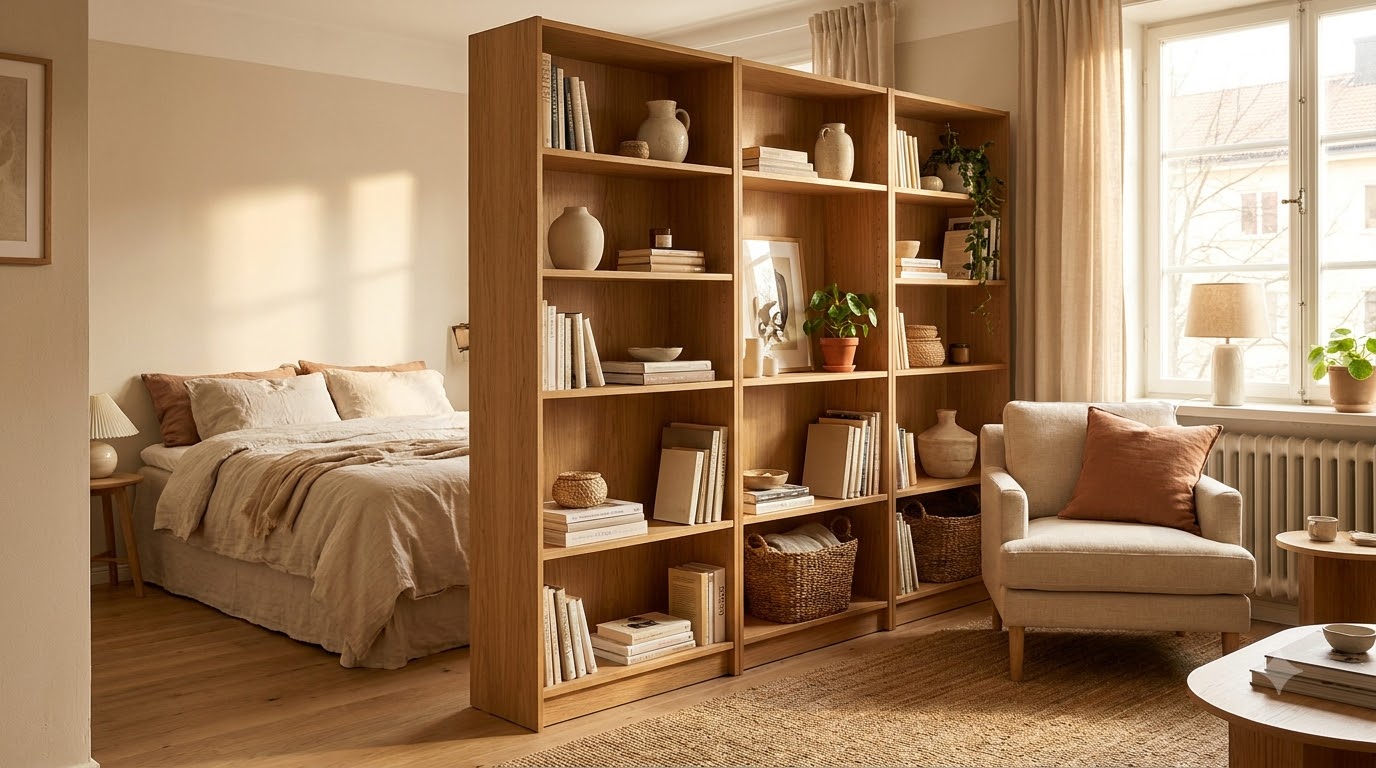
When we styled our last studio, we turned a five-tier open-back shelf so the spines faced the living room and the backs faced the bed, then filled the bed-side openings with fabric bins. It gave the sleeping zone a calm, solid face and the living zone a curated library wall. A few placement rules we’ve learned the hard way:
- Anchor tall shelves to the wall with an anti-tip strap; every renter can remove one screw at move-out.
- Load heavy items on the bottom two shelves to keep a freestanding unit stable.
- Open-back shelves borrow light and feel airy; solid-back shelves block light and feel like a true wall.
- Leave the top shelf half-empty so the divider doesn’t feel like a wall of clutter.
Budget-wise, a basic 5-cube open shelf runs $40–$90, a 72-inch ladder or etagere lands around $90–$180, and a solid-wood room-divider bookcase can reach $200–$350. For more ways to make a divider pull double duty, our small apartment storage ideas cover vertical storage that doubles as zoning.
Curtains and no-drill tracks for full privacy
When you want a zone you can close off completely, fabric wins. A ceiling-mounted curtain is the only divider that gives a bed real privacy while folding flat against the wall by day. The renter-friendly move is a no-drill setup: a tension rod for short spans, or a track that mounts with removable adhesive brackets or a friction-fit ceiling channel for longer runs.
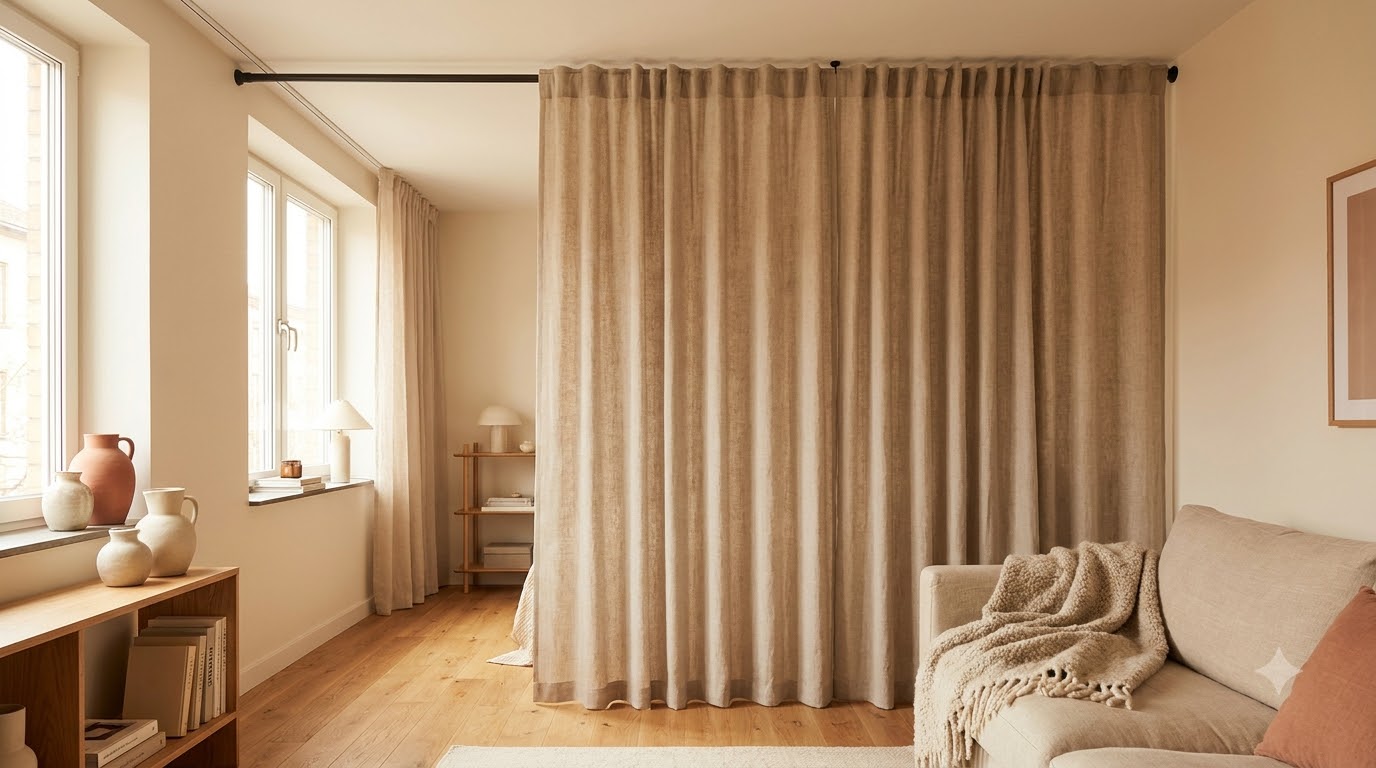
We ran a no-drill ceiling track across an 8-foot span to curtain off our bed, and the whole install took under an hour with no holes to patch. What we’d tell any renter before buying:
- Measure floor-to-ceiling and subtract 1 inch so the curtain skims the floor without dragging.
- Blackout or heavy velvet panels block sight and muffle sound; sheer linen blocks neither but softens the space.
- Tension rods hold spans up to about 4–5 feet; use a ceiling track for anything wider.
- Wave or pinch-pleat headers stack tighter when open, so they hide better against the wall.
- Choose a curtain that puddles slightly at the floor to read as intentional, not accidental.
Cost is friendly: a tension rod is $15–$40, a no-drill track kit is $25–$60, and a pair of blackout panels runs $30–$70. Total privacy for a bed for well under $150, and every piece comes down clean.
Open shelving, plants, and folding screens
Not every zone needs a wall. Between a living area and a home office, or a kitchen and a dining nook, a lighter divider keeps the studio feeling open while still signaling “different room.” These are the pieces we reach for when light matters more than privacy.
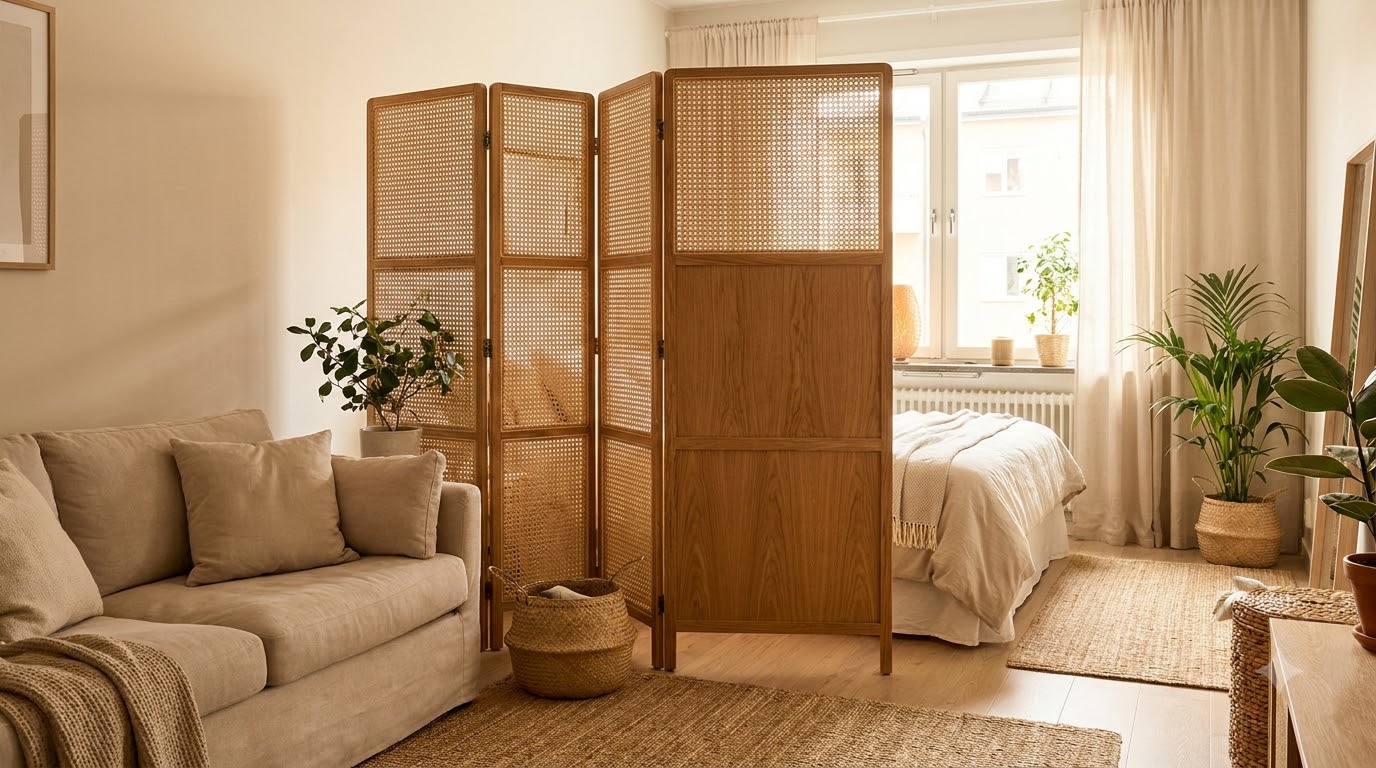
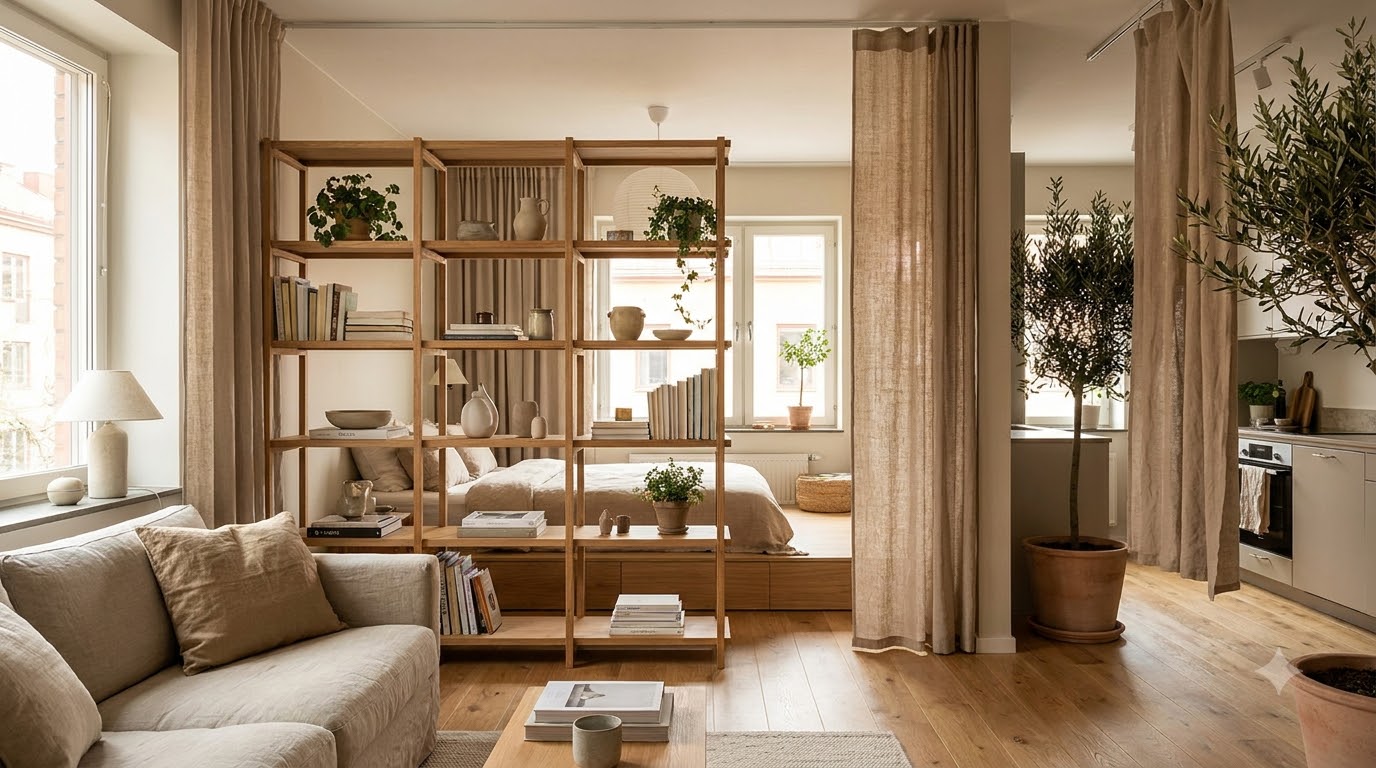
Open shelving at 10–14 inches deep divides a space while daylight and air pass straight through. A backless étagère styled with a mix of books, baskets, and one trailing plant is our go-to for splitting a sofa zone from a desk zone. Tall plants—a 5–6 foot fiddle-leaf fig, a cluster of pole-mounted pothos, or a row of 4-foot snake plants on a plant shelf—create a soft green screen that blocks sight from a seated angle without darkening the room. Folding screens (three or four panels, typically 68–72 inches tall) are the most portable option of all; you unfold one in seconds and fold it away when guests come.
- Use a narrow plant shelf (8–10 inches deep) so a row of plants divides without stealing walking room.
- Group plants in odd numbers and vary height for a screen that looks lush, not sparse.
- Weight folding-screen feet or anchor them to a shelf if you have pets or a drafty window.
- Rattan and cane screens filter light beautifully; solid wood or upholstered screens block it entirely.
Expect $50–$150 for a backless étagère, $30–$120 per large plant, and $60–$200 for a folding screen depending on material. For more ways to layer softness and color into these zones, our small apartment decor ideas pair well with any of these dividers.
What is the best renter-friendly room divider?
The best renter-friendly room divider depends on whether your top priority is privacy, light, or storage—because no single piece delivers all three. A ceiling curtain wins on privacy, a freestanding bookshelf wins on storage, and open shelving or plants win on preserving light. Use the table below to match your goal to the right divider before you buy.
| Divider type | Privacy | Light | Renter-friendly | Price range |
|---|---|---|---|---|
| Freestanding bookshelf (60–72 in) | Medium–High | Blocks light (solid back) | Yes (anti-tip strap) | $40–$350 |
| No-drill ceiling curtain | High (blackout) | Blocks when closed | Yes (no holes) | $25–$150 |
| Open shelving / étagère | Low | Passes light | Yes | $50–$150 |
| Tall plants / plant shelf | Low–Medium | Passes light | Yes | $30–$120 each |
| Folding screen (68–72 in) | Medium | Varies by material | Yes (portable) | $60–$200 |
If we had to name one all-rounder for a first apartment, it’s the 72-inch open-back bookshelf: it divides at full height, stores your things, and moves with you. If privacy for the bed is non-negotiable, add a no-drill curtain behind it.
Sight versus light: what each divider blocks
The single most useful thing to understand before you buy is that blocking a sightline and blocking light are two different jobs. A studio’s biggest asset is usually its daylight, so we’re careful never to sacrifice it for privacy we don’t actually need. Here’s the quick mental model we use:
- Blocks sight and light: solid-back bookshelves, closed blackout curtains, upholstered folding screens—use these for the bed.
- Blocks sight, keeps light: open-back shelving, cane screens, tall plants—use these between shared-daylight zones.
- Blocks neither, softens space: sheer curtains, low shelving under 48 inches, a single plant—use these as gentle cues only.
Place the light-blocking dividers along interior sightlines (from the front door toward the bed) and the light-passing dividers between your window and the rest of the room. That way you protect privacy where it counts and keep the whole studio bright.
One more thing we’ve noticed: color and finish change how heavy a divider feels. A white or pale open shelf almost disappears into the room, while a dark solid bookcase reads as a firm wall even at the same height. When we wanted to shrink the visual weight of a divider in a tight studio, we painted a thrifted screen the same shade as the walls and it melted right in. If you’re layering finishes and want the boundary to feel deliberate, keep these cues in mind:
- Match a divider to your wall color to make it recede and the room feel larger.
- Choose a contrasting finish only when you want the divider to read as a deliberate architectural feature.
- Mirror-backed or glossy dividers bounce daylight deeper into a windowless zone.
- Keep both faces of a freestanding divider styled, since in a studio you always see both sides.
Frequently Asked Questions
How tall should a room divider be in a studio?
For real separation between a bed and living area, aim for 60–72 inches tall. A 72-inch divider blocks the sightline for most standing adults, while 60 inches works from a seated position. Anything under 48 inches only suggests a boundary rather than creating one, so save low pieces for zones that can stay visually open.
Are room dividers allowed in rentals?
Freestanding dividers—bookshelves, folding screens, and plants—need no permission at all. For curtains, choose no-drill tension rods or adhesive-mount tracks so you leave no holes behind. If you do anchor a tall shelf for safety, a single anti-tip screw fills easily with spackle at move-out, keeping your deposit intact.
How do I divide a studio without blocking light?
Use dividers that interrupt the sightline while letting daylight pass: open-back shelving 10–14 inches deep, cane or rattan folding screens, and clusters of tall plants. Position these between your window and the rest of the room, and reserve solid, light-blocking dividers for interior sightlines toward the bed where privacy matters more.
What is the cheapest way to divide a studio apartment?
A no-drill tension rod with a fabric panel is the cheapest full-height divider, often $30–$50 total. Repurposing a bookshelf you already own costs nothing, and a single large plant runs $30–$60. Anchoring each zone with a rug you have on hand reinforces the boundary without spending anything extra.
Can a room divider make a small studio feel bigger?
Yes, when it’s chosen well. Open-back and light-passing dividers add depth and give the eye layers to travel through, which reads as more spacious, not less. The mistake is over-dividing: one or two purposeful dividers define zones, while too many solid pieces chop a studio into cramped, dim corners.