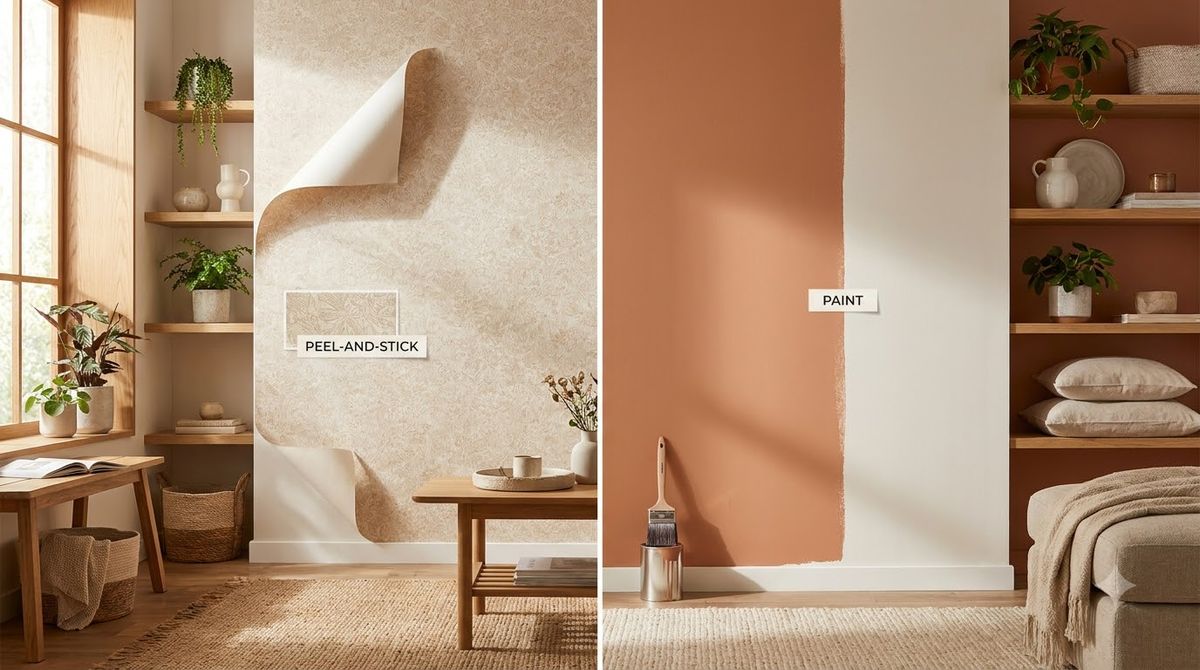
If you rent and you want a wall that actually feels like yours, here is the quick verdict: peel-and-stick wallpaper is the safer, more flexible choice for most renters because it is reversible, hides no commitment behind it, and protects your deposit. Paint is the cheapest option per square foot, but it usually needs landlord permission and a repaint before you move out, which can quietly eat the money you saved. If your lease forbids painting or you move often, peel-and-stick (or a removable, low-VOC paint you agree to reverse) almost always wins. If you have written permission and plan to stay a few years, a can of paint is hard to beat on price.
Key Takeaways
- Reversibility wins the deposit: Peel-and-stick comes off cleanly on primed drywall; paint almost always needs a repaint before move-out.
- Cost per square foot: Paint runs roughly $0.50–$1.50 per sq ft; peel-and-stick wallpaper runs about $1.50–$4 per sq ft.
- Effort: Paint needs prep, drop cloths, and drying time; peel-and-stick needs a clean wall and patience, but no fumes.
- Permission: Painting usually requires landlord sign-off; peel-and-stick often does not, though you should still ask.
- Where peel-and-stick fails: textured, freshly painted, dirty, or high-humidity walls. Smooth, cured, matte or eggshell surfaces are ideal.
Is peel-and-stick wallpaper better than paint for renters?
For renters specifically, peel-and-stick usually edges out paint, and the reason has nothing to do with looks. It is about what happens on move-out day. Paint is a permanent change to someone else’s property. Even a color your landlord approves has to be returned to the original shade in many leases, which means primer, two coats, and a weekend you did not plan on. Peel-and-stick was designed to disappear. On a smooth, cured wall it lifts off in strips and leaves the paint underneath intact.
Here is how renters get burned: paint an accent wall a deep navy without thinking about the exit, and the landlord can charge for two coats of primer and a repaint because dark colors bleed through white. That single wall can cost more than the paint ever did. Peel-and-stick on the same kind of accent wall comes off in strips at move-out, with no repainting.
That said, “better” depends on your situation. Here is how to weigh it:
- Choose peel-and-stick if your lease bans painting, you move every year or two, you want pattern rather than a solid color, or your deposit is large.
- Choose paint if you have written permission, you are staying several years, you want the lowest possible material cost, or you are covering a very large area.
- Consider removable or “renter-friendly” paint if you want a painted look but need to reverse it; some primers and paints are formulated to peel away in sheets later.
Peel-and-stick vs paint: the full comparison
This table compares the two on the five things that actually matter when you are on a budget and worried about your deposit.
| Factor | Peel-and-Stick Wallpaper | Paint |
|---|---|---|
| Cost | ~$1.50–$4.00 per sq ft; a typical accent wall runs $60–$180 in materials. | ~$0.50–$1.50 per sq ft; one gallon covers ~350–400 sq ft for $25–$60. |
| Reversibility | High. Peels off cleanly on smooth, cured drywall with no residue. | Low. Requires priming and repainting to restore the original color. |
| Effort | Moderate. Clean wall, measure, align pattern, smooth out bubbles. No dry time. | Moderate to high. Tape, prep, drop cloths, two coats, plus hours of drying. |
| Durability | 3–5+ years on the wall; edges may lift in humidity or heat. | Very durable; 5–10 years, wipeable, resists daily wear well. |
| Deposit-safe | Usually yes, with permission and the right wall surface. | Often no, unless you repaint to the original color before leaving. |
The pattern that jumps out: paint is cheaper to put on, but peel-and-stick is cheaper to take off. For renters, the take-off cost is the one that hits your wallet at the worst possible moment, so it deserves heavy weight.
How much does each really cost per square foot?
Let’s put real numbers on it, because “cheap” and “expensive” mean nothing without square footage. A standard accent wall is roughly 8 feet tall by 12 feet wide, or about 96 square feet before you subtract windows and doors.
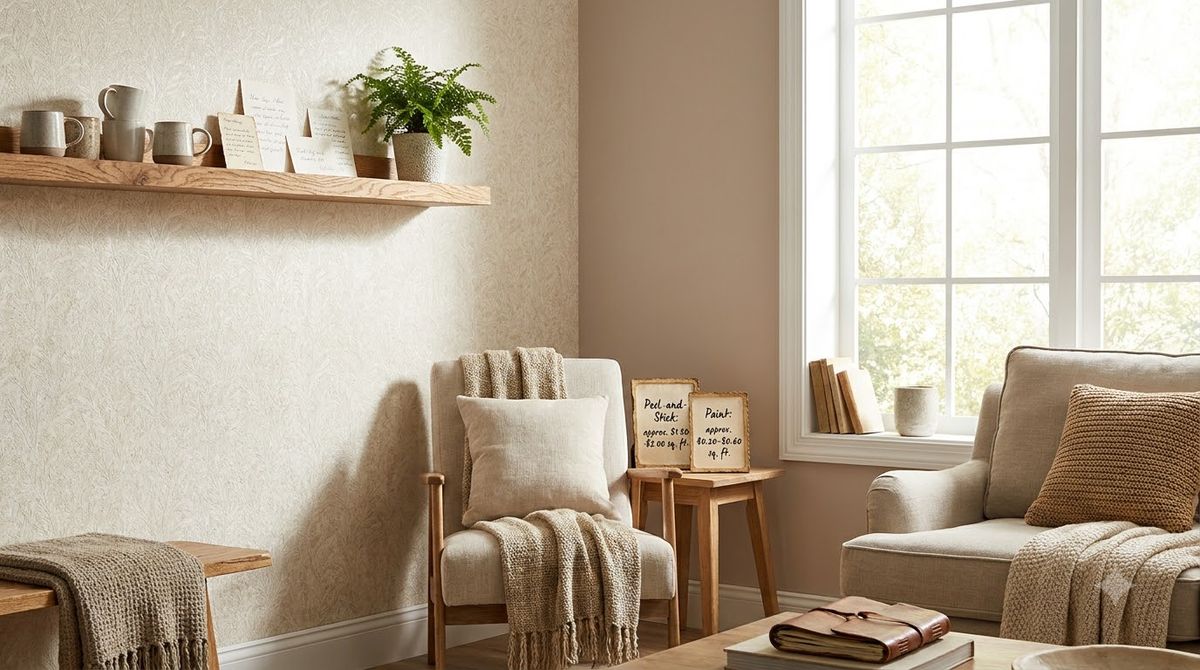
- Paint for one accent wall: One quart to one gallon covers it in two coats. Budget $25–$60 in paint, plus $15–$30 for a roller, tray, tape, and a drop cloth if you own nothing. Total: roughly $40–$90.
- Peel-and-stick for the same wall: At $1.50–$4 per sq ft, 96 square feet lands around $145–$385 depending on brand and pattern. Total: roughly $60–$180 once you account for pattern repeat waste on a single wall.
- Whole small room (all four walls, ~400 sq ft): Paint stays near $50–$100 in materials. Peel-and-stick climbs to $600–$1,600, which is where paint’s per-square-foot advantage becomes dramatic.
This is the honest math renters skip: paint’s cost advantage grows with area. One accent wall keeps peel-and-stick competitive. A full room does not. If you want an all-over transformation on a tight budget, paint (with permission) is the value pick. If you want a single statement wall you can undo, peel-and-stick’s premium is small and worth it. If you are decorating a whole studio, our guide to small apartment decor ideas pairs well with this decision.
Does peel-and-stick damage walls?
On the right surface, no. On the wrong surface, sometimes yes. Peel-and-stick is engineered to bond to a smooth, fully cured, matte or eggshell painted wall and release from it later without pulling paint. The damage stories almost always trace back to one of two mistakes: applying it to fresh paint, or peeling it off carelessly.
Here is where it tends to fail:
- Freshly painted walls: Paint needs about 3–4 weeks to fully cure. Apply wallpaper too early and it grabs the soft paint and lifts it on removal.
- Textured walls: Orange-peel, knockdown, or heavy texture leaves air gaps; the adhesive fails and edges curl within weeks.
- Flat or high-sheen extremes: Very flat “builder white” can chalk and release too easily; high-gloss can reject the adhesive entirely.
- Dirty or dusty surfaces: Grease in kitchens and dust anywhere weaken the bond. Wipe down and dry first.
- High-humidity zones: Bathrooms and un-vented laundry areas cause edges to peel and patterns to warp.
To remove it without damage, peel slowly at a low angle, keep the strip close to the wall rather than yanking outward, and use a hair dryer on stubborn corners to soften the adhesive. Done this way, a well-applied panel leaves a wall that looks untouched. For more damage-free ideas across a whole unit, our rental apartment decor with no damage guide goes deeper.
Prep, coverage, and removal: what each takes
The day-of experience is different enough that it may decide things for you, especially if you have neighbors, kids, or a landlord who notices smells.
- Paint prep: Fill nail holes, sand, tape edges, lay drop cloths, and prime if you are covering a dark color. Plan two coats with 2–4 hours of drying between them, plus ventilation for fumes.
- Peel-and-stick prep: Wipe the wall with a damp cloth, let it dry, measure, and cut. No primer, no drop cloths, no fumes. You can sleep in the room the same night.
- Coverage math: One gallon of paint covers ~350–400 sq ft per coat; one wallpaper roll typically covers ~28–30 sq ft, so buy by the wall, not by feel.
- Removal: Paint removal means priming and repainting. Wallpaper removal means peeling and, at most, a warm-water wipe.
A peel-and-stick wall can be an afternoon project, and the room is usable by dinner. A paint accent wall takes the afternoon plus a night or two of airing out, and a nagging worry about redoing it on the way out. That intangible, the freedom from move-out anxiety, is why wallpaper is the renter’s pick. If nail-free decorating is your priority, a gallery wall without nails layers beautifully over either surface.
Which should a renter actually pick?
Run your situation through this short checklist and the answer usually appears on its own:
- Does your lease allow painting? If no, peel-and-stick (or removable paint) is your lane. If yes, both are open.
- How long will you stay? Under two years favors peel-and-stick. Several years favors paint’s durability and lower cost.
- How big is the area? One wall keeps costs close; a whole room tilts hard toward paint.
- Do you want pattern or a solid color? Pattern means wallpaper. A clean solid means paint.
- How large is your deposit? The bigger it is, the more reversibility matters, which points to peel-and-stick.
For most renters, that checklist lands on peel-and-stick for statement walls and paint only when there is written permission plus a long stay. If you are building a whole cozy scheme around the wall, our aesthetic bedroom ideas 2026 complete guide shows how to layer texture, light, and color on top of either choice.
Frequently asked questions
Is peel-and-stick wallpaper cheaper than paint?
No, not per square foot. Paint runs about $0.50–$1.50 per sq ft while peel-and-stick runs roughly $1.50–$4. But wallpaper is cheaper to remove, since paint often forces a repaint at move-out. For a single accent wall the gap is small; for a whole room, paint wins on price by a wide margin.
Will my landlord charge me for peel-and-stick wallpaper?
Usually not, if it is applied to a smooth, cured wall and removed cleanly. Problems happen on textured or freshly painted walls where adhesive lifts paint. Ask permission in writing first, test a small corner, and remove slowly at move-out. Done right, the wall looks untouched and your deposit stays safe.
How long does peel-and-stick wallpaper last on the wall?
On a proper surface, expect three to five years or more, which comfortably outlasts most leases. Lifespan drops in humid rooms like bathrooms, near heat sources, or on textured walls where edges curl. Keep it in dry, smooth-walled spaces and it will stay put for the length of your rental with little fuss.
Can I use peel-and-stick over a painted wall?
Yes, and painted walls are actually the ideal surface, as long as the paint is fully cured for three to four weeks and has a matte or eggshell finish. Wipe away dust and grease first, then apply. Avoid high-gloss or very flat builder-grade paint, since both can weaken the bond and cause peeling.
What walls should I never put peel-and-stick on?
Skip textured surfaces like orange-peel or knockdown, freshly painted walls under a month old, high-humidity bathrooms, and dirty or greasy kitchen walls. On these the adhesive fails, edges curl, and removal can pull paint. Stick to smooth, clean, cured, matte-finish drywall for the cleanest look and the safest deposit outcome.
Our bottom line
Paint is the value champion when you have permission, a long stay, and a whole room to cover. Peel-and-stick is the renter’s champion when you want pattern, flexibility, and a wall you can undo quickly. For statement walls, wallpaper is usually the better bet, because it lets you make a rental feel like home without gambling the deposit. Whichever you pick, test a small area first, respect the wall surface, and read your lease before the roller or the roll ever touches the wall.