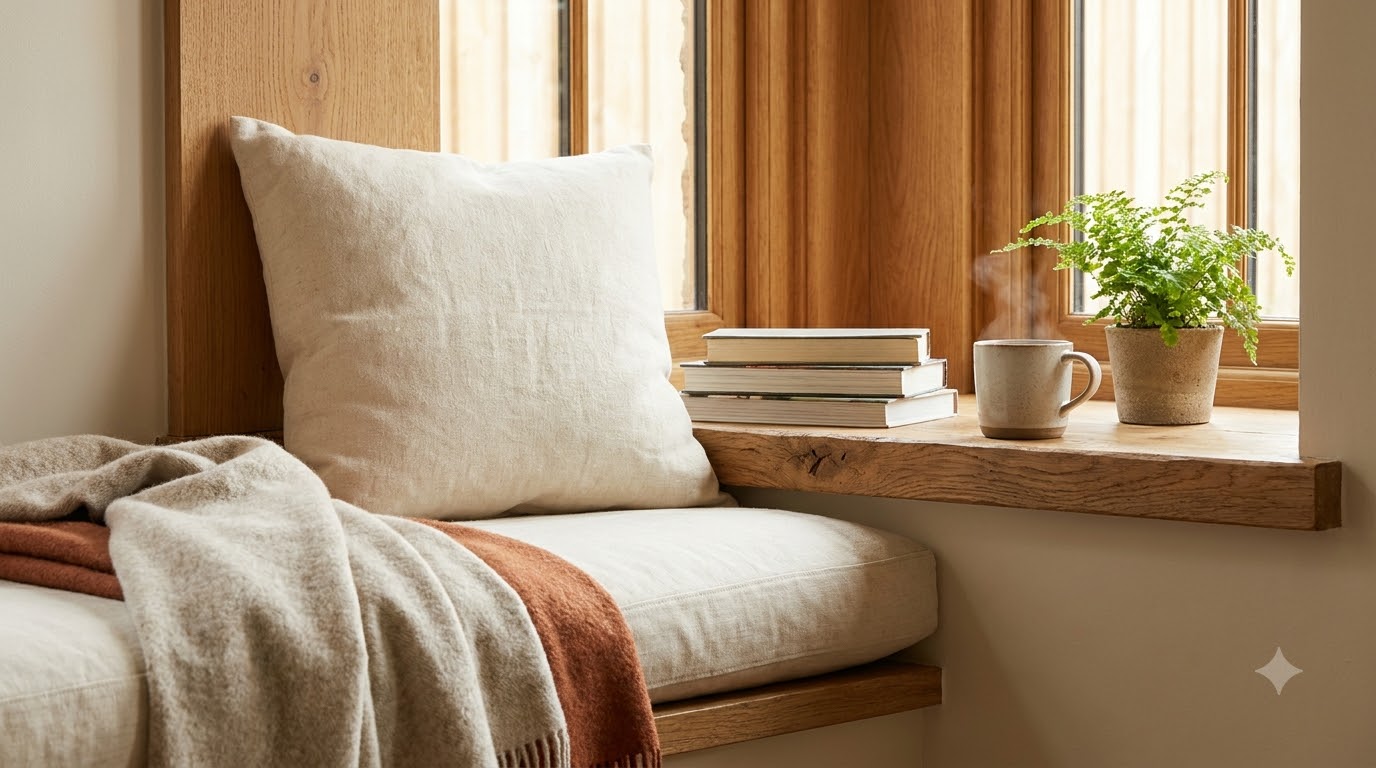
A cozy reading nook is really just four things working together: a comfortable seat, warm light, a surface within arm’s reach, and a layer of softness. That’s it. You do not need a whole spare room or a bay window straight out of a magazine. Give any quiet corner a supportive chair, a 2700K lamp, a small side table, and a throw with a couple of cushions, and you have a reading nook. Everything after that is styling.
Key Takeaways
- The formula for any nook: comfy seat + warm light + a small surface + softness (a throw and cushions).
- You can build one in a corner, by a window, inside a closet, or under the stairs. Location is flexible; comfort is not.
- Choose a chair 28 to 32 inches wide, or a window seat 18 to 20 inches deep, so you can curl up sideways.
- Light it with a warm 2700K floor or wall lamp placed behind your reading shoulder, never overhead glare.
- A renter-friendly nook costs roughly $150 to $450 using a chair or cushion, one lamp, a 16 to 20 inch side table, and textiles.
Where can you put a reading nook?
Almost anywhere. When we started testing nooks in our own small rentals, the biggest surprise was how little square footage a good one actually needs, usually a patch of floor about three feet by three feet. The trick is to claim a corner that is already a little bit quiet and a little bit out of the traffic path, then define it so it reads as its own zone. A rug, a lamp, and a chair angled away from the door do most of that work.
Here are the spots we reach for first, especially in apartments where every wall is already spoken for:
- An empty corner in the living room or bedroom, angled with a chair and a floor lamp.
- Under a window, where natural daytime light and a low bench or cushion make an instant window seat.
- A wide closet with the doors removed and a cushion laid on the floor or a low shelf.
- Under the stairs, where that awkward triangular void becomes a tucked-away den.
- The foot of the bed or a hallway dead-end, using a slim armchair and a wall-mounted lamp.
If the room is doing double duty, borrow layout tricks from our cozy living room ideas and layout guide to carve the nook out without crowding the rest of the space.
What do you need for a cozy reading nook?
Four essentials, and a few nice-to-haves. Keep the essentials tight and the nook will feel intentional instead of cluttered. Here is our short shopping list, in the order we buy things:
- A comfortable seat. An armchair 28 to 32 inches wide, a slipper chair, a chaise, or a window bench. Wide enough to tuck your legs up.
- Warm light. One 2700K bulb in a floor lamp or a wall-mounted swing-arm lamp, positioned over your shoulder.
- A small surface. A side table roughly 16 to 20 inches tall, so your mug and book sit at armrest height.
- Softness. One chunky throw blanket plus two cushions in different sizes for back and lumbar support.
- Nice-to-haves. A small rug to anchor the zone, a shelf or basket for books, a plant, and a candle.
Notice how much comfort those first four lines buy you. We have furnished a full nook for a friend’s studio with a secondhand armchair, a $25 lamp, a stool as a side table, and a blanket we already owned, and it felt more inviting than rooms that cost ten times as much.
Choosing the seat
Seat depth matters more than seat size. Look for a chair with a seat depth around 20 to 22 inches, which lets most people sit back and pull their knees up without sliding forward. If you love reading sideways, a chaise or a window seat 18 to 20 inches deep gives you room to swing your legs across. For a window seat, keep the cushion 4 to 6 inches thick so it stays supportive after an hour of reading.
Getting the light right
Light is the single most underrated part of a nook, and the easiest to get wrong. A few rules we live by:
- Use a warm 2700K bulb. It reads as candlelight-adjacent and keeps the corner feeling cozy rather than clinical.
- Place the light behind and slightly above your reading shoulder, so the page is lit but the bulb is out of your eyeline.
- Renters should reach for a floor lamp or a plug-in wall sconce to avoid hardwiring or drilling.
- Add a dimmer or a smart bulb so you can drop the brightness for evening reading.
- Aim for roughly 400 to 800 lumens of task light, which is plenty for a single chair.
Reading nook ideas by location
Every corner has its own quirks, so the setup shifts a little depending on where you build. Here is how we adapt the four essentials to the four most common spots:
| Nook location | Best seat | Light | Surface and extras |
|---|---|---|---|
| Window | Bench or cushion 18 to 20 in deep, 4 to 6 in thick | Daylight by day; 2700K wall sconce by night | Slim ledge or 16 in stool; two cushions against the frame |
| Corner | Armchair 28 to 32 in wide, angled from the wall | Floor lamp behind the shoulder | Round side table 18 to 20 in tall; throw and a plant |
| Closet | Floor cushion or a low daybed inside the frame | Plug-in puck lights or a battery sconce | Built-in shelf for books; blanket and layered pillows |
| Under-stairs | Fitted bench cushion or a beanbag | Wall-mounted swing-arm lamp | Wall pegs or a narrow shelf; two cushions for the sloped side |
Bedrooms are our favorite place to start, since the door is already closed and the room is already calm. If that is your plan, pair the nook with the rest of the room using our complete aesthetic bedroom guide, and steal the nightstand-and-corner pairings in our bedroom nightstand and reading corner setups.
How much does a reading nook cost?
Less than most people expect. Because the whole thing is one chair, one lamp, one table, and some textiles, you can scale it up or down without much compromise. Here is roughly how the budget breaks down at three levels, all renter-friendly and no-drill:
- Thrift build ($80 to $150): a secondhand armchair or a $30 floor cushion, a $25 lamp, a repurposed stool, and a blanket you own.
- Mid build ($200 to $350): a new accent chair ($120 to $200), a floor lamp ($40 to $70), a side table ($40 to $60), and a throw plus two cushions ($40 to $60).
- Comfort build ($400 to $600): a wider upholstered chair or chaise, a designer lamp, a small rug ($60 to $120), a bookshelf, and layered textiles.
Our honest take after building several: put the money in the seat and the throw, because those are what you actually feel. A $200 chair with a $30 blanket beats a $30 chair with a $200 blanket every time.
Renter-friendly and small-space tips
Small rentals reward nooks precisely because they use the leftover space nothing else wants. A few moves keep it landlord-safe and clutter-free:
- Choose freestanding and plug-in lighting so you skip hardwiring and holes.
- Use peel-and-stick hooks for a hanging book sling or a plug-in sconce instead of drilling.
- Anchor the zone with a small 3×5 rug rather than built-ins, so the whole nook moves with you.
- Pick double-duty pieces: an ottoman that stores blankets, a stool that is also a side table.
- Go vertical with a slim wall shelf or a ladder to keep the floor clear in tight rooms.
Greenery is the finishing touch that makes a corner feel alive without adding clutter. One trailing plant on the shelf or one floor plant beside the chair is enough; our guide to the best indoor plants for bedroom decor covers low-light picks that thrive in the exact dim corners nooks tend to live in.
Styling your nook so it feels cozy
Once the four essentials are in, styling is about layers and restraint. Texture is what your eye reads as “cozy,” so mix a chunky knit throw with a smooth linen cushion and a nubby rug underfoot. Keep the palette to two or three warm, muted tones and let the lamplight do the rest. We like to leave one small stack of books and a single candle on the side table, and nothing else, so the surface stays usable for a mug and a real book.
Height and scale are the quiet details that separate a nook that feels finished from one that feels thrown together. Hang art or a small shelf so its center sits about 57 to 60 inches off the floor, roughly eye level from a standing position, and let the lamp rise a little above your head when seated. If the corner has a bare wall, a single framed print or a garland of clip lights softens it without turning the nook into a display.
The last thing we do is sit in it, at night, with the lamp on, and read for ten minutes. That test tells you everything: whether the light hits the page, whether your arm reaches the table, whether your back wants one more cushion. Adjust once, and the nook is done. In our experience, that ten-minute sit is the step most people skip, and it is the one that turns a nice-looking corner into a spot you actually return to every evening.
Frequently Asked Questions
How small can a reading nook be?
Smaller than you think. A patch of floor about three feet by three feet fits a single chair or a floor cushion, a slim lamp, and a stool. As long as you can sit, reach a surface, and light the page, the corner works. Nooks thrive in the leftover spaces bigger furniture ignores.
What is the best lighting for a reading nook?
A warm 2700K bulb in a floor lamp or plug-in wall sconce, placed behind and slightly above your reading shoulder. Aim for 400 to 800 lumens of task light and add a dimmer for evenings. This keeps the page bright while the bulb stays out of your eyeline and the corner stays cozy.
What size side table works best?
Choose one 16 to 20 inches tall so it lands near armrest height, keeping your mug and book within easy reach. A small round or square top around 12 to 16 inches wide holds a drink and a few books without crowding the seat. A stool or nesting table doubles as extra surface when guests visit.
Can renters build a reading nook without damage?
Absolutely. Stick to freestanding, plug-in pieces: a floor lamp instead of a hardwired sconce, peel-and-stick hooks for a book sling, and a small rug to define the zone. Everything sits on the floor or removes cleanly, so nothing needs drilling. When you move, the entire nook packs up and comes with you.
How much should a cozy reading nook cost?
A thrifted build runs $80 to $150, a mid-range setup lands around $200 to $350, and a fuller comfort build reaches $400 to $600. Spend the most on the seat and the throw, since those are the parts you physically feel. Everything else, from the lamp to the table, can be modest and still look intentional.