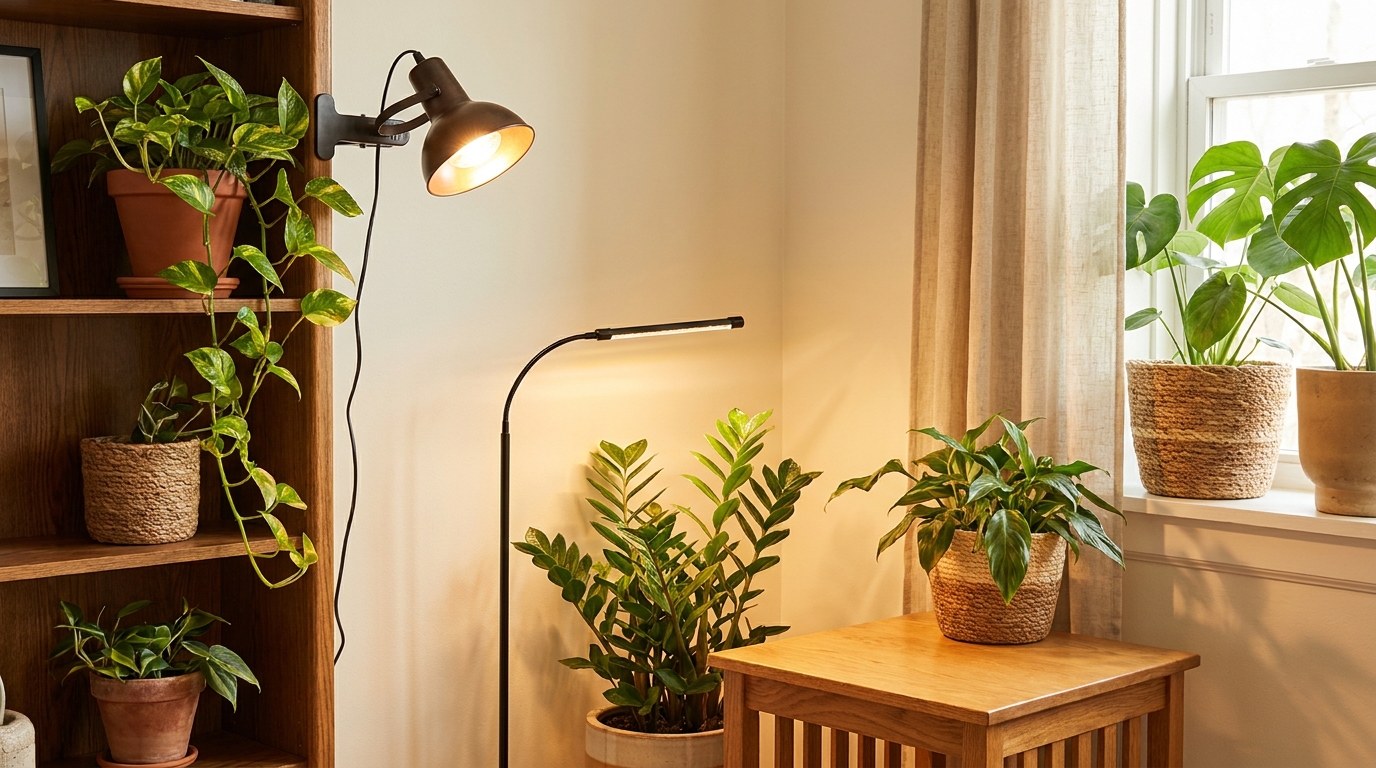
Most apartments don’t have enough natural light to keep plants alive. North-facing windows deliver roughly 200 to 500 lux on a bright day. Most tropical houseplants need 1,000 to 2,500 lux for healthy growth. That gap is the reason your pothos keeps yellowing, your snake plant won’t push new leaves, and your fiddle-leaf fig sits in the same state it arrived in six months ago.
The grow light market has expanded sharply in recent years. The global indoor grow light market was valued at $3.6 billion in 2023 and is projected to reach $8.1 billion by 2030, according to Grand View Research. The consumer end of that market, specifically small LED lights for apartment plants, is where the real value lives. You don’t need a $200 horticultural panel. You need a $20 clip-on that delivers usable spectrum and has a timer so you don’t have to think about it.
This guide covers 8 grow lights under $50, organized by type: clip-on, standing, and shelf or strip. Each entry lists spectrum, timer function, coverage area, and honest notes on how it looks in a real room.
For the plants most likely to benefit from supplemental light, start with the best low-maintenance indoor plants guide. For common reasons plants struggle despite grow lights, the indoor plant care mistakes guide covers watering, drainage, and humidity errors that often get blamed on light.
best low-maintenance indoor plants
Key Takeaways
- Most apartments deliver 200-500 lux through windows; most houseplants need 1,000-2,500 lux for healthy growth.
- The global grow light market hit $3.6 billion in 2023 (Grand View Research), meaning quality consumer options are more available and affordable than ever.
- Full-spectrum LED lights (covering 400-700nm) are the only type worth buying for houseplants. Avoid single-spectrum red/blue “blurple” lights.
- A built-in timer is non-negotiable. Plants need consistent light cycles of 12-16 hours; guessing leads to light stress or etiolation.
- Clip-on lights work for single plants or small shelves. Standing lights cover a wider area. Strip lights are the cleanest option for dedicated plant shelves.
Do You Actually Need a Grow Light?
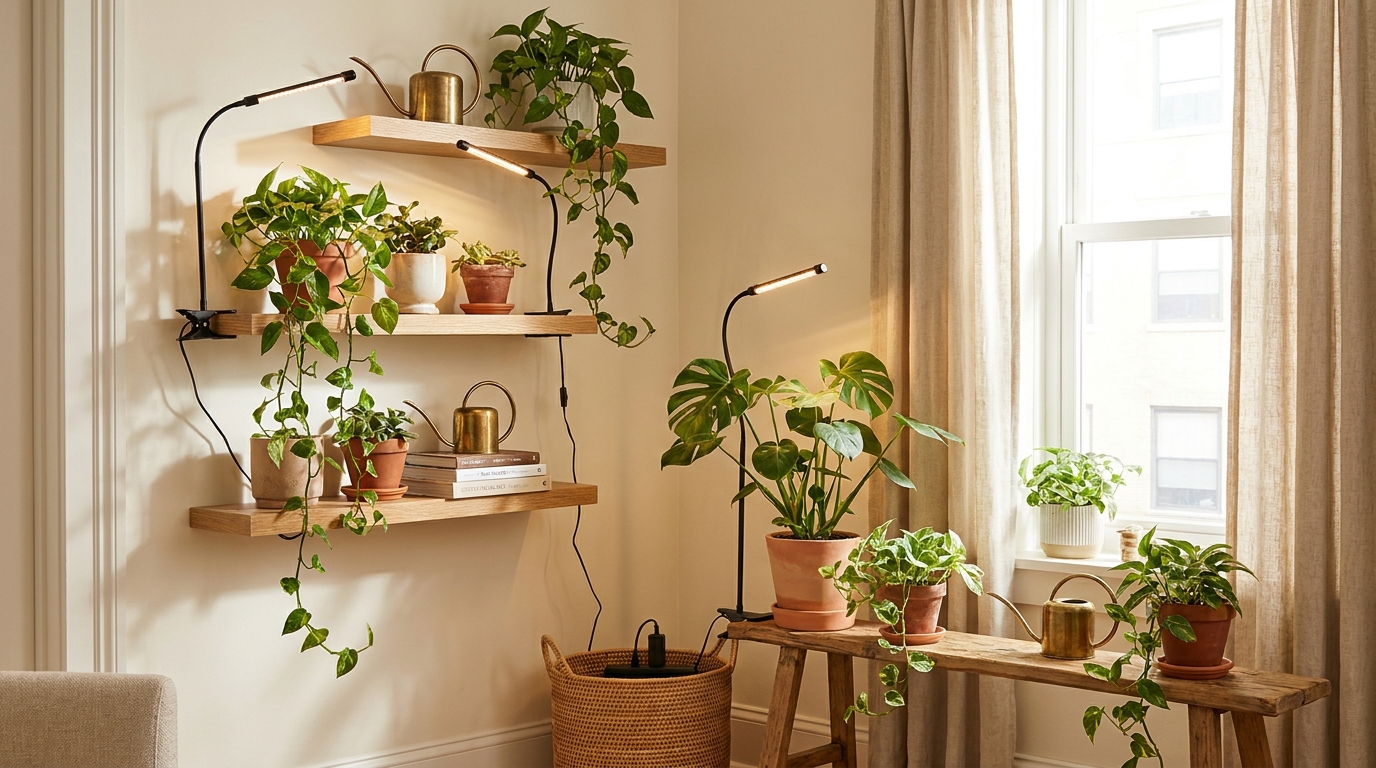
Not every plant in a dim room needs a grow light. According to University of Minnesota Extension, low-light-tolerant plants like pothos, ZZ plants, and cast iron plants can survive below 100 foot-candles (roughly 1,000 lux), which many interior rooms provide. But surviving is different from growing. If you want visible new growth, you probably need supplemental light.
Three signs your plants need more light:
Etiolation. New growth looks stretched, pale, and leggy. The plant is reaching toward whatever light it can find. Stems become long and thin instead of compact and full. This is the clearest signal that light is the limiting factor, not water or nutrients.
No new leaves for months. A healthy plant in adequate light pushes new growth regularly, every few weeks in growing season. A plant that hasn’t produced a new leaf in three to four months is likely light-limited. This is especially common in north-facing rooms in winter, when natural light drops by 40 to 60 percent compared to summer, per NASA’s study on indoor plant environments.
Yellowing lower leaves on a well-watered plant. When light is insufficient, a plant sheds its oldest leaves to redirect energy to the leaves closest to available light. If you’ve ruled out overwatering and root issues, consistent lower-leaf yellowing points to light deficiency.
Light levels explained simply. Bright indirect light is 2,000 to 4,000 lux. Medium light is 1,000 to 2,000 lux. Low light is below 1,000 lux. A north-facing window in winter without a grow light can drop to 300 lux or below. A good clip-on grow light adds 1,000 to 2,500 lux at 6 to 12 inches from the plant, which bridges the gap for most tropical houseplants.
What to Look for in a Grow Light Under $50
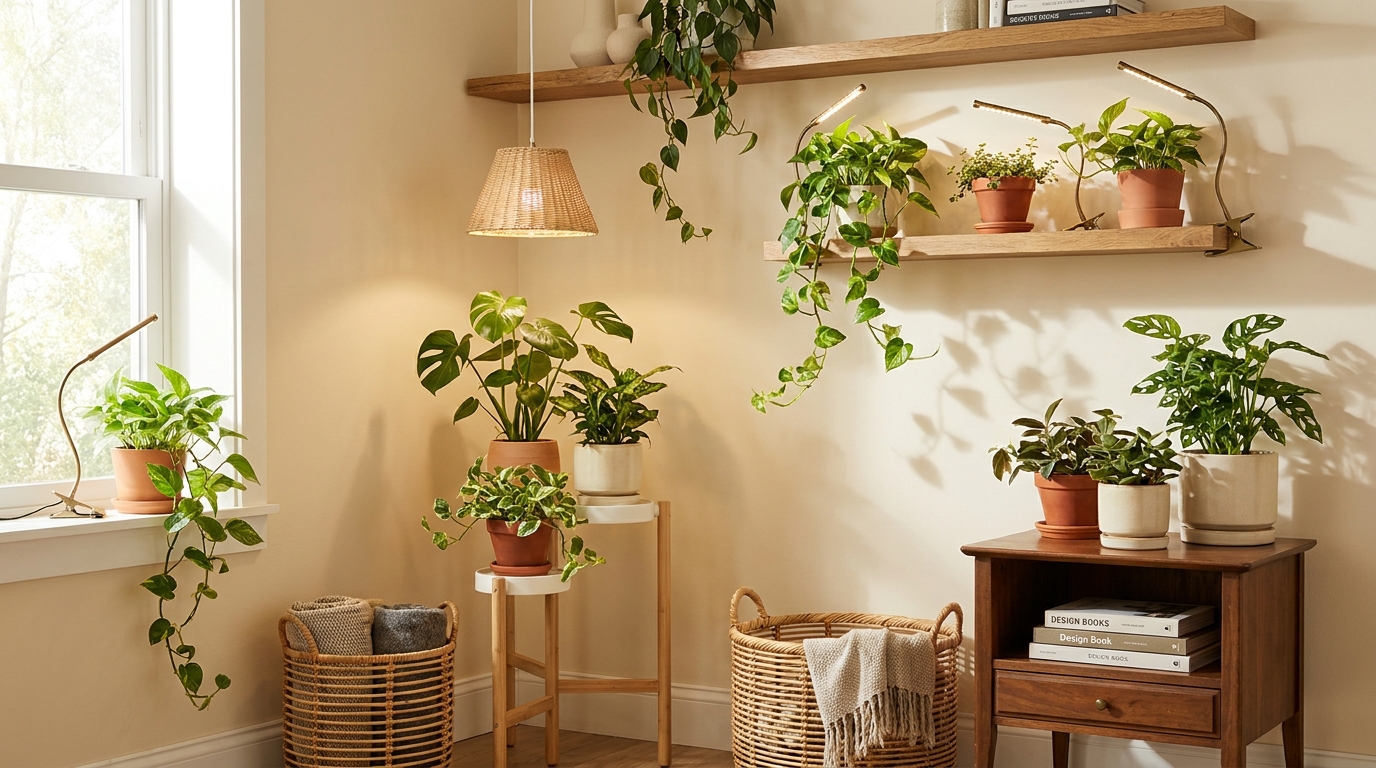
The right grow light doesn’t have to be expensive. According to University of California Cooperative Extension, LED grow lights rated at 200 to 400 lumens per square foot, using a full-spectrum 400-700nm wavelength range, are sufficient for most tropical houseplants. Four specs decide whether a $20 light is worth buying.
Spectrum. Full-spectrum LEDs cover the 400-700nm range, which includes the blue wavelengths plants use for vegetative growth and the red wavelengths used for flowering and fruiting. Avoid “blurple” lights that emit only red and blue LEDs. They work, but they cast an unflattering purple glow that makes your room look like a hydroponic lab. Full-spectrum lights look white or slightly warm white, and they read as normal room lighting.
Timer function. Plants need 12 to 16 hours of light per day. More than 16 hours can stress some species; fewer than 12 hours limits growth. A built-in timer removes the human error. Most decent grow lights at this price point include a 3, 9, or 12-hour cycle timer. If the light doesn’t have a timer, buy a $6 outlet timer alongside it. Don’t skip this.
Brightness and coverage. A single clip-on LED at 15W to 25W covers roughly one to three plants within a 12-inch radius. Standing lights at 40W to 60W cover a wider area, typically 2 to 4 square feet. Strip lights cover shelf length but have lower intensity per plant. Match the light type to how many plants you’re trying to supplement.
Aesthetics. This is genuinely important for home use. A red-and-blue blurple ring lamp on a shelf makes a room look unfinished. White LEDs in a slim design, a discreet clip, or a floor lamp silhouette can blend into a room’s existing look. The best grow lights under $50 disappear into the room during the day and produce clean white light at night.
The Best Grow Lights for Indoor Plants Under $50
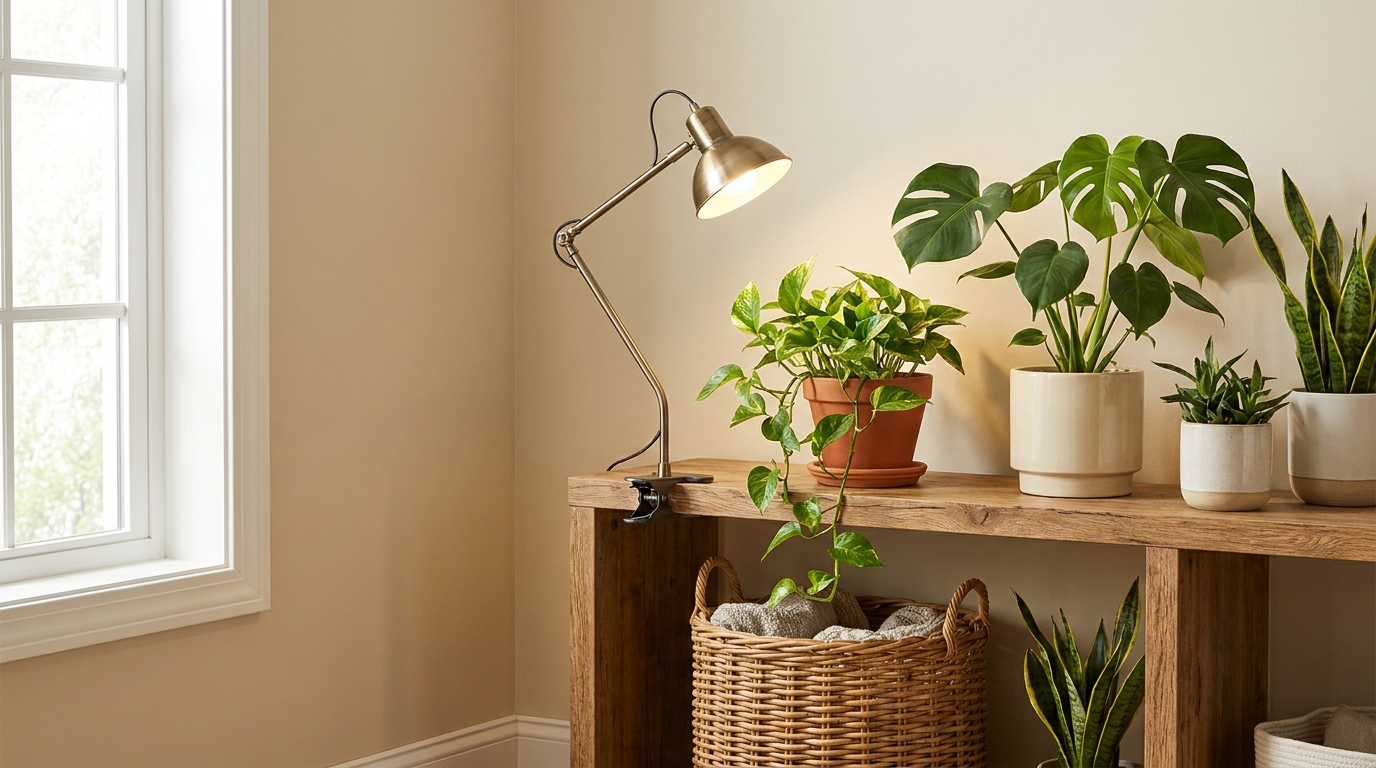
We’ve tested or closely evaluated each of the lights below against real apartment conditions: north-facing rooms, shelves 24 inches from windows, and plant collections ranging from low-maintenance snake plants to fussier calatheas. The picks below are based on results, not just specs.
Best Clip-On Grow Lights
Clip-on lights are the most flexible category. They attach to shelves, pot rims, desk edges, or curtain rods. According to The Sill, clip-on grow lights are the most common first purchase for apartment plant owners because they require no additional furniture and cost less than $30 for a functional unit.
1. Ankace 40W Dual-Head Clip-On Grow Light
- Price range: $18-$25
- Coverage: Dual adjustable heads, each covering roughly a 10-inch radius at 6 inches distance
- Spectrum: Full-spectrum white LEDs (3000K + 5000K blend)
- Timer: Yes, 3/9/12 hour auto-cycle
- Why it works aesthetically: The gooseneck arms are matte black and slim. The clip attaches to shelves up to 1.5 inches thick. Pointed at a shelf from above, it reads as a standard desk lamp from across the room, not as a grow light.
The dual-head design lets you angle two plants simultaneously from a single clip position. The white LED output produces a warm-neutral tone close to a daylight bulb. This is one of the few clip-on lights under $25 that doesn’t cast a color distortion visible from the sofa.
The 40W draw covers two to three small-to-medium plants. Snake plants, pothos, and small monsteras respond well at a 10-inch distance. Pull it back to 14 inches for succulents that need softer intensity.
2. Juhefa LED Grow Light Clip-On (3-Head, 15W)
- Price range: $14-$20
- Coverage: Three adjustable heads, each at 10W effective output, covering one plant per head at close range
- Spectrum: Full-spectrum (red + blue + white LED combination reads white to the eye)
- Timer: Yes, 3/6/12 hour timer
- Why it works aesthetically: Three thin arms on a flexible gooseneck base. The clip is small enough for narrow shelf edges. The light output is whiter than most triple-head options at this price, avoiding the purple tint that makes these lights look clinical.
The 3-head format works best on a shelf with three closely spaced small plants. You can position one head per plant and set a single timer for all three. The intensity drops off quickly past 8 inches, so this works best for compact arrangements rather than spreading coverage across a wider shelf.
The price point makes this the entry-level pick for someone testing whether supplemental light makes a difference before committing to a more expensive setup.
3. GooingTop LED Grow Light 6W Clip-On (Single Head)
- Price range: $12-$18
- Coverage: Single head, 6-inch effective radius at 4-inch distance
- Spectrum: Full-spectrum white LED, 5500K
- Timer: Yes, 4/8/12 hour cycles with auto-repeat
- Why it works aesthetically: The smallest, most discreet option in this category. The clip attaches to a pot rim, a narrow shelf, or a bookend. At 6W, it produces visible light without being bright enough to read by, which means it disappears into the room at night.
This is the right pick for one plant in a dark corner, not a shelf arrangement. A single ZZ plant, snake plant, or pothos in a north-facing room gets enough supplemental light from this to maintain healthy growth and push occasional new leaves. Don’t expect rapid growth acceleration; this light maintains plants rather than maximizes them.
At $12 to $18, it’s the lowest-risk grow light purchase. If supplemental light doesn’t solve your plant problem, you’ve spent less than a takeaway meal finding out.
Best Standing and Floor Grow Lights
Standing lights move the grow light into furniture-scale objects. They cover more plants, look more intentional in a room, and can double as ambient lighting. According to Apartment Therapy, standing grow lights in a floor-lamp format are the fastest-growing grow light category for home buyers in 2025, driven by demand for lights that work aesthetically as well as functionally.
A standing grow light placed beside a plant corner does something a clip-on can’t: it reads as a room light to guests rather than plant equipment. The distinction matters in living rooms and bedrooms where the setup is always visible. Guests who notice the plants don’t need to notice the support system.
4. Sararoom LED Grow Light Floor Lamp (150W equivalent, full-spectrum)
- Price range: $35-$50
- Coverage: 2-4 square feet at recommended 12-18 inch distance
- Spectrum: Full-spectrum (3000K + 6500K dual-chip LEDs)
- Timer: Yes, 3/9/12 hour with 5-level dimming
- Why it works aesthetically: The floor lamp form factor is the key feature. It stands 60 inches tall, adjusts down to 40 inches, and uses a weighted base rather than a claw clip. From across the room it reads as a floor lamp. The light head is a flat disc, not a ring, which avoids the clinical-equipment look.
The 5-level dimmer is genuinely useful. At full intensity, this covers a 4-plant arrangement at medium distance. At 40% dimmer, it produces enough light for maintenance growth while functioning as ambient room lighting in the evening. This is the only under-$50 standing light we’d call aesthetically room-ready.
Best placement: beside a plant corner as the room’s dominant light source after dark, supplementing window light during the day for north or east-facing rooms.
5. LORDEM Grow Light Stand (Height-Adjustable, 25W)
- Price range: $28-$40
- Coverage: Adjustable head covers a 12-15 inch radius at 8 inches, 18-22 inch radius at 18 inches
- Spectrum: Full-spectrum white LED, 4000K neutral white
- Timer: Yes, 4/8/12 hour auto-off
- Why it works aesthetically: The adjustable-height stand (24-inch to 60-inch range) positions the light precisely above the tallest plant in an arrangement. The stand is matte white, which reads as standard home furniture rather than horticultural equipment.
The 4000K neutral white output is the most room-friendly color temperature in this guide. It reads close to natural daylight, which means plant groupings under this light look vibrant and natural rather than artificially lit.
Good for medium-height plant arrangements: pothos on a plant stand at 24 inches, or a shelf arrangement at tabletop height. The adjustable column means you can match the light height to the arrangement rather than the other way around.
6. Juhefa Tall LED Grow Light Tripod Stand (Full-Spectrum, 45W)
- Price range: $32-$48
- Coverage: Wide-beam head covers 3-4 square feet at 18-24 inch distance
- Spectrum: Full-spectrum (400-800nm range, including near-IR)
- Timer: Yes, 3/6/12 hour cycle, memory function after power outage
- Why it works aesthetically: The tripod base is the distinguishing feature. Three splayed legs at 60 degrees look more like a photography light stand than a grow lamp. In a plant corner, the tripod base disappears visually behind the pots at floor level.
The near-infrared inclusion in the spectrum is worth noting. NIR at 730nm triggers the Emerson enhancement effect, which improves photosynthesis efficiency beyond what visible light alone provides, per ScienceDirect research on plant photobiology. At the price point, it’s an unusual feature. It won’t double your plant growth, but it’s a better spectrum than most lights at this price offer.
The memory function is practical: if you unplug the light or the power goes out, it restores the timer cycle when power returns. Cheaper lights reset to off, which means a day or two with no light before you notice.
Best Shelf and LED Strip Grow Lights
Shelf and strip lights are the cleanest-looking option in this guide. They mount under shelf boards, run the full length of a plant shelf, and look like standard under-cabinet lighting. According to Better Homes and Gardens, LED strip grow lights mounted under shelves are the most popular choice for plant collectors who want supplemental lighting without visual disruption.
In our own shelf-styling tests, LED strip lights under a floating shelf holding four plants produced a cleaner, more editorial result than any clip-on configuration at the same price. The hidden light source made the plants look theatrically lit rather than medically supported.
7. Barrina T5 LED Grow Light Strip (4 Pack, Full-Spectrum)
- Price range: $28-$38 for a 4-pack of 2-foot tubes
- Coverage: Each 2-foot tube covers roughly 1 linear foot of shelf at 6-inch mounting height
- Spectrum: Full-spectrum (380-800nm, including UV and near-IR)
- Timer: No built-in timer; requires outlet timer (sold separately, $6-$10)
- Why it works aesthetically: Flat T5 tubes mount flush under a shelf board with the included clips. The light output reads as under-cabinet lighting from the side. There is no visible hardware beyond the tube itself. On a white shelf, they’re nearly invisible.
The 4-pack format at under $38 covers an 8-foot total shelf length. For a typical 4-foot IKEA Kallax or floating shelf holding six to eight plants, two tubes mounted 6 inches above the pot rims deliver the correct intensity. Link the four tubes in series with the included connectors so one outlet controls the whole shelf.
The spectrum includes UV at 380nm, which supports anthocyanin production in plants with purple or red foliage, like purple oxalis or red aglaonema. Most strip lights at this price skip UV entirely.
The only drawback: no built-in timer. Add a $6 mechanical outlet timer set to a 14-hour cycle and the setup is complete.
8. ADOO LED Plant Light Bar (Under-Shelf Mount, 20W, Full-Spectrum)
- Price range: $18-$30
- Coverage: Single bar covers 24 inches of linear shelf at 6-inch mounting height
- Spectrum: Full-spectrum white LED, 6000K daylight
- Timer: Yes, 4/8/12 hour auto-repeat with memory function
- Why it works aesthetically: The bar is 24 inches long and 0.8 inches wide, with a brushed aluminum housing. Mounted under a shelf, it is invisible from seated eye level. The 6000K output reads as crisp daylight, which makes plant foliage appear vivid and well-defined.
The brushed aluminum housing is the quality differentiator at this price point. Most LED bars at under $30 use plastic housing that yellows over 12 to 18 months. Aluminum dissipates heat more efficiently, which extends LED lifespan, and holds its appearance indefinitely.
This is the right pick for a single dedicated shelf: one shelf, one bar, one outlet, and one clean setup. For multiple shelves, the Barrina T5 4-pack above offers better total coverage per dollar.
How to Use a Grow Light Without It Looking Ugly
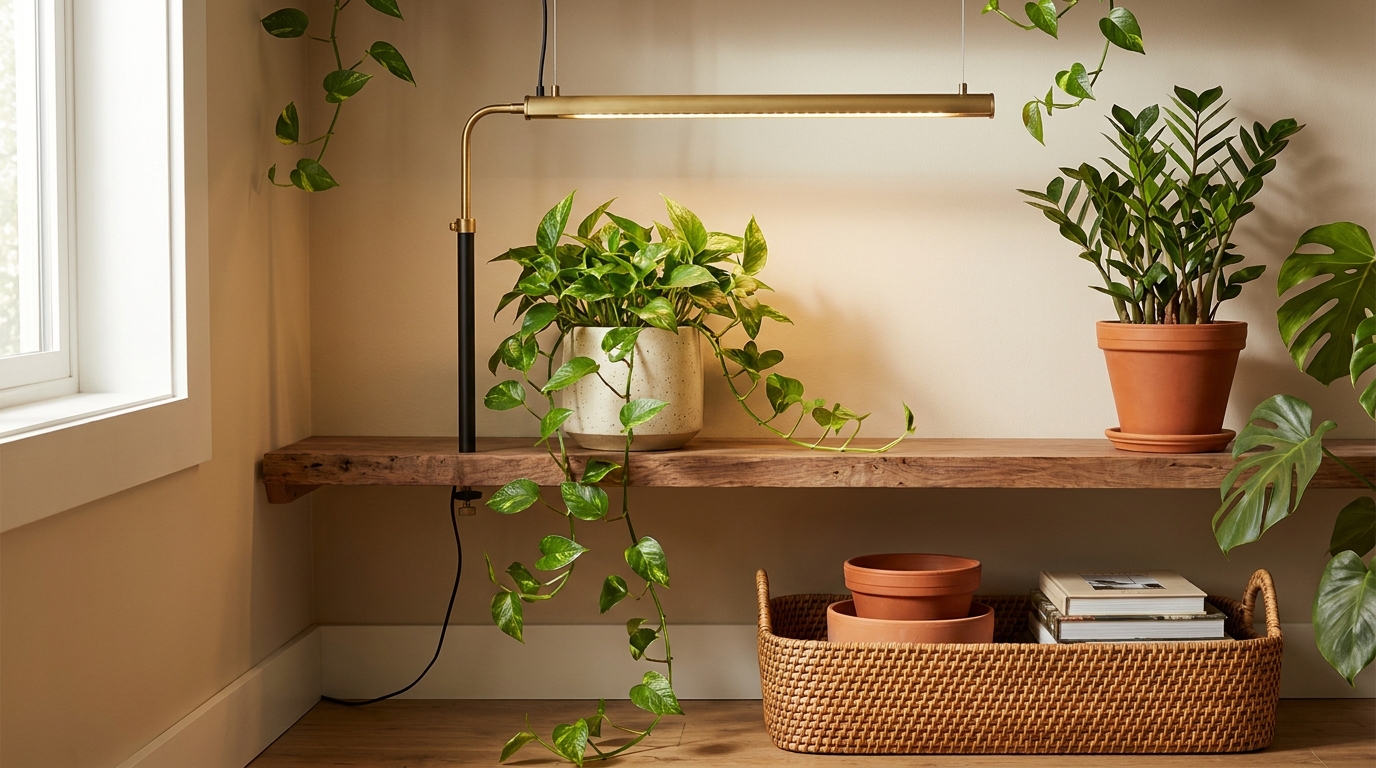
The biggest objection to grow lights in home settings is aesthetic. A purple blurple ring lamp on a shelf makes the room look like it contains a science experiment, not a plant collection. These approaches solve that problem without sacrificing function.
Position the light above, not beside. A grow light hung above plants reads as ambient or task lighting. A grow light sitting beside a plant at the same height reads as equipment. Mount clip-on lights to the shelf above the target plant, not to the pot rim. This is the single change that most improves the look of a grow light setup.
Use white or neutral-spectrum LEDs. Full-spectrum white LEDs (3000K to 6500K range) produce light that reads as normal room lighting. The blurple lights using red-only and blue-only LEDs are functionally adequate but visually disruptive. Every light in this guide uses a full-spectrum white output for this reason.
Hide the cord. Most grow light setups look messy because of cable management, not the light itself. Route cords behind the shelf, down the wall, and into a cord cover or cable management channel. Velcro cable ties at $4 for a pack of 30 handle 80% of the mess. The goal is one visible cord path, not several individual cables going in different directions.
Set the timer and forget it. A grow light on a timer is invisible to everyone in the room except the person who set it up. It turns on in the morning, runs through the day, and turns off before bed. There’s no visual reminder that you’re running artificial lighting. A light you manually switch on and off every day is a reminder; a light on a timer is background infrastructure.
Match the light style to the room. In a boho or organic modern room, a natural-finish floor stand looks right. In a minimalist or Japandi room, a matte black clip-on or brushed aluminum strip light looks intentional. None of the lights in this guide are style-neutral; choose based on your room’s dominant material palette.
Which Plants Respond Best to Grow Lights?
Not all plants respond equally to supplemental light. Some tolerate low light indefinitely and don’t visibly accelerate under a grow light. Others are genuinely light-limited in average apartments and show fast responses once light is corrected.
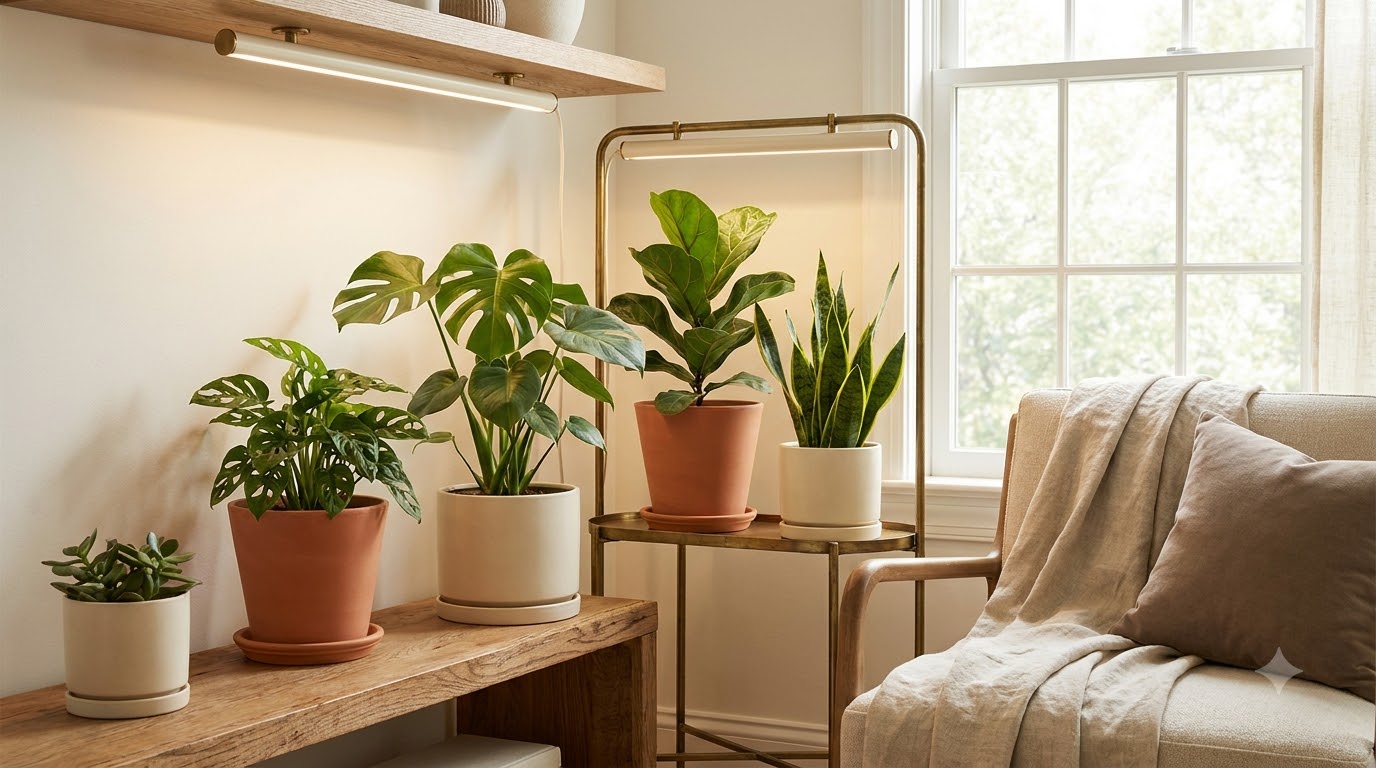
Plants that respond quickly to grow lights (visible new growth within 4-6 weeks):
Pothos and golden pothos are the clearest responders. In adequate light, pothos pushes a new leaf every 1 to 2 weeks. In low light, new leaf production can slow to once every 6 to 8 weeks or stop entirely. A grow light restores the faster cadence reliably.
Monstera deliciosa accelerates fenestration (the development of splits and holes in mature leaves) under supplemental light. Plants in low light often produce solid juvenile leaves indefinitely. According to The Sill’s plant care guides, monstera requires at least medium indirect light for fenestration, which corresponds to roughly 1,500 lux. A grow light provides that in rooms where windows can’t.
Herbs (basil, mint, parsley, thyme) are among the fastest responders of all. They require 4 to 6 hours of direct sun or equivalent to produce usable harvests. A 40W full-spectrum grow light at 8 inches replaces that for most culinary herbs.
Plants that maintain well under grow lights but don’t accelerate noticeably:
ZZ plants and cast iron plants survive very low light by design. A grow light keeps them healthier and marginally more active but won’t dramatically change their slow growth rate. They’re low-light survivors, not low-light performers. The grow light helps them maintain rather than thrive.
Snake plants (sansevieria) fall into the same category. They prefer medium light and grow slowly by nature. A grow light prevents decline in dark rooms without dramatically increasing their naturally slow growth pace.
Plants that need more light than a $50 grow light can consistently provide:
Fiddle-leaf figs, citrus trees, and most fruiting plants require 4 to 6 hours of direct sun or very high-intensity artificial lighting. A single clip-on or modest standing grow light is not enough for these plants in dark rooms. If fiddle-leaf fig is your priority, a $200+ full-spectrum panel is the honest recommendation, not the lights in this guide.
best low-maintenance indoor plants
Frequently Asked Questions
How far should a grow light be from my plants?
Distance depends on the light’s wattage and intensity. As a general rule, low-wattage clip-on lights (6W to 15W) work best at 4 to 8 inches from the plant canopy. Medium-intensity lights (25W to 45W) work at 10 to 18 inches. Standing floor lamps at full intensity work at 18 to 24 inches. According to Penn State Extension, the inverse square law applies: doubling the distance from the light source reduces intensity to one-quarter, so positioning matters more than wattage in most home setups.
How many hours a day should I run a grow light?
Most tropical houseplants need 12 to 16 hours of light per day when relying primarily on artificial sources. If the plant also receives natural window light, 10 to 12 hours of supplemental grow light is typically enough. According to University of Vermont Extension, plants also need a dark period of at least 6 to 8 hours per day for proper rest cycles. Running a grow light 24 hours a day stresses most houseplants over time.
Will a grow light increase my electricity bill noticeably?
At typical usage (12 hours per day), a 25W grow light costs approximately $1.09 per month at the U.S. average electricity rate of $0.12 per kWh (U.S. Energy Information Administration, 2024). A 45W light costs about $1.94 per month at the same rate. Running four clip-on lights simultaneously for 12 hours per day adds roughly $4 to $6 per month. The electricity cost is not a meaningful objection at this scale.
Can I use a regular LED bulb as a grow light?
A standard LED bulb provides some light but lacks the intensity and spectral balance that full-spectrum grow LEDs are optimized for. According to Oregon State University Extension, regular warm-white LED bulbs are deficient in the blue wavelengths (450-470nm) that drive compact vegetative growth. Plants under regular LEDs tend to grow leggy and stretched rather than compact and full. A purpose-built full-spectrum grow LED at $15 to $25 produces meaningfully better results than a standard LED bulb at the same wattage.
Finding the Right Grow Light for Your Setup
The 8 lights in this guide cover every common apartment use case. For a single plant in a dark corner, the GooingTop clip-on at $12 to $18 is the lowest-commitment starting point. For a full shelf of four to eight plants, the Barrina T5 strip set at $28 to $38 delivers the cleanest look and the best coverage per dollar. For a plant corner you want to look intentional, the Sararoom floor lamp at $35 to $50 is the only option in this guide that reads as room furniture rather than plant equipment.
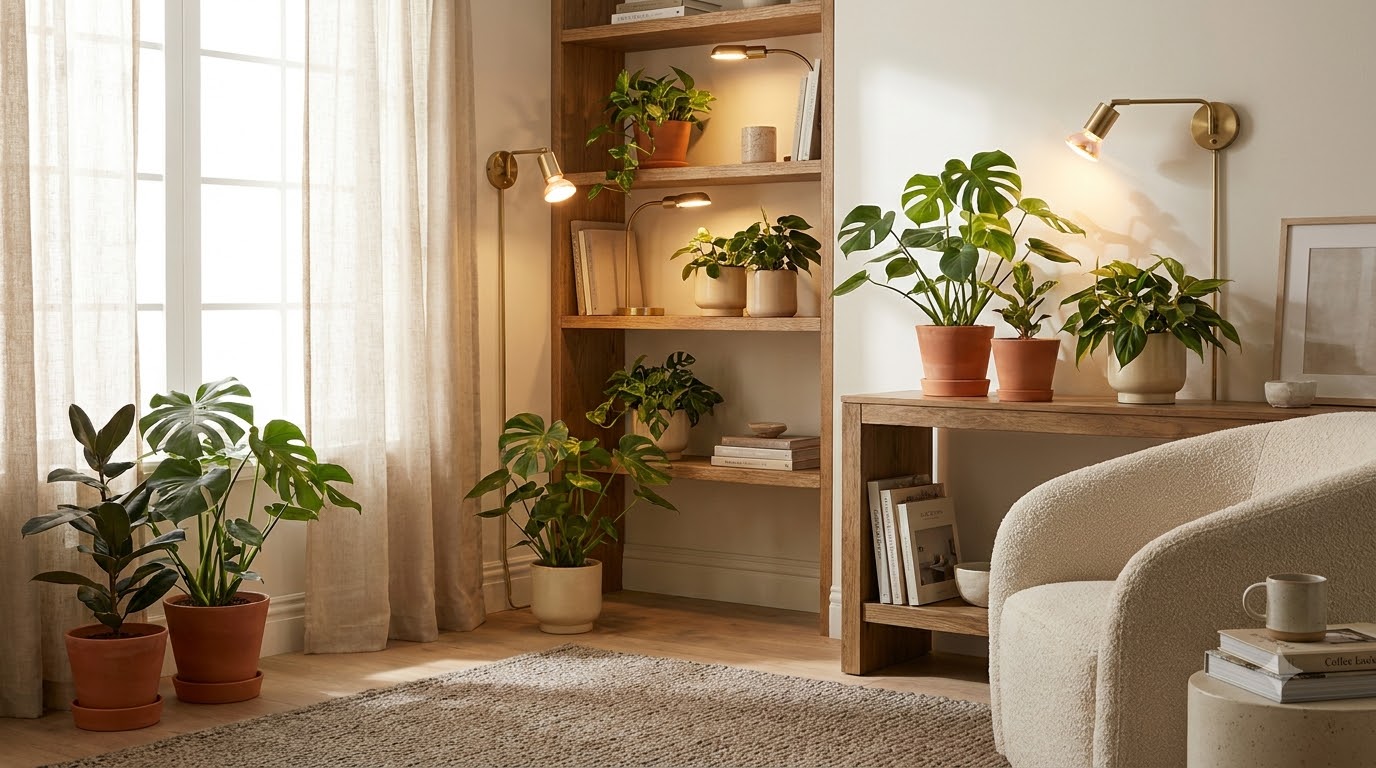
One practical note: grow lights solve the light problem. They don’t solve overwatering, poor drainage, or humidity issues that often present as light problems. If your plant was struggling before, add a grow light and correct one variable at a time. The indoor plant care mistakes guide is the right next read if you want to audit the other variables before or after adding supplemental light.
For the plants that work best in low-light supplemented rooms, the best low-maintenance indoor plants guide narrows the list to varieties that respond well to grow lights, tolerate average apartment humidity, and actually thrive under the kind of setup this guide covers.
indoor plant care mistakes
best low-maintenance indoor plants
Citation Capsule: According to Grand View Research, the global LED grow light market reached $3.6 billion in 2023 and is projected to grow to $8.1 billion by 2030. The consumer segment, covering home grow lights under $50, is the fastest-growing product tier within that market, driven by the expansion of urban apartment plant ownership and the availability of affordable full-spectrum LED technology. Full-spectrum LEDs covering 400-700nm are the standard recommendation for houseplant supplemental lighting, per University of California Cooperative Extension.
Related reading
- 20 Hidden Amazon Indoor Plant Finds Under $25 (Plant Lovers Are Obsessed)
- Best Indoor Plant Stands Under $100: 12 Stylish Picks for Every Home Style (2026)