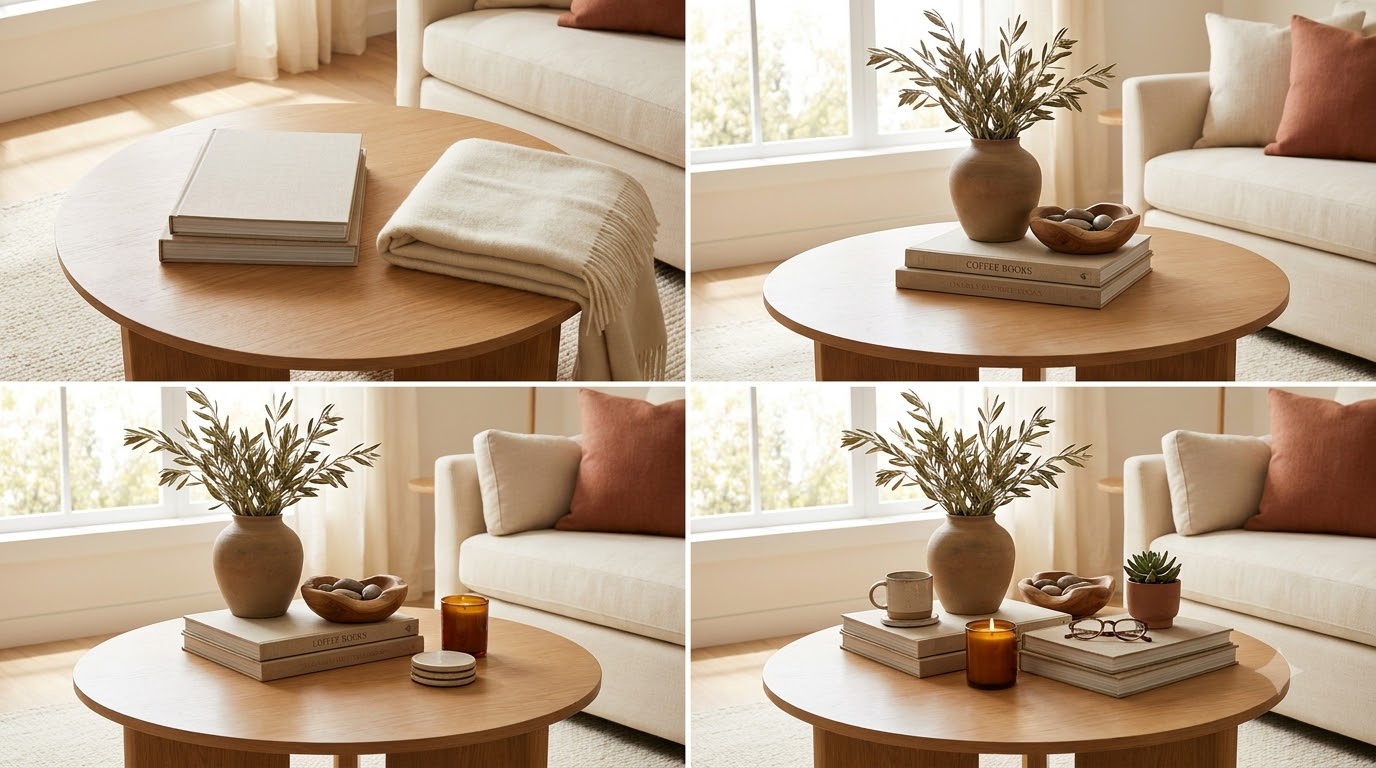
To style a coffee table, start with a tray to anchor the surface, add a short stack of books, tuck in something living like a small plant or fresh stems, and finish with two or three objects at varied heights. That four-part formula — tray, stack, greenery, and height — works on almost any table because it gives your eye a place to land while keeping the surface useful. Aim to fill roughly two-thirds of the tabletop and leave the rest open, group decorative objects in odd numbers (three reads as more collected than four), and vary the heights of your pieces by at least 3–4 inches so nothing looks flat. In our styling projects, this is the exact order we build in, and it takes about ten minutes with things most renters already own.
Key Takeaways
- Use a tray sized to about one-third of your tabletop to corral small items and create instant order.
- Group objects in odd numbers (3 or 5) and vary their heights by 3–4 inches for a layered, collected look.
- Every good vignette needs four things: something to contain (tray), something to stack (books), something living (plant), and something personal (object).
- Leave at least one-third of the surface clear so the table still works for coffee, remotes, and feet-up evenings.
What do you put on a coffee table?
The best coffee tables mix a few functional pieces with a few personal ones so the surface feels styled but still livable. We think in four categories, and you rarely need more than one or two items from each. Here is our go-to checklist:
- A tray or catch-all bowl — corrals the remote, coasters, and a lighter or matches (12–18 in trays fit most tables).
- Two to four books — a stacked pair plus a standing spine, ideally with colors that echo your room.
- Something living — a 6-inch potted plant, a single stem in a bud vase, or dried pampas that never needs water.
- A sculptural object — a ceramic knot, a chunky candle, a small box, or a piece of coral-like decor.
- A scent or ambiance piece — a candle in the $12–$30 range or a small diffuser for movie nights.
Notice what is missing: clutter. Mail, chargers, and half-finished snacks belong in the tray or off the table entirely. If you want a deeper walkthrough of surface styling across the whole room, our guide to aesthetic living room coffee table and bookshelf styling pairs well with this method.
The four styling zones (and how much space each gets)
We divide any tabletop into four zones and assign each a job. This is the fastest way to make a table look intentional instead of piled-on. Match your table shape to the layout below.
| Zone | What goes here | Space to give it |
|---|---|---|
| Anchor | Tray or large book stack | ~1/3 of the surface |
| Height | Vase, tall candle, or stems (8–12 in) | One back corner |
| Personal | Sculptural object, box, or coasters | Small footprint, front zone |
| Negative space | Nothing — kept clear on purpose | At least 1/3 of the surface |
The negative-space zone is the one renters skip most often, and it is the one that reads as “designed.” A table crowded to the edges feels busy; a table with breathing room feels styled.
How do you style a coffee table step by step?
Here is the exact sequence we follow, start to finish. Clear the table completely first, then build back up in this order:
- Place your tray slightly off-center, toward one side of the table.
- Stack two books flat inside or beside the tray, largest on the bottom.
- Add height in a back corner — a bud vase or 8–10 in candlestick.
- Set one sculptural object on top of the book stack to add a layer.
- Tuck greenery so a leaf or stem breaks the straight line of the table edge.
- Step back six feet, remove one item, and stop. Restraint is the last step.
That “remove one item” step matters more than any single object you add. In our styling projects, the tables that photograph best almost always had one thing taken away at the end.
How do you style a round coffee table?
Round tables have no corners to hide behind, so styling works from the center out instead of side to side. A round or circular tray (14–16 in) echoes the shape and does most of the work. Follow these adjustments:
- Choose round-footprint objects — a round tray, a squat vase, and a low bowl mirror the table’s curve.
- Build one central cluster instead of spreading pieces to opposite ends.
- Use a triangle, not a line — arrange three objects so their tops form a triangle of varied heights.
- Keep the outer ring clear so drinks and hands have a landing spot all the way around.
For square and rectangular tables, do the opposite: run a longer horizontal arrangement, like a runner of books and objects along one half, and reserve the other half as open space.
How to style a coffee table on a budget
You do not need a shopping trip to style a table well — most renters already own 80% of the pieces. When you do buy, these are the highest-impact swaps for the money:
- A tray ($15–$40) — the single best-value item; instantly organizes the surface.
- Thrifted hardcover books ($1–$3 each) — buy for spine color, not title; wrap ugly jackets in kraft paper.
- One good candle ($12–$30) — adds warmth, scent, and a sculptural shape at once.
- A bud vase ($8–$20) — a single grocery-store stem looks intentional in the right vessel.
- Dried stems ($10–$25) — pampas or bunny tails last for months with zero upkeep.
Shop your own home first: kitchen bowls become catch-alls, a stack of cookbooks adds height, and a jar of matches reads as styling. If you are ready to upgrade the table itself, our roundup of the best coffee tables under $400 covers renter-friendly picks, and the best indoor plants for a living room helps you choose greenery that survives low light.
How to style a coffee table in a small space
Small-space and apartment tables reward editing. When the table is 40 inches or less, or doubles as a dining and work surface, scale everything down and keep it mobile:
- Use one tray, not two vignettes — a single 12–14 in tray you can lift off in one motion.
- Go vertical for interest — a taller 10–12 in vase adds presence without eating surface area.
- Choose double-duty pieces — a lidded box hides remotes; a stacked-book riser lifts a plant.
- Limit yourself to three objects total so the table can still hold a plate and a laptop.
- Pick a low profile — keep decor under 12 inches so it never blocks the TV or sightlines.
Color discipline helps small rooms feel calm. We like grounding a tight palette with a warm neutral such as Greige (#B7A99A) or a soft Sage (#A3B18A), then adding one accent — a Terracotta (#C97C5D) candle or a deep Navy (#2A3D54) book — so the table has a focal point without visual noise. For pulling that palette across the whole seating area, our living room layering technique for rugs, pillows, and throws shows how to repeat the same three colors from floor to sofa.
Common coffee table styling mistakes
Most tables that feel “off” share the same few problems. Scan this list and fix whichever apply:
- Everything is the same height. Add one piece that is 3–4 inches taller than the rest.
- Objects float alone. Cluster them into one or two groups instead of scattering singles.
- The tray is too small. If it holds only the remote, size up to about one-third of the table.
- No negative space. Clear at least a third of the surface and resist refilling it.
- Nothing personal. Add one object with a story — a travel find, a photo, a handmade dish.
If your whole living room needs a reset before the table can shine, start with our cozy living room ideas and layout guide, then come back and style the table last — it is easier to accessorize a surface once the layout around it works.
How to style a coffee table by shape
Shape changes the arrangement more than any other factor. Use this quick reference to match your table:
| Table shape | Best arrangement | Tray to use |
|---|---|---|
| Round | One central cluster, triangle of heights | Round, 14–16 in |
| Square | Off-center tray plus one corner accent | Square, 12–14 in |
| Rectangular | Horizontal runner along one half | Rectangular, 16–18 in |
| Oval | Loose S-curve of 3 groupings | Oval or rectangular |
What is the rule of thirds for coffee table styling?
The rule of thirds is the fastest mental shortcut we teach for a balanced table. Instead of measuring anything, you divide the surface into thirds and assign each a purpose. It keeps you from centering everything, which is the most common way a table ends up looking stiff. Here is how we apply it:
- First third — the anchor: your tray or main book stack lives here, set slightly off to one side.
- Second third — the accent: height and greenery go here, offset diagonally from the anchor.
- Final third — the breathing room: left deliberately empty for drinks, feet, and daily life.
- Balance the diagonal: a tall vase in one corner is offset by a low, wide object in the opposite zone.
Odd-number grouping and varied heights do the rest. When we walk into a room and a table feels effortless, this diagonal, off-center balance is almost always the reason — not an expensive object.
Frequently asked questions
How many items should be on a coffee table?
Three to five items usually looks best, arranged in one or two clusters. Odd numbers read as more collected than even ones. On small or shared tables, cap it at three objects plus a tray so the surface still holds a drink and a book. When in doubt, remove one piece and reassess.
What size tray should I use on a coffee table?
Aim for a tray that covers about one-third of your tabletop, most often 12–18 inches long. It should be big enough to gather the remote, coasters, and a candle without crowding them. Match the tray shape to the table — round for round, rectangular for rectangular — so the lines feel intentional.
How do I style a coffee table without books?
Replace the book stack with another way to add height and layers: a small wooden riser, a stack of two nesting boxes, or a footed bowl. Then keep the rest of the formula — tray, greenery, and one sculptural object. Height and grouping matter more than the books themselves, so any low platform works.
What can I put on a coffee table besides a plant?
If a live plant is too much upkeep, try dried pampas or eucalyptus, a single faux stem in a bud vase, or a bowl of natural objects like stones or citrus. A textured candle or a small ceramic sculpture also adds the organic warmth that greenery usually provides, with zero watering required.
How often should I restyle my coffee table?
A light refresh every season keeps the table feeling current — swap the candle scent, change one book, or rotate stems. The daily habit matters more: reset the tray each night so the table starts clear every morning. Ten seconds of tidying protects the styling you spent ten minutes creating.
Style your table with the tray-stack-greenery-height formula, respect the one-third negative space rule, and edit until it feels calm. That is the whole method — and it costs almost nothing to try tonight with pieces you already own.