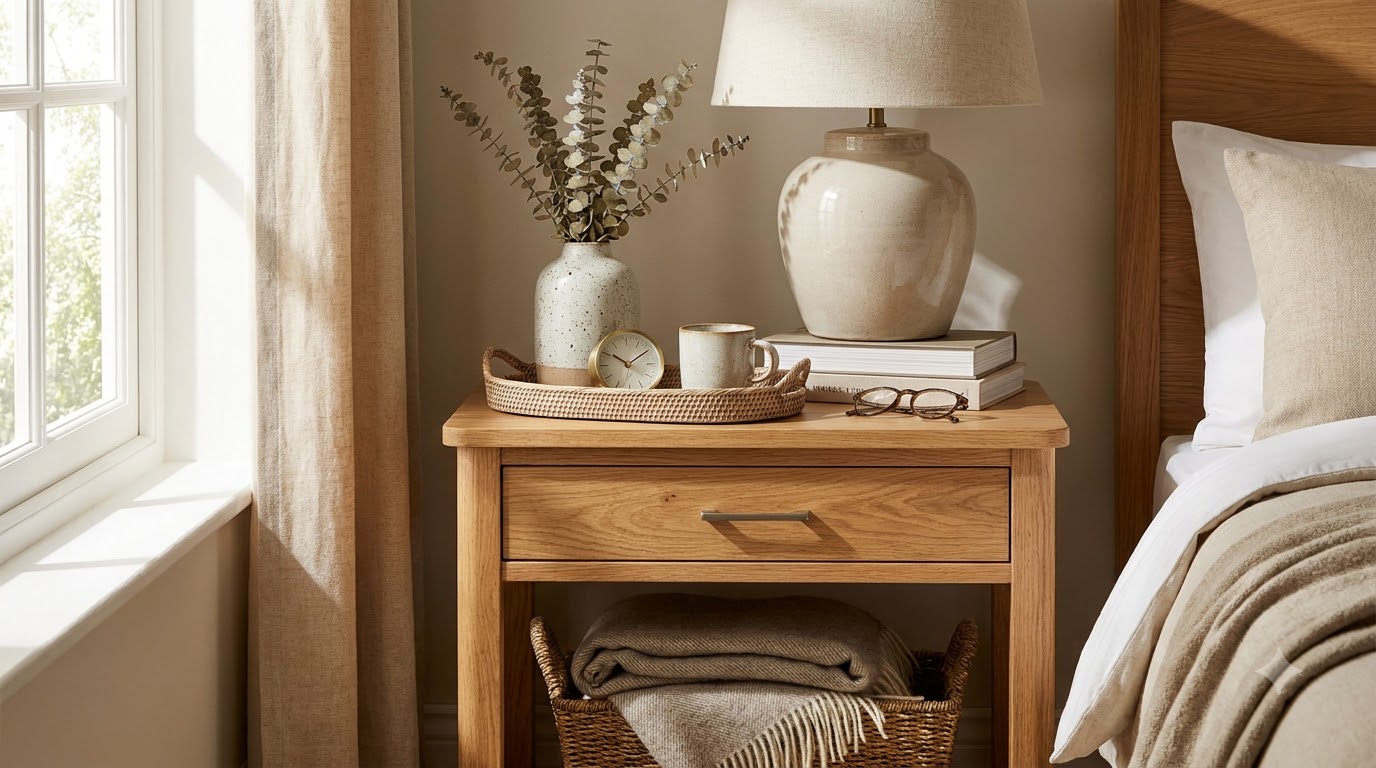
To style a nightstand, start with four things at varied heights: a lamp (24–28 inches tall), a small stack of two or three books, a little tray to corral the clutter, and one personal or green object like a trailing pothos cutting or a framed photo. That combination gives you light to read by, a landing spot for your phone and glasses, and just enough personality to make the corner feel like yours. Everything after this is refinement.
We style rental bedrooms for a living, and the nightstand is the piece we come back to most because it does the heavy lifting in a small space. Get nightstand decor right and the whole room reads calmer, even when the square footage is tight and the lease says no drilling. Below is our exact playbook, built for renters, small footprints, and budgets that end in double digits.
Key Takeaways
- Anchor every nightstand with four essentials: a lamp, a short book stack, a tray, and one personal or green object.
- Match the nightstand height to within 2 inches of your mattress top so you can reach a glass of water without leaning.
- Keep the lamp between 24 and 28 inches tall so the shade sits near shoulder height when you sit up in bed.
- Work in odd numbers and three height tiers (tall, medium, low) to keep a small surface from looking flat.
- Leave at least 40 percent of the surface empty so the nightstand stays functional, not just pretty.
- A complete, renter-friendly nightstand styling refresh can be done for $30 to $75 using items you likely already own.
The four things every styled nightstand needs
Before we talk color or trays, we anchor to a formula we use in almost every bedroom. It is simple enough to memorize and flexible enough to work on a $40 thrifted table or a built-in shelf. Each item earns its place by doing a job and adding a different height:
- A lamp (the tall tier): Your light source and your vertical anchor. Aim for 24–28 inches total height so the bottom of the shade lands roughly at your shoulder when seated in bed.
- A book stack (the medium tier): Two or three books laid flat, spines facing out or in for a quieter look. They add mass and a landing pad for a small object on top.
- A tray or catch-all (the functional tier): A 6–9 inch tray or dish that holds your glasses, rings, and lip balm so the surface never reads as scattered.
- One personal or green object (the low, soft tier): A 4–6 inch plant, a framed photo, a small candle, or a ceramic dish. This is the piece that makes the corner feel lived-in.
Own those four categories and you already have a styled nightstand. Everything below is about spacing and proportion, the small decisions that make it look intentional. For the full bedroom picture, our complete guide to aesthetic bedroom ideas for 2026 shows how the nightstand connects to bedding, walls, and lighting.
What should a nightstand height be?
A nightstand should sit within about 2 inches of the top of your mattress. The reach test matters more than any rule: when you lie down and stretch your arm out, your hand should land flat on the surface without you propping yourself up. That is what makes a glass of water or a phone alarm feel effortless in the dark.
Most mattresses land between 24 and 28 inches off the floor, so a nightstand in the same range is the safe target. If yours runs short, we stack a book or two under the lamp to lift the light. Here is the quick decision list we run through:
- Measure from the floor to the top of your mattress, not the frame.
- Choose a nightstand within 2 inches above or below that number.
- If the table is too low, add height with a book stack or a riser.
- If the table is too tall, drop the lamp and mount light on the wall instead.
- Confirm with the reach test before you commit to styling anything on top.
How do you style a small nightstand?
On a small nightstand (12–16 inches wide, common in rentals), the rule is subtraction. You do not need fewer categories, you need smaller versions of each. We swap a table lamp for a slim column lamp or wall sconce, use a single book instead of a stack, and choose a tray that covers no more than half the surface. Keep at least 40 percent of the top clear so it still works as a nightstand.
Our favorite small-space moves, in order of impact:
- Go vertical. A tall, narrow lamp or a wall sconce frees the surface and draws the eye up, which makes the whole corner feel bigger.
- Use a tray as a boundary. Corralling small items into one 6-inch tray reads as tidy even when you own a lot of little things.
- Choose one hero object. A single trailing plant or a small framed photo does more on a tight surface than three competing trinkets.
- Add a wall hook. A removable adhesive hook beside the bed holds headphones or a water bottle so they never touch the surface.
- Mind the outlet. A small cord organizer keeps charging cables off the top and out of sight.
If your nightstand doubles as a reading zone, we go deeper on lamp placement, book storage, and cozy layering in our aesthetic nightstand and reading corner setup.
Small nightstand vs. large nightstand: how the styling changes
The formula stays the same, but the scale of each piece shifts. This table is the cheat sheet we keep in our heads when we size up a surface:
| Element | Small nightstand (12–16 in wide) | Large nightstand (18–24 in wide) |
|---|---|---|
| Lighting | Slim column lamp or wall sconce | Full table lamp, 24–28 in tall |
| Books | One book, laid flat | Stack of 2–3, plus one standing |
| Tray | 6 in round or square | 8–9 in, room for two zones |
| Greenery | One 4-in trailing plant | One 6-in plant or small vase |
| Empty space | Keep 40% clear | Keep 30% clear |
| Object count | 3 items total | 5 items total (odd number) |
The height and proportion rules that make it look designed
The difference between a random pile and a styled nightstand is almost always proportion. We lean on four rules that need no measuring tape once you get the eye for them:
- The rule of three heights. Every arrangement needs a tall element (lamp), a medium element (books), and a low element (tray). Three tiers reads as intentional; one flat line reads as forgotten.
- Odd numbers win. Groupings of three or five feel more natural to the eye than pairs or fours. On a tight surface, three is the sweet spot.
- The triangle test. Arrange your three tallest points so they form a loose triangle rather than a straight row. It keeps the eye moving across the whole surface.
- The 60 percent lamp rule. Your lamp should not take up more than about 60 percent of the nightstand’s depth, or it will crowd everything else off the top.
We test the triangle every time: lamp back left, book stack front center, small plant back right. Three points, one triangle, and the corner instantly looks composed.
Color, texture, and a palette that calms a bedroom
Color is where a nightstand earns its warmth. We keep the palette to two or three quiet tones and let texture do the talking. A reliable renter-friendly scheme: a warm white base like Swiss Coffee (hex #F4F0E8), a soft sage green accent (hex #B2BFA5), and a grounding muted terracotta (hex #C08457). Those three read as calm, natural, and forgiving under warm-toned bulbs.
To keep it from feeling flat, mix at least three textures: something smooth (a ceramic tray), something organic (a linen-bound book or raw-clay pot), and something living (the plant). We always choose a 2700K warm-white LED for the bedside lamp, never a cool daylight bulb, because the warmer light signals wind-down and makes every color look softer. If bedding is your next stop, our roundup of the best bedroom bedding for 2026 in linen, cotton, and bamboo pairs beautifully with this palette.
Adding greenery without killing the plant
A little green is the fastest way to make a nightstand feel alive, but bedrooms are often low-light corners, so plant choice matters. We stick to species that tolerate low light and forgive a missed watering:
- Pothos: Trails beautifully off the edge, thrives in low light, and roots from a cutting in a glass of water for free.
- Snake plant (small): Upright, sculptural, nearly impossible to kill, and tolerant of the driest corners.
- ZZ plant: Glossy leaves, handles neglect, and stays compact in a 4-inch pot.
- Faux stem: If your corner gets almost no light, a single quality faux eucalyptus stem in a small vase gives the same softness with zero upkeep.
Keep the pot to 4–6 inches so it stays in proportion with the lamp and books. For which species actually survive a bedroom, see our bedroom indoor plants decor guide, and for whole-home pairings, our list of the 35 best indoor plants for every room in 2026.
The essentials checklist (and what to skip)
When we style a rental nightstand on a budget, we shop our own home first and fill gaps for $30 to $75. Here is what earns a spot and what we leave off:
- Keep: A lamp with a warm bulb, a short book stack, a small tray, one plant or personal object, and a coaster.
- Keep if you have room: A tiny candle, a small analog clock, or a low dish for jewelry.
- Skip: More than five objects, tall picture frames that block the light, and anything you never actually use.
- Skip: A second matching decor object just to fill space, since empty surface is part of the design.
- Renter tip: Use removable adhesive strips for a wall sconce or a small shelf so you never touch the drill or lose a deposit.
A five-minute nightstand reset
When a nightstand gets cluttered (and every nightstand does), we run a quick reset instead of a full redo. Clear everything off, wipe the surface, then rebuild in this order:
- Place the lamp first, back corner, as your tall anchor.
- Add the book stack in the front center as your medium tier.
- Set the tray beside the books and load it with only daily-use items.
- Add your one plant or personal object opposite the lamp to complete the triangle.
- Remove anything left over. If it did not make the cut, it lives in a drawer.
That is the whole system: four categories, three heights, one triangle, and 40 percent left to breathe.
Frequently asked questions
How tall should a bedside lamp be?
Aim for a bedside lamp between 24 and 28 inches in total height. The goal is for the bottom of the shade to sit near your shoulder when you are seated upright in bed, so light falls onto your book instead of into your eyes. On a low nightstand, lift the lamp with a book or two underneath.
How many items should be on a nightstand?
Keep it to three items on a small nightstand and up to five on a larger one, always an odd number. That means a lamp, a book stack, and a tray at minimum, with a plant or candle if there is room. Anything past five starts to crowd the surface and defeats the nightstand’s real job.
What can I put on a nightstand besides a lamp?
Beyond a lamp, the most useful additions are a small tray for glasses and rings, a two- or three-book stack, a low plant or a framed photo, and a coaster for water. Choose items that do a job or hold real meaning; a tidy tray beats three decorative objects that only collect dust.
How do I style a nightstand without a lamp?
If a lamp will not fit, replace the tall tier with a wall sconce or a clip-on light mounted with removable strips, then use a small vase or a stacked pair of books to hold vertical interest on the surface. You still want three heights, so let the wall light and a low tray and plant do the work together.
How much does it cost to style a nightstand?
Most renters can style a nightstand for $30 to $75 by shopping their own home first and buying only the gaps, usually a tray, a warm bulb, and a small plant. Thrift stores, plant cuttings rooted in water, and books you already own bring the cost down further. It is one of the cheapest high-impact updates in a bedroom.
A well-styled nightstand is quiet proof that a small, rented room can still feel considered. Anchor it with the four essentials, respect the heights, keep the palette calm, and leave a little room to breathe.