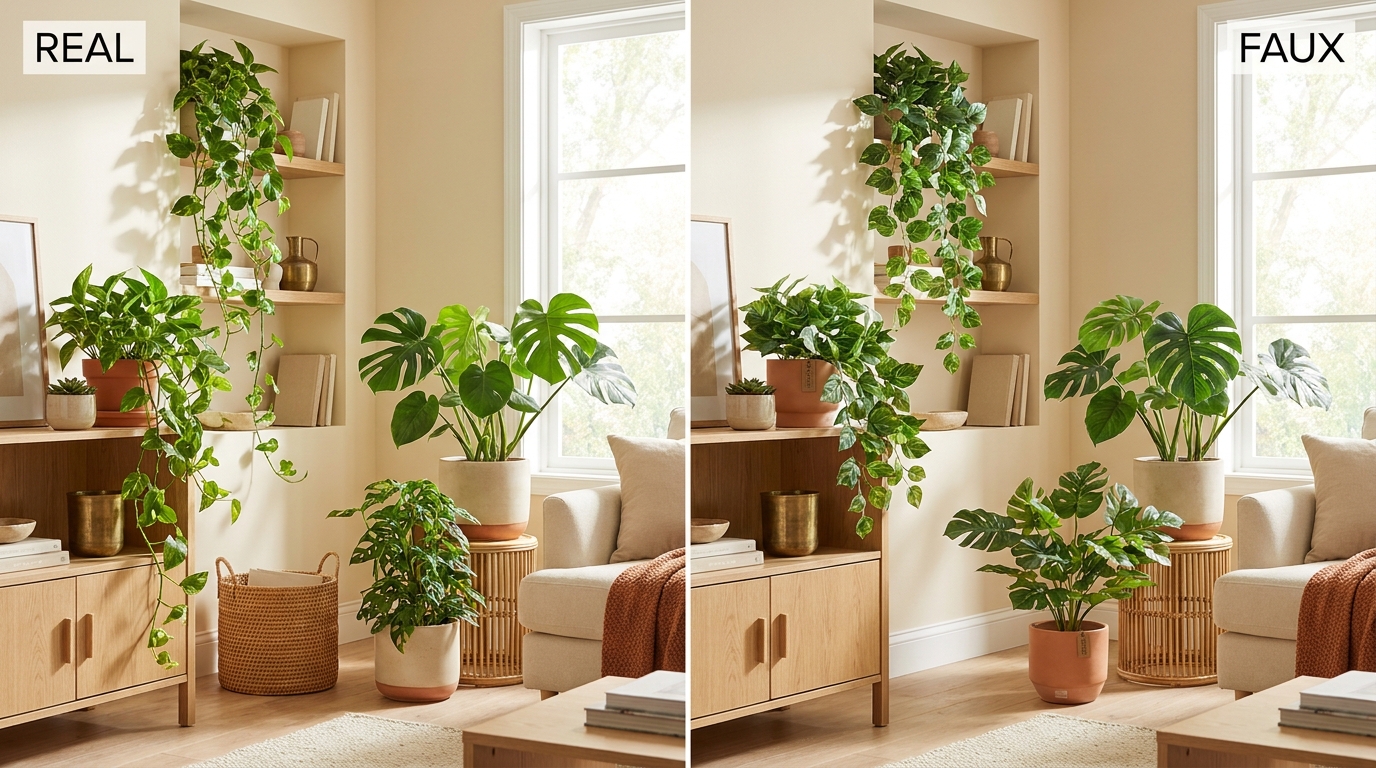
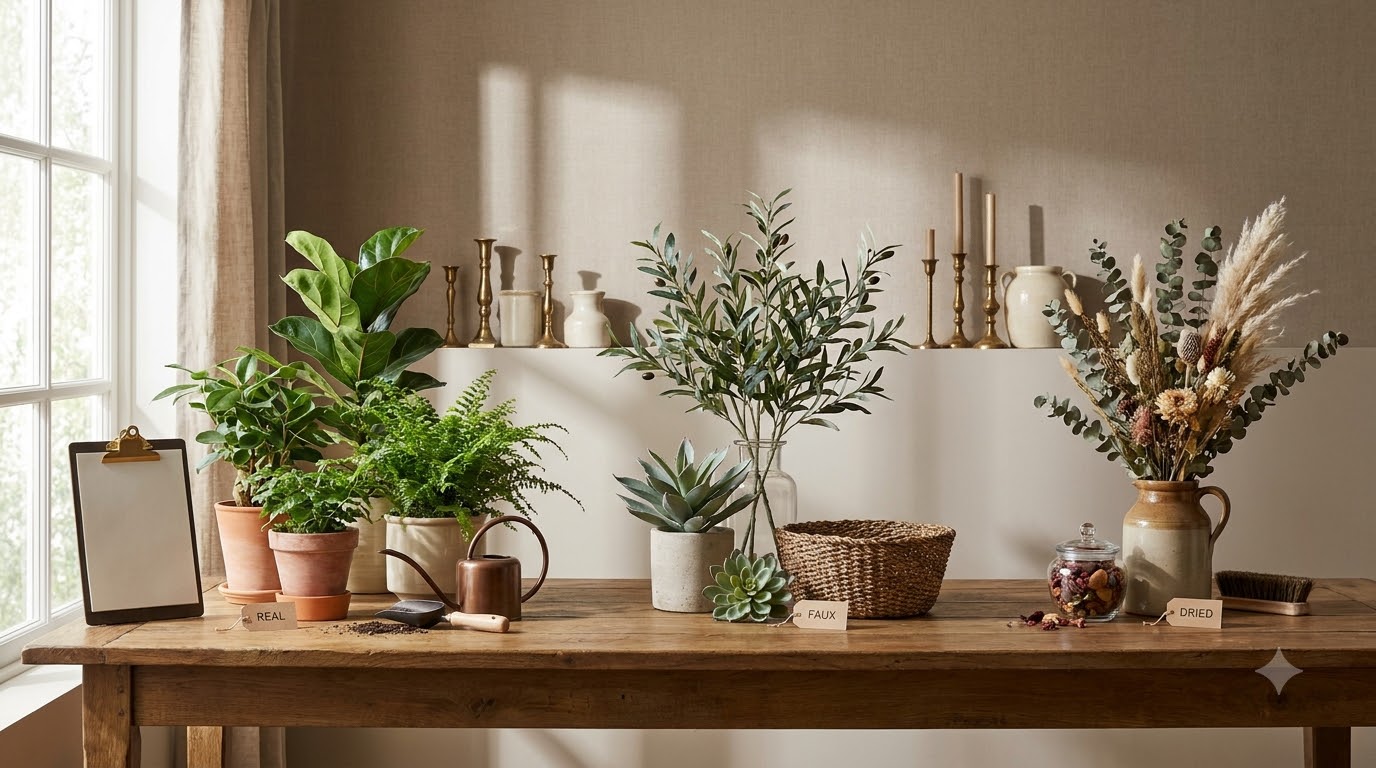
Here’s the take most plant articles won’t give you: all three options are valid, and the right answer depends on your room, your schedule, and your aesthetic goals, not on which one sounds more virtuous.
Real plant enthusiasts will tell you nothing replaces living greenery. Faux plant defenders will point out that a $5 plastic monstrosity from a dollar store isn’t the category they’re defending. Dried botanical fans will remind you that pampas grass on a shelf costs nothing and lasts three years. They’re all partially right.
The National Gardening Association reports that US households spent $23.4 billion on houseplants and gardening in 2024, a 47% increase over 2019 spending figures, while the faux plant market reached $2.7 billion globally and dried floral demand spiked 38% in two years (National Gardening Association, 2025; Grand View Research Artificial Plants Market, 2025). All three markets are growing at the same time, which means the answer isn’t “pick one.” It’s “know which one fits where.”
This comparison breaks down cost, maintenance, longevity, aesthetic flexibility, and best room use for all three. No winner declared at the top. The room decides.
Key Takeaways
- All three options have legitimate uses. The right choice depends on the room’s light, your schedule, and the aesthetic you’re building.
- Real plants outperform on mood, air quality, and authenticity but demand consistent light and care.
- Quality faux plants (above $40) are visually indistinguishable from real ones in most photos and low-light settings.
- Dried botanicals last 2-4 years with zero care, cost the least over time, and suit 2026’s warm, textured aesthetics.
- The US houseplant market hit $23.4 billion in 2024, while the global faux plant market reached $2.7 billion (National Gardening Association, 2025; Grand View Research, 2025).
Real Plants: Pros, Cons, and Where They Shine
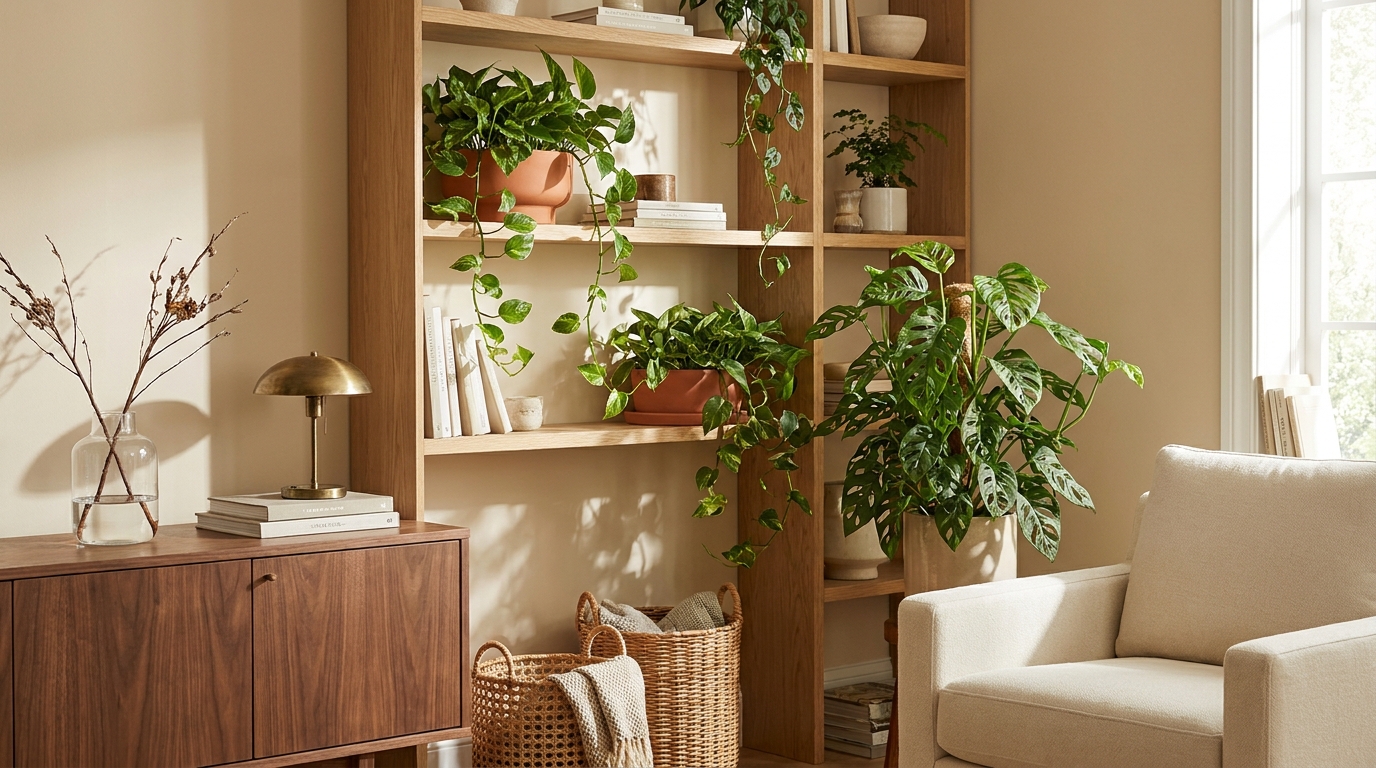
Real plants have one capability the other two categories simply don’t: they’re alive. Research published in the Journal of Physiological Anthropology found that interaction with indoor plants reduces both systolic blood pressure and psychological stress, with effects measurable in office and residential settings (Journal of Physiological Anthropology, 2015). Beyond the science, a living plant moves, grows, and changes with the seasons.
From a pure decor standpoint, real plants deliver texture, dimension, and organic shape that photograph differently every week. A monstera unfurling a new leaf changes the room. A trailing pothos growing two feet longer over three months becomes a new design element you didn’t plan for. No faux or dried version does that.
In our experience styling rooms with all three categories side by side, real plants hold a visual quality that’s hard to name but immediately obvious in person. The slight movement from air currents, the way leaves catch and filter light, the variance in leaf color, all of it reads as “alive” in a way that faux replicates in photos but loses in person. Real plants have presence that the other two don’t.
What are the real benefits of living plants for home decor?
Real plants provide genuine air quality improvements, though the effect is more modest than the famous NASA clean air study suggested at scale. A Harvard Health review noted that plants do filter certain volatile organic compounds (VOCs), with species like spider plants, peace lilies, and snake plants among the most effective, though a room would need multiple plants to make a measurable air quality difference (Harvard Health Publishing, 2024).
The mood benefit is more consistently documented. Multiple studies show that having plants in a room increases a person’s rated sense of calm, comfort, and connection to space. Interior designers track this subjectively too: rooms with real plants consistently photograph as “warmer” and “more lived-in” in reader surveys across shelter publications.
What are the real drawbacks of living plants?
Maintenance is the honest answer. The Sill’s care data shows roughly 50% of houseplants purchased die within the first year, mostly from light mismatch, overwatering, and neglect during travel (The Sill Plant Care Resource, 2025). A real plant requires you to be present, attentive, and consistent. That is not a small ask for busy households, renters who travel frequently, or dark apartments with limited windows.
Cost over time adds up in ways people underestimate. A $20 plant that dies and gets replaced three times costs $60. Add in pots, soil, and occasional fertilizer, and a single plant corner can run $150 to $200 per year in replacement costs if your care situation isn’t right.
Best rooms for real plants
Real plants perform best where they can receive correct light and be checked on regularly. The living room is the obvious anchor point, specifically near east or west-facing windows. The kitchen window ledge suits herbs and small succulents. Home offices and bedrooms with adequate indirect light benefit from the mood and air quality effects. Any room you spend significant time in justifies the care investment.
Skip real plants in rooms you rarely enter, rooms with no natural light, or any space where watering consistency is genuinely difficult to maintain.
Citation Capsule: Research from the Journal of Physiological Anthropology found that interacting with indoor plants measurably reduces systolic blood pressure and psychological stress in residential settings, suggesting that real plants deliver a mood benefit that no faux or dried alternative replicates (Journal of Physiological Anthropology, 2015).
Faux Plants: Pros, Cons, and When They’re the Right Call
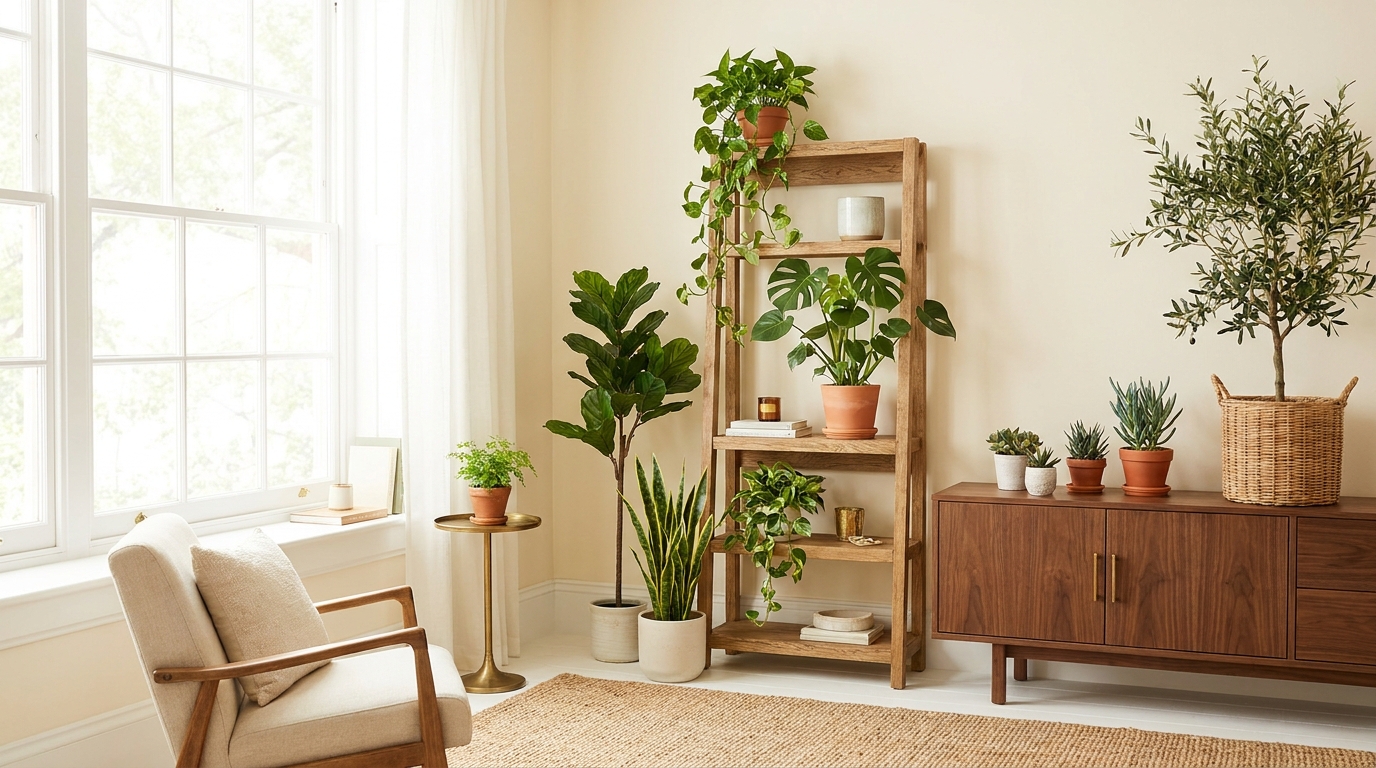
IMAGE: Dried botanicals home decor styling 2026

Quality faux plants have changed significantly in the past five years. The global artificial plants market grew from $1.9 billion in 2021 to $2.7 billion in 2024, driven largely by demand for premium, photorealistic pieces that hold up under close inspection (Grand View Research Artificial Plants Market, 2025). The $5 plastic fern from the dollar store and the $85 silk monstera from Afloral are not the same product category, and they shouldn’t be evaluated as one.
The honest case for faux: if a room has zero natural light, no amount of real plant love will keep a plant alive there. Faux solves that completely. A bathroom with one frosted window, a shelf above a staircase that no light reaches, a hallway with no windows, these are faux plant territory.
Why quality faux plants are no longer “cheating”
The visual gap between real and quality faux has narrowed enough that the distinction stops mattering in most design contexts. IKEA’s FEJKA faux plant line, Afloral’s silk botanicals, and Amazon’s high-rated premium faux options all photograph credibly alongside real plants. The differentiator is price: quality faux starts at $35-$45 for a small piece and runs $80-$150 for larger statement plants.
The “cheating” framing around faux plants is a relatively recent and largely online attitude. Professional interior stylists have used faux plants on shoots and in model homes for decades precisely because they’re controllable: same shape, same color, same position, every time. The real-plant zealotry mostly comes from social media culture, not from interior design practice. In rooms that don’t support real plants, quality faux is the correct professional choice.
Best quality faux plant sources
IKEA FEJKA line, $8-$20. IKEA’s faux range is the best value in the category. The monstera, succulent, and eucalyptus options look credible at normal viewing distance and photograph well. Best for: bookshelves, small table styling, bathroom counters.
Afloral, $35-$120. The premium option for realistic silk stems, branches, and larger pieces. Their eucalyptus branches and dried-look botanicals are used widely by event stylists and interior decorators. Best for: vases, tall floor arrangements, entryway styling.
Amazon premium faux, $25-$85. Highly variable quality, so check the reviews and photos carefully. RIHE, Nearly Natural, and Mkono consistently rate well. Best for: medium-sized plants in pots, trailing vine pieces, and bathroom styling.
Target threshold line, $15-$45. Reliable mid-range option. Their cement-pot faux succulent arrangements and small trailing vines work well on office desks, bathroom counters, and kitchen shelves.
Where faux plants work best
Faux excels in low-light or no-light spots where real plants can’t survive. Bathrooms with frosted windows or no windows are the clearest use case. High shelves above the 6-foot line where watering would require a ladder make strong faux candidates. Entryways and hallways without natural light, dining table centerpieces where watering would disrupt styling, any surface where consistent placement matters more than organic variation.
Faux also works in rental spaces where frequent moving makes real plant logistics difficult. A high-quality faux monstera survives a move in a box and looks the same on the other side.
Citation Capsule: The global artificial plants market grew 42% between 2021 and 2024, reaching $2.7 billion, driven largely by demand for premium photorealistic pieces, suggesting a broad shift toward quality faux as a legitimate interior design tool rather than a decorating shortcut (Grand View Research Artificial Plants Market, 2025).
Dried Botanicals: Pros, Cons, and the 2026 Aesthetic
Dried botanicals have moved from craft supply filler to a central element of 2026’s dominant interior aesthetics. Pinterest’s 2025 trend report noted a 52% increase in saves for “dried floral decor” and “dried pampas grass home” searches year over year, with dried botanicals appearing prominently in cottagecore, warm minimalist, Japandi, and boho-adjacent rooms (Pinterest Predicts, 2025). This isn’t a trend that snuck up. It’s been building since 2020 and shows no sign of declining.
The core appeal is honest: dried botanicals require zero care, cost less than real or quality faux per year, and deliver a warmth and texture that neither of the other categories quite matches. A bunch of pampas grass, bunny tail grass, or eucalyptus stems in a tall vase costs $15 to $35 and lasts two to four years.
The rise of dried pampas, bunny tail, and eucalyptus
Pampas grass became the most widely recognized dried botanical in home decor around 2020, appearing in boho living rooms, farmhouse entryways, and minimalist apartments simultaneously. Bunny tail grass (Lagurus ovatus) followed as the smaller, more delicate complement. Dried eucalyptus moved from shower bundles to shelf and vase styling. Dried cotton stems, lunaria (honesty plant seed pods), and thistle round out the current palette.
What these all share: they read as natural without requiring maintenance, they suit warm and neutral color palettes that dominate in 2026, and their texture photographs exceptionally well. For a room that needs organic warmth without the care commitment of real plants, dried botanicals often land more consistently than either alternative.
Honest drawbacks of dried botanicals
They’re fragile. Dried botanicals shed, especially pampas grass, which can leave fluffy fibers across a floor or shelf. They fade over time, and the fade is visible after 18 to 24 months in bright light settings. Direct sunlight accelerates color loss significantly. They also collect dust and aren’t washable, so placement in low-traffic, low-wind spots helps longevity.
The aesthetic range is narrower than real or faux. Dried botanicals suit warm, natural, and textured room palettes. They don’t work in modern-minimalist rooms with cool palettes and clean lines. A sleek white-and-chrome bathroom doesn’t benefit from pampas grass. A warm oak and linen living room absolutely does.
Best rooms for dried botanicals
Dried botanicals perform best as vase styling in living rooms and entryways, shelf accents in bedrooms and home offices, and wall-mounted arrangements in dining rooms. They’re particularly effective in rooms that already use natural materials (rattan, jute, terracotta, linen) because dried botanicals extend that material story rather than contrasting with it.
best low-maintenance indoor plants
Citation Capsule: Pinterest’s 2025 trend report showed a 52% year-over-year increase in saves for dried floral decor and dried pampas home searches, with dried botanicals appearing as a dominant design element across cottagecore, warm minimalist, Japandi, and boho-adjacent interior aesthetics (Pinterest Predicts, 2025).
Side-by-Side Comparison Table
Here’s where the three categories land across the variables that actually matter for home decor decisions.
| Factor | Real Plants | Faux Plants | Dried Botanicals |
|---|---|---|---|
| Upfront cost | $10-$80 per plant | $8-$150 per plant | $8-$45 per arrangement |
| Annual cost | $20-$80 (replacements, soil, pots) | $0 (one-time) | $15-$35 (refresh every 2-3 years) |
| Maintenance | Weekly watering, monthly care | Zero | Zero |
| Longevity | Indefinite if cared for | 3-7 years | 2-4 years |
| Light required | Low to bright (species-dependent) | None | None |
| Aesthetic range | All styles | All styles | Warm, natural, boho, cottagecore |
| Air quality | Modest improvement | None | None |
| Mood effect | Documented stress reduction | Minimal | Minimal |
| Best for | Rooms you use daily with correct light | Dark or high-shelf spots | Vases, shelves, wall arrangements |
| Travel-friendly | No | Yes | Yes |
| Rental-friendly | Medium | Yes | Yes |
How to Mix All Three Like a Designer
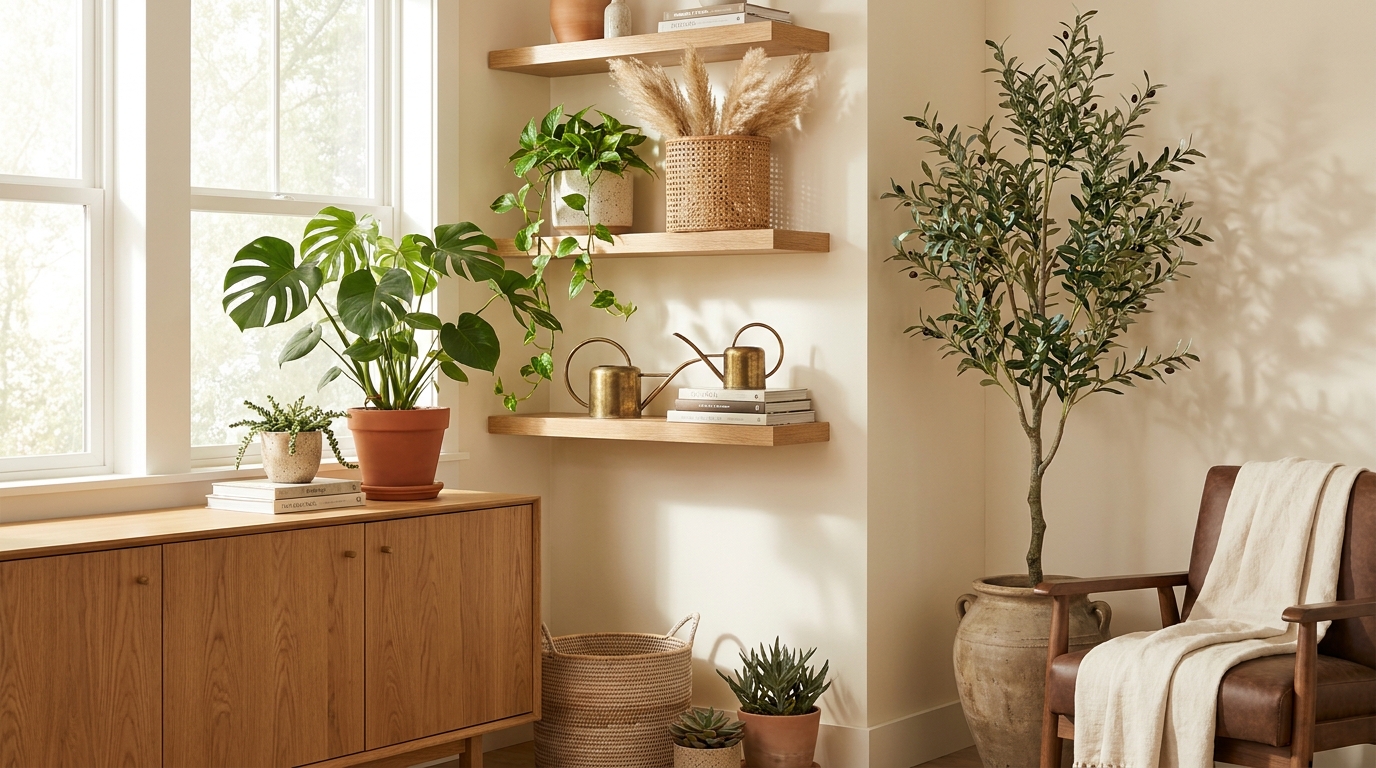
Professional interior stylists rarely use just one category. A well-styled plant corner typically combines all three, each playing a distinct role. The mix produces more visual interest than any single category achieves alone, and it’s more practical too: real plants in the spots that get light, faux in the spots that don’t, dried botanicals as textural punctuation.
The framework is simple: anchor with real, fill with faux, and accent with dried.
The anchor-fill-accent framework for mixing all three
Real plant as anchor. The largest, most prominent plant in the grouping should be real if your light allows it. A floor-standing monstera near a window, a rubber plant in a corner that gets east light, or a small cluster of three pothos on a shelf all create the living focal point that anchors the group. People sense that the real plant is alive, and that quality reads outward to everything nearby.
Faux plant as fill. Use faux to populate spots that would otherwise look bare but don’t receive enough light for real plants. A credible faux trailing vine on a high shelf above the real plants extends the green layer upward without requiring a ladder and a watering can every week. A faux olive tree in a corner that gets no direct light provides mass and vertical fill that real plants can’t sustain there.
Dried botanicals as accent. A tall vase of dried pampas grass or bunny tail stems alongside the plant grouping adds texture contrast. Dried botanicals read differently from real and faux: their muted, warm tones and feathery texture break up the green in a way that adds warmth to the whole composition. A small bunch of dried eucalyptus on a shelf between pots creates a styling moment that neither green category delivers on its own.
We’ve found that rooms using all three categories consistently look more intentional than rooms using only real plants, even when the real plant rooms are otherwise well-styled. The mix signals visual literacy: you’re using each category for a reason, not defaulting to one option across the board. That intentionality is what separates a “plant person’s apartment” from a well-styled room that happens to include plants.
What to avoid when mixing categories
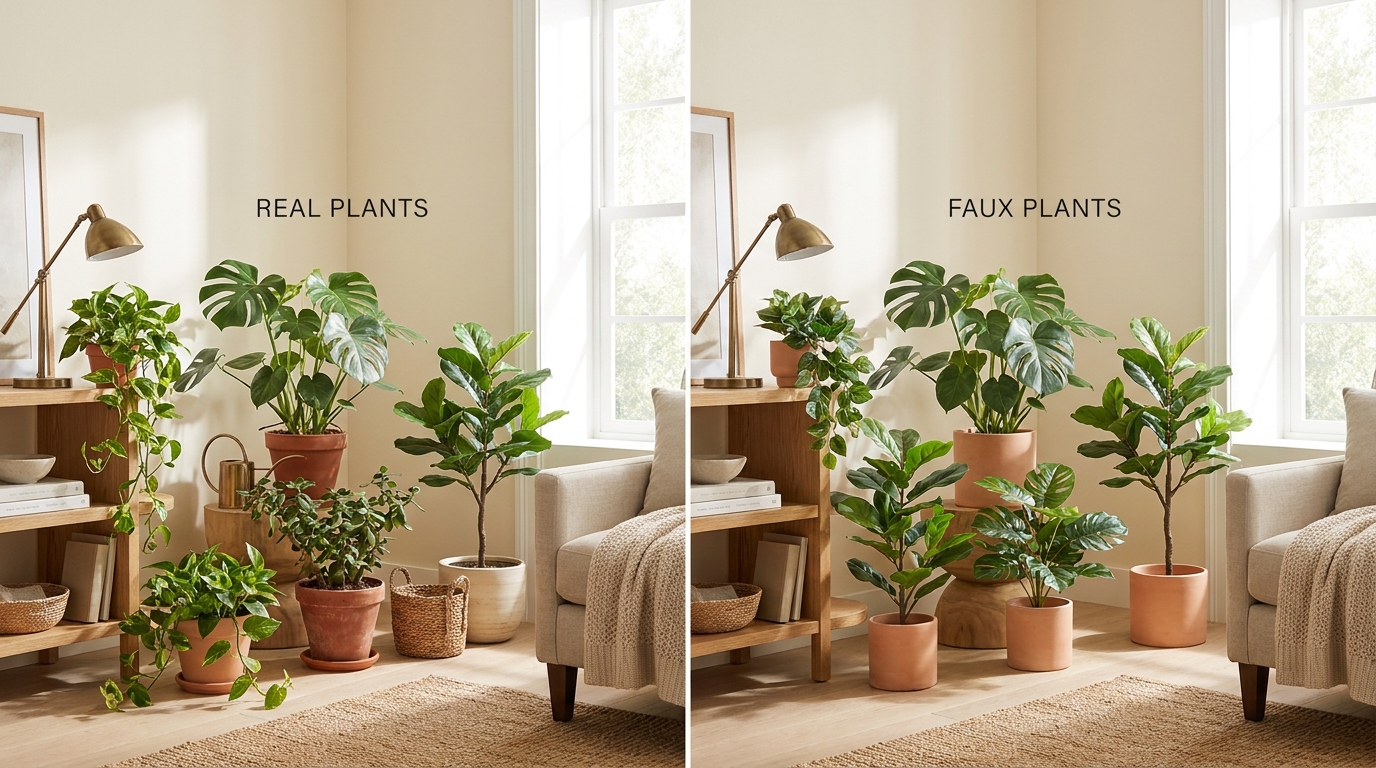
Don’t let faux and real plants sit directly next to each other at the same height and scale. The contrast is often visible up close and the faux plant loses. Keep faux at heights where detailed inspection is less likely, or use it for plant types (trailing vines, small succulents) where the quality gap is smallest. Dried botanicals should be used as textural accents, not as replacements for green volume. A room full of dried botanicals reads beige and flat. They work as punctuation, not as the full paragraph.
The Verdict: Which to Choose by Room
There’s no single right answer across all rooms, but specific conditions in each room point clearly toward one category.
Living room
Real plants win in living rooms with adequate light. This is the room where the mood and presence benefits of real plants pay off most. If your living room gets east or west light, a floor-standing real plant (monstera, rubber plant, bird of paradise) should anchor the space. Supplement with faux on high shelves or in corners beyond the light zone. Add dried botanicals in a vase on the coffee table or console for textural layering.
If your living room gets minimal light, a large premium faux plant plus dried botanicals in a vase delivers a credible result without the plant death cycle.
Bedroom
The bedroom is where the mix pays off most clearly. Real plants provide the documented mood and stress-reduction benefits that matter most in sleeping spaces. A pothos, snake plant, or peace lily near the window handles the green layer. Dried botanicals on the nightstand or floating shelf add warmth without any maintenance. Faux fills gaps on high shelves or in dark corners.
Bathroom
Bathrooms with windows can support real plants: pothos, spider plants, and peace lilies handle the humidity and lower light well. Bathrooms without windows, or with frosted windows that provide minimal light, are faux territory. A high-quality faux pothos in a hanging planter works better than a slowly-dying real plant. Skip dried botanicals in high-humidity bathrooms: they absorb moisture and break down faster.
Kitchen
The kitchen window ledge is real plant territory. Herbs (basil, rosemary, thyme, mint) serve a dual purpose: visual and functional. Small succulents on a sunny counter work well. Away from the window, a small faux plant on a floating shelf or in a corner keeps the green layer without risk. Dried botanicals suit kitchen shelving as styling accents, especially in farmhouse or warm minimalist kitchens.
Entryway
Entryways rarely have the right light or the right humidity for real plants to thrive. Faux and dried botanicals both perform well here. A tall faux olive tree or ficus in a basket planter creates the welcoming green moment most entryways benefit from. A floor vase with dried pampas grass stems or tall dried branches delivers a sculptural statement. If the entryway has a window or gets reasonable indirect light, a real snake plant or ZZ plant is the strongest choice for both durability and visual impact.
Citation Capsule: The Sill’s care data shows roughly 60% of indoor plant deaths trace to light mismatch, not watering errors, which directly supports using faux or dried botanicals in rooms where light conditions won’t support real plants, rather than replacing failing real plants with more failing real plants (The Sill Plant Care Resource, 2025).
Frequently Asked Questions
Are faux plants worth buying for home decor?
Quality faux plants are worth buying in specific conditions: rooms with no natural light, high shelves that are hard to water, frequent travelers, or renters who move often. Low-quality faux plants are not worth buying in any condition. The visual difference between a $9 plastic plant and a $45 silk one is significant. For rooms with decent light, real plants deliver more visual and mood value per dollar over time.
How long do dried botanicals last in home decor?
Most dried botanicals last two to four years before fading becomes noticeable. Pampas grass holds up well for two to three years if kept away from direct sunlight and handled carefully. Dried eucalyptus retains its structure for two to three years but loses fragrance within months. Dried cotton stems and lunaria last the longest, often four years or more. Direct sunlight shortens all these timelines significantly.
Can real plants actually improve air quality?
Real plants do filter certain VOCs from indoor air, but the effect is modest at typical home plant densities. The famous NASA clean air study was conducted in sealed lab conditions with plant density far higher than a normal room. A Harvard Health review notes that you would need dozens of plants per room to achieve measurable air quality improvement (Harvard Health Publishing, 2024). The mood and stress reduction benefits are more consistently documented at normal household plant densities.
Which plants work best in low-light rooms?
Snake plants, ZZ plants, pothos, and peace lilies are the four most reliable real plants for low-light rooms. If light is truly minimal (no windows, interior hallway), even these will decline over time, and quality faux plants are the practical solution. The key indicator: if your low-light room is dark enough that you need artificial light to read comfortably, it’s too dark for any real plant to thrive long-term.
Is it okay to mix real and faux plants in the same room?
Yes, and professional stylists do it routinely. The rule is to keep real and faux plants from sitting directly side by side at the same height and scale, where the comparison is obvious. Use real plants in the visible, well-lit focal points and faux plants in the supplementary spots. Mixing the two at different heights and plant types, with dried botanicals adding a third texture layer, typically produces a more visually interesting room than any single category achieves alone.
Conclusion
The real vs faux vs dried debate doesn’t have a universal winner, and any article claiming otherwise is selling something.
Real plants deliver mood benefits, living texture, and organic authenticity that the other two categories genuinely can’t replicate. They’re worth the effort in rooms where light and care conditions support them. Quality faux plants solve real design problems in dark rooms, on high shelves, and in frequently-moved households. Pretending they don’t work is ignoring a legitimate tool. Dried botanicals offer a warmth, texture, and low-maintenance longevity that suit 2026’s dominant aesthetics better than either of the other two categories in certain applications.
The practical answer for most homes: use real plants where light allows and care is sustainable, use quality faux where it doesn’t, and use dried botanicals as textural accents throughout. Mix all three intentionally. That combination delivers the most visually complete result at the lowest ongoing cost.
For room-by-room light mapping and placement guidance, start with the indoor plants placement guide. For a curated list of real plants that survive most home conditions, see best low-maintenance indoor plants.
indoor plants home decor pillar