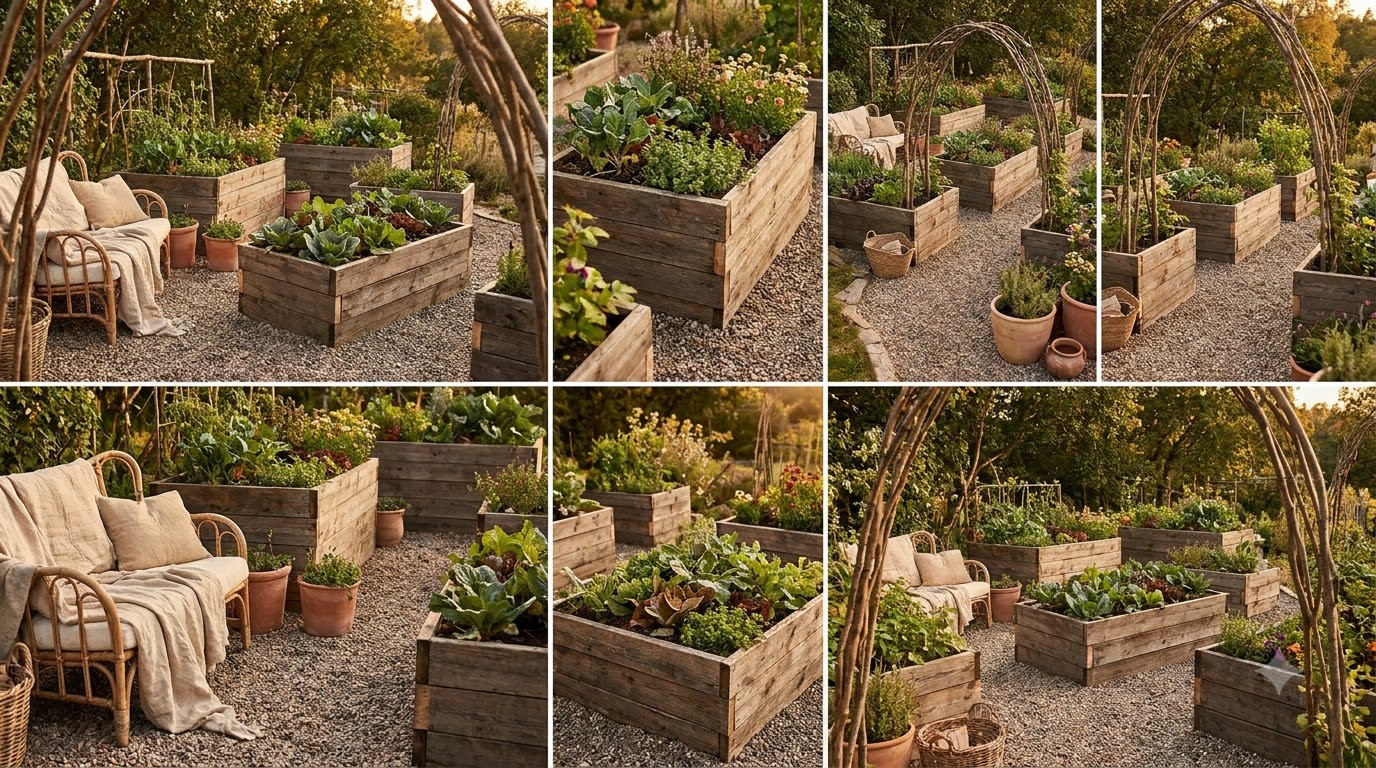
To plan a raised garden bed, start with size and reach: keep the bed no wider than 4 feet so you can tend the center from either side, and use a 4×8 ft footprint as your standard first build. Choose 10-12 inches of depth for most crops (18 inches for carrots and other root vegetables), pick a durable material like untreated cedar, galvanized steel, or concrete block, then arrange the layout around a walkable path. These raised garden bed ideas walk through layouts, materials, and dimensions we have tested in our own backyard so you can build one that fits your space and budget.
Key Takeaways
- Keep beds a maximum of 4 ft wide so you can reach the middle without stepping on the soil.
- A 4×8 ft bed is the standard starter size; 4×4 ft suits small patios and first-time gardeners.
- Use 10-12 in of depth for most vegetables and flowers, and 18 in for carrots, parsnips, and other roots.
- Cedar, galvanized steel, and concrete block are the three most reliable, rot-resistant materials.
- Leave 18-24 in wide paths between beds so a wheelbarrow and your knees both fit.
What Size Should a Raised Garden Bed Be?
Width is the number that matters most. In our own garden we started with a 5 ft wide bed and regretted it within a month, because reaching the center meant leaning hard or stepping onto the soil and compacting it. We rebuilt at 4 ft wide, and the difference was immediate: every plant sits within an arm’s reach from a path. If a bed touches a wall or fence on one side, drop it to 30 in wide, since you can only reach it from the front.
Length is flexible and mostly limited by lumber. An 8 ft board is the most economical cut, which is why the 4×8 ft bed is the classic default. Here are the sizes we recommend depending on your space:
- 4×4 ft: Best for balconies, small patios, and beginners. Easy to fill and manage in a single afternoon.
- 4×8 ft: The standard all-purpose bed. Enough room for a mixed vegetable and herb layout.
- 3×6 ft: A narrower footprint for tight side yards where a wheelbarrow needs to pass.
- 2×8 ft: A long, slim bed that hugs a fence line or runs along a walkway.
- 4×12 ft: A large bed for serious harvests, best split into planting zones so you never over-reach.
Depth follows what you plant. Ten to twelve inches covers lettuce, tomatoes, peppers, herbs, and most flowers. Go to 18 in when you want long root crops like carrots and parsnips to grow straight. If your bed sits on a hard patio or concrete, add a couple of extra inches because roots cannot travel down into native soil below.
Which Raised Garden Bed Ideas Work Best for Small Yards?
Small spaces reward vertical thinking and tidy layouts. When we downsized to a townhouse, we swapped one big bed for three narrow ones and gained more usable planting edge than before. The trick is to combine a raised footprint with height, trellises, and containers so every cubic foot earns its keep. If you are working with a patio or a rental, our guide to balcony garden ideas for renters pairs well with a compact raised bed.
- L-shaped bed: Wraps a patio corner and defines an outdoor room without blocking the view.
- Tiered or stepped bed: Two or three stacked levels add growing area and drainage on a slope.
- Keyhole bed: A notch cut into one side lets you reach the center of a wider circular bed.
- Bed-plus-trellis: A 4×4 ft bed with a rear arch grows cucumbers and beans upward, not outward.
- Rolling planter bed: A waist-high bed on locking casters moves with the sun on a deck.
For layered planting in a footprint smaller than a doormat, combine a raised bed with wall-mounted pockets and a trellis. Our notes on vertical garden ideas for small spaces show how to stack greenery so a 4×4 ft bed produces like a bed twice its size. If containers are more your speed, the container garden ideas for beginners guide covers pot sizing that plays nicely alongside a raised bed.
What Materials Should You Use to Build a Raised Bed?
Material sets the look, the lifespan, and the cost. We have built beds from three of these over the years, and each has a clear best use. Avoid old pressure-treated lumber and railroad ties for anything you plan to eat from. Here is how the common options compare:
- Cedar or redwood: Naturally rot-resistant, warm-looking, and easy to cut. A cedar 4×8 ft bed typically runs $120-$250 in lumber.
- Galvanized steel: Modern stock-tank or panel beds last for decades and heat the soil early in spring. Kits often fall in the $90-$300 range.
- Concrete block or brick: Permanent, heavy, and great for a formal look. Budget for the blocks plus a level base.
- Untreated pine or fir: The cheapest wood at roughly $40-$90 per bed, but expect to rebuild in 3-5 years.
- Composite boards: Low-maintenance and splinter-free, at a higher upfront price than pine.
Whatever you choose, line the inside walls of wood beds with landscape fabric to slow moisture rot, and skip a solid bottom so worms and drainage can do their work. The material also drives the style of the whole yard. If you are still deciding on an overall look, our comparison of cottage vs modern garden styles helps match cedar’s softness or steel’s clean lines to the rest of your space.
How Do You Lay Out Beds and Paths?
Layout is where a collection of beds becomes a garden. We learned to sketch the paths first and the beds second, because a comfortable path is what makes daily watering and harvesting pleasant instead of a chore. Aim for a main path wide enough for a wheelbarrow and narrower service paths between beds.
- Main path: 30-36 in wide so a wheelbarrow, a kneeling pad, and your feet all fit.
- Secondary paths: 18-24 in wide between parallel beds for walking and weeding.
- Bed spacing from walls: Leave at least 18 in from a fence so you can reach the back.
- Grid layout: Two or three 4×8 ft beds in a row create a classic kitchen-garden potager.
- U-shape layout: Three beds around a central path give you a sheltered, productive work zone.
Orient beds so their long side runs roughly north to south, which spreads sunlight evenly and keeps tall plants from shading short ones. Put a trellis or your tallest crops on the north end. If your beds anchor an entertaining area, coordinate them with your seating; our outdoor patio dining area ideas show how a bed can double as a green screen beside a dining table.
How Much Soil and What Will It Cost?
Soil volume is simple math: length times width times depth. A 4×8 ft bed filled 12 in deep needs about 32 cubic feet, or just over 1 cubic yard, of soil. Buying by the bag gets expensive fast, so for anything larger than a single small bed we order bulk soil by the cubic yard and split it between beds. The table below shows our go-to sizes with their soil needs.
| Bed size (depth) | Best for | Approx. soil volume |
|---|---|---|
| 4×4 ft (12 in) | Beginners, patios, herbs | ~16 cu ft (0.6 cu yd) |
| 4×8 ft (12 in) | All-purpose vegetables | ~32 cu ft (1.2 cu yd) |
| 4×8 ft (18 in) | Carrots and root crops | ~48 cu ft (1.8 cu yd) |
| 2×8 ft (12 in) | Fence lines, walkways | ~16 cu ft (0.6 cu yd) |
| 4×12 ft (12 in) | Large harvests | ~48 cu ft (1.8 cu yd) |
To stretch the budget, fill the bottom third of a deep bed with chunky organic matter like small logs, branches, and leaves, then top with a blend of topsoil, compost, and aeration. A balanced fill is roughly 60 percent topsoil, 30 percent compost, and 10 percent aeration such as coarse perlite or pine bark. For a whole-yard budget approach beyond the beds themselves, our small backyard ideas on a budget guide covers paths, edging, and seating that stretch every dollar.
What Should You Plant in Each Bed?
Spacing decides your yield more than bed size does. In our own garden the year we crowded tomatoes 8 in apart, we got tall, leggy plants and very little fruit; at proper spacing the next season the same bed produced twice as much. Use these plant spacings as a starting grid:
- Lettuce and leafy greens: 6-8 in apart; a 4×4 ft bed holds a generous salad supply.
- Bush beans and beets: 4-6 in apart in rows about 12 in apart.
- Tomatoes and peppers: 18-24 in apart with a cage or stake at planting time.
- Carrots and radishes: 2-3 in apart in an 18 in deep bed for straight roots.
- Herbs like basil and parsley: 8-12 in apart, tucked along the bed edges for easy picking.
Group plants by height and water needs so tall, thirsty crops do not overshadow small, drought-tolerant ones. A single 4×8 ft bed comfortably mixes one climbing crop on a rear trellis, a row of tomatoes, and an edge of herbs and greens. Rotate what grows where each year to keep the soil healthy and pests guessing.
Frequently Asked Questions
How deep should a raised garden bed be?
Most vegetables, herbs, and flowers thrive in 10-12 inches of soil, which gives roots plenty of room while keeping fill costs reasonable. Step up to 18 inches when you want to grow carrots, parsnips, or other long root crops that need to travel straight down. On a hard patio, add a couple of extra inches since roots cannot reach native ground.
How wide should a raised bed be?
Keep beds no wider than 4 feet so you can reach the center from either side without stepping on and compacting the soil. If a bed sits against a wall or fence and you can only access it from one side, drop the width to about 30 inches. This single rule prevents more layout regret than any other decision we have made.
What is the best material for a raised garden bed?
Cedar, galvanized steel, and concrete block are the three most reliable choices. Cedar looks warm and resists rot naturally, steel lasts for decades and warms the soil early, and concrete gives a permanent, formal edge. Avoid old pressure-treated lumber or railroad ties for edible gardens, and line wood beds with fabric to slow moisture damage over time.
How much soil do I need for a 4×8 raised bed?
A 4×8 ft bed filled 12 inches deep needs about 32 cubic feet of soil, which is just over 1 cubic yard. At 18 inches deep for root crops, that rises to roughly 48 cubic feet. For anything larger than one small bed, ordering bulk soil by the cubic yard costs far less than buying individual bags.
How far apart should raised beds be spaced?
Leave a main path of 30-36 inches so a wheelbarrow, a kneeling pad, and your feet all fit comfortably, and 18-24 inches between parallel beds for walking and weeding. Keep beds at least 18 inches from a fence so you can reach the back. Comfortable paths are what turn daily watering into a pleasure rather than a chore.
Whether you build one 4×4 ft starter or a full grid of cedar beds, the fundamentals stay the same: stay within arm’s reach, match depth to your crops, and lay out generous paths. For a compact patio version, revisit our patio decor ideas for small spaces and pair a single raised bed with the seating and greenery that make an outdoor room feel finished.