
The biggest small apartment decorating mistakes are surprisingly consistent: buying a rug that is too small, pushing every piece of furniture flat against the walls, relying on a single overhead light, and choosing oversized furniture that swallows the floor. Fix those four and a cramped rental instantly feels calmer, larger, and more intentional. We have decorated a string of tiny apartments over the years, and nearly every “my place feels claustrophobic” problem traces back to one of these habits. The good news for renters and budget decorators: none of the fixes require permission from a landlord or a big spend.
Related: for the full playbook, start with our small apartment decorating ideas.
Key Takeaways
- Size the rug up. In a living room, front furniture legs should sit on the rug; a 5×8 ft rug is the realistic minimum, and 8×10 ft is better.
- Pull furniture off the walls. Even 3 to 6 inches of breathing room makes a room read larger, not smaller.
- Use three light sources. Ceiling, mid-height, and table or floor lamps replace flat, shadowy overhead lighting.
- Scale furniture to the room. Keep sofas under 72 inches and choose pieces with visible legs and slim arms.
- Keep 30-inch walkways. Clear paths through a space signal openness far more than empty wall area does.
What are common small apartment mistakes?
Most small-space struggles are not about square footage at all. They are about a handful of repeatable decorating decisions that quietly shrink a room. When we walk into a friend’s cramped studio, we can usually name the culprit within a minute, and it is almost always on this list.

- The too-small rug. A 3×5 ft rug floating in the middle of a seating area makes furniture look like it is drifting apart. It fragments the floor into small zones and draws the eye to how little space there is.
- Everything shoved against the walls. Renters assume hugging the perimeter opens up the center. It usually creates a dead, echoey hole in the middle and a ring of furniture with no relationship to each other.
- One sad ceiling light. A single flush-mount fixture casts flat, top-down light that flattens the room and creates harsh shadows in the corners.
- Oversized furniture. An 88-inch sectional in a 12×12 ft living room leaves no room to walk, no room for a side table, and no visual breathing space.
- Too many tiny things. A scatter of small frames, trinkets, and accent pieces creates visual noise that makes a compact room feel busy and cluttered.
- Ignoring vertical space. Stopping shelves and art at eye level wastes the tallest, cheapest real estate in any rental: the wall above 60 inches.
If you want a broader starting point before diving into fixes, our roundup of small apartment decor ideas pairs well with everything below.
How do you make a small space look bigger?
Making a small space look bigger is mostly about editing and proportion, not buying more. The trick is to give the eye long, uninterrupted lines to travel across, keep the floor as visible as possible, and layer light so no corner falls into shadow. Here is the exact playbook we use every time we move into a new rental.

- Choose leggy furniture. Sofas, chairs, and consoles raised on visible legs let you see the floor underneath, which tricks the eye into reading more open space.
- Hang curtains high and wide. Mount the rod 4 to 6 inches above the window frame and extend it 8 to 12 inches past each side to make windows and ceilings feel taller.
- Add one large mirror. A 24×36 inch or larger mirror opposite a window bounces daylight and visually doubles the space; expect to spend $40 to $120.
- Stick to a tight color story. Keeping walls, large furniture, and rugs within two or three related tones removes visual borders that chop a room into pieces.
- Clear the floor. Fewer objects touching the ground equals more visible floor, and visible floor always reads as bigger.
When we moved into a 480-square-foot one-bedroom, we swapped a bulky armchair for a slim accent chair on tapered legs and hung a single 30×40 inch mirror across from the window. Nothing about the footprint changed, but every guest since has asked if we knocked down a wall. That is the whole game: proportion and light over quantity.
The rug mistake: why size matters most
If we could fix only one thing in a small apartment, it would be the rug. An undersized rug is the single most common error we see, and it is the one that most reliably makes a room feel small and unfinished. The rule is simple: the rug should anchor the furniture, not sit apart from it like a bath mat.
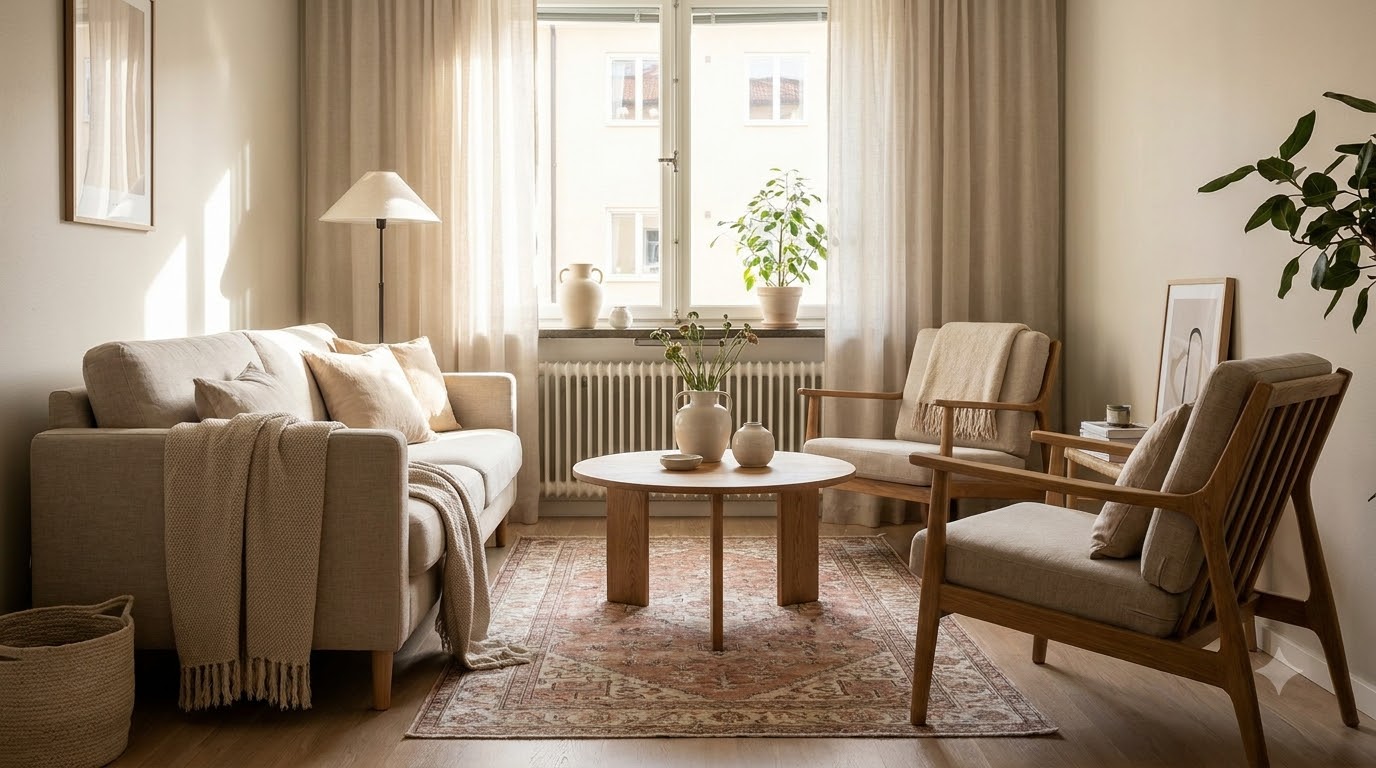
- Living room: at minimum, the front two legs of your sofa and chairs should rest on the rug. Reach for a 5×8 ft rug in a compact space and an 8×10 ft rug wherever it fits.
- Bedroom: a 5×8 ft rug placed two-thirds under the bed frame frames the bed and softens the floor on both sides.
- Studio: use one larger rug to define the living zone rather than several small ones, which only chop up the floor.
- Dining nook: the rug should extend at least 24 inches beyond the table edge so chairs stay on it when pulled out.
Budget-friendly 5×8 ft rugs routinely run $50 to $150, and a larger, well-sized rug almost always looks more expensive than a small one, regardless of the price tag. For more ways to arrange furniture around a properly sized rug, our guide to small apartment layout ideas walks through zoning a single room.
Furniture scale and placement
Scale is where good intentions go wrong. A comfortable, deep sofa feels great in the showroom and terrible in a 12-foot-wide living room. In small apartments, we shop by dimensions first and looks second.
- Sofa: keep it under 72 inches wide in a compact living room; an apartment sofa or loveseat at 58 to 68 inches usually fits best.
- Coffee table: leave 14 to 18 inches between it and the sofa, and choose a round table to ease traffic flow in tight spots.
- Walkways: maintain a clear path of at least 30 inches through main routes so the room never feels like an obstacle course.
- Multi-functional pieces: a storage ottoman, a nesting side table, or a drop-leaf desk earns its footprint twice over.
- Off-the-wall float: pull the sofa 3 to 6 inches from the wall and angle a chair to create a real conversation area instead of a perimeter line-up.
The instinct to press everything to the walls is understandable, but it backfires. A room with a small gap behind the furniture reads as intentional and layered. A room with every piece flattened against the drywall reads as a waiting room.
Lighting: the fix renters forget
Lighting is the cheapest, most transformative fix in a small apartment, and it is the one renters skip because they assume they are stuck with the builder-grade ceiling fixture. You are not. The goal is three light sources at three different heights so the room glows evenly instead of casting one flat overhead wash.
- Overhead (high): your existing ceiling fixture, ideally on a smart bulb or dimmer so you can soften it at night.
- Mid-height: a floor lamp in a corner, around 58 to 64 inches tall, to lift light into the upper half of the room.
- Task or accent (low): a table lamp on a console or nightstand at roughly 26 to 30 inches for a warm, eye-level pool of light.
Warm bulbs in the 2700K to 3000K range read cozy rather than clinical, and a plug-in dimmer costs about $15. A decent floor lamp runs $30 to $80 and a table lamp $20 to $60, so a full three-source setup is achievable for well under $150. We added exactly this trio to a windowless rental bedroom, and it went from cave to calm without touching a single wall.
Small apartment mistakes and fixes at a glance
| Mistake | The Fix |
|---|---|
| Rug too small (3×5 ft floating) | Size up to 5×8 ft or 8×10 ft; front furniture legs on the rug |
| Furniture pushed flat to walls | Float pieces 3 to 6 inches off the wall to create depth |
| Single overhead light | Layer three sources: ceiling, floor lamp, table lamp |
| Oversized sofa or sectional | Choose a sofa under 72 inches with visible legs |
| Blocked, narrow walkways | Keep at least 30 inches of clear path on main routes |
| Cluttered floor and surfaces | Edit to fewer, larger pieces; add vertical storage |
| Wasted vertical wall space | Hang shelves and art up to 12 inches from the ceiling |
Storage and clutter: the invisible mistake
Clutter is the mistake that hides in plain sight. You can size the rug perfectly and layer the lighting beautifully, but if surfaces are covered in stuff, the room still feels cramped. In small apartments, storage has to work vertically and do double duty.
- Go up: mount floating shelves or a tall bookcase to draw the eye upward and free the floor.
- Hide it: a storage ottoman or bed with under-frame drawers swallows blankets, off-season clothes, and clutter.
- Use the back of doors: over-door organizers add square footage you already pay for but never use.
- Contain the small stuff: baskets and lidded boxes corral the visual noise that makes tiny rooms feel chaotic.
- Edit ruthlessly: every surface left clear is a surface that makes the room feel bigger.
For a deeper system, our small apartment storage ideas cover renter-safe solutions that leave no wall damage. And if you are still deciding on a floor plan, our comparison of a studio vs one-bedroom apartment can help you match your decorating strategy to the space you actually have.
Frequently Asked Questions
What size rug should I use in a small living room?
Aim for a 5×8 ft rug as the realistic minimum in a small living room, and go up to 8×10 ft if the space allows. The goal is for at least the front legs of your sofa and chairs to rest on the rug, which anchors the seating and makes the floor feel larger and more unified.
Should furniture touch the walls in a small apartment?
Not entirely. Pulling furniture 3 to 6 inches off the wall creates a sense of depth and makes a room read as more spacious, not less. Floating key pieces slightly and grouping them into a conversation area feels far more intentional than lining every item around the perimeter of the room.
How much lighting does a small room need?
Plan for three light sources at three heights: an overhead fixture, a floor lamp around 58 to 64 inches, and a table lamp near 26 to 30 inches. Use warm 2700K to 3000K bulbs and a dimmer. A full setup costs under $150 and eliminates the flat, shadowy feel of a single ceiling light.
What is the biggest small apartment decorating mistake?
Using a rug that is too small is the most common and most damaging mistake we see. A tiny rug floating between furniture fragments the floor and shrinks the whole room. Sizing up to a 5×8 ft or larger rug that the furniture sits on is the fastest, most affordable way to make a space feel finished.
How do I decorate a small apartment on a budget?
Prioritize the fixes with the biggest impact per dollar: a properly sized rug ($50 to $150), a large mirror ($40 to $120), and layered lighting (under $150). Add vertical storage and edit clutter for free. Together these changes transform a rental without paint, permission, or a large investment.